Showing posts with label elections. Show all posts

Sunday, March 26, 2023

Votes not elections: Reflections on the Castro regime's electoral charade in Cuba

Dictator Raul Castro votes today in sham elections in Cuba.

The Castro regime is seeking to spin a non-vote into a democratic election, but there are some basic facts that exposes the true nature of what is going on. 

"Cuba holds National Assembly elections Sunday, but there are only 470 candidates running for the 470 seats, with no opposition challengers and no campaigning," reports the Associated Press

Why go through this political circus?

Professor Jaime Suchlicki of the Cuban Studies Institute offers an explanation of what the dictatorship's actual objective is:

"Like in most communist countries, elections in Cuba are not aimed at changing previously selected officials, but rather at highlighting existing polices and mobilizing the population to support the communist system." 

 This is not a secret, but established in existing regime rules. 

Cuba's 2019 constitution declares that the country is officially a one-party system with the Communist Party serving as the "superior driving force of the society and the state" and "orienting the communal forces" toward the creation of a "communist society." 

Internal democracy does not exist in the Cuban Communist Party.  It is a top down process.

Despite this, the Cuban dictatorship finds itself in a crisis. Cubans are losing their fear, and refusing to go along with the regime's charade.

Reuters, in their March 22, 2023 article "As Cuba Election Day Nears, Some Voters Ask, 'Why Bother?'" offers anecdotal evidence of voter apathy.

Like a growing number of Cubans, 77-year-old Havana resident Humberto Avila says he will likely sit out Sunday's legislative elections. The retired university professor says he's done the math - 470 candidates, 470 open seats - and sees no point in voting. "That's the same number of candidates as open seats," he told Reuters. "There are no choices."

Cuban dissidents in the island are calling on citizens not to take part in the sham. "Not attending the electoral farce orchestrated by the regime is an act of elementary consistency with truth and justice. No to tyranny," tweeted from Cuba Eduardo Cardet, national coordinator of the Christian Liberation Movement on March 24, 2023. 

As Professor Suchlicki observed above, this is not a question of electing representatives in a democracy, but measuring the communist dictatorship's ability to influence or coerce mass support for the system in a vote.

This is why the regime is threatening Cuban citizens with consequences if they do not participate in the regime's vote today.

This is also why they do not allow independent international observers, or independent domestic observers for today's vote, despite recognizing in law the ability of citizens to observe elections.

Cubans that had wanted to observe the elections today found police cars outside their homes, and were told that they were under house arrest, and could not leave.

 The dictatorship has reason to be concerned.

The Armed Conflict Location & Event Data Project in their March 23, 2023 report "Political Repression in Cuba Ahead of the 2023 Parliamentary Elections" predicted that "unaddressed grievances and repression might lead to lower voter turnout in the upcoming elections, which could, in turn, further undermine the legitimacy of Cuba’s next government." 

With no observers agents of the dictatorship can stuff the ballot boxes, and claim whatever result they want, but internally they will know the true level of dissatisfaction within the populace.

This dissatisfaction was observed on July 11-12, 2021 when tens of thousands of Cubans, knowing what dangers openly defying the regime entailed, took to the streets of Cuba in protest. 

Soviet dictator Josef Stalin in 1923 commented the following about elections,“I consider it completely unimportant who in the party will vote, or how; but what is extraordinarily important is this - who will count the votes, and how.” 

The effort to stop the poll watchers, though poll watching is permitted under current electoral law in Cuba, hearkens back to that principle of control alluded to by Stalin 100 years ago.

This is why Cubans should stay home, and abstain from taking part in this charade.


One last, but important observation that many have gotten wrong. Cuba has not entered the post-Castro era.

Osvaldo Dorticós Torrado and Miguel Díaz-Canel

President Osvaldo Dorticós Torrado held the title of president from July 17, 1959 through December 2, 1976. Cubans called him "president spoon" (because he neither pricks [like a fork] nor cuts [like a knife]). It was their way of saying he had no real power because it resided with Fidel Castro and his brother Raul.

Miguel Díaz-Canel, the current president of Cuba is another Dorticós Torrado, a figure head without any power. Raul Castro remains the strong man, and his son Alejandro Castro Espin, the heir apparent.


Thursday, October 10, 2019

Grito de Yara 151: Cubans' continuing call for freedom and democratic elections

151 years later, Cubans are still shouting for freedom in the island nation.


October 10, 1868 holds special meaning for Cubans. It is the day that Cubans issued a call for rebellion and independence from Spain in the town of Yara. This marked the start of the Ten Years War that forever marked both Cuba and Spain. Under Cuba's old democratic system it was the day that the democratically elected president would assume office.  

Today, a brutal sixty year old totalitarian dictatorship has organized a farce that it calls an election to legitimize its continued totalitarian rule. History says otherwise. This is the latest rebranding of the Castro dictatorship.

Cuba's last freely elected president, Carlos Prio Socarras, was elected by Cubans in free and fair elections on July 1, 1948 and assumed office 71 years ago today on October 10, 1948. He was not perfect, but he was a democrat who respected civil liberties and presided over years of prosperity and freedom for Cubans. On his watch Cuban diplomats played an important role in the drafting of the Universal Declaration of Human Rights. President Socarras warned Cubans not to be consumed by hatred, but his warnings were not heeded.

Carlos Prio Socarras, Cuba's last freely elected president
It has been sixty seven years without democracy in Cuba. On March 10, 1952 Fulgencio Batista carried out a coup and overthrew the democratic order. Fidel Castro and his guerillas promised to restore democracy obtaining the support of the United States, but transitioned Cuba from an authoritarian left wing dictatorship to a totalitarian communist dictatorship that continues to hold power in Cuba today.  Fidel Castro in a 1960 interview with a Brazilian journalist explained his disdain for elections:
"It never functioned in Latin America. Elections are a myth. The parliamentary system in Cuba reflected the old system, which we are now destroying. Elections now would be a step backward, with time and effort wasted in sterile discussions and theoretical considerations."
The only "elections" held in Cuba in recent years have been that of the dictatorship electing which opposition leader that threatens to be a political alternative will die under suspicious circumstances. On October 14, 2011 the founder of the Ladies in White, Laura Pollán and on July 22, 2012 the founder of the Christian Liberation Movement, Oswaldo Payá Sardiñas each died under strange circumstances that point to Cuban state security's involvement.

Murdered by dictatorship: Oswaldo Payá Sardiñas, Laura Pollán Toledo.
Today we are concerned for the life of Xiomara Cruz Miranda, a Lady in White, whose health has been seriously deteriorating without a diagnosis of her condition by Cuban doctors. We are also concerned for the life of Jose Daniel Ferrer Garcia, who has been detained since October 1, 2019.

Now is the time to speak out and speak up for those who can no longer do so for themselves.

Sunday, March 11, 2018

These are not elections: Reflections on the electoral farce in Cuba

Poll watching a non-election in Cuba

Raul Castro at ballot box in Cuba
The Castro regime is seeking to spin a non-vote into a democratic election, but there is a basic fact that exposes the true nature of what is going on. Cuban blogger Yoani Sanchez explained it succinctly over twitter, "#TheseAreNotElections Did you know that today Cubans do not elect parliamentarians but can only ratify 605 names written on the ballots for the 605 seats in the National Assembly? They do not select or discard because "selection" was already made by 'up there'."

Rosa María Payá reported from Havana that in polling stations where they could observe the counting of votes, an average of 37% of Cuban citizens had the courage to show their rejection of the electoral system and the government. In a tweet she gave a more detailed breakdown. "In all polling stations where we were able to carry out the independent observation of the vote count, percentage of rejection of the regime and support for the Plebiscite CUBADECIDE ranged from 18% in Río Cauto, Granma, up to 90% in Songo La Maya, Santiago de Cuba."
Cuban blogger Yoani Sanchez tweeted this morning, "[d]id you know that all possible independent candidates who tried to be nominated in their neighborhoods were subject to arrests, acts of repudiation, house arrest and even legal irregularities in the assemblies to prevent their candidacy?" She was referring to the campaign Otro18 (Another 18), organized by social democrat Manuel Cuesta Morua and Candidates for Change organized by Julio Antonio Aleaga Pesant. Both initiatives sought to field candidates for 2018.

Annulled ballots in Cuba earlier today
 Press accounts of the "vote" in Cuba on Sunday claimed that this was the beginning of a post-Castro era and France 24 reported that it was "a key step in a process leading to the elevation of a new president, the first in nearly 60 years from outside the Castro family."  This is incorrect for two reasons because the last President without the last name Castro was 42 years ago and his name was Osvaldo Dorticós Torrado and he held that title from July 17, 1959 through December 2, 1976. Cubans called him "president spoon" (because he neither pricks nor cuts). It was their way of saying he had no real power because it resided with Fidel Castro and his brother Raul. Secondly, Miguel Díaz-Canel, the named successor to Raul Castro for the presidency of Cuba in all probability will be another Dorticós Torrado, a figure head without any power. Raul Castro will remain head of the Communist Party and de facto head of the military.


Osvaldo Dorticós Torrado and Miguel Díaz-Canel
The CubaDecide campaign on March 10th announced that they were organizing a poll watching effort today across Cuba and presented their results this evening. Over the course of the day irregularities were reported by poll watchers, and citizens attempting to vote.  Rosa María Payá Acevedo tweeted below on measures taken by State Security to shut down the poll watchers and block dissident voters from going to the polls. "Agents of the Cuban political police persecute sympathizers and promoters of the Plebiscite CUBADECIDE while we go to the polling stations to annul our ballots. It is not only an electoral farce, but one that violates its own rules."

Rosa María Payá also tweeted that "MININT - PNR police forces in Havana show the observers of @CUBADECIDE handcuffs as a threat so that we do not go to the polling stations to exercise our right, according to the law. Zero transparency in the Cuban Electoral farce." 

Soviet dictator Josef Stalin in 1923 commented the following about elections,“I consider it completely unimportant who in the party will vote, or how; but what is extraordinarily important is this - who will count the votes, and how.” 

The effort to stop the poll watchers, though poll watching is permitted under current electoral law in Cuba, hearkens back to that principle of control alluded to by Stalin 95 years ago. Reports of mistreatment also appeared on social media. Ladies in White leader Berta Soler tweeted that Cuban State Security "tortured Lady in White Aymara Nieto [placing her] under the sun, handcuffed inside a patrol car."
Rosa María Payá described how "Cuban political police assaulted with electric current Abel Melcochini in Manzanillo, Granma, observer and activist of CUBADECIDE  and UNPACU, to coerce him and prohibit him from going to vote."
Rosa María reported that the following activists were arrested and or disappeared today by the Cuban regime to prevent them from reaching the polling stations: José Díaz Silva, Lourdes Esquivel, Adonis Milan, Zaqueo Báez, Sonia de la Caridad, Roberto Pérez, Aimara Muñoz, Abdel Estévez, Lázaro González Matamoros, Dairon, Alberto de la Caridad, among others.

Cubans "get" to approve the 605 pre-selected candidates with no other option. Poll watching, although legal, led to poll watchers being threatened, harassed and detained. Cubans are dissatisfied and a significant percentage engage in protest votes or refuse to take part. Despite the media hype, Raul Castro will maintain control from his position as head of the Cuban Communist Party and other Castro family members are in key regime posts.

Friday, February 2, 2018

State media of the Castro regime announces "suicide" of Fidel Castro-Diaz Balart due to depression. Some questions.

Was it suicide or is something else going on?

Fidel Castro Diaz Balart with Paris Hilton and Naomi Campbell on February 27, 2015
CubaDebate, an official press outlet of the Castro regime, announced that Fidel "Castro Diaz-Balart, who had been attended by a group of doctors for several months due to a state of profound depression, committed suicide this morning." Was it really a suicide or was it a "suicide", in other words a staged suicide?

Fidel Castro Diaz Balart, age 68, was a a nuclear scientist who was also involved in the field of nanotechnology, scientific advisor to the Council of State, and was vice-president of the Castro regime's Academy of Sciences. He traveled the world promoting the Cuban revolutionary project and had been involved in trying to develop nuclear power in Cuba and some of his interviews and excerpts of his presentations can be found on social media.

In 2006 he was giving a talk in South Africa on Cuban efforts to develop nuclear power, nuclear technology for medicine and other technologies that was covered by the Associated Press. In 2013 he was on Putin's propaganda channel RT discussing the uprisings during the Arab Spring in a program titled "Fidelity to the Revolution"and pushing forth the usual official narrative. A couple of years later he was partying with Naomi Campbell and Paris Hilton at a cigar festival in  Havana on February 27, 2015.

Could the systemic social economic crisis in Cuba, the death of his father in 2016, and family tensions provoked a profound depression? Could it have been something biochemical or bipolar? Or was it even suicide?

Could this be the first casualty in the succession struggle inside the Castro clan? Does this begin to shed light on the decision in late December 2017 to change the "vote" from February 2018 to April 2018? Is there internal dissension in the ruling family?

In Communist totalitarian states like the Soviet Union, North Korea and Cuba "suicides" aren't necessarily suicides but maybe failures in positioning oneself in a new power scheme, or failing to take power, or being viewed as a threat. The same holds true for some "accidents."

Fidel Castro Diaz Balart may have been killed or it may have been another of the many suicides of regime loyalists depressed by the disaster created in Cuba by the Castro regime, or tensions within the Castro family exacerbated following the death of Fidel Castro Ruz in November of 2016.

Meanwhile for those obsessed with lives and deaths of dictators and their families, please take a moment to consider their victims. There is a  long list of Cubans executed by firing squad, extrajudicially killed, or massacred for wanting a free Cuba: Yunisledy Lopez Rodriguez (2014) Harold Cepero Escalante (2012), Oswaldo Payá Sardiñas (2012), Juan Wilfredo Soto (2011), Orlando Zapata Tamayo (2010),  Armando Alejandre Jr, (1996), Carlos Costa (1996), Mario Manuel de la Peña (1996), Pablo Morales (1996), Armando Hernández González, (1982), Ramón Toledo Lugo (1982), Pedro Luis Boitel Abraham (1972) Virgilio Campanería Angel (1961) ,Alberto Tapia Ruano (1961), or for wanting to flee Cuba to live in freedom: Yuriniesky Martínez Reina (2015), Lorenzo Enrique Copello Castillo (2003), Bárbaro Leodán Sevilla García (2003), Jorge Luis Martínez Isaac (2003), and tens of thousands more victims and martyrs of Cuban communism under the Castro dictatorship. The full scale will have to be accounted for in a post-Castro Cuba when truth commissions can work on the island to document all that has happened.

This includes the question of whether or not Fidel Castro Diaz Balart committed suicide this morning due to depression or if something else happened. One must remember that state media in a communist dictatorship is the ultimate in fake news.


Tuesday, October 17, 2017

Night Comes to Venezuela: Electoral Farce in Venezuela

"Support Venezuelan democratic institutions that must today work in exile. - Luis Almagro, General Secretariat of the OAS

Message from the Secretary General on Venezuela

October 16, 2017

Yesterday gubernatorial elections were held in Venezuela. We are not going to comment on the irregularities in the process, given that they repeat the same variables of illegality, uncertainty and fraud that we have been denouncing since our first communication to the president of the National Electoral Council, Tibisay Lucena, in November 2015. We reiterate these same complaints regarding the election process for the National Constituent Assembly or the annulment of the recall referendum.

Today we would have liked to greet the winners and welcome the completion of a civic celebration. However, we have to express skepticism and denounce the lack of guarantees that take place over and over in elections held by dictatorships.

The General Secretariat of the OAS rejects all of these illegitimate acts carried out by illegitimate governments, and condemns in particular, once more, the abuses of the civil and political rights of the Venezuelan people by the regime.

The results of an election in a country with no guarantees for the effective exercise of democracy cannot be recognized. It is clear that any political force that agrees to go to an election without guarantees becomes an essential tool of the eventual fraud, and shows that it has no democratic reflexes to protect the rights of the people, in this case, the right to the vote.

This type of act is not new: it first happened when the recall referendum was annulled and it was repeated when the results of the July 16 consultation were not respected.

This is an important lesson for everyone, for the political leadership of Venezuela and for the international community.

These are the only kind of results we can expect – fraud and human rights violations – if the political strategy and acts distance themselves from democratic principles and values in favor of easy and circumstantial agreements.

No election in Venezuela will provide guarantees to voters unless it is carried out with qualified electoral observation – in particular by this Organization – that ensures a transparent and legal process.

In order to generate a democratic reconstruction in the country, the opposition political leadership must unite with the people and those few leaders who, in accordance with their principles, understood at all times that the citizens of Venezuela want freedoms and are not willing to follow the rules of the dictatorship.

We consider that it is no longer the time for resolutions or declarations, although we appreciate that the last ones made have been conclusive and reflect more accurately the agenda we proposed on May 30, 2015: general elections, freedom for all political prisoners, the separation of powers and respect for institutions, and the opening of a humanitarian channel.

The General Secretariat of the OAS, for its part, will continue along the lines of action that have been announced:

a) Continue the processes underway to determine the evidence for crimes against humanity by the authorities of the regime in Venezuela;
b) Promote and legitimize the application of sanctions against the Venezuelan regime; and
c) Support Venezuelan democratic institutions that must today work in exile.

Reference: S-031/17

Thursday, May 12, 2016

How rejecting Obama's Cuba policy is good for America and GOP prospects in Florida

Anti-communism is still a key factor in the Cuban-American Republican vote 

Young Cuban Americans picketed Clinton & protested Cuban embassy opening (2015)
Cuban-Americans have been a reliable Republican voting block since at least 1980 with Ronald Reagan. This has been due to the GOP's consistent anti-communist stand on the Castro regime in Cuba.  Nevertheless, there has been an attempt over the decades to claim that younger Cubans are shifting and voting Democrat while at the same time softening their "hard-line" (read pro-democracy) stand on Cuba.

This is a dangerous lie for aspiring politicians whose policy positions are driven by dodgy polls. The political graveyard is littered with those who bought into that lie. Even pollsters that try to shape questions to favor the Obama Cuba policy in rigged polls cannot engineer majority support from Cuban American voters.

The latest victim was Charlie Crist in 2014 who lost a narrowly to unpopular Florida governor Rick Scott. This was because the forces advocating for the end of economic sanctions on the Castro dictatorship produced push polls that convinced candidate Charlie Crist in his run for governor of Florida to support ending the embargo and announce that he planned to go to Cuba. As reality hit and his numbers dropped the trip was put off but in the end Crist lost despite running against the unpopular incumbent Rick Scott in a tight race because of the Cuban vote.

In the Republican primary in Florida the two candidates loudly rejecting the Obama administration's Cuba policy got 75% of the Cuban-American vote to Donald Trump's 18%. Cuban American voters have rejected the Obama administration's failed Cuba policy.

Donald Trump's candidacy poses a threat to continued Cuban-American support for the Republican Party, and despite conventional wisdom, it is not due to his anti-immigration stand. Both Senators Marco Rubio and Ted Cruz tried to out trump Trump on being tough on immigration and together got 75% of the Cuban vote to Trump's 18%. Current polls in Miami-Dade place Trump ahead of Clinton among Cuban Americans by 37% to 31% which is extremely low compared to previous elections. This is also part of the reason that Clinton is ahead in South Florida by 27 points. If Trump's Cuba policy contrasted with Clinton's support of Obama's Cuba policy he would likely expand that lead among Cuban Americans to 56% to 31%. This is based on data from Scott vs Crist in 2014 where the pro-engagement issue got 5% who would vote on it versus 24% who would not vote for a candidate who supported engagement with the Castro regime. This could make a different in narrowing Clinton's lead in Miami-Dade and could tip the balance for the GOP candidate.

This is because Donald Trump has publicly declared that he supports Obama's disastrous Cuba policy which is extremely unpopular with Cuban-Americans, and especially the vast majority of those who are Republicans.  Unfortunately, a small cohort of wealthy Cuban-American businessmen who do not represent the majority are peddling a different message that will hurt Mr. Trump's prospects in Florida.

Young Cubans protesting U.S. Embassy opening in Cuba
This ignores that over the past year young 20 something Cuban-Americans picketed Hillary Clinton at Florida International University protesting her support for Obama's Cuba policy, and took to the streets to protest the opening of the United States Embassy in Cuba. This also ignores that in mid-April 2016 hundreds of Cuban Americans poured into the Miami Beach City Hall to reject efforts to bring a Cuban Consulate there.

However, there are more important considerations than electoral ones, such as is this new Cuba policy good for America?

How is it good for Americans to have trade with Cuba drop from $711.5 million in 2008 under the Bush administration with sanctions that protected U.S. taxpayers from picking up the tab to 2015 under the Obama administration when trade dropped to $180.3 million in 2015 and in January 2016 opened up financing for the notorious deadbeat nation?

Under the old policy, which Donald Trump and President Obama both agreed it was time to abandon, American companies made over $5.2 billion while other countries had to forgive billions in debts owed to them by the regime in Cuba. This means that taxpayers in those countries end up picking the tab. If Obama/Hillary/Trump succeed in ending the embargo then the trade in goods with Cuba will descend into negative territory with businesses not getting paid by the Castro regime and manufacturing jobs shipped to Cuba. (Businesses will get their money back through taxpayer bailouts.)

At the same time the Castro regime got a hold of a U.S. Hellfire missile in 2014 and refused to return it to the United States for almost two years turning the U.S. into a laughing stock internationally and raising ominous questions about U.S. national security.
How is this good for America?

Wednesday, December 23, 2015

Venezuela Update: Maduro's Christmas Coup versus The Democratic Opposition's Call for an Amnesty

"We knew that they were elections in a dictatorship; that is why we fought in the streets and tables. Today, it is the same dictatorship, defeated politically and electorally." - María Corina Machado, Venezuelan opposition leader over twitter on December 22, 2015

Maria Corina Machado, Leopoldo López Mendoza, on February 18, 2014

Venezuela is not a democracy but a country where contested elections are held within an anti-democratic regime. This has meant that the opposition had had to take to the street to ensure that the vote be respected on and following December 6, 2015. There are prisoners of conscience today in Venezuela and the democratic opposition is demanding their release in an amnesty before Christmas which Maduro has rejected. 

Furthermore the Maduro regime has packed the Supreme Court and is seeking to use this court to undo the results of the National Assembly elections by challenging the results in 22 races. By denying the opposition its super majority it opens the path to gutting the National Assembly's powers replacing it with a newly created and un-elected communal congress. This is generating a political crisis in Venezuela. 

However the opposition understands that this is a political struggle with a dictatorship and is waging a nonviolent struggle to regain the rule of law and the respect for democratic practices.
Their message is a transparent and open challenge to the continuing irregularities of Nicolas Maduro and his regime. Freddy Guevara of the opposition party, Voluntad Popular over twitter declared: "Let it be clear: We defended the December 6th vote and didn't allow one deputy to be stolen. Now they are less able to do it. Strength and faith!"
Prisoner of conscience Leopoldo López Mendoza from his prison cell got the following message out: "If Maduro and the rest of the powers kidnapped by a corrupt elite torpedo change then we must remove them." Leopoldo is a prisoner of conscience who is falsely imprisoned because of his massive popularity and nonviolent defiance of the Maduro regime. 

The democratic opposition has had a message of reconciliation and a call for an amnesty for political prisoners following their December 6, 2015 victory while Nicolas Maduro has rejected call and is trying to carry out a Christmas Coup against the newly elected National Assembly that has the support of a vast majority of Venezuelans. 

For more information on developments in Venezuela:

The anti-democratic maneuvers of Venezuela’s leaders / The Washington Post 

U.S. says $1 billion linked to Venezuelan energy corruption scheme / Reuters

Venezuela-Argentina spat over human rights comments / BBC

Sunday, December 6, 2015

Venezuela: Contested elections in a country with an anti-democratic regime

Voting in Venezuela is a militarized process full of irregularities

Armed forces sent to "guard" the electoral process in Venezuela
 Today's vote in Venezuela is important but it won't be the decisive factor in restoring democracy in that country. If the opposition truly believe that the majority voting against Maduro's political party, the PSUV will alone end his dictatorship then they have lost before the first ballot was cast.  On Tuesday, December 1st on his weekly television show Nicolas Maduro spoke clearly on how he would respond to an opposition victory in the legislative elections: "I will never allow this to happen, ever. I would go out on the streets and fight side by side with the people." His government's approval ratings are languishing around 22 percent but may narrow the opposition's margin of victory or yet "win" the vote today through massive fraud. Even if he were to lose in the elections Maduro has declared: "Were we to lose, which I find unimaginable, I will govern with the people in a civilian-military alliance." Civil society and the democratic opposition need to do much more to ensure that the votes of Venezuelans today and their right to vote are respected. These are contested elections in a country with an anti-democratic regime in power.

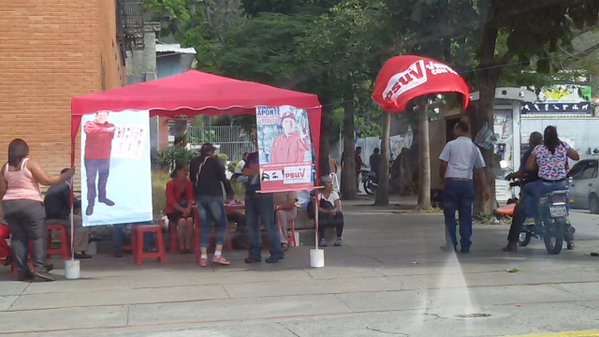
Maduro's PSUV campaigning on election day in violation of the law
The Maduro regime has demonstrated once again today that it does not respect the rule of law when it comes to the ruling party and its own regime. There have been reports that the military have blocked entry of opposition poll watchers to the polling stations. According to Venezuelan electoral law campaigning should have ended on Thursday night at midnight, but Maduro's political party has set up campaigning tents near voting centers today drawing complaints from citizens in Caracas, La Florida, and elsewhere. Reports have emerged of voting centers with broken equipment and voter intimidation by PSUV supporters. Attorney Edicson Cubillan and Franklin Gavidia of the opposition Democratic Unity were detained  in Aragua when they opposed massive "assisted voting."

Former presidents from Latin America, Luis Alberto Lacalle of Uruguay, Andrés Pastrana of Colombia, Jorge Quiroga of Bolivia and Laura Chinchilla of Costa Rica had their credentials suspended and Diosdado Cabello called for their expulsion from Venezuela for having criticized the irregularities in the election. 

Venezuelans lining up to vote this morning in legislative elections (Photo: RMP)
Human rights defender Santiago A. Canton gave seven reasons in an article in CNN en Español on why the Venezuelan elections will not be free, or transparent or fair because of the actions taken by the Maduro regime to compromise them before election day: 
(1) Ballot positioning: the ruling party is highlighted in the first ballot box, the main opposition party gets lost among countless squares, colors and symbols of minor parties. 
(2) Mainstream media controlled by Maduro. Since 2000 the Inter-American Commission on Human Rights and the Special Rapporteur on Freedom of Expression, have reiterated the lack of freedom of expression in Venezuela. On November 30, 2015 international reporters were required to sign a good conduct pledge before the election.
(3) Political violence and intimidation are constant. Opposition candidate Luis Manuel Diaz was assassinated. President Nicolas Maduro said that the murder of Diaz was due to a clash between gangs
(4.) Maduro set the clock back in Latin America three decades, when he did not accept international election observation
(5) Leopoldo Lopez, one of the leading opposition leaders remains in prison  despite  complaints from the UN, the IACHR and human rights organizations. Next to him are about seventy others made up of political leaders and students. Lopez was sentenced to 13 years, 9 months, 7 days and 12 hours in prison in a political show trial. 
(6) Several opposition leaders have been declared ineligible to be candidates in the elections by Maduro including popular candidates Leopoldo Lopez Mendoza and more recently María Corina Machado. Regional human rights courts found Maduro's disqualification procedure running afoul of the American Convention.
(7) State of siege extended to 23 municipalities in the states of Zulia, Tachira and Apure, prohibiting, among others the rights to public assembly, of transit and to demonstrate peacefully. In these municipalities the military is the "sole authority" that responds directly to Nicolas Maduro who appointed them.
These are some of the reasons that international organizations have expressed their concerns about today's legislative elections and are trying to assist with observers. María Corina Machado over twitter yesterday explained the stakes: "Win by a landslide or a monumental fraud will be done that we will not accept." 

Monday, November 30, 2015

OAS Secretary General open letter on upcoming elections in Venezuela

On December 6, 2015 parliamentary elections will be held in Venezuela, but in the days leading up to them there has been an escalation in violence and threats against the democratic opposition by the Maduro regime and its allies. Below is an open letter from OAS president Luis Almagro on the situation in Venezuela.

Plane Lilian Tintori's team was traveling on caught fire on landing when brakes suspiciously failed
Venezuela: Open letter from the OAS Secretary General regarding Pre-Electoral Climate

November 28, 2015

Today, one week before the December 6 elections, I reiterate my call for peace and an end to the violence in Venezuela. The insults and impunity, whatever their source, cannot be an answer to the national and international clamor for equal rights and electoral justice.

It does not make one 'garbage,' Mister President Nicolas Maduro, to condemn the killing of a politician and call for an end to the ongoing violence in the country, or to say that "the violent death of any person is a heinous act that we cannot accept. The killing of a political activist, moreover, leaves us all more vulnerable, and signals that we are all real victims, not just potential victims." 'Garbage' would be to say anything else.

In addition, it is not 'garbage' to say that "the killing of a political leader is a deadly wound to democracy and a succession of violent acts in an electoral process can be a mortal blow to nearly any kind of democracy."

Similarly, it is not 'garbage' to refer to "other attacks against other opposition political leaders in a strategy to intimidate the opposition," and to note that "the entire society is affected by fear and it has shaken the entire international community."

Insecurity and Fear Cannot Dominate the Campaign

And if the fear and insecurity of the opposition is not enough, Mister President of all Venezuelans, you should listen to them so they can tell you directly.

I only ask that every activist and every student - from any political affiliation - be able to express themselves peacefully, and be sure that they can return to their homes in peace; that any politician, from the best to the worst, be protected, be safe from any attack whatever the motive. To be 'garbage' would be to ask for anything else.

It is not 'garbage' to ask that "the government act now," to call for "an end to all violence;" to ask that "the electoral process be transformed into a celebration and not an exercise of force, violence and fear;" and to call for "the most absolute guarantees for everyone." It would be 'garbage' not to demand these rights.

Disarmament of civilian groups, a civic imperative

It is not 'garbage' to urge the immediate reestablishment of a climate of peace and respect for the law, nor to urge an end to "speeches filled with threats and dark forecasts and for the disarmament of any armed civilian group, in particular those that depend on the government or the party of the government." And my request refers specifically to these, because I suppose and I hope that you have influence and power in these cases, Mister President. In any case it would be good for the country to put aside the politics of weapons and crime.

It is not 'garbage' to say that "there should not be one more death, one more threat," and that it is "time to put an end to the fear," and that "every death in Venezuela today hurts everyone in the Americas."

It would be 'garbage' to allow violent death, threats, and the logic of fear; it would be 'garbage' if the deaths in Venezuela did not cause us pain. Every death should hurt us, whether the name is Eleazar Hernández or Pablo Sussoni, Génesis Arguisone or past cases such as those of Robert Serra and his partner or Eliezer Otaiza, or more recently, Luis Manuel Diaz, who died during a campaign event.

Principles Must Not Divide Us

Regarding the case of Luis Manuel Diaz it is urgent - due to the nature of the political crime - to carry out an investigation of the killing and that the investigation result in irrefutable conclusions, just as it is necessary to investigate and resolve the pending cases of the 43 people killed in past demonstrations and other still unresolved cases. This would bring security.

I hope these principles, Mister President, do not divide us and put myself on one side and yourself on the other. And I do not make this response today to keep myself safe from insults, but because I prefer to hear arguments.

I care about the happiness and the peace of your country. And I want the Venezuelan people to achieve their happiness during your mandate, because the happiness of the people, "does not allow for the slightest delay," nor do its causes, in the initial meaning of the words of General José Gervasio Artigas.


Luis Almagro,
Secretary General of the OAS

Reference: E-345/15

Spanish version (En castellano)


Thursday, May 21, 2015

Czech NGO reports on rigged votes in Cuba that try to pass for elections

No tangible results with Raul Castro's so-called "reforms"


Elections In Cuba: The Dictatorship Lives On

Over the past few weeks, the international press has been all eager to inform the world that, for the first time in the history of Cuba (after the Revolution), two candidates of the opposition, Hildebrando Chaviano and Yuniel Lopez, stood as candidates in the election of delegates to the Municipal Assemblies of People’s Power held on April 19. Recent thaw in relations with the United States has brought Cuba into spotlight and potential changes in the island’s governance toward a more democratic model certainly seem very appealing to foreign governments and investors from all over the world.

However, People in Need would like to draw attention to the Cuban electoral system, which hasn’t changed: it continues to be a hollow mechanism whose sole purpose is to ensure continuity of the one-party system. Despite the fact that every two years and a half there are elections with new candidates, we mustn’t forget that the elected delegates are at the lowest level of the strongly hierarchical system of government. As such, they are obliged to comply with the directives from the upper echelons of power.

There’s no denying that any citizen can propose a candidate for a delegate to any of the Municipal Assemblies of People’s Power in Cuba. Elected delegates then choose the Presidents of People’s Council and these, in turn, elect the Chairman of the Municipal Administration, who must be a member of the Communist Party of Cuba and whose decisions are governed by the Municipal Secretary of the Communist Party. However, none of the candidates elected to posts at any of the levels will be able to defend any social or economic political program: they are all supposed to work in concert to implement the directives approved by the Communist Party, which is, in contrary to the principle of popular sovereignty, the actual governing power in Cuba under Article 5 of the Cuban Constitution.

On the other hand, it’s clear that two opposition candidates (both standing for election in Havana) in the mass of over 27,000 official candidates for delegates cannot, by any means, be thought to represent the Cuban society as a whole and its desires. Rather, they can be seen as a minor concession – an attempt to try to improve the semblance of an electoral system in which citizens’ votes lack real value. In addition, when the CVs of the candidates were published on April 1, 2015, those of Chaviano and Lopez contained information that the two men were related to “counter-revolutionary” groups. Although the Municipal Electoral Commission had previously warned them that this word will appear in their CVs, it wasn’t able to explain what the term “counter-revolutionary” meant.

Another interesting factor in the context of Cuban elections is that citizens vote for CVs, not for political projects. They give their votes to candidates judging on their merits, not on what they intend to do for the community. Thus, the act of voting in Cuba is not an entitlement to choose, but an obligation to participate in elections, which are a way of keeping the system going. Cuban citizens have become used to the fact that their vote has no real impact and that it cannot contribute to any kind of change. Some of them have even lost their fear and refused to go to the polls.

As far as the opposition is concerned, many of its members decline to participate in the elections because they see them as a way of legitimization of the regime. Then there are others, such as members of the platform known as “Candidatos por el Cambio” (“Candidates for Change”), which seeks to promote democracy from below – from the basic structures of State administration. These, on the other hand, believe that the 400 votes Chaviano and Lopez obtained are like 400 blows given to Raul Castro’s dictatorship, even though they didn’t win in the end.

In any case, so far there haven’t been any tangible results with regard to the reform of the electoral law. We should bear in mind that if a new electoral law is introduced one day, the change it will produce will be totally inadequate because free elections are impossible without freedom of expression, association and the press, which Cuba still lacks. Citizens can never be able to freely vote in a country where members of the Ladies in White movement continue to be assaulted every Sunday when marching to the Mass, a country where the graffiti artist El Sexto remains in jail for having tried to do an artistic performance, a country listed by the Committee to Protect Journalists as the 10th most censored state in the world. 


Graffiti artist El Sexto remains jailed in Cuba
==================================================

People in Need - Human Rights and Democracy
Cubalog.eu - rewriting Cuba, EyeOnCuba.org

Elecciones en Cuba: la pervivencia de la dictadura

La prensa internacional se ha volcado durante la últimas semanas en mostrar al mundo cómo por primera vez en la historia de Cuba (después de la Revolución) dos candidatos de la Oposición, Hildebrando Chaviano y Yuniel López, se presentaban a las elecciones de delegados a las Asambleas Municipales del Poder Popular que tuvieron lugar el pasado 19 de abril. El comienzo del deshielo entre Cuba y EEUU ha puesto a la isla en el punto de mira, y la idea de que Cuba está cambiando hacia un modelo de gobierno más democrático es muy atractiva para gobiernos extranjeros e inversores de todo el mundo.

Sin embargo, desde People in Need queremos llamar la atención sobre el sistema electoral cubano, que continúa siendo un mecanismo hueco con el único objetivo de asegurar la continuidad del partido único. Aunque nuevos delegados sean propuestos y votados cada dos años y medio, no son más que la base de un sistema fuertemente jerarquizado, y están obligados a cumplir las directrices que les llegan desde las altas esferas del poder.

En Cuba, es cierto, existe la posibilidad de proponer a cualquier ciudadano como delegado de una Asamblea Municipal del Poder Popular. Los delegados que ganan eligen a los Presidentes de Consejo Popular y estos a su vez al Presidente del Consejo de la Administración Municipal, este ya miembro del Partido Comunista de Cuba (PCC), cuyas decisiones están subordinadas al Secretario Municipal del PCC. Sin embargo, ninguno de los elegidos a los distintos niveles defenderá ningún programa político económico y social, pues se supone que todos van a trabajar para aplicar los Lineamientos aprobados por el PCC, que es el que dirige la nación por encima de toda soberanía popular,según el artículo 5 de la Constitución de Cuba.

Por otro lado, dos candidatos de la oposición (ambos en La Habana), entre más de 27.000 candidatos a delegados, no puede suponer en ningún caso una cifra representativa de la sociedad cubana y sus deseos, sino más bien una cuota marginal para intentar “lavar la cara” de un sistema donde el voto de los ciudadanos carece de valor real. Además, el 1 de abril de 2015, cuando se colgaron las biografías de los candidatos, en las de Chaviano y López se especificaba que estaban relacionados con grupos “contrarrevolucionarios”. La Comisión Electoral Municipal había avisado previamente a los dos candidatos de que esta palabra iría en sus biografías, pero no supieron explicarles qué significaba el término “contrarrevolucionario”.

Otro factor interesante de las elecciones cubanas es que los ciudadanos votan biografías, no proyectos políticos; votan a una persona según sus méritos, y no por lo que tenga pensado hacer por la comunidad. Así, el acto de votar en Cuba no responde al derecho de elegir, sino a la obligación de participar para mantener el sistema, y los ciudadanos cubanos ya están acostumbrados a que su voto no tenga ninguna repercusión real ni pueda generar algún tipo de cambio. Por eso, algunos de los que van perdiendo el miedo dejan de votar.
Respecto a los opositores, muchos se niegan a participar de las elecciones porque las ven como una forma de legitimar el sistema. Otros, por el contrario, como los Candidatos por el Cambio, plataforma que busca promover la democracia desde las estructuras de base del Estado Cubano, afirman que aunque esta vez Chaviano y López hayan perdido, los 400 votos que recibieron son 400 golpes a la dictadura de Raúl Castro.

En todo caso, tenemos que ser muy conscientes de que por mucho que el gobierno cambie la Ley Electoral, sería un cambio del todo insuficiente. Sin libertad de expresión, de asociación y de prensa, como no las hay en Cuba, no es posible que haya unas elecciones libres: no es posible que voten con libertad los ciudadanos de un país donde las Damas de Blanco siguen siendo agredidas cada domingo al desfilar hacia misa y donde el grafitero El Sexto sigue en la cárcel por intentar hacer una performance; un país que es considerado por el Comité para la Protección de Periodistas como el el décimo país con más censura del mundo.