Venezuela in crisis
 |
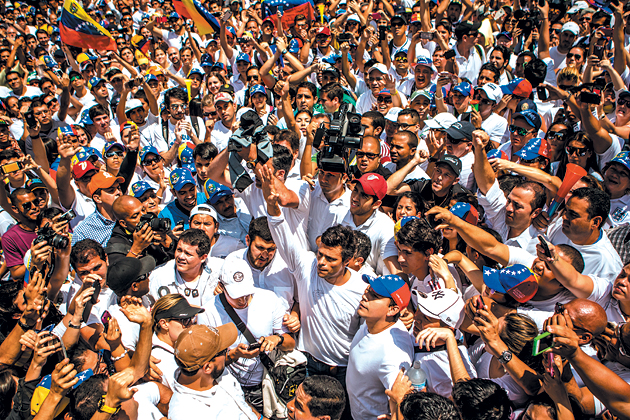
| Venezuelan women march on May 6, 2017 against repression in Cuba |
Protests across Venezuela continue
Thousands of Venezuelan women, dressed in white, marched through the streets of Venezuela on Saturday denouncing repression by security forces. Some of the women flashed their breasts waving posters that read: "We have no firearms, just breasts." Young Venezuelans continue to be shot in the head by paramilitary groups working together with the police and national guard. Opposition leader Maria Corina Machado pleaded: "We beg the armed forces: don't open fire on unarmed people."
Young Venezuelans peacefully demonstrating the Maduro regime continue to be shot in the head and killed some victims from over the past month are:
Hecder Lugo (age 20),
Miguel Medina (age 20),
Jairo Otriz (age 19)
Carlos Moreno (age 17) and although not shot in the head, but in the throat, was 18 year old violinist,
Armando Cañizales. This
last death led the Venezuelan director of the Los Angeles Philharmonic, Gustavo Dudamel,
to say "It is time to listen to the people: Enough is enough.” There is a long
list of Venezuelan youth murdered by the Maduro regime.
Where is Leopoldo?
Venezuelan prisoner of conscience
Leopoldo López Mendoza has not been seen in a month. Rumors are circulating that he has been murdered. Considering that the same Cubans who are advising Maduro also murdered an international human rights figure like
Oswaldo Payá Sardiñas, the fears for Leopoldo's well-being are not unwarranted.
 |
| Nicolas Maduro with his rubber stamp Supreme Court |
Venezuela's downward spiral into totalitarianism continues with the Nicolas Maduro regime ramping up control and repression causing millions of Venezuelans to resist it then pause for a while until the protests die down and then begin again. The latest round began on March 30, 2017, the Maduro controlled Supreme Court stripped the National Assembly of its powers provoking the latest round of mass protests in Venezuela and international condemnation. President Maduro, following the escalating protests, called on the Supreme Court to reverse itself and they did. However at the same time Nicolas Maduro announced the activation of the green phase of Plan Zamora reported by Caracas Chronicles as:
an exercise of “integral anti-imperialist action (…)
meant to strengthen the national deployment of civilian-military union
to defend the nation.” The description’s made worse by the threats made
by several regime members since Monday, concerning the plan to align all
of their paramilitary groups – colectivos – and PSUV’s fighting corps towards the same goal of “defense”.
Cuban role in the rise of Chavism
In addition to domestic repressive forces there is a
foreign presence heavily embedded in the Venezuelan military and intelligence services. Last year the
head of the opposition National Assembly of Venezuela
on May 15, 2016 was complaining, over social media, of the presence of
60 Cuban officers. This included a Cuban general, who he identified by
the last name Gregorich, who had a leadership role that included issuing
orders to Venezuelan troops. Capitol Hill Cubans
identified the Cuban General as Raul Acosta Gregorich.
 |
| Castro regime's number three man, Ramiro Valdez with Hugo Chavez and Nicolas Maduro |
It is also surprising that when reviewing Cuban involvement in Venezuela that the February 2010 hiring of
Ramiro Valdes, then age 77, "as a consultant for that country's energy crisis" did not raise more eyebrows. He is viewed by some Cuba experts as "the No. 3 man in the Cuban hierarchy." Afro-Cuban scholar
Carlos Moore offers the following background information on Commander
Valdez :
"Ramiro Valdez was an inflexible, totalitarian and brutal person. He was the most feared man in Cuba. The repressive policies of the regime were crafted by him. Valdez
struck fear into the hearts of Cubans (even revolutionary ones). Today,
he apparently continues to be the same dogmatic, sectarian and brutal
person he was at the height of his power."
The Castro regime's interest in Venezuela began from the earliest days of the dictatorship. Venezuelans understood the threat poised by the Cubans by 1960 when Ernesto "Che" Guevara was
giving unsolicited advice to Rómulo Betancourt, the democratically elected president of Venezuela. Guevara called for Betancourt to use the firing squad against his "rightist opponents." In 1963 Congressional Quarterly
reported on how:
"Riots led by Communists and other pro-Castro elements in Caracas [in the
autumn of 1960] took the lives of 13 persons and injured 100. Venezuela recalled
its ambassador to Cuba, and Betancourt ordered out the army to end the
rioting, which he termed an attempt to “install a regime similar to that
in Cuba.”
Cuban Communist leader Blas Roca,
told a Havana rally on January 23, 1963 that when the communists gained full control and “make themselves owners of the great
riches in oil, aluminum and everything their earth imprisons, then all
of America shall burn.”
A cache of three tons of weapons was found on a Venezuelan beach in November
1963 that was to be used to disrupt the democratic elections there.
 |
| Fidel Castro meeting with President-elect Rómulo Betancourt in 1959 |
Fidel Castro would continue to agitate for revolution in Venezuela. A well documented incident occurred on May 8, 1967 and was reported by Francisco Toro in
The Washington Post who described
how: "two small boats carrying a dozen heavily armed fighters made landfall
near Machurucuto, a tiny fishing village 100 miles east of the
Venezuelan capital, Caracas. Their plan was to march inland and recruit
Venezuelan peasants to the cause of socialist revolution." An all night gun battle with the Venezuelan military led to nine guerrillas dead, two captured, and one who had escaped.
The Castro regime's efforts would not begin to bear fruit
until December 1994 with the arrival of Hugo Chavez in Havana to a hero's welcome following two years in prison for a coup attempt in Venezuela. Four years later Chavez had won the presidency of Venezuela and the Castro regime finally had its entry to Venezuela. By 2007, Chávez
had declared that Cuba and Venezuela were a single nation. “Deep down,”
he said, “we are one single government.” When Hugo Chavez
died in 2013 the succession to Nicolas Maduro
was planned in Havana.
 |
| Diosdado Cabello target of the DEA with General Raul Castro and his Foreign Minister |
Consequences of Cubazuela
The name of this "single nation" is
Cubazuela and is a term that has been used by mainstream press publications such as
The Wall Street Journal. The consequences to the people of Venezuela are well known. Violence
has escalated during the Chavez-Maduro era to levels never seen before. There is
widespread hunger now in Venezuela. Civil liberties and the rule of law are
rapidly disappearing.
What is not generally known are the consequences for the United States and the role the Castro regime plays in this. There are
numerous news
reports about the Venezuelan regime's
links to international drug trafficking, and that U.S. investigations point to high ranking officials in Venezuela
turning the country "into a global hub for cocaine trafficking and money laundering," but little is said about
the Castro regime's
decades long involvement in it that still continues. Panamanian police
seized more than 400 kilograms of cocaine in a Cuban ship on its way to Belgium
in April of 2016.
Cuba was placed on the list of state sponsors of terrorism on March 1, 1982, less than three months after the US State Department confirmed that the Cuban government was using a narcotics ring to funnel both arms and cash to the Colombian M19 terrorist group then battling to overthrow Colombia’s democratic government.
In a 1991 Frontline documentary, Cuba and Cocaine,
U.S. Coast Guard Lt. Commander Jeff Karonis, stated, "We would observe
in the middle of the day an air drop going on inside Cuban waters. The
scenario would be for a small twin-engine airplane with maybe 1,000 to
2,000 pounds of cocaine to fly over Cuba, drop the drugs to a
predesignated rendezvous point to several boats. Then it would exit back
down off Cuba, and many times a Cuban military vessel would be in the
immediate vicinity, right on scene with them.''
Venezuela: Global hub of drug trafficking
Jackson Diehl in The Washington Post reported on the Venezuela, FARC, Cuba trafficking axis on May 24, 2015 in the article "A drug cartel’s power in Venezuela":
Ever since Colombian commandos captured the laptop of a leader of the
FARC organization eight years ago, it’s been known that Chávez gave the
Colombian narcoguerrillas sanctuary and allowed them to traffic cocaine
from Venezuela to the United States with the help of the Venezuelan
army. But not until a former Chávez bodyguard [ Leamsy Salazar] defected to the United
States in January did the scale of what is called the “Cartel of the Suns ” start to become publicly known. [...] The day after Salazar’s arrival in Washington, Spain’s ABC newspaper published a detailed account of the emerging case against Cabello, and last month, ABC reporter Emili Blasco followed up with a book
laying out the allegations of Salazar and other defectors, who say
Cuba’s communist regime and the Lebanese militia Hezbollah have been cut
in on the trafficking. That was followed by a lengthy report
last week in the Wall Street Journal that said Cabello’s cartel had
turned Venezuela into “a global hub for cocaine trafficking and money
laundering.”
Wikileaks revealed that American diplomats also know that the Castro regime provides safe haven for the FARC in Cuba. Considering the close working relationship between Cuban and Venezuelan officials and the rampant drug trafficking and money laundering in Venezuela the claim that officials of the Castro regime are not involved seems highly unlikely. Furthermore in confronting the problem of rising levels of drugs flooding the United States, U.S. officials should re-visit
sharing drug intelligence with the Castro regime.
Outlaw regimes in Venezuela also allied with Cuba
North Korea
"Our government, our people, our party, in addition to condemning any imperialist attack, will fight with Venezuelans to safeguard the Bolivarian Revolution" - North Korean Ambassador Jon Yong Jin, 10/3/13
A report
appeared on May 18, 2016 that North Korean Special forces and the
Chinese People's Liberation Army are in Venezuela conducting military exercises with their Venezuelan counterpart.
In March 2016, the same month that
President Obama visited Cuba, the Castro regime signed a confidential military cooperation
and intelligence-sharing agreement with North Korea reports the Paris based publication
Intelligence Online. The Cuban dictatorship,
under Raul Castro, has had
extensive relations with the Hermit Kingdom that
has included violating international sanctions to smuggle
tons of weapons.
North Korea
reopened an embassy in Venezuela on June 20, 2014 following a
high level meeting in October 2013 with North Korea's ambassador to Cuba
Jon Yong Jin who was executed in a purge in December of 2013. Venezuela recognized North Korea in 1974 but due to North Korea's economic crisis in the 1990s it shut down its embassy in Venezuela at the time. Venezuelan officials who met with the North Korean diplomat showed an interest in grafting elements of the North Korean governing philosophy onto the Bolivarian Revolution.
The official claim by the Maduro regime is that all this is being done to combat the threat of U.S. imperialism, but the reality appears that this has more to do with maintaining and consolidating control over Venezuela.
Iran
"I've visited Iran more than 20 times, I deeply know the good nature, the
good, deep spirit of the Iranian people and I love it. I love Iran as
much as I love our Commander Chavez.” - Nicolas Maduro, August 30, 2016
Fox News reported on April 17, 2017 of a serious security threat for the United States:
A former director of Venezuela’s Office of Identification, Migration
and Foreigners said that during his 17 months in the post, the socialist
government gave at least 10,000 Venezuelan passports and other
documents to citizens of Syria, Iran and other Middle Eastern countries.
In an interview with El Nuevo Herald, Colonel Vladimir Medrano Rengifo said the operation was headed by current Vice President Tareck El Aissami.
He said most passports and visas were granted in the Venezuelan Consulate in Damascus, Syria’s capital.
"Today we don’t know where these people are, nor what they are doing,” said Medrano, who currently resides in the United States.
The crisis in Venezuela is having tragic consequences for Venezuelans and, with the rising levels of drugs entering the United States, also for Americans. However the relations with outlaw states points to more ominous dangers that need to be taken into account. Lastly ignoring the role played by Cuba is a mistake.






 Posts
Posts

