Showing posts with label Santiago. Show all posts

Saturday, April 12, 2025

Bacardi’s long fight for a free and independent Cuba continues

 NBC’s The Today Show featured a segment looking back at the spirited history of BACARDI on April 3, 2025, from the company’s founding in Santiago de Cuba in 1862, expropriation by Castro’s communist dictatorship, to their ongoing success, but much was left out.

Bacardi’s history is intrinsically related to the fight for Cuban independence from Spain, the defense of democracy during the Republic, and the ongoing struggle for the restoration of democracy and the rule of law under the current communist dictatorship. The Bacardi family arrived in Colonial Cuba from Spain in the early 1800s. In 1828, Don Facundo Bacardi Massó joined his older brothers in Santiago, Cuba, where Bacardi Limited was founded by him on February 4, 1862. Don Facundo had three sons who went into the family business: Emilio Bacardi Moreau, Juan Bacardi Moreau, and Facundo Bacardi Moreau.

Emilio Bacardi Moreau was born in Santiago de Cuba on June 5, 1844, the son of Facundo Bacardí Massó,who together with his father was arrested by Spanish loyalist forces for their support of Cuban independence. Don Facundo was released shortly afterwards, but his son Emilio spent four years imprisoned, and then forced into exile. Don Facundo passed away at age 71 on May 9, 1886.

Emilio Bacardi Moreau’s son, Emilio Bacardi Lay, actively took part in Cuba’s war of independence. In 1895, he was a field officer for Gen. Antonio Maceo during the invasion of Cuba by independence forces. He reached the rank of colonel by the age of 22. After a life of entrepreneurship and patriotic service, Emilio Bacardi Moreau died on August 28, 1922, of a heart ailment. He was 78 years old. The city of Santiago suspended all public events for two days to mourn and celebrate his life. He had been nicknamed “Cuba’s foremost son.”

Emilio Bacardi Lay, who had fought for Cuban independence and been opposed to the dictatorships of Gerardo Machado and Fulgencio Batista but remained in Cuba and repeatedly resisted authoritarianism, was forced to flee when Castroism consolidated control in 1961. Emilio Bacardi Lay, who was born in Santiago de Cuba on June 12, 1877, died in exile in Miami on October 14, 1972 at the age of 95. He was the last surviving ranking officer from Cuba’s war of independence with Spain.

Emilio Bacardi Lay ( Source: Cuba en la memoria )

A history of the Bacardi family written by Tom Gjelten, a reporter for National Public Radio, titled “Bacardi and The Long Fight for Cuba :The Biography of a Cause,” led to renewed interest in their role in Cuba’s independence.  A 2008 review of the book in The New York Times by Randy Kennedy touches on the figure of Emilio Bacardi Moreau.

Emilio Bacardi, especially, comes to life as the book’s most powerful character, though one so strange that Gabriel García Márquez might have invented him. Emilio was imprisoned twice by Spain off the coast of Morocco for his revolutionary activities. But he still managed to hold the company together, to serve as Santiago’s mayor during the unsettled years of the American occupation, to help found a salon called the Victor Hugo Freethinker Group, to practice theosophy in a predominantly Catholic country and to track down a genuine mummy on a trip to Egypt, which he bought as the centerpiece for a museum he had founded in San­tiago. (Modest he was not; he signed his revolutionary correspondence with the name Phocion, after the Athenian statesman known as “the good.”)

Bacardi Imports, Inc., re-established its headquarters in Miami in 1963 after having been based for a century in Santiago de Cuba.

This is the history that the Castros would like to erase but have been unable to. Meanwhile, to all who read this, please consider that if you wish to make a toast to freedom with alcoholic spirits, do it with Bacardi or the real Havana Club.

However, it is important to point out that Bacardi, in addition to having a great history, also retain an enlightened vision for the future that is human centered.  Today, an article appeared that revealed how Bacardi is putting money behind people to make sure artificial intelligence doesn’t replace human bartenders.

Bacardi also has a positive track record on environmental stewardship that has been repeatedly recognized. Bacardi USA was awarded the SmartWay® Excellence Award from the U.S. Environmental Protection Agency for the fourth time in 2020.

In contrast, the Cuban dictatorship continues to sell their stolen version of Havana Club, that today “pumps 1,288 cubic meters of waste liquids into the Chipriona inlet in Cuba every day, mostly vinasse (a residual liquid remaining from the fermentation and distillation of alcoholic liquors). It has been doing that since the 1990s, although the problems became more acute starting in 2007,” according to Julio Batista in his 2017 report described the impact of this pollution as follows:

“The Chipriona inlet is a place where no one goes, where no one fishes, that doesn’t need a fence because no one wants to swim in the boiling filth that flows into its waters every day. The waters of what used to be a beach are now soupy and have the sour smell of decomposition. No studies about the marine life in the inlet are publicly available, but fishermen say there’s no fish there.” …”In the last decade, Chipriona has become the drainage point for the Ronera Sana Cruz, the biggest distillery in the country and one of the four owned by Cuba Ron S.A. It’s the end point of the sewage of the only place where the white and 3-year-old brands are distilled by Havana Club International (HCI). And the dumping ground for a company that earned $118.5 million in profits in 2016 from the sale of 4.2 million boxes each with nine liters of rum.”

 Bacardi has recognized the work of Oswaldo Payá Sardiñas, and in 2017 that of his daughter, Rosa María Payá and they are supporting the Cuba Decide initiative to push for a democratic transition in Cuba.

Bacardi is synonymous with the best of Republican Cuba. Generations of the Bacardi family fought for Cuban independence with one family member fighting alongside General Antonio Maceo, and during the Republic the family not only had enlightened business practices but also engaged in civic activities that promoted a democratic culture based in the rule of law. Through their marketing, Bacardi put Cuba on the map. They continue in the long fight for a free and independent Cuba.


Monday, May 20, 2024

Cuba Independence Day 2023: A reflection on the first 467 years [ 1492 - 1959 ]

  Before the arrival of the totalitarian darkness

Independence Day in Havana, Cuba on May 20, 1902

One hundred and twenty two years ago today at noon the flag of the United States was brought down and the Cuban flag raised over Havana as Cuba became an independent republic. However, when looking at Cuba one should look back over the first 467 years [1492 - 1959] and where it is situated today to gain greater understanding of the unfolding tragedy.

Cuba is just 90 miles south of the United States with a population of approximately 11 million people. It is 780 miles long and has a land area of 40,369 square miles and is the largest island in the Caribbean and 17th-largest island in the world by land area.

Cuba seen from space.

Columbus’s second stop in the New World was on October 28, 1492 when he landed in Cuba. (The first place he landed on October 12 was the Bahamas). Cuba was a Spanish colony from Columbus’s landing in 1492 until 1898 when Spain lost Cuba in the Spanish-American War.

President Tomas Estrada de Palma

Cubans engaged in two protracted wars of independence. The first was the 10 Years War that took place between 1868 and 1878 and the second took place between 1895 and 1898 ending with U.S. intervention and a 4-year occupation that ended on May 20, 1902. Cuba's first president was a Cuban exile named Tomas Estrada de Palma.

Future first Cuban president Tomas Estrada de Palma travels to Havana

There are many important figures and entities that emerge in the 19th century but for the sake of brevity will mention Father Felix Varela, Jose Marti, Antonio Maceo, Maximo Gomez and the Bacardi family.

Father Varela was a catholic priest who is said to “have taught the Cubans how to think” and entertained ideas of independence that led to his exile to the United States. 

Antonio Maceo and Maximo Gomez were Cuban generals that played important roles in both wars of independence. Antonio Maceo was of a mixed racial background: part Spanish and part African.

Maximo Gomez, was an experienced military man of Dominican origin who oversaw the overall military campaign in the second war of independence and of the three previously mentioned was the only one who survived the war to see the arrival of the Republic.

José Martí and Antonio Maceo

Jose Marti was a journalist, poet and revolutionary who organized and advocated for the 1895 war of independence and spent most of his adult life exiled in the United States in New York City.

The Bacardi family, began their world famous Rum business in Santiago de Cuba. Don Facundo Bacardí Massó and Don Emilio Bacardi founded Bacardi Limited on February 4, 1862.

Emilio Bacardi Lay, son of one of the two founders of Bacardi, Don Emilio Bacardi, "was a field officer for Gen. Antonio Maceo in 1895 during the invasion of Cuba by independence forces, and reached the rank of colonel by the age of 22," according to his obituary in The New York Times on October 16, 1972 when he died at the age of 95 in exile in Miami. 

Emilio Bacardi Lay

The family would also play an important role in civic life in Cuba, especially Santiago over the 20th century, and were constant opponents of dictatorship, political corruption and remained ardent Cuban nationalists over several generations.

Forced into exile by the Castro regime the Bacardi family has maintained the traditions of the Cuban Republic celebrating independence day, carrying on the family business and continuing the fight for a free Cuba.

The beginning of the Cuban republic on May 20, 1902 had an asterisk – The Platt Amendment: which allowed the United States to intervene in Cuban affairs if U.S. interests were threatened. This Amendment was gotten rid of in 1933 but left a bad taste in the mouth of Cuban nationalists.

Between 1902 and 1952 Cuba progressed socially and economically but faced challenges on the political front. For example in the late 1920s Gerardo Machado, the democratically elected president did not want to leave power becoming a dictator. He was driven from office and into exile in 1933 by a general strike

This was followed by a revolution led by university students and enlisted men in what became known as the sergeants revolt.  

During this period labor unions made great strides for worker's rights in Cuba, especially after the ousting of President Gerardo Machado in 1933.  

Ramon Grau San Martin's provisional government marked a before and after in Cuban history. Between October and December of 1933, it issued a first package of popular and nationalist measures that strengthened labor rights in Cuba.

  1. Created the Ministry of Labor, since there was no body specifically in charge of labor matters.
  2. Established employer liability for accidents; he suspended the evictions of tenants and canceled 50% of the taxes and contributions not paid in due time.
  3. Established the eight-hour work day and the right to unionize. He promulgated the Labor Nationalization Law that established the obligation that 50% of the workers and employees had to be native Cubans.

Labor legislation passed in 1938 guaranteed Cuban workers' additional rights: 

  1.  A minimum wage; 
  2. Pensions that assumed a constitutional character;
  3. Creation of the Central of Workers of Cuba Central de Trabajadores de Cuba (CTC in Spanish) 

In 1940 all the political tendencies in Cuba met to draft what became known as the 1940 Constitution and a presidential election was held and Fulgencio Batista elected. He served out his term as president from 1940 to 1944. Due to a clause in the new Constitution he was unable to run for re-election. Cuba's 1940 Constitution further enshrined workers’ rights into law with 26 articles which included:

A maximum work day of no more than 8 hours and a maximum working week of 44 hours equivalent to 48 in wages (Article 66); The right to paid vacation of one month for each 11 months of work in each calendar year (Article 67); The right of unionization (Article 69); The right to strike (Article 71); The system of collective labor contracts (Article 72); a non-discriminatory practice in the distribution of opportunities to work ( Article 74).

Strong trade unions and labor legislation in the Cuban Republic were a factor in rising living standards, and improved healthcare outcomes.

In the election of 1944 the opposition candidate, Ramon Grau San Martin, won and served a term as president from 1944-1948 and in the election of 1948, Batista’s political party again lost at the general elections and Carlos Prios Socarras was elected president.

Cuba's republic during this democratic period played an important role in the drafting of the Universal Declaration of Human Rights of the United Nations and the establishment of the UN Human Rights Commission.

This democratic renaissance was brought to an end within days of the 1952 presidential elections, when on March 10th Fulgencio Batista organized a coup against the last democratically elected president.

A little over a year later on July 26, 1953, Fidel Castro organized an armed assault on the Moncada Military barracks that was a military disaster but a public relations success. Although most of the men involved with Fidel Castro in the assault were killed, Fidel Castro became a national figure at his trial for organizing the attack. At the trial he portrayed himself as a democrat that wanted to restore the previous democratic order and attacked the Batista dictatorship for its usurpation of the democratic order.


How the totalitarian darkness arrived in Cuba

Upon Batista’s departure from Cuba on January 1, 1959 Fidel Castro began his triumphal trek across Cuba to Havana where he began to consolidate power while continuing publicly to claim that he was a democrat but privately began to infiltrate his movement with communists, alienating many who had fought with him. 

On January 22, 1959 the CTC was replaced by the CTC-Revolucionaria. In the X Congress, held in November 1959, the Secretary General, David Salvador Manso,"said that the workers had not gone to the event to raise economic demands but to support the revolution." And in the XI Congress, November 1961, the delegates renounced almost all the achievements of the labor movement, including  "the nine days of leave for sickness, the supplementary Christmas bonus, the weekly shift of 44 x 48 hours, the right to strike and an increase of 9.09%, among many others. Workers were required to do "voluntary work" that was actually mandatory.

Castro began to approach the mass media threatening them with violence if they reported anything critical. As the months passed all independent media were taken over. Mass televised executions imposed fear in the populace.

 Ramiro Valdez oversaw the installation of the totalitarian communist apparatus in Cuba beginning in 1959. He is now probably doing the same thing in Venezuela.  It was on his watch that the East German Stasi, and KGB created and trained Cuban State Security.

This is how the darkness of totalitarianism took over Cuba and 64 years later remains entrenched there. Cuba gained its independence on May 20, 1902 after centuries of Spanish colonial rule and four years of U.S. occupation following the Spanish American war.

Half of Cuba's post colonial history, thus far, has been under the boot of communist caudillos whose father, ironically, fought for the Spanish crown in the war of independence.

What would José Martí say?

José Julián Martí Pérez: January 28, 1853 - May 19, 1895

José Martí was killed in battle against Spanish troops at the Battle of Dos Ríos, near the confluence of the rivers Contramaestre and Cauto, on May 19, 1895. He is buried in the Santa Efigenia Cemetery in Santiago de Cuba. Cubans the world over honor his memory and Cuban independence follows a day later. Seven years and one day after Martí's death Cuba formally obtained its independence on May 20, 1902.

Cubans across the ideological divide claim José Martí as their own. The claims of the dictatorship led by the Castro brothers that Martí is the intellectual author of their political project is ironic considering that the life and writings of this Cuban patriot is the antithesis of the Castro regime.

José Martí believed that "Peace demands of Nature the recognition of human rights." A 64 year old dictatorship that rejects fundamental human rights is the antithesis of what the Cuban independence leader fought and died for.

Furthermore, José Martí proclaimed the idea that: "One just principle from the depths of a cave is more powerful than an army." 

A principle shared not only by dissidents in Cuba today but also echoed by Vaclav Havel, one of the dissidents who had an important role in ending Communism in Eastern Europe in 1989 said: "I really do inhabit a system in which words are capable of shaking the entire structure of government, where words can prove mightier than ten military divisions."

On this Cuban Independence Day we observe that Cubans have lived without democracy for 72 years, and rededicate ourselves to the struggle for a free Cuba. 


May 20, 1902 the Cuban flag is raised and the Republic born

Saturday, May 20, 2023

Cuba Independence Day 2023: A reflection on the first 467 years

 Before the arrival of the totalitarian darkness


Independence Day in Havana, Cuba on May 20, 1902

One hundred and twenty one years ago today at noon the flag of the United States was brought down and the Cuban flag raised over Havana as Cuba became an independent republic. However, when looking at Cuba one should look back over the first 467 years and where it is situated today to gain greater understanding of the unfolding tragedy.

Cuba is just 90 miles south of the United States with a population of approximately 11 million people. It is 780 miles long and has a land area of 40,369 square miles and is the largest island in the Caribbean and 17th-largest island in the world by land area.

Cuba seen from space.

Columbus’s second stop in the New World was on October 28, 1492 when he landed in Cuba. (The first place he landed on October 12 was the Bahamas). Cuba was a Spanish colony from Columbus’s landing in 1492 until 1898 when Spain lost Cuba in the Spanish-American War.


President Tomas Estrada de Palma

 Cubans engaged in two protracted wars of independence. The first was the 10 Years War that took place between 1868 and 1878 and the second took place between 1895 and 1898 ending with U.S. intervention and a 4-year occupation that ended on May 20, 1902. Cuba's first president was a Cuban exile named Tomas Estrada de Palma.


Future first Cuban president Tomas Estrada de Palma travels to Havana

There are many important figures and entities that emerge in the 19th century but for the sake of brevity will mention Father Felix Varela, Jose Marti, Antonio Maceo, Maximo Gomez and the Bacardi family.

Father Varela was a catholic priest who is said to “have taught the Cubans how to think” and entertained ideas of independence that led to his exile to the United States. 

Antonio Maceo and Maximo Gomez were Cuban generals that played important roles in both wars of independence. Antonio Maceo was of a mixed racial background: part Spanish and part African.

Maximo Gomez, was an experienced military man of Dominican origin who oversaw the overall military campaign in the second war of independence and of the three previously mentioned was the only one who survived the war to see the arrival of the Republic.

José Martí and Antonio Maceo

Jose Marti was a journalist, poet and revolutionary who organized and advocated for the 1895 war of independence and spent most of his adult life exiled in the United States in New York City.

The Bacardi family, began their world famous Rum business in Santiago de Cuba. Don Facundo Bacardí Massó and Don Emilio Bacardi founded Bacardi Limited on February 4, 1862.

Emilio Bacardi Lay, son of one of the two founders of Bacardi, Don Emilio Bacardi, "was a field officer for Gen. Antonio Maceo in 1895 during the invasion of Cuba by independence forces, and reached the rank of colonel by the age of 22," according to his obituary in The New York Times on October 16, 1972 when he died at the age of 95 in exile in Miami.  

Emilio Bacardi Lay

The family would also play an important role in civic life in Cuba, especially Santiago over the 20th century, and were constant opponents of dictatorship, political corruption and remained ardent Cuban nationalists over several generations.

Forced into exile by the Castro regime the Bacardi family has maintained the traditions of the Cuban Republic celebrating independence day, carrying on the family business and continuing the fight for a free Cuba.

The beginning of the Cuban republic on May 20, 1902 had an asterisk – The Platt Amendment: which allowed the United States to intervene in Cuban affairs if U.S. interests were threatened. This Amendment was gotten rid of in 1933 but left a bad taste in the mouth of Cuban nationalists.

Between 1902 and 1952 Cuba progressed socially and economically but faced challenges on the political front. For example in the late 1920s Gerardo Machado, the democratically elected president did not want to leave power becoming a dictator. He was driven from office and into exile in 1933 by a general strike

This was followed by a revolution led by university students and enlisted men in what became known as the sergeants revolt.  


During this period labor unions made great strides for worker's rights in Cuba, especially after the ousting of President Gerardo Machado in 1933.  

Ramon Grau San Martin's provisional government marked a before and after in Cuban history. Between October and December of 1933, it issued a first package of popular and nationalist measures that strengthened labor rights in Cuba.

  1. Created the Ministry of Labor, since there was no body specifically in charge of labor matters.
  2. Established employer liability for accidents; he suspended the evictions of tenants and canceled 50% of the taxes and contributions not paid in due time.
  3. Established the eight-hour work day and the right to unionize. He promulgated the Labor Nationalization Law that established the obligation that 50% of the workers and employees had to be native Cubans.

Labor legislation passed in 1938 guaranteed Cuban workers' additional rights: 

  1.  A minimum wage; 
  2. Pensions that assumed a constitutional character;
  3. Creation of the Central of Workers of Cuba Central de Trabajadores de Cuba (CTC in Spanish) 

In 1940 all the political tendencies in Cuba met to draft what became known as the 1940 Constitution and a presidential election was held and Fulgencio Batista elected. He served out his term as president from 1940 to 1944. Due to a clause in the new Constitution he was unable to run for re-election. Cuba's 1940 Constitution further enshrined workers’ rights into law with 26 articles which included:

A maximum work day of no more than 8 hours and a maximum working week of 44 hours equivalent to 48 in wages (Article 66); The right to paid vacation of one month for each 11 months of work in each calendar year (Article 67); The right of unionization (Article 69); The right to strike (Article 71); The system of collective labor contracts (Article 72); a non-discriminatory practice in the distribution of opportunities to work ( Article 74).

Strong trade unions and labor legislation in the Cuban Republic were a factor in rising living standards, and improved healthcare outcomes.

In the election of 1944 the opposition candidate, Ramon Grau San Martin, won and served a term as president from 1944-1948 and in the election of 1948, Batista’s political party again lost at the general elections and Carlos Prios Socarras was elected president.

Cuba's republic during this democratic period played an important role in the drafting of the Universal Declaration of Human Rights of the United Nations and the establishment of the UN Human Rights Commission.

This democratic renaissance was brought to an end within days of the 1952 presidential elections, when on March 10th Fulgencio Batista organized a coup against the last democratically elected president.

A little over a year later on July 26, 1953, Fidel Castro organized an armed assault on the Moncada Military barracks that was a military disaster but a public relations success. Although most of the men involved with Fidel Castro in the assault were killed, Fidel Castro became a national figure at his trial for organizing the attack. At the trial he portrayed himself as a democrat that wanted to restore the previous democratic order and attacked the Batista dictatorship for its usurpation of the democratic order.


How the totalitarian darkness arrived in Cuba

Upon Batista’s departure from Cuba on January 1, 1959 Fidel Castro began his triumphal trek across Cuba to Havana where he began to consolidate power while continuing publicly to claim that he was a democrat but privately began to infiltrate his movement with communists, alienating many who had fought with him. 

On January 22, 1959 the CTC was replaced by the CTC-Revolucionaria. In the X Congress, held in November 1959, the Secretary General, David Salvador Manso,"said that the workers had not gone to the event to raise economic demands but to support the revolution." And in the XI Congress, November 1961, the delegates renounced almost all the achievements of the labor movement, including  "the nine days of leave for sickness, the supplementary Christmas bonus, the weekly shift of 44 x 48 hours, the right to strike and an increase of 9.09%, among many others. Workers were required to do "voluntary work" that was actually mandatory.

Castro began to approach the mass media threatening them with violence if they reported anything critical. As the months passed all independent media were taken over. Mass televised executions imposed fear in the populace.

 Ramiro Valdez oversaw the installation of the totalitarian communist apparatus in Cuba beginning in 1959. He is now probably doing the same thing in Venezuela.  It was on his watch that the East German Stasi, and KGB created and trained Cuban State Security.

This is how the darkness of totalitarianism took over Cuba and 64 years later remains entrenched there. Cuba gained its independence on May 20, 1902 after centuries of Spanish colonial rule and four years of U.S. occupation following the Spanish American war.

Half of Cuba's post colonial history, thus far, has been under the boot of communist caudillos whose father, ironically, fought for the Spanish crown in the war of independence.

What would José Martí say? 

José Julián Martí Pérez: January 28, 1853 - May 19, 1895


José Martí was killed in battle against Spanish troops at the Battle of Dos Ríos, near the confluence of the rivers Contramaestre and Cauto, on May 19, 1895. He is buried in the Santa Efigenia Cemetery in Santiago de Cuba. Cubans the world over honor his memory and Cuban independence follows a day later. Seven years and one day after Martí's death Cuba formally obtained its independence on May 20, 1902.

Cubans across the ideological divide claim José Martí as their own. The claims of the dictatorship led by the Castro brothers that Martí is the intellectual author of their political project is ironic considering that the life and writings of this Cuban patriot is the antithesis of the Castro regime.

José Martí believed that "Peace demands of Nature the recognition of human rights." A 64 year old dictatorship that rejects fundamental human rights is the antithesis of what the Cuban independence leader fought and died for.

Furthermore, José Martí proclaimed the idea that: "One just principle from the depths of a cave is more powerful than an army." 

A principle shared not only by dissidents in Cuba today but also echoed by Vaclav Havel, one of the dissidents who had an important role in ending Communism in Eastern Europe in 1989 said: "I really do inhabit a system in which words are capable of shaking the entire structure of government, where words can prove mightier than ten military divisions."

On this Cuban Independence Day we observe that Cubans have lived without democracy for 71 years, and rededicate ourselves to the struggle for a free Cuba. 

May 20, 1902 the Cuban flag is raised and the Republic born


Friday, May 20, 2022

Cuba Independence Day 2022: A reflection on the first 530 years

 Before the arrival of the totalitarian darkness

Independence Day in Havana, Cuba on May 20, 1902

One hundred and twenty years ago today at noon the flag of the United States was brought down and the Cuban flag raised over Havana as Cuba became an independent republic. However, when looking at Cuba one should look back over the past 530 years and where it is situated today to gain greater understanding of the unfolding tragedy.

Cuba is just 90 miles south of the United States with a population of approximately 11 million people. It is 780 miles long and has a land area of 40,369 square miles and is the largest island in the Caribbean and 17th-largest island in the world by land area.

Columbus’s second stop in the New World was on October 28, 1492 when he landed in Cuba. (The first place he landed on October 12 was the Bahamas). Cuba was a Spanish colony from Columbus’s landing in 1492 until 1898 when Spain lost Cuba in the Spanish-American War.

Cubans engaged in two protracted wars of independence. The first was the 10 Years War that took place between 1868 and 1878 and the second took place between 1895 and 1898 ending with U.S. intervention and a 4-year occupation that ended on May 20, 1902. Cuba's first president was a Cuban exile named Tomas Estrada de Palma.


Future first Cuban president Tomas Estrada de Palma on way to Havana

There are many important figures and entities that emerge in the 19th century but for the sake of brevity will mention Father Felix Varela, Jose Marti, Antonio Maceo, Maximo Gomez and the Bacardi family.

Father Varela was a catholic priest who is said to “have taught the Cubans how to think” and entertained ideas of independence that led to his exile to the United States. 

Antonio Maceo and Maximo Gomez were Cuban generals that played important roles in both wars of independence. Antonio Maceo was of a mixed racial background: part Spanish and part African.

Maximo Gomez, was an experienced military man of Dominican origin who oversaw the overall military campaign in the second war of independence and of the three previously mentioned was the only one who survived the war to see the arrival of the Republic.

José Martí and Antonio Maceo

Jose Marti was a journalist, poet and revolutionary who organized and advocated for the 1895 war of independence and spent most of his adult life exiled in the United States in New York City.

The Bacardi family, began their world famous Rum business in Santiago de Cuba. Don Facundo Bacardí Massó and Don Emilio Bacardi founded Bacardi Limited on February 4, 1862.

Emilio Bacardi Lay, son of one of the two founders of Bacardi, Don Emilio Bacardi, "was a field officer for Gen. Antonio Maceo in 1895 during the invasion of Cuba by independence forces, and reached the rank of colonel by the age of 22," according to his obituary in The New York Times on October 16, 1972 when he died at the age of 95 in exile in Miami.  

Emilio Bacardi Lay

The family would also play an important role in civic life in Cuba, especially Santiago over the 20th century, and were constant opponents of dictatorship, political corruption and remained ardent Cuban nationalists over several generations. 

Forced into exile by the Castro regime the Bacardi family has maintained the traditions of the Cuban Republic celebrating independence day, carrying on the family business and continuing the fight for a free Cuba.

The beginning of the Cuban republic on May 20, 1902 had an asterisk – The Platt Amendment: which allowed the United States to intervene in Cuban affairs if U.S. interests were threatened. This Amendment was gotten rid of in 1933 but left a bad taste in the mouth of Cuban nationalists.

Between 1902 and 1952 Cuba progressed socially and economically but faced challenges on the political front. For example in the late 1920s Gerardo Machado, the democratically elected president did not want to leave power becoming a dictator. He was driven from office and into exile in 1933 by a general strike

This was followed by a revolution led by university students and enlisted men in what became known as the sergeants revolt. This put Fulgencio Batista into the national spotlight and by 1934 he was the strong man behind the scenes even though democratic formalities were restored.

In 1940 all the political tendencies in Cuba met to draft what became known as the 1940 Constitution and a presidential election was held and Fulgencio Batista elected. He served out his term as president from 1940 to 1944. Due to a clause in the new Constitution he was unable to run for re-election. 

In the election of 1944 the opposition candidate, Ramon Grau San Martin, won and served a term as president from 1944-1948 and in the election of 1948, Batista’s political party again lost at the general elections and Carlos Prios Socarras was elected president.

Cuba's republic during this democratic period played an important role in the drafting of the Universal Declaration of Human Rights of the United Nations and the establishment of the UN Human Rights Commission.

This democratic renaissance was brought to an end within days of the 1952 presidential elections, when on March 10th Fulgencio Batista organized a coup against the last democratically elected president.

A little over a year later on July 26, 1953, Fidel Castro organized an armed assault on the Moncada Military barracks that was a military disaster but a public relations success. Although most of the men involved with Fidel Castro in the assault were killed, Fidel Castro became a national figure at his trial for organizing the attack. At the trial he portrayed himself as a democrat that wanted to restore the previous democratic order and attacked the Batista dictatorship for its usurpation of the democratic order.


How the totalitarian darkness arrived in Cuba

Upon Batista’s departure from Cuba on January 1, 1959 Fidel Castro began his triumphal trek across Cuba to Havana where he began to consolidate power while continuing publicly to claim that he was a democrat but privately began to infiltrate his movement with communists, alienating many who had fought with him, and began to approach the mass media threatening them with violence if they reported anything critical. As the months passed all independent media were taken over. Mass televised executions imposed fear in the populace.

Ramiro Valdez oversaw the installation of the totalitarian communist apparatus in Cuba beginning in 1959. He is now probably doing the same thing in Venezuela.  It was on his watch that the East German Stasi trained Cuban State Security.

This is how the darkness of totalitarianism took over Cuba and 63 years later remains entrenched there. Cuba gained its independence on May 20, 1902 after centuries of Spanish colonial rule and four years of U.S. occupation following the Spanish American war.

Half of Cuba's post colonial history, thus far, has been under the boot of communist caudillos whose father, ironically, fought for the Spanish crown in the war of independence.


José Martí
What would José Martí say? 

José Martí was killed in battle against Spanish troops at the Battle of Dos Ríos, near the confluence of the rivers Contramaestre and Cauto, on May 19, 1895. He is buried in the Santa Efigenia Cemetery in Santiago de Cuba. Cubans the world over honor his memory and Cuban independence follows a day later. Seven years and one day after Martí's death Cuba formally obtained its independence on May 20, 1902.

Cubans across the ideological divide claim José Martí as their own. The claims of the dictatorship led by the Castro brothers that Martí is the intellectual author of their political project is ironic considering that the life and writings of this Cuban patriot is the antithesis of the Castro regime.

José Martí believed that "Peace demands of Nature the recognition of human rights." A 63 year old dictatorship that rejects fundamental human rights is the antithesis of what the Cuban independence leader fought and died for.

Furthermore, José Martí proclaimed the idea that: "One just principle from the depths of a cave is more powerful than an army." 

A principle shared not only by dissidents in Cuba today but also echoed by Vaclav Havel, one of the dissidents who had an important role in ending Communism in Eastern Europe in 1989 said: "I really do inhabit a system in which words are capable of shaking the entire structure of government, where words can prove mightier than ten military divisions."

On this Cuban Independence Day we observe that Cubans have lived without democracy for 70 years, and rededicate ourselves to the struggle for a free Cuba. 

May 20, 1902 the Cuban flag is raised and the Republic born


Sunday, August 26, 2018

#VigiliaMundial #WorldVigil united for the victims of repression in Bolivia, Nicaragua, Venezuela and Cuba

"When bad men combine, the good must associate; else they will fall one by one, an unpitied sacrifice in a contemptible struggle." - Edmund Burke


On Sunday, August 26, 2018 at 6:00pm at St. Michael Archangel Catholic Church in Miami, Florida people of goodwill gathered together for victims of repression in Bolivia, Nicaragua, Venezuela and Cuba as part of a world vigil united for the victims of repression. Hopefully this will be the beginning of new tradition to be observed annually where friends of freedom gather and network in order to collaborate in the struggle for liberty in the hemisphere.

Miami, USA

The enemies of liberty have been gathering regularly for decades at the São Paulo Forum, and its most recent addition was held in Havana back in mid July 2018. The members of the Forum backed Daniel Ortega and his Sandinista Party despite their mass slaughter of civilians.  

For far too long democrats in this hemisphere have failed to join together in solidarity against those suffering under tyranny and others have fallen, one by one, failing to arouse sympathy or solidarity in far too many remaining in freedom. This is a recipe for disaster.

Berlin, Germany
However this past Sunday across the world people of goodwill gathered around the world for victims of repression in Bolivia, Nicaragua, Venezuela and Cuba. This was a good start.Let us pray that it is repeated in years to come.


Geneva, Switzerland and Oslo, Norway
If we do not join together to resist tyranny, support the rule of law, liberty, and the freedom of all prisoners of conscience then the list of countries succumbing to tyranny will continue to grow until freedom is extinguished in this hemisphere.

Maracay, Venezuela
Therefore it is imperative for people of goodwill to join together in networks of freedom to counter totalitarian networks that seek to enslave free peoples. Free peoples must remain vigilant and not succumb to the complacency of living in freedom, only to lose it. 


Buenos Aires, Argentina
Buenos Aires, Argentina 🇦🇷 contó con la participación de testimonios de miembros de la Red que han padecido las dictaduras. Unidos hoy en la #VigiliaMundial #UnidosPorLasVictimas y por la causa de la libertad y la democracia. pic.twitter.com/pGGiA5SNJA
Oswaldo Payá Sardiñas on December 17, 2002 addressing the European Parliament observed that  “the cause of human rights is a single cause, just as the people of the world are a single people. The talk today is of globalization, but we must state that unless there is global solidarity, not only human rights but also the right to remain human will be jeopardized.” The world is witnessing his prophetic vision in Venezuela, Nicaragua, Bolivia, and Cuba. The distancing away from human rights has had dire consequences in these countries.

Santa Cruz, Bolivia
Witnessing these democrats and human rights defenders gathering together all over the world does give one hope for the future, but it must go beyond a symbolic act, to sustained concrete coordination and action.

Santiago, Chile
These vigils took place in many other places around the world, but there is not sufficient space to cover all of them.

Friday, May 27, 2016

Paying homage and giving thanks to Patricio Aylwin Azócar

“Gratitude is not only the greatest of virtues, but the parent of all others.” ― Marcus Tullius Cicero

Patricio Aylwin Azócar with Vaclav Havel in 2004 in Prague, Czech Republic
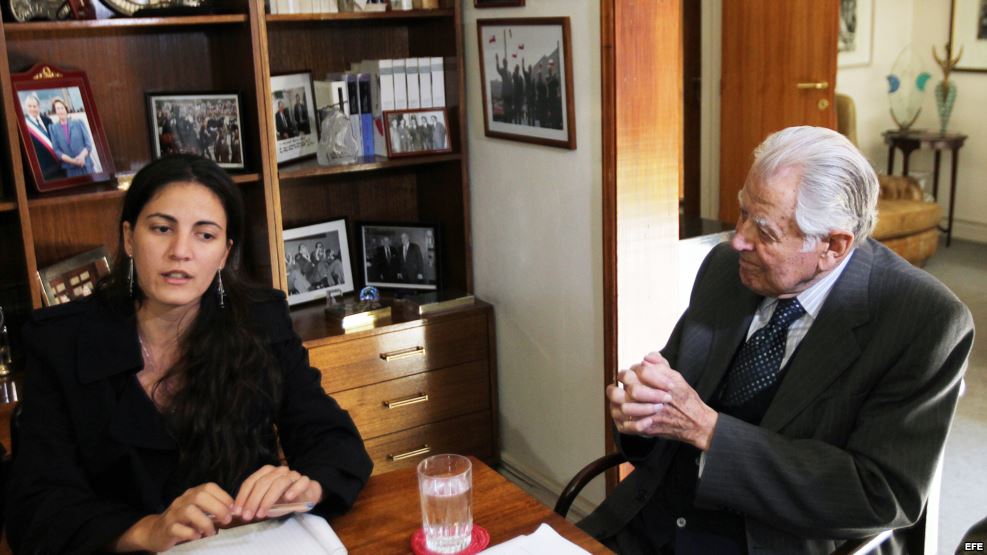
Patricio Aylwin Azócar passed away on  April 19, 2016 in his beloved Santiago, Chile. Don Patricio presided over the unification of the democratic opposition in Chile, the No Campaign, and the democratic transition following 17 years of military rule under Augusto Pinochet.

We would have to be grateful to him for that example alone, but free Cubans owe him for much more. President Patricio Aylwin met with pro-democracy Cubans over the years in Santiago, Chile at his private home and freely gave his advice, but he did more.

Rosa Maria Paya meets with Patricio Aylwin Azócar at his home (2013)
 In 2004 Don Patricio was a founding member of the International Committee for Democracy in Cuba. The former Chilean president traveled to the Czech Republic at age 85 to spend three days with other Latin American and European leaders in an act of solidarity with a free Cuba that will long be remembered. At the time of his passing Orlando Gutierrez of the Cuban Democratic Directorate remembered President Aylwin's role. We also know that the best way to honor his memory of solidarity is through following his example.

Patricio Aylwin, Luis Alberto Lacalle, Petr Pithart, Philip Dimitrov, Luis Alberto Monge, José María Aznar, Václav Havel, Mart Laar close the meeting of former presidents and prime ministers at the ICDC Summit.
Free Cubans are grateful, and today in Santiago, Chile when members of the Christian Democrat Organization of America gathered to pay homage and pray for Patricio Aylwin Azócar at the Frei family mausoleum, where he is being temporarily laid to rest, the above episode was remembered and given thanks for by the representative of the Cuban Democratic Directorate.

On May 27, 2016 ODCA laid flowers to Ex-presidents Eduardo Frei & Patricio Aylwin.
The Christian Democrat Organization of America held its 21st Congress in Santiago, Chile from May 25 -27, 2016.

Friday, May 20, 2016

Cuba Independence Day 2016: A reflection on the first 467 years

Before the arrival of the totalitarian darkness

Independence Day in Havana, Cuba on May 20, 1902
One hundred and fourteen years ago today at noon the flag of the United States was brought down and the Cuban flag raised over Havana as Cuba became an independent republic. However, when looking at Cuba one should look back over the past 500 years and where it is situated today to gain greater understanding of the unfolding tragedy.

Cuba is just 90 miles south of the United States with a population of approximately 11 million people. It is 780 miles long and has a land area of 40,369 square miles and is the largest island in the Caribbean and 17th-largest island in the world by land area.

Columbus’s second stop in the New World was on October 28, 1492 when he landed in Cuba. (The first place he landed on October 12 was the Bahamas). Cuba was a Spanish colony from Columbus’s landing in 1492 until 1898 when Spain lost Cuba in the Spanish-American War.

Cubans engaged in two protracted wars of independence. The first was the 10 Years War that took place between 1868 and 1878 and the second took place between 1895 and 1898 ending with U.S. intervention and a 4-year occupation that ended on May 20, 1902. Cuba's first president was a Cuban exile named Tomas Estrada de Palma.

Future first Cuban president Tomas Estrada de Palma on way to Havana
There are many important figures that emerge in the 19th century but for the sake of brevity will mention Father Felix Varela, Jose Marti, Antonio Maceo, Maximo Gomez and the Bacardi family.
Father Varela was a catholic priest who is said to “have taught the Cubans how to think” and entertained ideas of independence that led to his exile to the United States. Antonio Maceo and Maximo Gomez were Cuban generals that played important roles in both wars of independence. Antonio Maceo was of a mixed racial background: part Spanish and part African.

Jose Marti was a journalist, poet and revolutionary who organized and advocated for the 1895 war of independence and spent most of his adult life exiled in the United States in New York City.
Maximo Gomez, was an experienced military man of Dominican origin who oversaw the overall military campaign in the second war of independence and of the three previously mentioned was the only one who survived the war to see the arrival of the Republic.


The Bacardi family, began their world famous Rum business in Santiago de Cuba in 1862. Don Facundo Bacardí Massó founded Bacardi Limited on February 4, 1862. The family would also play an important role in civic life in Cuba, especially Santiago over the next century, and were constant opponents of dictatorship, political corruption and remained ardent Cuban nationalists over several generations. Forced into exile by the Castro regime the Bacardi family has maintained the traditions of the Cuban Republic celebrating independence day, carrying on the family business and continuing the fight for a free Cuba.

Emilio Bacardi: Rebel who fought for independence
The beginning of the Cuban republic on May 20, 1902 had an asterisk – The Platt Amendment: which allowed the United States to intervene in Cuban affairs if U.S. interests were threatened. This Amendment was gotten rid of in 1933 but left a bad taste in the mouth of Cuban nationalists.

Between 1902 and 1952 Cuba progressed socially and economically but faced challenges on the political front. For example in the late 1920s Gerardo Machado, the democratically elected president did not want to leave power becoming a dictator. He was driven from office and into exile in 1933 by a general strike. This was followed by a revolution led by university students and enlisted men in what became known as the sergeants revolt. This put Fulgencio Batista into the national spotlight and by 1934 he was the strong man behind the scenes even though democratic formalities were restored.

In 1940 all the political tendencies in Cuba met to draft what became known as the 1940 Constitution and a presidential election was held and Fulgencio Batista elected. He served out his term as president from 1940 to 1944. Due to a clause in the new Constitution he was unable to run for re-election. In the election of 1944 the opposition candidate, Ramon Grau San Martin, won and served a term as president from 1944-1948 and in the election of 1948, Batista’s political party again lost at the general elections and Carlos Prios Socarras was elected president.

Cuba's republic during this democratic period played an important role in the drafting of the Universal Declaration of Human Rights of the United Nations.

This democratic renaissance was brought to an end within days of the 1952 presidential elections, when on March 10th Fulgencio Batista organized a coup against the last democratically elected president.

A little over a year later on July 26, 1953, Fidel Castro organized an armed assault on the Moncada Military barracks that was a military disaster but a public relations success. Although most of the men involved with Fidel Castro in the assault were killed, Fidel Castro became a national figure at his trial for the attack. At the trial he portrayed himself as a democrat that wanted to restore the previous democratic order and attacked the Batista dictatorship for its usurpation of the democratic order.

How the totalitarian darkness arrived in Cuba

Upon Batista’s departure from Cuba on December 31, 1958, Fidel Castro began his triumphal trek across Cuba to Havana where he began to consolidate power while continuing publicly to claim that he was a democrat but privately began to infiltrate his movement with communists, alienating many who had fought with him, and began to approach the mass media threatening them with violence if they reported anything critical. As the months passed all independent media were taken over. Mass televised executions imposed fear in the populace.

Ramiro Valdez oversaw the installation of the totalitarian communist apparatus in Cuba beginning in 1959. He is now probably doing the same thing in Venezuela.  It was on his watch that the East German Stasi trained Cuban State Security.

This is how the darkness of totalitarianism took over Cuba and 57 years later remains entrenched there. Cuba gained its independence on May 20, 1902 after centuries of Spanish colonial rule and four years of U.S. occupation following the Spanish American war.

Half of Cuba's post colonial history, thus far, has been under the boot of a totalitarian caudillo whose father, ironically, fought for the Spanish crown in the war of independence.

José Martí
What would José Martí say? 

José Martí was killed in battle against Spanish troops at the Battle of Dos Ríos, near the confluence of the rivers Contramaestre and Cauto, on May 19, 1895. He is buried in the Santa Efigenia Cemetery in Santiago de Cuba. Cubans the world over honor his memory and Cuban independence follows a day later. Seven years and one day after Martí's death Cuba formally obtained its independence on May 20, 1902.

Cubans across the ideological divide claim José Martí as their own. The claims of the dictatorship led by the Castro brothers that Martí is the intellectual author of their political project is ironic considering that the life and writings of this Cuban patriot is the antithesis of the Castro regime.

José Martí believed that "Peace demands of Nature the recognition of human rights." A 57 year old dictatorship that rejects fundamental human rights is the antithesis of what he fought and died for.
Furthermore, he proclaimed the idea that "One just principle from the depths of a cave is more powerful than an army." A principle shared not only by dissidents in Cuba but also echoed by Vaclav Havel, one of the dissidents who had an important role in ending Communism in Eastern Europe in the1989: "I really do inhabit a system in which words are capable of shaking the entire structure of government, where words can prove mightier than ten military divisions."


May 20, 1902 the Cuban flag is raised and the Republic born