Saturday, April 11, 2015

The President meets the General: Dictatorship legitimized and misbehaviour whitewashed

"The Presidents will be sitting here speaking with a General (Raul Castro) who has never been elected by the people, who arrived in power through dynastic means."  - Rosa María Payá Acevedo, April 8, 2015 in El Clarin

The President meets the General

Today at the Summit of the Americas, President Obama made some remarks in his meeting with the 83 year old Cuban dictator Raul Castro which included the following statement:
"So I want to thank President Castro for the spirit of openness and courtesy that he has shown during our interactions. And I think if we can build on this spirit of mutual respect and candidness, that over time we will see not just a transformation in the relationship between our two countries, but a positive impact throughout the hemisphere and the world."
The contradictions and cognitive dissonance surrounding Cuba policy have reached a fever pitch at and around the Summit of the Americas. The misreading of the past half century was bad enough but now the omission of the behavior of the Castro regime during this Summit needs to be addressed.

First, the economic embargo on Cuba was not about overthrowing the Castro regime but limiting its spread in the region. Since 1977 when President Jimmy Carter engaged the Castro regime and interests sections were opened along with diplomatic outreach the policy of isolation began to crumble. This was paused for a time during the Reagan administration but took off again with the Clinton administration culminating in the 2000 handshake between Fidel Castro and President Bill Clinton followed by the opening of cash and carry trade between U.S. companies and the dictatorship. This coincided with the rise of Chavez in Venezuela.

Second, lets set the record straight, over the past week the world witnessed the rudeness and violence of the Castro regime at this international forum. The Telegraph on April 10, 2015 reported on specific incidents:
1. The Cuban government has reportedly put pressure on Panama to restrict the accreditation of summit participants, according to a Panamanian government official who spoke on condition of anonymity. There were six different flights on which certain passengers had been listed as "subversives" and "terrorists" by the Cuban government, according to the official. Among the passengers targeted was Rosa María Payá Acevedo.
Rosa María Payá and Mica Hierro both targeted by Castro regime
2. Cuban dissidents and international pro-democracy activists arriving for the summit of American leaders were met by pro-regime militants trying to block their access to meetings and intelligence teams watching their every move. 
Castro regime mob trying to block independent civil society
3. Scuffles broke out when Cuban government supporters tried to prevent Rosa Maria Paya, the daughter of a prominent dissident leader killed in a mysterious car crash in 2012, from entering the summit's human rights and youth forums.

4. Cuban ambassador was involved in a street fight, later calling the pro-democracy demonstrators "mercenaries of imperialism". The Culture Minister led a mob in a repudiation act against dissidents, including Rosa María.
5. Fresh scuffles broke out on Friday afternoon between pro- and anti-Castro demonstrators outside the hotel where Mr Obama was about to address the summit's social forum. 
6. Democracy activists from the region argued that the intimidating behavior of Cuban regime supporters mirrored moves by Havana to help other left-leaning countries in Latin America to suppress domestic opposition.
This Panama edition of the Summit of the Americas gives an insight into the future of the region. Democracy and human rights will continue to decline in the Americas. The United States along with other remaining democracies will play some lip service while recognizing the new authoritarians and totalitarians as another example of "political diversity" and agreeing politely to disagree. This was also evident from the President's remarks today:
Now, obviously there are still going to be deep and significant differences between our two governments.  We will continue to try to lift up concerns around democracy and human rights.  And as you heard from President Castro’s passionate speech this morning, they will lift up concerns about U.S. policy as well. But I think what we have both concluded is that we can disagree with the spirit of respect and civility, and that over time it is possible for us to turn the page and develop a new relationship in our two countries.
The Castro regime has had a plan to spread its revolutionary and totalitarian project far and wide and with the arrival of Chavez in Venezuela it has reshaped Latin America. Engagement has led, in part, to a situation in which there are a number of countries with heads of state hostile to international human rights standards, the rule of law, and competitive elections that look to the Castro regime for support in order to maintain power. This is what the future of this new Obama-Castro relationship will continue to look like. To paraphrase the late Sir Edward Grey, "Democracies are being compromised all over the Americas, once they are gone we shall not see them return in our life-time."

Activists beaten up by Castro agents in Panama

Friday, April 10, 2015

The Odd Couple, The Summit of the Americas and Democracy's decline

"I do not believe that we can make progress in European appeasement if we allow the impression to gain currency abroad that we yield to constant pressure." - Anthony Eden, 21 February, 1938

"And when will the relations between the "government" of Cuba and the people of Cuba be re-established?"  - Christian Liberation Movement, April 10, 2015
 

On the evening of April 10, 2015 Raul Castro and Barack Obama met and shook hands again in Panama at the Summit of the Americas the first time was on December 10, 2013 in South Africa at Nelson Mandela's funeral.

Both occasions coincided with massive assaults on human rights by the Castro regime, the first being in Cuba on international human rights day and the second in Panama when mobs of Castro agents rioted to prevent independent civil society activists from gathering together to address issues of democratic consolidation and human rights because they did not want Cuban dissidents participating.

Despite ample evidence that the Castro regime continues to be a state sponsor of terrorism the Obama administration is speedily moving to remove Cuba from the list of terror sponsors in order to proceed to the normalization of diplomatic relations. The Cuban dictatorship has made removal from the list one of the key elements in formally opening embassies.

The United States over the past six years has had a policy towards Cuba that yields to the constant pressures of the regime to a degree that it gives appeasement a bad name.

For example the woes of the Summit of the Americas began this past weekend with Cuban dissidents and rights activists being retained. harassed and threatened by Panamanian security. This was followed up by a brutal beat down of Cuban resistance activists in Panama City's Porra Park. Finally at the Summit of the America's Civil Society Forum mobs of Castro regime agents rioted and disrupted the gatherings slandering and libeling Cuban and Venezuelan activists. This has gone on through the present day.

Raul Castro met with President Obama, shook his hand and spoke with him but the Castro regime is unwilling to do that with Cubans who dissent politically from the regime calling them mercenaries and puppets.  This leads to the question when will relations be "normalized" between Cubans and their "government"?  This is the question raised by the Christian Liberation Movement tonight.

Apparently, for the Castro regime only Raul Castro and the people he designates are the only Cubans who can meet with President Obama. Over social networks regime agents denounced the president's meeting with Cuban dissidents in the civil society forum. 

Apologists for the engagement policy claim that this is the Castro regime sabotaging the President's attempt to lift sanctions and normalize diplomatic relations. This is a misreading of two fundamental truths. First, this behavior is in the regime's nature because it is totalitarian and cannot tolerate dissenting views. Secondly, the Castro regime observes the United States having normal relations with pariah states such as Saudi Arabia and the Peoples Republic of China and ask why can't they be treated the same way.

Human rights in Cuba and throughout the world have been in decline for years and the current policy of legitimizing the Castro regime while providing financial credits and loans to the dictatorship promises to erode democracy and human rights for years to come in the Americas.

On April 2, 2015 Amnesty International recognized another prisoner of conscience which is another sign that the nature of the regime in Cuba remains unchanged, as do thousands of arbitrary detentions.

This Summit of the Americas has demonstrated on a small scale where human rights and democracy is going in the region. This future is bleak in the area of human rights and democracy.  On April 8, 2015 in El Clarin,  Rosa María Payá Acevedo observed the underlying fact of this summit:  "The Presidents will be sitting here speaking with a General (Raul Castro) who has never been elected by the people, who arrived in power through dynastic means." Today the presidents of democratic states of the Americas legitimized a military dictatorship in Cuba.

Thursday, April 9, 2015

The Castro Regime's idea of dialogue: The monologue of the closed fist

If liberty means anything at all, it means the right to tell people what they do not want to hear. - George Orwell
 

Leticia Ramos and Augusto Monge attacked in Panama
Today nonviolent dissidents, representing independent civil society from Cuba, sought to engage in a dialogue with representatives of the dictatorship who claimed to be civil society. The Miami Herald reported that the "Panamanian government extended an invitation to all sectors of Cuba’s civic society to participate in the hopes of an unedited dialogue, in celebration of the resumed relations between the U.S. and Cuba." Panama’s Vice President and chancellor, Isabel Malo de Alvarado, called on all the involved parties to “listen to each other within the frame of respect.” 

 The Herald explained that the response of the Castro regime delegation on Wednesday, was to not attend the inauguration of the Civic Society Forum  stating it: “will not share the same space as mercenaries and terrorists”.  Today "activists Rosa Maria Paya, daughter of murdered opposition leader Oswaldo Paya, and Lillian Tintori, wife of imprisoned Venezuelan opposition leader Leopoldo Lopez were welcomed by screams and insults at the Civic Society Forum. 


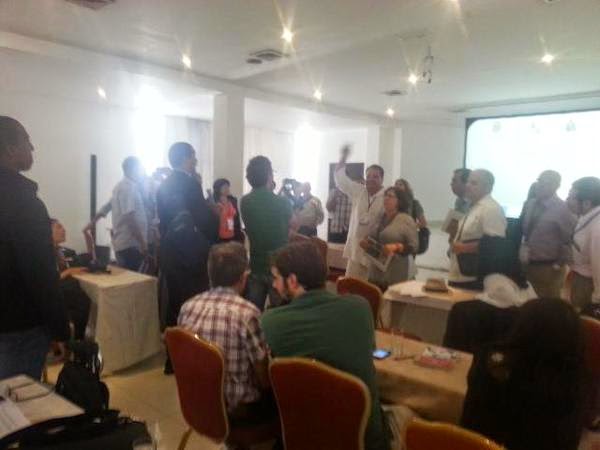
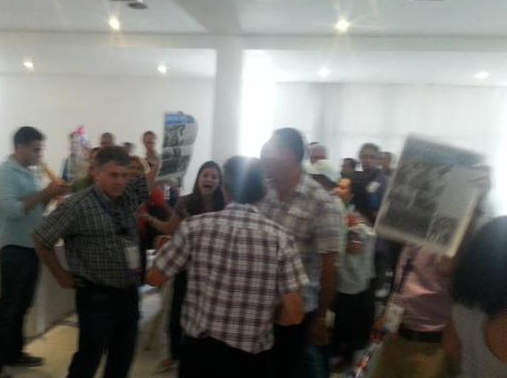
 Over twitter at 11:43am today Rosa María Payá tweeted "Cuban delegation official still impedes initiation of the start of the panel" along with the above photograph. Two minutes later and another tweet: "Cuban officials begin violence and police at the door do not enter." In the next tweet she posted the photo below of Cuban GONGOs holding up a publication slandering dissidents and shouting "mercenaries must get out."


El Nuevo Herald in an exclusive interview with Abel Prieto, Cuba’s former minister of culture and adviser to Raúl Castro, learned that the Castro regime had turned down the opportunity to debate with critics. Prieto, who is the president of the official delegation of the Cuban dictatorship in the VII Summit of the Americas and was also present during the aforementioned acts slandered dissidents who were attending the forum when he stated:
"It’s not possible to ask Cuba to dialogue with puppets of these special services agencies in the U.S. We can’t legitimize that opposition which is absolutely fabricated; it doesn’t have any weight, it doesn’t have any real connection to our society. It’s just people who are seeking a way of life."
 In response to a question from El Nuevo Herald about the acts of repudiation carried out in Panama against dissident activists the former Minister of Culture once again sought to defame those who dissent from the regime line:
"This has nothing to do with acts of repudiation. I mean, I don’t know, for me it has nothing to do with that, and there’s no fanatics here. There’s people who are intelligent, a lot more intelligent…those mercenaries have to be born again to reach the most minimal level of decency and intelligence that is found within the Cuban delegation. They’re not fanatics, or people who yell often: they yell because they feel offended."  
Panamanian President Juan Carlos Varela, in his address following the walk out of Castro regime representatives said that governments "must not fear the empowerment of civil society that is called to play a watchdog role on governance." However for a totalitarian dictatorship such as the one that has ruled in Cuba for 56 years all power is centralized in the Communist party and more specifically in the Castro family. This regime operates with complete impunity and with a monopoly control of the national media and all other political parties outlawed by the imposed communist constitution. It has also sought to crush an manifestations of independent civil society, refusing to legally recognize them and subjecting them to repression.


Beginning in the 1970s the Castro regime has sought to appropriate the word dialogue in what in practice is a regime monologue that is the opposite of what the word means. This has had a negative impact on public discourse. In July of 2004 the late Bishop Agustin Roman wrote about the necessity of rescuing, a word that he described as beautiful, but that had been twisted by the dictatorship in Cuba:
"It's good that to start this effort, the true meaning of the word dialogue be rescued. We have all witnessed the misrepresentation of this beautiful word, thanks to the manipulations of the dictatorship that has wanted to use it for its own purposes, and also thanks to some complying with the Castro lexicon, perhaps without noticing where the misrepresentation comes from, seem content to have them steal the dictionary, the same ones who previously stole our homeland."
The word dialogue has a long history and to have arisen in the West with Plato and the Greeks over 2,400 years ago. The root meaning of the word dialogue is formed by two words dia and logos which literally means  'two way flow/exchange' of meaning.This is precisely what the dictatorship in Cuba fears most because in a two way dialogue where different ideas and opinions can be expressed the edifice of the totalitarian regime begins to dissolve into nothingness as society, long repressed begins to emerge from its long and forced hibernation.

This existential threat to totalitarianism terrifies the Castro clan and their regime agents who benefit from the current status quo. This is why what the regime calls dialogue in reality is the monologue of the closed fist and unfortunately over the past 56 years it has been used to beat down those who peacefully dissent. 

Yesterday it was seen dramatically at Porra park in Panama City when a group of Cuban dissidents from the diaspora and the island sought to lay flowers before a bust of Jose Marti and were subjected to a violent act of repudiation by Castro regime state security. Carlos Alberto Montaner reported on twitter:  They have identified the ringleader of the attacks on Cuban democrats in Panama. It is Col. Alexis Frutos Weeden, head of Cuban intelligence in Venezuela.

 Sadly, the negation of both dialogue and civil society has now intruded into the Summit of the Americas for the first time since 1994 with the entrance of the Castro regime. This is just a small part of the price to be paid for inviting a totalitarian dictatorship into the fold of democratic states and does not bode well for the future.   

Meanwhile at a parallel forum in Panama City bruised up Cuban activists from the island and exile gathered to discuss the Agreement for Democracy and issued a statement outlining a course of action following the events of the past two days.   

Wednesday, April 8, 2015

Cuba policy and the story of the frog and the scorpion

"A scorpion wanted to cross a river, so he asked the frog to carry him. The frog refused because the scorpion would sting him. That would not be logical, explained the scorpion, because if he stung the frog they would both drown. So the frog agreed to carry the scorpion. Half way across, the frog felt a terrible pain - the scorpion had stung him. There is no logic in this, exclaimed the frog. I know, replied the scorpion, but I cannot help it - it is my nature." - Orson Welles, Confidential Report (1955) 


If media reports are accurate the Obama administration is rushing to remove Cuba from the list of state sponsors of terror.  The Castro regime has a long track record of sponsoring terrorism.  President Obama has tried to downplay the February 24, 1996 shoot down as a "tragic circumstance" not the premeditated act of state terrorism that it was. No doubt in part to justify commuting the life sentence of Gerardo Hernandez, the man found guilty of conspiracy to murder the four humanitarians. 

This is being done in a rushed fashion in order apparently to avoid an embarrassment at the upcoming Summit of the Americas and to try to rack up a foreign policy success that the political establishment with regards to Cuba has been trying to portray as low hanging fruit. 

The trouble is that this new policy is based on ignoring the character of the Castro regime and its 56 year history. The parable of the scorpion and the frog first stated by Orson Welles in the 1955 film Confidential Report seems appropriate in this new relationship between the Obama administration and the Castro dictatorship.

Welles's parable is a variation of Aesop's Fable of "The Farmer and the Viper" with the moral that "kindness is thrown away on evil."

Let us hope and pray that in this case Oscar Wilde is wrong and life does not imitate art. 

Tuesday, April 7, 2015

Save Tenzin: Take two minutes and help save a life

Medical Parole for Tenzin Delek Rinpoche
Above image and text below copied from Students for a Free Tibet. Please take two minutes and sign the petition below and help save a life.


For the past 13 years, Tenzin Delek Rinpoche a human rights defender, and revered Tibetan Buddhist Lama and a widely respected community leader has been a prisoner of the Chinese state and suffered years of abuse and torture in prison for a crime he did not commit. His family and all of us are extremely fearful for his life. With little to no medical treatment for his heart condition, his health has severly deteriorated.


Sign the petition to urge your Foreign Minister to call on Chinese leaders to grant medical parole for Tenzin Delek Rinpoche. For more information visit the website SaveTenzin.org and view the video below: