Showing posts with label Juan Carlos González Leiva. Show all posts

Saturday, May 12, 2018

Cuba is a dictatorship that brutalizes blind dissenters: Time to hold it accountable

Note to UPR 30 and the Office of the High Commissioner of Human Rights: Cuba is a dictatorship.

Blind Rights Defender Juan Carlos Gonzalez Leiva
The dictatorship in Cuba systematically violates all human rights both in law and in action. Article 13 of the Universal Declaration of Human Rights recognizes the right of all persons to to travel into and out of their own country. The regime in Cuba does not recognize that right and treats it as a priviledge to be granted or taken away at the whim of the dictatorship. The concerns raised by the Office of the High Commissioner calls attention to the problem but with diplomatic language that minimizes the true extent of the problem.

Will the Office of the High Commissioner speak out against the physical assault of Juan Carlos Gonzalez Leiva, a blind human rights defender, on January 9, 2014 at 10:30am?  Together with his wife, Tania Maceda Guerra, and six other activists in Ciego de Avila, his home town, he was distributing "Voz Avileña", a dissident publication. Juan Carlos described what happened next.
I carried in my hand a copy of the newsletter "The Avileña Voice." There was a very large state security operation and they demanded that we give them the newsletter. When I refused and we eight activists sat on the ground, and began to shout, " Freedom", "Long live human rights" and "Down with Fidel" military troops reinforcements arrived and they beat us up. We were taken by car to the First police headquarters. During the trip a police officer pulled my wife's hair and bit her hands. I responded to the police officer biting him and then the official gave me a savage beating to the point that it made ​​me lose consciousness. They hit me so many times that I have both the right foot and index finger of the left hand broken. I have aches and bruises throughout my entire body . To all the activists who were with me Junior Ortega Rivero, Daniel Camacho Marchena, Daniel Martínez, Alberto Pla Risco, Quintana Sarría and others that were with me, all were violently beaten and dragged away and were also detained. Without any explanation we were all released around 3:00pm in the afternoon.
Ignorance is not an excuse for the Human Rights Council. On September 16, 2014 Juan Carlos Gonzalez Leiva spoke before the Council and denounced the brutal beating he and the other activists suffered placing it in the larger context. Seven months later another Cuban human rights defender, Sirley Avila Leon, was the victim of a machete attack that cost her a hand and the use of both knees.

Allowing the Castro regime to operate with impunity is unacceptable and there needs to be a cost for the criminal actions taken.  Time to indict Raul Castro.

Thursday, December 17, 2015

Castro clings to power and President Obama has his hand out

"We are going to have diplomatic relations with the United States without having ceded one iota." - Gerardo Hernandez, Cuban spy sentenced to life in prison for murder conspiracy freed by Obama as part of his deal with Raul Castro. (Capitol Hill Cubans)

Castro and President Obama (April 2015) Sirley Ávila machete attacked (May 2015)

Breaking Kennedy's policy
President Barack Obama in his first inaugural address on January 20, 2009 declared “To those who cling to power through corruption and deceit and the silencing of dissent, know that you are on the wrong side of history, but that we will extend a hand if you are willing to unclench your fist.” The Obama administration’s Cuba policy was not reset on December 17, 2014 but was a continuation of what came before when it began to loosen sanctions on the Castro regime on April 13, 2009. The Washington Post in 2009 described it as “breaking from policies first imposed by the Kennedy administration and stepping into an emotional debate over the best way to bring democratic change to one of the last remaining communist regimes.” 

Snubbing dissidents
At the same time that the President extended a hand to the Castro dictatorship he withdrew it from Cuban democrats. President Obama refused to meet in June of 2009 with the winners of the National Endowment for Democracy’s Democracy Award who happened to be five Cuban dissidents that year. This was the first time in five years that the president of the United States had not met with the award laureates.

The regime strikes back
The response by the Cuban government to the overtures of the Obama administration in December of 2009 was to take an American citizen, Alan Gross, hostage. The administration responded with initial silence and it took American diplomats 25 days to visit the arbitrarily detained American.
On January 14, 2011 with this American citizen still arbitrarily detained in Cuba the Obama administration loosened travel restrictions on travel to the island to an extent not seen in a decade. The concessions and the cold shoulder to Cuban dissidents sent a clear message to the dictatorship that would be devastating for the prospects of a nonviolent and democratic transition in Cuba.

Murdered activists
These signals would coincide with the start of three devastating years for the Cuban democratic opposition. Rising levels of violence against  nonviolent activists and the suspicious deaths of human rights defenders: Orlando Zapata Tamayo (February 23, 2010), Daisy Talavera de las Mercedes Lopez (January 31, 2011) , Juan Wilfredo Soto Garcia (May 8, 2011), Laura Inés Pollán Toledo (October 14, 2011), Wilman Villar Mendoza (January 19, 2012), Sergio Diaz Larrastegui (April 19, 2012), Oswaldo Payá Sardiñas (July 22, 2012) and  Harold Cepero Escalante (July 22, 2012). Both Laura Pollán and Oswaldo Payá each had the international recognition and ability to head an authentic democratic transition in Cuba. Oswaldo Payá had forced the dictatorship to change the constitution in 2002 because of Project Varela, a citizen initiative demanding legal reforms within the existing system, and Laura  Pollán through constant street demonstrations achieved the freedom of scores of Cuban prisoners of conscience. It is important to remember that the deaths of these high profile human rights defenders happened on President Obama's watch.

Skyrocketing arbitrary detentions
In 2008 according to the Cuban Commission of Human Rights and National Reconciliation (CCDHRN) there were 640 arbitrary detentions in Cuba during the first six months. Cuban human rights defender Juan Carlos González Leiva documented 1,500 arrests for all of 2008.  The Obama administration entered office on January 20, 2009. In 2010 the number of politically motivated arbitrary detentions in Cuba increased to 2,074 arbitrary detentions and tripled in 2013 with 6,602 arbitrary detentions. In 2014 the total number of arbitrary detentions was 8,899 a new record and trends in 2015 point to that number being met or exceeded by the Castro regime's repressive apparatus.

Gerardo Hernandez was found guilty of conspiracy to murder these four men
Letting a killer go
The December 17, 2014 announcement by the President broke new ground in only one area releasing Gerardo Hernandez, a Cuban spy and terrorist, convicted of murder conspiracy of three U.S. citizens and a resident. Not only did President Obama commute the sentence but tried to rewrite history calling an act of international terrorism, the Brothers to the Rescue shoot down, a tragedy. Further attempts to provide a positive image to this dismal arrangement led to the Obama administration taking credit for the release of 53 political prisoners in early January but once the names were released it was revealed that 17 of the 53 had been released prior to the agreement and had nothing to do with it. This means that a total of 38 political prisoners were freed at the time. The policy of legitimizing the dictatorship, while marginalizing the democratic opposition, that began in 2009 was continued and intensified in 2015.

Patterns of regime violence worsen
This was not the only practice intensified. The United States and Cuba held secret negotiations for 18 months. Coinciding with the start of these negotiations were a series of machete attacks against opposition activists. On June 8, 2013 in Holguin, Cuba Werlando Leiva Batista of the Christian Liberation Movement was attacked with a machete on a public street. Later that same month on June 21, 2013 in Camaguey, Orlando Lazaro Gomez Hernandez, a member of the Pro Human Rights Party of Cuba stepped out of his home with a sign supporting hunger striker Luis Enrique Santos Caballero. Seeing this protest the president of the Committee for the Defense of the Revolution (CDR),  ran out of his home with a machete and attacked Orlando Lazaro with it, cutting part of his right hand and also striking him on the back. Others came out as the activist fell to the ground and began to kick him.

Sirley Ávila León victim of state security ordered machete attack
Cuban human rights defender, Sirley Ávila León, age 56, was gravely wounded in a machete attack in Cuba on May 24, 2015 by Osmany Carrión who had been sent by state security agents. She lost her left hand while raising it to block a machete blow to the head. She suffered deep cuts to her neck and knees, lost her left hand and the machete cut through the bone of her right humerus leaving her arm dangling. This was an escalation of previous machete attacks against opposition activists.

Looking the other way on terrorism and trafficking
Furthermore removing Cuba from the list of terror sponsors on May 29, 2015 while ignoring the Castro regime smuggling heavy weapons to North Korea (which is again in the news with a company in Singapore found guilty of transferring funds) and weapon shipments through Colombia and its links to international drug trafficking to satisfy the dictatorship’s demand in order normalize relations sends a dangerous signal. Politicizing the State Department’s human trafficking report to ignore sex trafficking in Cuba and the dictatorship sending Cuban workers overseas for profit compromised its integrity placing victims at risk. These unilateral concessions ignore realities on the ground and undermine the credibility of the United States.

Rosa Maria Payá being warned to keep quiet by State Department spokesman
Crudely snubbing dissidents and empowering dictatorship
On July 20, 2015 Cuban human rights defender Rosa Maria Payá attended a press conference at the State Department, with U.S. Secretary of State John Kerry and Castro's foreign minister Bruno Rodriguez. She had proper accreditation as a member of the press. Rear Admiral John Kirby,  the State Department spokesman, took Rosa Maria aside and warned her that she would be physically removed if Rosa asked any questions during the press conference.

 Apparently this was not a fluke but also a harbinger of the new status quo for Cuban democrats dealing with the new embassy. Independent journalist Iván García reported in August of 2015 that the Embassy of the United States in Cuba was no longer credentialing independent journalists but telling them to go to the International Press Center of the Ministry of Foreign Affairs, located at 23rd and O, in Havana's Vedado. This is a ministry of the Castro regime that systematically denies independent Cuban journalists accreditation and in practice since July of 2015 has barred them from events at the American embassy.

On August 14, 2015 Secretary of State John Kerry presided over the flag raising ceremony at U.S. Embassy in Havana, Cuba and at the same time that he said that they would not give Cuba a pass on human rights did not invite any Cuban human rights defenders to the official event.  The State Department argued that it was a government to government affair and that there was not enough space to accommodate the dissidents but would meet with them at an informal gathering separately. However, the State Department did accommodate a plane load of "entrepreneurs and Cuban American activists" to fly down with Secretary Kerry and his official delegation with a planeload of them. The "activists" support the Obama administration's Cuba policy and are advocates of lifting sanctions on the dictatorship. Furthermore, Secretary Kerry did have enough room for Cuban spies who had been expelled from the United States by Administrations due to their espionage activities against the country.

Hypocrisy exposed

Exposing the State Department's claim that there wasn't room, CNN anchor Jake Tapper in a tweet observed that there was plenty of space to have invited Cuban dissidents. It wasn't space considerations but accommodating the Castro dictatorship that led to the non-invite of human rights defenders.

Activist Hugo Damián Prieto Blanco jailed since October 25, 2015
Old and new political prisoners
The Castro regime still has political prisoners. Long term political prisoners include: Armando Sosa Fortuny, Ernesto Borges Pérez, Pedro de la Caridad Álvarez Pedroso, Daniel Candelario Santovenia Fernández, Elías Pérez Bocourt, Raúl Manuel Cornell de la Rosa, José David Herman Aguilera, Miguel Díaz Bouza, Humberto Eladio Real Suarez, Claro Fernando Alonso Hernández, Santiago Padrón Quintero, Ihosvani Suris de la Torre. Some of them have spent over 20 years in prison. However the number of political prisoners are growing as they jail more dissidents such as Hugo Damián PrietoLaudelino Rodriguez Mendoza,   Geovanys Izaguirre and Andres Fidel Alfonso Rodriguez.  On the one year anniversary of President Obama's December 17th Cuba policy announcement at least three new political prisoners are currently on hunger strike. Vladimir Morera Bacallao has been on hunger strike since October 9, 2015 and his life is in danger. He was assaulted and jailed for anti-government messages on the front of his home. Alexander Palacio Reyes and Felipe Martínez Companioni both of the Pedro Luis Boitel Pro-Democracy Movement have been on hunger strike since December 1, 2015 protesting their unjust incarceration in Cuba.

Yuriniesky Martínez with his dad, son, and on (right) how he was found
 Castro regime's violently repressive observance of Human Rights Day
International Human Rights Day on December 10 alone saw 300 politically motivated arrests. The number of politically motivated arbitrary detentions for 2015 broke a new record crossing 9,000 in the first two weeks of December. Little surprise that Cubans want to leave and in the course of 2015 alone at least 70,000 Cubans have fled the island which is in dramatic contrast to the 7,000 who migrated from Cuba in 2009 the year Obama entered the White House.  It is important to recall that on the eve of the Obama Administration's Cuba policy announcement that a boatload of 32 refugees was sunk killing one Cuban and detaining the rest and on April 9, 2015 a Cuban state security agent shot a fleeing rafter in the back killing him and leaving face down for others to find.

When an adversary is willing to unclench his fist it is not always to shake hands: sometimes its to slap down hard those who are marginalized and unable to defend themselves in an act of repudiation, to cover up the mouths of free men and women before they shout out freedom and long live human rights as they are taken away or to grip a machete before attacking a nonviolent activist. Trying to call this a positive change is a fraud.

Fake Change in Cuba
Oswaldo Payá Sardiñas speaking on behalf of the Christian Liberation Movement in Havana on March 30, 2012 bravely denounced the fraudulent change that was then taking shape and that is being carried out today with the Obama administration's Cuba policy:
Our Movement denounces the regime's attempt to impose a fraudulent change, i.e. change without rights and the inclusion of many interests in this change that sidesteps democracy and the sovereignty of the people of Cuba. The attempt to link the Diaspora in this fraudulent change is to make victims participate in their own oppression. The Diaspora does not have to "assume attitudes and policies in entering the social activity of the island." The Diaspora is a Diaspora because they are Cuban exiles to which the regime denied rights as it denies them to all Cubans. It is not in that part of oppression, without rights, and transparency that the Diaspora has to be inserted, that would be part of a fraudulent change. 
What real change would look like
Oswaldo Payá in the same statement outlined that authentic change was contingent upon a principled path of action not economic determinism:
The gradual approach only makes sense if there are transparent prospects of freedom and rights. We Cubans have a right to our rights. Why not rights? It is time. That is the peaceful change that we promote and claim. Changes that signifies freedom, reconciliation, political pluralism and free elections. Then the Diaspora will cease being a Diaspora, because all Cubans will have rights in their own free and sovereign country. That is why we fight.
President Obama Cuba visit the apex of fake change
The crowning moment of the fraudulent change underway would be a visit by the President of the United States to Cuba. This is something that President Obama has indicated that he would like to do in 2016 if he sees enough "progress" in Cuba. However the focus in the media, academia and in government has been on the Castro regime making economic reforms, resuming commercial flights and human rights has been relegated to the back burner. The end result of this approach contributed to the untimely death of Oswaldo Payá on July 22, 2012 and continues to be seen today in Cuba with escalating violent repression against Cuban democrats and human rights defenders. Things have gotten worse across the board in Cuba and shows no signs of improving.
Independent journalist Lázaro Yuri Valle taken away December 10, 2015


Tuesday, October 20, 2015

The Cuban Democratic Directorate 25 years later: A look back to the midpoint

The Pedro Luis Boitel Freedom Prize, Human Rights and Directorio meets with opposition in Cuba

Between 2001 and 2003 the Cuban Democratic Directorate began a new decade of activism shifting gears, taking risks and raising the challenge to the Castro dictatorship. As Directorio marks 25 years of defending human rights in Cuba and supporting the opposition in the island's efforts to transition to a free and democratic society it is worthwhile to reflect on the midpoint of the organization's history between 2001 and 2003 when new traditions were established and courageous actions and positions taken in the continuing nonviolent struggle for liberation.

In 2001, the first Pedro Luis Boitel Freedom Prize was awarded to Juan Carlos González Leiva for his work as a human rights defender and began a tradition that would continue for the next 15 years and that will be observed this Thursday at 6:30pm at Bacardi House.

Juan Carlos González Leiva, 2001 Boitel Freedom Laureate
Without seeking permission from the Cuban government, Javier de Céspedes, President of the Cuban Democratic Directorate, traveled to Cuba in May of 2001 and met with democratic opposition leaders. There, he signed the Varela Project in Oswaldo Payá’s home in Havana. Javier also signed the Agreement for Democracy at the Cuban capitol building in a show of defiance to the island’s illegitimate government.


In August of 2002 in Havana, Cuba Lorenzo De Toro III, Vice-president of the Cuban Democratic Directorate entered Cuba to hand over humanitarian assistance to opposition activists on the island. In Miami a video is made known where Lorenzo appears with Bertha Antúnez Pernet, president in Cuba at the time of the Pedro Luis Boitel National Civic Resistance Movement.

In January of 2003 the Cuban Democratic Directorate hosted the visit of Oswaldo Payá Sardiñas to Miami, Florida while demonstrating their continuing support for the Varela Project. A month later, on February 11, 2003 journalist Hank Tester in a NBC6 story titled " Big Trouble In Little Havana : Raw Emotion Is At Heart Of Discussion, wrote about the Directorate's support for the Christian Liberation Movement leader at a time when such a position was considered controversial in some quarters.
"Groups with memberships that skew a younger population of Cubans, such as the Directorio Democratico Cubano run by Orlando Gutierrez, have made numerous people-to-people contacts on the island and with political prisoners. They have also closely aligned themselves with dissidents who have formed independent libraries and Gutierrez' organization has been funneling hundreds of books to them from the US. Gutierrez has avoided the spotlight and the wrath of the hard-liners by keeping his organization low profile until recently when the Directorio hosted Oswaldo Paya's visit in Miami."
 It was also during this period of time that the Cuban Democratic Directorate began a systematic effort to get the voice of victims of repression heard at the United Nations Human Rights Commission.


Adjunct National Secretary, Janisset Rivero was the pioneer in this action, training other activists at Directorio who would continue this work in later years and would be present in Geneva during the 2003 Black Cuban Spring.


On Thursday, October 22, 2015 at 6:30pm the 2015 Boitel Freedom Laureates will be announced at the Institute for Cuban and Cuban American Studies at Casa Bacardi in the University of Miami located at 1531 Brescia Avenue in Coral Gables. Entrance is free.

Friday, March 20, 2015

Human rights deteriorating in Cuba

"In the single session on Cuba, three activists complained that repression of government opponents and human rights workers in the country has continued and even increased since the announcement of normalization of U.S.-Cuba diplomatic relations last December." - Latin American Herald Tribune, March 20, 2015

Testifying before the IACHR on the general human rights situation in Cuba
On March 19, 2015 in the late afternoon in the Rubén Darío room, the one and only hearing on the human rights situation in Cuba during the 154 Period of Sessions was held at the Inter-American Commission on Human Rights (IACHR). The complete presentation is available online in Spanish and runs 54 minutes and 8 seconds.

However, for the sake of brevity there are some key observations that underline the reality that the human rights situation in Cuba under the Castro dictatorship is worsening:

In 2013 there were 5,718 arbitrary detentions documented in 2014 the number increased to 8,519. This is 1.49 times higher than the previous year. Source: CIHPRESS.

Erika Guevara Rosas, Americas Director at Amnesty International on the situation in Cuba warned:
 “We have been receiving incredibly worrying reports about a rise in harassment and short-term detentions of dissidents throughout 2014 which has continued in recent weeks. Prisoner releases will be no more than a smokescreen if they are not accompanied by expanded space for the free and peaceful expression of all opinions and other freedoms in Cuba.” 
Death threats and torture are common practices by agents of the dictatorship that are well documented and still continue in Cuba. The presentation on March 19, 2015 began with excerpts of two video interviews documenting the February and June 2014 raids on the home, arbitrary detentions and tortures of Jorge Luis García Pérez "Antúnez", and Yris Tamara Pérez Aguilera who testified before the IACHR in 2013. Following this testimony two IACHR members expressed concerns about reprisals against IACHR petitioners.

Also highlighted in the testimony was the arbitrary detention, beating and torture of human rights defender Juan Carlos González Leiva. The fact that Juan Carlos, who is an attorney, also happens to be blind and was physically brutalized while he could listen to his wife being manhandled by state security agents at the same time only compounds the outrage that took place on January 9, 2014. Source: Frontline Defenders.

Sara Martha Fonseca shows bloody spot were officials pricked her with a needle
 Human rights defender and resistance activist now political refugee, Sara Martha Fonseca Quevedo gave testimony about her life in Cuba. Particularly disturbing was the account of being injected with a debilitating substance while walking with the Ladies in White and finding a spot of blood and finding a needle mark on her skin. Photograph of the blood spot on her white dress was presented to the IACHR. The full presentation in Spanish is available below.


Tuesday, October 21, 2014

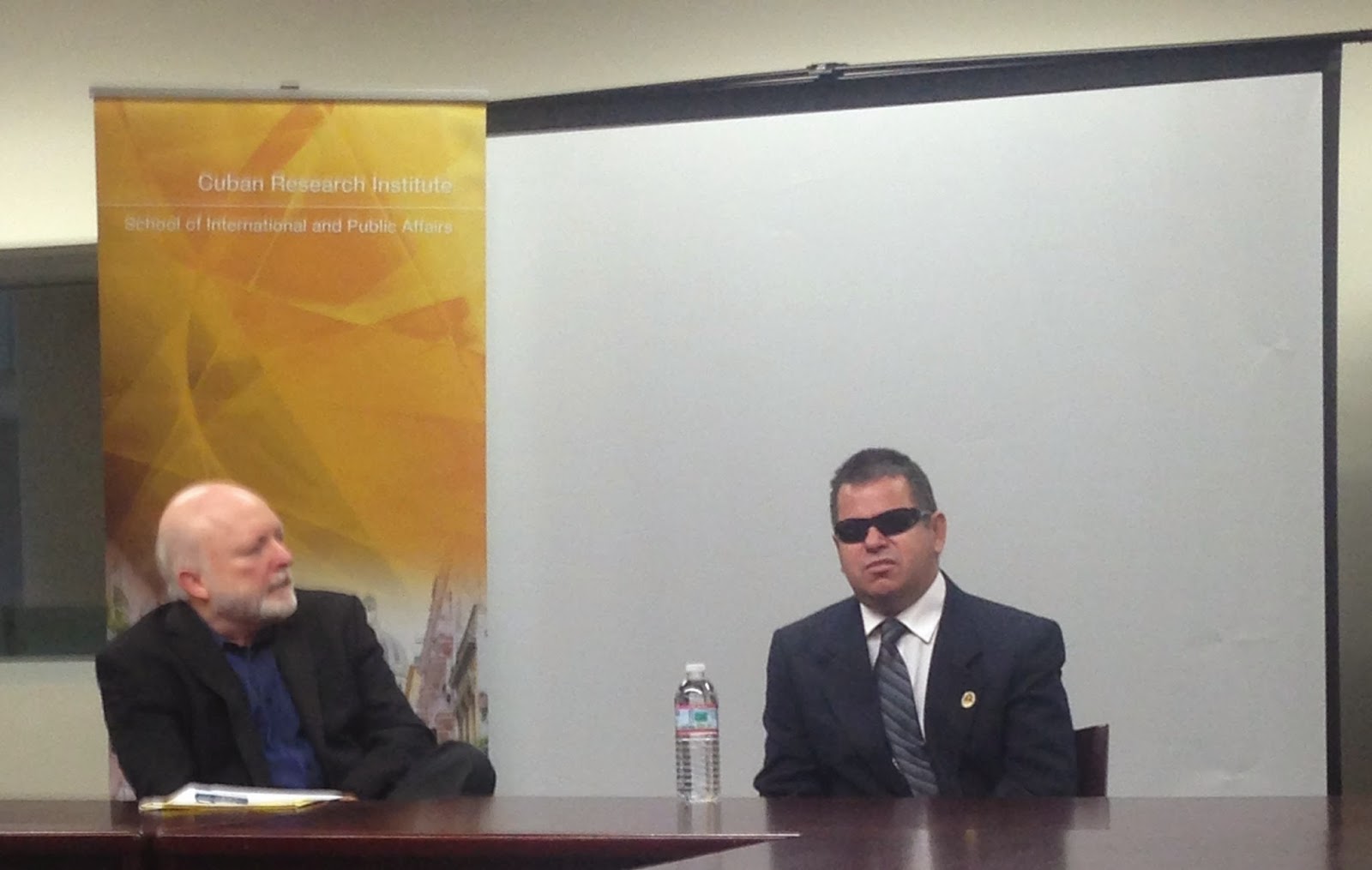
A conversation with human rights defender Juan Carlos González Leiva at Florida International University

Jorge Duany, Director of  CRI and Juan Carlos González Leiva
Tonight at the Green Library at Florida International University the Cuban human rights defender Juan Carlos González Leiva spoke about his experiences as an activist in Cuba at an event organized by the Cuban Research Institute (CRI).The conversation was in Spanish and excerpts are available in the video playlist below. He is an attorney who has spent the past twenty years in Cuba defending human rights in an atmosphere that is hostile.

Juan Carlos has been a prisoner of conscience and been subjected to cruel and unusual treatment while in captivity amounting to torture. The sound in the recording is muffled by the air conditioning in the room but it is worthwhile to listen closely to what he has to say especially on the subject of extrajudicial killings in Cuba where he engages in an overview of a number of well known and not so well known cases.

Tuesday, September 23, 2014

Juan Carlos González Leiva: Speaking out before they hurt him again

"The wisest thing in the world is to cry out before you are hurt. It is no good to cry out after you are hurt; especially after you are mortally hurt. People talk about the impatience of the populace; but sound historians know that most tyrannies have been possible because men moved too late. It is often essential to resist a tyranny before it exists. It is no answer to say, with a distant optimism, that the scheme is only in the air. A blow from a hatchet can only be parried while it is in the air."
—G.K. Chesterton, From his book, "Eugenics and Other Evils", found in Volume 4 of "The Collected Works of G.K. Chesterton"


Juan Carlos González Leiva at the UN Human Rights Council last week
When Juan Carlos González Leiva spoke last week at the United Nations Human Rights Council he explained what he had suffered and called on the human rights body to watch over him when he returns to Cuba in a few weeks time. Today the Cuban human rights defender spoke to the international press and again called for greater solidarity with Cubans on the island resisting tyranny and vigilance over the plight of human rights defenders.


G.K. Chesterton, early in the last century, explained the importance of crying out before being hurt. Let us hope that Juan Carlos's warnings and requests are heeded.  Too many good people have died under suspicious circumstances in Cuba.  Let us see that he is not added to the list of martyrs.

Berlin: Rosenstrasse and The Wall

The Berlin Wall Memorial
Visiting Berlin in the year of the 25th anniversary that the Berlin Wall was finally torn down with a Cuban human rights icon is a once in a life time experience. Above is The Berlin Wall Memorial with the names, and in most cases the photographs of the 136 Germans killed trying to cross the Wall. In West Germany it was known as the "death strip." Estimates place the total number killed as greater than 200. The Wall began to be built by the communist East on August 13, 1961 and was finally torn down on November 9, 1989.

Chris Gueffroy 1968 - 1989
One of the last victims, Chris Gueffroy was born on June 21, 1968 and shot dead on February 5, 1989 trying to cross on the Britzer Zweigkanal, near the small garden colonies “Harmonie“ and “Sorgenfrei” on the sector border between Berlin-Treptow and Berlin-Neukölln. The Wall is a symbol of communist totalitarianism and control celebrated by tyrants such as Fidel Castro who visited there in1972 addressing the border guards and praising their "work."

The Memorial to the Rosenstrasse Protest in Berlin
Amidst the dark shadows of Nazi and Communist totalitarianism shines a powerful example of hope found in the example set by German housewives who using nonviolent means rescued their Jewish husbands who had been abducted in 1943 to be sent to the death camps. This led to a sustained civic action on Rosenstrasse Street. The book, A Force More Powerful, describes how these housewives frustrated the aims of Adolph Hitler’s Third Reich:
Word spread quickly about the abductions in Berlin, and before long a group of non-Jewish German women had gathered on the Rosenstrasse with food and other personal items for their Jewish husbands and children, whom they believed were being held inside. One of the women, Charlotte Israel, arrived and found 150 women already huddled outside. She asked one of the guards for her husband's potato ration cards, which he went to get. On the back of a card, her husband Julius wrote, "I'm fine." Other women began asking for personal effects to confirm that their husbands were inside and, soon after, began demanding their release. One woman's brother, a soldier on leave, approached an SS guard and said, "If my brother-in-law is not released, I will not return to the front." The crowds grew considerably despite the winter chill, and soon women waited outside day and night, holding hands, singing songs, and chanting "Let our husbands go!" By the second day of the protest, over 600 women were keeping a vigil on the Rosenstrasse.
This was not the first time many of these women had voiced dissent. For over a decade they and their families had challenged Nazi racial policies through letters and small demonstrations, insisting that the regime would be hurting fellow Germans by persecuting their Jewish spouses. Hitler and his circle had always tried to minimize unrest and avoid the kind of domestic opposition that German rightists saw as the "stab in the back" that had crippled the German effort during World War I. Until this point the regime had largely managed to keep the genocide against the Jews a secret. But when it affected a group who were unafraid to speak out against Nazi policies, that secrecy was jeopardized.
What gave further resonance to the wives' protest was that it was happening in the heart of Berlin, a city that had never been enthusiastic about Nazism. Cosmopolitan Berliners always saw it as a crude Bavarian aberration. Moreover, Berlin was the German base for foreign news organizations that still operated during the war. If political malcontents or the wire services were to get wind of the protest, the myth of the omnipotent Nazi state could be exposed. In fact, London radio did report on the demonstrations.
By the third day SS troops were given orders to train their guns on the crowd but to fire only warning shots. They did so numerous times, scattering the women to nearby alleyways. But the wives always returned and held their ground. They knew the soldiers would never fire directly at them because they were of German blood. Also, arresting or jailing any of the women would have been the rankest hypocrisy: According to Nazi theories, women were intellectually incapable of political action. So women dissenters were the last thing the Nazis wanted to have Germans hear about, and turning them into martyrs would have ruined the Nazis' self-considered image as the protector of motherhood.
The campaign soon expanded to include women and men who were not in mixed marriages. The ranks of protestors bulged to a thousand, with people chanting to let the prisoners go and taunting the SS soldiers. Joseph Goebbels, seeking to stop more from arriving, closed down the nearest streetcar station, but women walked the extra mile from another station to reach Rosenstrasse 2-4. By the end of the week Goebbels saw no alternative but to let the prisoners go. Some thirty-five Jewish male prisoners, who had already been sent to Auschwitz, were ordered to gather their belongings and board a passenger train back to Berlin.
My first stop in Berlin was to visit The Berlin Wall Memorial and pay my respects to those who died seeking freedom and those who in November of 1989 nonviolently tore down the wall. My final stop was to visit Memorial to the Rosenstraße Protest, the place were German housewives took a stand and saved their husbands.

The power of nonviolence when properly applied with sound strategy forced the Nazi Third Reich to blink in 1943 and brought down a hated symbol of Communism in 1989.

A segment of the Berlin Wall converted into protest art

Tuesday, September 16, 2014

Witnessing a hero in action at the United Nations Human Rights Council: Juan Carlos González Leiva

My life is my message. - Mohandas Gandhi
Juan Carlos González Leiva with Mohandas Gandhi in Geneva
Today I was honored and humbled to witness a courageous man in action at the United Nations Human Rights Council. Juan Carlos González Leiva is an attorney and human rights activist who has spent the past 20 years defending the rights of Cubans inside the island. He has been consistently threatened with death, suffered arbitrary detention for two years without trial, received death threats and been subjected that amounts to torture. Amnesty International, Human Rights Watch, Frontline Defenders and the Coalition of Cuban American Women have documented his plight over this time. His family has also been a target of harassment by the dictatorship in Cuba. Many have fled into exile, but Juan Carlos remains in Cuba carrying on the struggle for human rights. The Harvard Crimson in 2003 described him as the conscience of Cuba.

What is remarkable is that a man who lost his sight completely in 1986, at the age of 21 (he had suffered with vision problems since birth) would eight years later begin the life of a dissident and human rights defender in Cuba. Below is the statement that he gave today and in the video one can witness the hostility of the dictatorship towards this man and his courage confronting it. Reading the document in braille he demonstrated a far seeing vision into the reality of Cuba that many with sight refuse or are unable to see.

In a world where so many heroes are manufactured and false it is a powerful experience to see one in action. Listen to the exchange with the diplomat of the Castro regime below at 31:45.


Item 3
United Nations Human Rights Council
September 15, 2014
I am Juan Carlos González Leiva, spent 20 years as a blind lawyer defending human rights, suffering beatings, arbitrary arrests and organized mobs. From March 4, 2002 to April 26, 2004, was detained in the Police Center of Pedernales, Holguín, without trial, for celebrating a congress about human rights. There, systematically they sprayed chemical substances over me that burned my skin and occasioned hallucinations, strong headaches and allergies.

I was confined without access to the press, telephone, correspondence, or religious assistance. Murderous prisoners threatened me and prevented me from sleeping night and day. In my cell were left exposed electric cables with current.

Human rights defenders in my country are victims of a constant policy of repression.

For example: In 2014 I was beaten together with 10 activists in the street. Agents dislocated my left leg and right shoulder and I lost consciousness when they applied a choke hold. Jorge Luis García Pérez “Antúnez”and his wife Yris Tamara Perez Aguilera were arrested, beaten and transferred to the local police headquarters where Antúnez was placed in a choke hold losing consciousness several times and was injected by state security agents with an unknown substance. His home was invaded and sacked.

Other activists arbitrarily detained and beaten were: José Daniel Ferrer García, Yusmila Reina Ferrera, Geobanis Izaguirre Hernández and Ernesto Ortiz Betancourt.

I ask the United Nations protection for me and all the activists inside Cuba because soon I will return to my country to continue defending human rights.


Wednesday, January 15, 2014

Cuba: Physical attack against human rights defenders by state security forces


On 9 January 2014, at approximately 10:35am, in Ciego de Ávila, human rights defenders Mr Juan Carlos González Leiva, his wife Ms Tania Maceda, Messrs Junior Ortega Rivero, Daniel Camacho Marchena, Daniel Martínez, Alberto Pla Risco and Ms Quintana Sarría were subjected to a violent beating by members of the National Revolutionary Police.
Juan Carlos González Leiva is a human rights lawyer and member of the Consejo de Relatores de Derechos Humanos de Cuba (Council of Human Rights Reporters of Cuba), as well as director of the bulletin “Voz Avileña” in Cuba. He has also created various press organisations that document current events in Cuba and report them to the world. Tania Maceda is the editor of the bulletin and also a member of the Damas de Blanco (Ladies in White), a human rights organisation working on freedom for political prisoners in Cuba.
On 9 January 2014, Juan Carlos González Leiva, who is blind, Tania Maceda, Junior Ortega Rivero, Daniel Camacho Marchena, Daniel Martínez, Alberto Pla Risco and Quintana Sarría, together with three other individuals, were distributing the “Voz Avileña” when they were violently physically attacked by the police. They were tied to and dragged by the patrol car, while being beaten up. During their transfer to the police station, Juan Carlos González Leiva had his hands tied behind his back and received repeated blows to the face and head. Upon exiting the patrol car, he was strangled until he lost consciousness through asphyxiation. Tania Maceda had her hair pulled out, and was bitten and hit in the head. All were released at approximately 3pm without interrogation.
This attack comes in the context of increasing physical attacks and detentions of human rights defenders in the last months, in particular during the month of December 2013. Front Line Defenders issued an urgent appeal on 7 January 2014 regarding the attack on the son and daughter of human rights defender Ms Damaris Moya Portieles.
Front Line Defenders is seriously concerned about the physical attack on the above-mentioned human rights defenders, as it is directly related to their legitimate and peaceful human rights work and their exercise of their right to freedom of expression.
- See more at: http://www.frontlinedefenders.org/node/24667/#sthash.5Y898nWu.dpuf
http://www.frontlinedefenders.org/node/24667/action

January 14, 2014

On 9 January 2014, at approximately 10:35am, in Ciego de Ávila, human rights defenders Mr Juan Carlos González Leiva, his wife Ms Tania Maceda, Messrs Junior Ortega Rivero, Daniel Camacho Marchena, Daniel Martínez, Alberto Pla Risco and Ms Quintana Sarría were subjected to a violent beating by members of the National Revolutionary Police.

Juan Carlos González Leiva is a human rights lawyer and member of the Consejo de Relatores de Derechos Humanos de Cuba (Council of Human Rights Reporters of Cuba), as well as director of the bulletin “Voz Avileña” in Cuba. He has also created various press organisations that document current events in Cuba and report them to the world. Tania Maceda is the editor of the bulletin and also a member of the Damas de Blanco (Ladies in White), a human rights organisation working on freedom for political prisoners in Cuba.

On 9 January 2014, Juan Carlos González Leiva, who is blind, Tania Maceda, Junior Ortega Rivero, Daniel Camacho Marchena, Daniel Martínez, Alberto Pla Risco and Quintana Sarría, together with three other individuals, were distributing the “Voz Avileña” when they were violently physically attacked by the police. They were tied to and dragged by the patrol car, while being beaten up. During their transfer to the police station, Juan Carlos González Leiva had his hands tied behind his back and received repeated blows to the face and head. Upon exiting the patrol car,  he was strangled until he lost consciousness through asphyxiation. Tania Maceda had her hair pulled out, and was bitten and hit in the head. All were released at approximately 3pm without interrogation.

This attack comes in the context of increasing physical attacks and detentions of human rights defenders in the last months, in particular during the month of December 2013. Front Line Defenders issued an urgent appeal on 7 January 2013 regarding the attack on the son and daughter of human rights defender Ms Damaris Moya Portieles.

Front Line Defenders is seriously concerned about the physical attack on the above-mentioned  human rights defenders, as it is directly related to their legitimate and peaceful human rights work and their exercise of their right to freedom of expression.

Front Line Defenders urges the authorities in Cuba to:

1. Carry out a thorough, impartial and immediate investigation into the attack against the above-mentioned human rights defenders with a view to publishing the results and bringing those responsible to justice in accordance with international standards;

2. Take all necessary measures to guarantee at all times the physical and psychological integrity of the above-mentioned human rights defenders, and that of their family and colleagues;

3. Guarantee in all circumstances that all human rights defenders in Cuba are able to carry out their legitimate human rights activities without fear of reprisals and free of all restrictions.

http://www.frontlinedefenders.org/node/24667/action


En castellano: 

14 de enero de 2014

 Cuba - Ataque físico contra defensores de derechos humanos
por parte de las fuerzas del orden

El 9 de enero de 2014, aproximadamente a las 10:35 de la mañana, en Ciego de Ávila, los defensores y defensoras de derechos humanos, Juan Carlos González Leiva,  su esposa Tania Maceda, Junior Ortega Rivero, Daniel Camacho Marchena, Daniel Martínez, Alberto Pla Risco y Quintana Sarría fueron objetos de una violenta golpiza por parte de miembros de la Policía Nacional Revolucionaria.

Juan Carlos González Leiva es abogado de derechos humanos y presidente del Consejo de Relatores de Derechos Humanos de Cuba  así como director del boletín “Voz Avileña” de Cuba. También ha creado varias organizaciones de prensa que documentan eventos pasando en Cuba y los reportartan al mundo. Tania Maceda es editora del Boletín y miembro de las Damas de Blanco. Las Damas de Blanco es una organización de derechos humanos que lucha por la libertad para los prisioneros políticos en Cuba.

El 9 de enero de 2014, Juan Carlos Gonzalez Leiva, quien es ciego, Tania Maceda, Junior Ortega Rivero, Daniel Camacho Marchena, Daniel Martínez, Alberto Pla Risco, Quintana Sarría, junto con tres personas más repartían el boletín la Voz Avileña cuando fueron violentamente golpeados por la policía.  Fueron montados arrastrándolos al auto de la patrulla de la Policía mientras siendo golpeados. Mientras los trasladaban a la Primera Unidad de la Policía, a Juan Carlos González  le sujetaron las manos a la espalda al tiempo que fue golpeado repetidas veces en la cara y cabeza. Al sacarlo del auto lo estrangularon hasta que perdió el conocimiento por la asfixia. A Tania Maceda la estiraron de los pelos hasta arrancárselos, la mordieron,  y la golpearon en la cabeza. Todos fueron liberados aproximadamente a las tres de la tarde sin proceder antes a un interrogatorio.

Dicho ataque viene en un contexto de un incremento de ataques físicos y detenciones a defensores y defensoras de derechos humanos en los últimos meses; en particular durante el mes de diciembre de 2013. Front Line Defenders emitió un llamamiento urgente el 7 de enero de 2013 por la golpiza al hijo e hija de la defensora Damaris Moya Portieles. 

Front Line Defenders expresa su profunda preocupación sobre los ataques físicos a los ante-mencionados defensores y defensoras de derechos humanos, porque son directamente relacionados con su labor legitima y pacifica  y su ejercicio del derecho a la libertad de expresión.

Front Line Defenders insta a las autoridades Cubanas a que:

1. Inicien una investigación inmediata, exhaustiva e imparcial sobre la golpiza contra los defensores y defensora de derechos humanos con el fin de identificar a los responsables, llevarlos ante un tribunal competente e imparcial, y aplicarles las sanciones previstas por la ley;

2. Tomen todas las medidas necesarias para garantizar en todo momento la integridad física y psicológica de los mencionados defensores y defensoras de los derechos humanos así como de sus familia y colegas;

3. Aseguren que todos los defensores de derechos humanos en Cuba, desarrollando sus actividades legítimas en defensa de los derechos humanos, puedan operar libremente sin miedo a restricciones de cualquier tipo sin miedo a represalias.

 http://www.frontlinedefenders.org/node/24667/
On 9 January 2014, at approximately 10:35am, in Ciego de Ávila, human rights defenders Mr Juan Carlos González Leiva, his wife Ms Tania Maceda, Messrs Junior Ortega Rivero, Daniel Camacho Marchena, Daniel Martínez, Alberto Pla Risco and Ms Quintana Sarría were subjected to a violent beating by members of the National Revolutionary Police.
Juan Carlos González Leiva is a human rights lawyer and member of the Consejo de Relatores de Derechos Humanos de Cuba (Council of Human Rights Reporters of Cuba), as well as director of the bulletin “Voz Avileña” in Cuba. He has also created various press organisations that document current events in Cuba and report them to the world. Tania Maceda is the editor of the bulletin and also a member of the Damas de Blanco (Ladies in White), a human rights organisation working on freedom for political prisoners in Cuba.
On 9 January 2014, Juan Carlos González Leiva, who is blind, Tania Maceda, Junior Ortega Rivero, Daniel Camacho Marchena, Daniel Martínez, Alberto Pla Risco and Quintana Sarría, together with three other individuals, were distributing the “Voz Avileña” when they were violently physically attacked by the police. They were tied to and dragged by the patrol car, while being beaten up. During their transfer to the police station, Juan Carlos González Leiva had his hands tied behind his back and received repeated blows to the face and head. Upon exiting the patrol car, he was strangled until he lost consciousness through asphyxiation. Tania Maceda had her hair pulled out, and was bitten and hit in the head. All were released at approximately 3pm without interrogation.
This attack comes in the context of increasing physical attacks and detentions of human rights defenders in the last months, in particular during the month of December 2013. Front Line Defenders issued an urgent appeal on 7 January 2014 regarding the attack on the son and daughter of human rights defender Ms Damaris Moya Portieles.
Front Line Defenders is seriously concerned about the physical attack on the above-mentioned human rights defenders, as it is directly related to their legitimate and peaceful human rights work and their exercise of their right to freedom of expression.
- See more at: http://www.frontlinedefenders.org/node/24667/#sthash.5Y898nWu.dpuf
On 9 January 2014, at approximately 10:35am, in Ciego de Ávila, human rights defenders Mr Juan Carlos González Leiva, his wife Ms Tania Maceda, Messrs Junior Ortega Rivero, Daniel Camacho Marchena, Daniel Martínez, Alberto Pla Risco and Ms Quintana Sarría were subjected to a violent beating by members of the National Revolutionary Police.
Juan Carlos González Leiva is a human rights lawyer and member of the Consejo de Relatores de Derechos Humanos de Cuba (Council of Human Rights Reporters of Cuba), as well as director of the bulletin “Voz Avileña” in Cuba. He has also created various press organisations that document current events in Cuba and report them to the world. Tania Maceda is the editor of the bulletin and also a member of the Damas de Blanco (Ladies in White), a human rights organisation working on freedom for political prisoners in Cuba.
On 9 January 2014, Juan Carlos González Leiva, who is blind, Tania Maceda, Junior Ortega Rivero, Daniel Camacho Marchena, Daniel Martínez, Alberto Pla Risco and Quintana Sarría, together with three other individuals, were distributing the “Voz Avileña” when they were violently physically attacked by the police. They were tied to and dragged by the patrol car, while being beaten up. During their transfer to the police station, Juan Carlos González Leiva had his hands tied behind his back and received repeated blows to the face and head. Upon exiting the patrol car, he was strangled until he lost consciousness through asphyxiation. Tania Maceda had her hair pulled out, and was bitten and hit in the head. All were released at approximately 3pm without interrogation.
This attack comes in the context of increasing physical attacks and detentions of human rights defenders in the last months, in particular during the month of December 2013. Front Line Defenders issued an urgent appeal on 7 January 2014 regarding the attack on the son and daughter of human rights defender Ms Damaris Moya Portieles.
Front Line Defenders is seriously concerned about the physical attack on the above-mentioned human rights defenders, as it is directly related to their legitimate and peaceful human rights work and their exercise of their right to freedom of expression.
- See more at: http://www.frontlinedefenders.org/node/24667/#sthash.5Y898nWu.dpuf

Sunday, January 12, 2014

Blind Lawyer Badly Beaten by Castro's State Security Agents

  "I'm not afraid at all. These people threaten that they are going to enter my home, but they will have to take me by force. If I withstood 26 months in prison under daily torture by Cuban military officials, harassed, beaten up, and poisoned by chemical substances from which I still suffer, then I will withstand inside my house for 26 months more."  - Juan Carlos González Leiva,, blind human rights defender, from Cuba, January 2006
Blind Attorney and Rights Defender Juan Carlos Gonzalez Leiva
Imagine for a moment that you are a blind attorney and a human rights defender. Over the years you have been subjected to harassment, beatings, arbitrary detentions, death threatsattacks with substances, torture and one colleague died under circumstances that lead you to believe he was murdered by the government. After delivering a report to the Office of the United Nations Human Rights Commissioner in 2009 for Cuba's universal periodic review the repression worsened. Together with your wife, Tania Maceda Guerra, and six other activists in Ciego de Avila, your home town, you are distributing "Voz Avileña", a bulletin that you publish on January 9, 2014 at 10:35am.

Juan Carlos González Leiva and Tania Maceda Guerra

Juan Carlos González Leiva narrates what happened next
" I carried in my hand a copy of the newsletter "The Avileña Voice" there was a very large state security operative and they demanded that we will give them the newsletter. When I refused and we eight activists sat on the ground, and began to shout, " Freedom", "Long live human rights" and "Down with Fidel ". Military troops reinforcements arrived and they beat us up. We were taken by car to the First police headquarters. During the trip a police officer pulled my wife's hair and bit her hands. I responded to the police officer with another bite and then the official gave me a savage beating to the point that it made ​​me lose consciousness. They hit me so many times that I have both the right foot and index finger of the left hand broken. I have aches and bruises throughout my entire body . To all the activists who were with me Junior Ortega Rivero, Daniel Camacho Marchena, Daniel Martínez, Alberto Pla Risco, Quintana Sarría and others that were with me, all were violently beaten and dragged away were also detained. Without any explanation all were released around 3:00pm in the afternoon."
Below is the original audio statement:


Juan Carlos has been described as the "blind lawyer who can see" and is a long time human rights defender who has suffered imprisonment, torture and the denial of medical care he has been a victim of both psychological and physical torture for more than a decade. Amnesty International back on July 30, 2002 described what Cuban state security had subjected this human rights defender to:
Amnesty International is concerned for the health of Juan Carlos González Leiva, a 37-year- old blind lawyer, held in Holguín prison in Holguín Province, Cuba. He reportedly suffers from chest pain, high blood pressure and a ‘nervous condition’ (of which Amnesty International has no further details). The prison doctor reportedly told him that there is nothing wrong with him. In addition, he claims to have received threats from his cell mate, who has said that he will beat him.   Juan Carlos González Leiva reportedly had to have four stitches in his head as a result of the police aggression on his arrest on 4 March 2002. Amnesty International received reports that initially medical attention was denied to him although he was in severe pain. 
 He spent 20 months in prison and managed to get letters out to denounce prison conditions. Released from prison, following an international campaign for his release, he would continue his human rights work. Despite the constant war waged against him by the state security apparatus to break him, Juan Carlos González Leiva has remained in Cuba and continues to work to make the ongoing human rights violations known to the world.