Showing posts with label Laura Pollán. Show all posts

Monday, May 22, 2023

Twenty years ago brave Cuban women took the name Ladies in White.

Today four Ladies in White are in prison for demanding freedom for political prisoners and respect for human rights.

Ladies in White Tania Echevarría, Saylí Navarro, Sissi Abascal & Aymara Nieto jailed.
 

May 22, 2023 marks the day twenty years  ago when a group of brave Cuban women took the name the Ladies in White.  

They first came together on March 30, 2003 in the aftermath of a major crackdown that began on March 18, 2003, and with political show trials underway targeting their loved ones. 

Claudia Márquez (L) , Blanca Reyes (center) y Miriam Leiva (Rt), on 4/7/03 (Martí Noticias)

These courageous women carried out marches demanding the freedom of all prisoners of conscience and recognition of international human rights standards. 

Their objective was to see an end to prisoners of conscience in Cuba. 

Recognizing their struggle, the European Parliament awarded the Ladies in White the Sakharov Prize in 2005.

They've paid a high price for this stand. Movement leader Laura Pollán may have paid the highest price.  

Laura Pollán, February 13, 1948 - October 14, 2011

Mary O'Grady in The Wall Street Journal on October 24, 2011 reported that Pollán instead of disbanding sought to expand "the movement across the country and promised to convert it to a human rights organization open to all women. Speaking from the Guanajay prison as her condition was deteriorating, jailed former Cuban counterintelligence officer Ernesto Borges Pérez told the Hablemos Press that making public those objectives likely sealed her fate." Laura Pollán died on October 14, 2011 and was cremated shortly afterwards.

Twenty years later, and the Ladies in White continue to be subjected to brutal repression, and four women of this movement are now jailed in Cuba for calling for the release of political prisoners, and nonviolently defending human rights.

The current elected leader of the Ladies in White in Cuba is Berta Soler Fernandez.


Artists have celebrated them over the years, and their work endures. Mike Porcel in 2005 composed the song "Damas de Blanco" for a documentary about the Ladies in White.

In 2011, following Laura Pollán's death, Amaury Gutierrez composed the song "Laura", and in 2013 played it for Berta Soler and other Ladies in White at Our Lady of Charity when she visited Miami.

Today, 20 years later, we remember their courageous example, and the need to follow their lead both inside and outside of Cuba. 

Freedom for Tania, Sayli, Sissi, Aymara, and the over 1,000 other prisoners of conscience in Cuba.

Wednesday, February 15, 2023

Laura Pollán at 75 - Remembering the Cuban dissident leader's legacy. Global rise in number of political prisoners with Belarus and Cuba in the lead. Cuba and Iran undermining Peru

They can either kill us, put us in jail or release them. We will never stop marching no matter what happens." - Laura Inés Pollán Toledo (2010)

Laura Inés Pollán Toledo, February 13, 1948 - October 14, 2011

Earlier version published as a CubaBrief 

Laura Inés Pollán Toledo, was born 75 years ago on February 13, 1948. She had been a school teacher, before her husband,  Héctor Fernando Maseda Gutiérrez, was jailed for his independent journalism in 2003 along with more than 75 other civil society members. Amnesty International recognized them as prisoners of conscience.

Claudia Márquez (izq) , Blanca Reyes (centro) y Miriam Leiva (der), al salir el 7 de abril de 2003 del Tribunal Provincial de La Habana tras conocer las sentencias dictadas contra sus respectivos esposos (Foto: Radio Televisión Martí)

This drove her break with the regime, and the formation of a dissident movement that marked a before and after in Cuban history. Claudia Márquez (izq) , Blanca Reyes (centro) y Miriam Leiva, who had been long time activists, and also had their husbands jailed were founding leaders in the new movement.

Laura reached out to the wives, mothers, sisters, and daughters of the 75 prisoners of conscience jailed in March 2003, which included her husband and they carried out a sustained nonviolent campaign that after eight years obtained the freedom of their loved ones. The first group was released in November 2010, and the last of the group of 75 were freed in March 2011.

Laura was greatly admired both inside and outside of Cuba for founding the Ladies in White movement after the Black Cuban Spring of 2003. She, and the group of women she led, nonviolently challenged the Castro regime in the streets of Havana initially, and eventually across the island.

She did not disband the Ladies in White when her husband returned home in February 2011. Laura recognized that the laws had not changed, that prisoners of conscience remained behind bars.

Laura Pollán and Héctor Maseda reunited in February 2011

Mary O'Grady in The Wall Street Journal on October 24, 2011 reported that Pollán instead of disbanding sought to expand "the movement across the country and promised to convert it to a human rights organization open to all women. Speaking from the Guanajay prison as her condition was deteriorating, jailed former Cuban counterintelligence officer Ernesto Borges Pérez told the Hablemos Press that making public those objectives likely sealed her fate." Laura Pollán died on October 14, 2011 and was cremated shortly afterwards.

Following her death, her husband Héctor Fernando Maseda mourned and through tears observed that "the toll on our private lives has been that after eight years of forced separation, we didn't even get eight months together. So I had one month of happiness for every year of separation."


Héctor Fernando Maseda marches with the Ladies in White following Laura's death in October 2011

Dr. Oscar Elías Biscet MD, who was a first degree medical specialist in internal medicine, before being fired from his post by the government for his dissident views, examined the circumstances surrounding the death of  Laura Pollán and wrote an analysis in November 2011 titled "A MEDICAL ANALYSIS OF LAURA POLLAN'S PAINFUL, TRAGIC AND UNNECESSARY DEATH." He concluded that " There is concrete evidence that the closest relatives, friends and dissidents expressed suspicions about a possible assassination by the communist regime's political police. Now, what has been proven over and over again is the stubborn nature of the regime at this sad, tragic and unnecessary death."

U.S. journalist Tracey Eaton interviewed Laura's widower Héctor Maseda on Dec. 15, 2011, about three months after her death, and he held the Castro regime responsible for her death, but admitted that he did not have the evidence to back up his allegation.

Twelve years later, and the wisdom of her analysis is reflected in over a thousand prisoners of conscience, and a dictatorship that changed the penal code to increase punishments for exercising freedom of expression.

Belarus, Cuba, and Vietnam have jailed thousands of prisoners of conscience in recent years.

The Ladies in White continue to be subjected to brutal repression, and four women of this movement are today jailed in Cuba for calling for the release of political prisoners, and nonviolently defending human rights.

Ladies in White Tania Echevarría, Saylí Navarro, Sissi Abascal and Aymara Nieto jailed.

 On April 14, 2022, Ms.Tania Echevarría Menéndez was sentenced to six years in prison for crimes of public disorder and contempt.

On April 18, 2022, Ms. Sayli Navarro Alvares began serving an eight-year sentence for crimes of public disorder, contempt, and assault related to her participation in the July 11 protests.
 
Ms. Sissi Abascal Zamora was sentenced to six years in prison for participating in the 11J protests in the town of Carlos Rojas, in the municipality of Jovellanos, in the province of Matanzas. The 23-year-old activist and member of the Party for Democracy Pedro Luis Boitel has ten business days to appeal. Reports are that a bus full of women dressed as civilians arrived where Sissi was peacefully demonstrating with others on July 11, 2021, and proceeded to beat her and others up, and a bottle was broken over Ms. Abascal Zamora's head requiring that she receive stitches.

Mrs. Aymara Nieto Muñoz served four years in prison for her activism in the Ladies in White and when released officials created a new case against her and sentenced her to five years and four months in prison. This was in retaliation for not having agreed with State Security to leave the country with her family.

Laura is not forgotten, and her memory and example continue to animate the Ladies in White, and their current leader Berta Soler.

Berta Soler Fernandez is the current leader of the Ladies in White in Cuba.

Sadly, too many in the international community are funding the dictatorship, and ignoring what Havana does with the resources provided. On February  12, 2023 in her column "Cuba Dares Biden to Look Away" exposed the nexus between Iran, Cuba, Venezuela and terrorist groups in subverting democracy in Peru.

"In March 2015, political and security analyst Dardo López-Dolz, a former Peruvian vice minister of the interior, laid out the threat before a U.S. House subcommittee. He said Iran and Hezbollah came to his attention in 2011, when “a connection was forming between the Islamic Republic and other activist movements in Peru controlled by Havana, Caracas and La Paz.” The Cuban and Venezuelan “political/social organizations aimed at subverting and weakening our democratic institutions and spreading socialist ideology,” he said, had been operating in Peru “since at least 2005.”

The Islamic regime in Iran, a close ally of Havana, has embarked on a six month long crackdown against protesters killing over 528 protesters, and jailing approximately 20,000 protesters.

Sunday, December 12, 2021

Nonviolent resistance has a history of success in combating repression in Cuba by Regis Iglesias and John Suarez

Maria J. Stephan and Erica Chenoweth in their 2008 study "Why Civil Resistance Works: The Strategic Logic on Nonviolent Conflict" compared the outcomes of 323 nonviolent and violent resistance campaigns from 1900 to 2006. They found that major nonviolent campaigns achieved success 53 percent of the time, compared with just under half that at 26 percent for violent resistance campaigns."

Oswaldo Payá Sardiñas, Regis Iglesias, and Tony Diaz Sanchez deliver petitions

Grassroots movements in Cuba have fought for liberty for decades, mobilizing Cubans to defend human rights and freedom. The July 11 nationwide protests marked a historic moment, but they did not arise from nowhere.

In November 2020, hundreds of artists mobilized outside of the Ministry of Culture in a 15-day effort to free political prisoner Denis Solís González. They demanded both his release and greater artistic freedoms.

The San Isidro Movement (MSI), an artists collective formed in 2018 to nonviolently defend artistic freedom, challenged regime officials to free their unjustly jailed compatriot. Solís González was charged with contempt for protesting an illegal search of his home by a policeman, whom he had called a coward.

Rather than accede to MSI’s demands, officials repeatedly and violently escalated repression over 15 days, but they were met with nonviolent responses that inspired hundreds of artists and intellectuals to gather outside the Ministry of Culture, bringing officials to the negotiating table for dialogue.

The San Isidro Movement’s exercise in nonviolent power led to the formation of a new movement, 27N, and increased civic resistance. The pattern continued through 2021, reaching millions of Cubans across the island with the movement's art and music — in particular the song, “Patria y Vida.” The rapper Maykel Castillo Perez (Osorbo), co-author of the song and also a member of MSI, is currently in prison and severely ill.

This is not the first time nonviolent tactics have been carried out successfully in Cuba. The Cuban Committee for Human Rights, founded in 1976, systematically documented human-rights violations, information smuggled out of Cuba to international human rights organizations, which led to the installation of a special rapporteur focused on Cuba’s human-rights situation and the Castro regime’s condemnation over a 15-year period beginning in 1991. Havana’s record was carefully scrutinized, and it was held accountable annually until 2006.

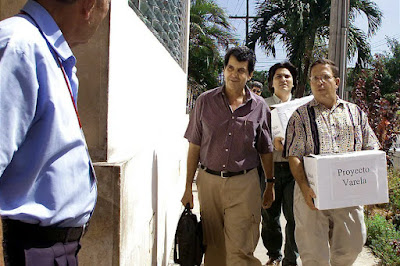
The Christian Liberation Movement (MCL), founded in 1988 to work for Cuba’s democratization, is best known for the Varela Project, a petition signed by 11,020 Cubans in May 2002 calling on the regime to guarantee international human-rights norms in law. Fidel Castro changed his constitution to prevent it from being amended that same year.

The regime responded with violence, not so much because of the number of signatures presented to the National Assembly, but because more than 120 Citizens’ Committees had been created throughout the country in the process and imprisoned most of their leaders. Despite this repression, MCL turned in an additional 14,384 signatures in October 2003.

Castro expected the March 2003 crackdown, dubbed the “Black Cuban Spring,” to be the end of the opposition. Instead, it sparked the emergence of a new movement, the Ladies in White, led by the wives, mothers, sisters and daughters of the men jailed. For eight years, these women lobbied, protested and marched for their loved ones’ freedom. They were successful, and the last of the men were released from prison in 2011, a nonviolent victory over the dictatorship. The Ladies in White continue to the present day, demanding human rights be respected in Cuba.

The price of nonviolent defiance has been high: long prison terms, exile, deportations and extrajudicial killings. Tempted by the understanding that Cubans are exerting power through nonviolent action, some voices have emerged advocating a turn to violence in the belief that it would expedite a democratic transition.

Strategic studies have demonstrated that the more brutal the regime, the less effective and successful violent movements are. Counterintuitively, nonviolent movements have been more successful in overthrowing brutal dictators and transitioning to lasting democracies.

The Castro dictatorship, with decades of experience in terrorism, torture and genocide around the world, is an expert in war, as demonstrated in the 1960s when it efficiently and ruthlessly crushed a violent opposition in Cuba with the aid of Soviet advisors to consolidate power.

Nonviolent resistance is better able to mobilize citizens to demand change and obtain global solidarity and sanctions, creating the political, diplomatic and economic isolation of the regime and punishing the individuals and entities that violate Cubans’ rights. 

Regis Iglesias Ramírez is spokesperson for the Movimiento Cristiano Liberación. 

John Suarez is executive director of Centro por una Cuba Libre.

Note: This article was published in The Miami Herald on Tuesday, November 30, 2021.

Wednesday, October 14, 2020

Remembering Laura Pollán, Cuba's Lady in White nine years after her killing

 They can either kill us, put us in jail or release them. We will never stop marching no matter what happens." - Laura Inés Pollán Toledo (2010

Laura Inés Pollán Toledo, February 13, 1948 – October 14, 2011

Nine years ago today, Cuban opposition leader and human rights defender Laura Pollán died under circumstances that Cuban dissident and medical doctor Oscar Elias Biscet described as "death by purposeful medical neglect."
Laura Inés Pollán Toledo, a courageous woman spoke truth to power and protested in the streets of Cuba demanding an amnesty for Cuban political prisoners. She had been a school teacher, before her husband was jailed for his independent journalism in 2003 along with more than 75 other civil society members. Laura was greatly admired both inside and outside of the island.
 
But when one opposes the regime in Cuba not only is their physical life in danger, but their reputation is systematically slandered. The dictatorship claimed that she was a stateless "traitor." She became ill and died within the space of a week under circumstances that raise the question of foul play by Castro's secret police. Following her death the official media of the dictatorship began a slander campaign asserting that she was a common criminal.
  Following brutal repression, in an effort to prevent them from marching through the streets of Havana, Laura Pollan directly and nonviolently challenged the regime declaring, "we will never give up our protest. The authorities have three options — free our husbands, imprison us or kill us."
Unfortunately beginning in 2010 a new and deadlier pattern of oppression presented itself with the extrajudicial death of Orlando Zapata Tamayo
 
Laura Pollán's "criminal" behavior was to start the Ladies in White movement after the Black Cuban Spring of 2003 and nonviolently challenged the Castro regime in the streets of Havana at the beginning, and eventually across the island. Laura reached out to the wives, mothers, sisters, and daughters of the 75 prisoners of conscience jailed in March of 2003 along with her husband and they carried out a sustained nonviolent campaign that after nine years obtained the freedom of their loved ones.
 
Since she did not dissolve the Ladies in White when her husband returned home because she recognized that the laws had not changed, and that political prisoners remained behind bars and that she would continue her human rights activism, the Castro regime did away with her on October 14, 2011.
 
Today let us remember the words that Laura put into action and that was nonviolent resistance to tyranny.
"They tried to silence 75 voices, but now there are more than 75 voices shouting to the world the injustices the government has committed." (2004) "We fight for the freedom of our husbands, the union of our families. We love our men." (2005)
"They can either kill us, put us in jail or release them. We will never stop marching no matter what happens." (2010) "We are going to continue. We are fighting for freedom and human rights.” (September 24, 2011)
"As long as this government is around there will be prisoners because while they've let some go, they've put others in jail. It is a never-ending story." (2011)
“If we must give our own lives in pursuit of the freedom of our Cuba that it be what God wants.” (September 24, 2011)
"We are not going to stop. If you have imprisoned our sisters thinking that we would give up, they are mistaken. We are very united (...) all the women's movements are very close." (October 2, 2011)
"My life has changed a lot, now I have learned to love the country much more, the prisoners, the humanity. That's how I have so much work, that I don't have much time to think about myself, what really satisfies me, in short, I owe myself to other more important tasks. Now I understand much more, before I could not understand these things, you have to live and feel them to be able to dedicate soul heart and life to this beautiful cause." (2011)
The regime in Cuba is the most misogynist government in all of Latin America. Women who speak out and exercise their fundamental rights are regularly slandered, physically assaulted and sometimes die under suspicious circumstances as Laura did nine years ago today.


Monday, October 14, 2019

Remembering Laura Pollán, Cuba's Lady in White eight years after her untimely death

They can either kill us, put us in jail or release them. We will never stop marching no matter what happens." - Laura Inés Pollán Toledo (2010)

Laura Inés Pollán Toledo, February 13, 1948 – October 14, 2011
Source: CubaBrief
Eight years ago today, Cuban opposition and human rights defender Laura Pollán died under circumstances that Cuban dissident and medical doctor Oscar Elias Biscet described as "death by purposeful medical neglect."
Laura Inés Pollán Toledo, a courageous woman spoke truth to power and protested in the streets of Cuba demanding an amnesty for Cuban political prisoners. She had been a school teacher, before her husband was jailed for his independent journalism in 2003. Laura was a figure greatly admired both inside and outside of the island.
However when one opposes the regime in Cuba not only is their physical life in danger, but their reputation is systematically slandered. The dictatorship claimed that she was a stateless "traitor." She became ill and died within the space of a week under circumstances that raise the question of foul play by the Castro tyranny. Following her death the official media began a campaign asserting that she was a common criminal.
Laura Pollán became a dissident when her husband was imprisoned during the Black Cuban Spring of 2003 along with more than 75 other activists and civil society members. She was one of the founders of the Ladies in White and challenged the Castro regime in the streets of Cuba. 


Following brutal repression, in an effort to prevent them from marching through the streets of Havana, Laura Pollan directly and nonviolently challenged the regime declaring, "we will never give up our protest. The authorities have three options — free our husbands, imprison us or kill us."
Unfortunately beginning in 2010 a new and deadlier pattern of oppression presented itself with the extrajudicial death of Orlando Zapata Tamayo.
Today let us remember the words that Laura put into action and that was nonviolent resistance to tyranny.
"They tried to silence 75 voices, but now there are more than 75 voices shouting to the world the injustices the government has committed." (2004)
"We fight for the freedom of our husbands, the union of our families. We love our men." (2005)
"They can either kill us, put us in jail or release them. We will never stop marching no matter what happens." (2010)
"We are going to continue. We are fighting for freedom and human rights.” (September 24, 2011)
"As long as this government is around there will be prisoners because while they've let some go, they've put others in jail. It is a never-ending story." (2011)
“If we must give our own lives in pursuit of the freedom of our Cuba that it be what God wants.” (September 24, 2011)
"We are not going to stop. If you have imprisoned our sisters thinking that we would give up, they are mistaken. We are very united (...) all the women's movements are very close." (October 2, 2011)
"My life has changed a lot, now I have learned to love the country much more, the prisoners, the humanity. That's how I have so much work, that I don't have much time to think about myself, what really satisfies me, in short, I owe myself to other more important tasks. Now I understand much more, before I could not understand these things, you have to live and feel them to be able to dedicate soul heart and life to this beautiful cause." (2011)
The regime in Cuba is the most misogynist government in all of Latin America. Women who speak out and exercise their fundamental rights are regularly slandered, physically assaulted and sometimes die under suspicious circumstances as Laura did eight years ago today.

Sunday, June 23, 2019

Responding to Carlos Gutierrez and Alan Gross on Cuba policy

Question asked and answered

Some of the Cubans killed by the Castro regime during Obama detente
 Secretary Carlos Gutierrez's observation would be more accurately directed at the Obama Administration that legitimized a dictatorship, distanced itself from dissidents, freed terrorists that planned attacks on U.S. soil and killed Americans, and looked the other way while diplomats and their dependents were being harmed in Cuba.

This was not a foreign policy but wishful thinking that was also doing the bidding of the U.S. Chamber of Commerce and the Agriculture lobby to open up credits to the Castro regime that would saddle Americans with the bill, and perpetuate the Castro dictatorship at the expense of the Cuban people.
Victims of state violence in Cuba during Obama detente
Oswaldo Payá, and Laura  Pollán, opposition leaders that would have overseen a democratic transition were killed, and repression exploded without consequences during the Obama years. Extrajudicial killings of fleeing Cubans continued but during the Obama years high profile activists also met untimely deaths that appear to have been carried out by Castro's state security service. The same spy agency that Obama's October 2016 Presidential Directive on Cuba ordered the CIA to share intelligence with.

Explosion in arbitrary detentions during Obama detente with Castro regime
Finally, with regards to the point raised by Alan Gross on agricultural export sales. They collapsed on President Obama's watch because they were no longer politically necessary to purchase leverage in the American political process. The Castro regime was getting everything it wanted through unilateral concessions. 


Saturday, October 14, 2017

NeverForget: Castro's misogynist regime killed nonviolent icon Laura Pollán 6 years ago

"Six years from the murder of Lady in White Laura Pollán, a regime of criminal male chauvinists is incompatible with the women of your lineage, it is condemned to fail." #LauraLives - Rosa María Payá


Laura Inés Pollán Toledo, February 13, 1948 – October 14, 2011
Five years ago today Cuban opposition leader and human rights defender Laura Pollán  died under circumstances that Dr. Oscar Elias Biscet described as "death by purposeful medical neglect."

Laura Inés Pollán Toledo, a courageous woman who spoke truth to power and protested in the streets of Cuba demanding an amnesty for Cuban political prisoners. She had been a school teacher, before her husband was jailed for his independent journalism in 2003. Laura was a figure greatly admired both inside and outside of Cuba.

However when one opposes the dictatorship in Cuba not only is their physical life in danger but their reputation is systematically slandered. The regime claimed that she was a stateless "traitor." She became ill and died within the space of a week under circumstances that raise the question of foul play by the Castro tyranny. Following her death the official media began a campaign asserting that she was a common criminal.

 Laura Pollán became a dissident when her husband was imprisoned during the Black Cuban Spring of 2003 along with more than 75 other activists and civil society members. She was one of the founders of the Ladies in White and challenged the Castro regime in the streets of Cuba. Following brutal repression, in an effort to prevent them from marching through the streets of Havana, Laura Pollan directly and nonviolently challenged the regime: "We will never give up our protest. The authorities have three options — free our husbands, imprison us or kill us. Unfortunately beginning in 2010 a new and deadlier pattern of oppression presented itself with the extrajudicial death of Orlando Zapata Tamayo.


Today let us remember the words that Laura put into action and that was nonviolent resistance to tyranny.

"They tried to silence 75 voices, but now there are more than 75 voices shouting to the world the injustices the government has committed." (2004)
"We fight for the freedom of our husbands, the union of our families. We love our men." (2005)
"They can either kill us, put us in jail or release them. We will never stop marching no matter what happens." (2010)

"We are going to continue. We are fighting for freedom and human rights.” (September 24, 2011)

"As long as this government is around there will be prisoners because while they've let some go, they've put others in jail. It is a never-ending story." (2011)

“If we must give our own lives in pursuit of the freedom of our Cuba that it be what God wants.” (September 24, 2011)

"We are not going to stop. If you have imprisoned our sisters thinking that we would give up, they are mistaken. We are very united (...) all the women's movements are very close." (October 2, 2011)
The regime in Cuba is the most misogynist government in all of Latin America. Women who speak out and exercise their fundamental rights are regularly slandered, physically assaulted and sometimes die under suspicious circumstances as Laura did six years ago today.


Tuesday, April 25, 2017

Reality Bites: Living in Communist Cuba in 2017

“The difference between the communist and capitalist systems is that, although both give you a kick in the ass, in the communist system you have to applaud, while in the capitalist system you can scream." - Reinaldo Arenas, Before Night Falls, 1993


General Raul Castro and Colonel Alejandro Castro of the secret police
In the debate over U.S. - Cuba policy the discussion often times pretends that the crimes of the Castro regime are a thing of the past. This does not reflect the current reality of living in this communist country. Fidel Castro died on November 25, 2016, but his equally ruthless brother Raul Castro had already been in charge since July 31, 2006 when Fidel became deathly ill. General Raul Castro formally took power on February 24, 2008 and repression worsened. 

Cubans who did not sufficiently mourn Fidel Castro's death were arrested and jailed. Cuban physician Eduardo Cardet, jailed since November 30, 2016, was sentenced to three years in prison in March 2017 for giving a critical assessment of Castro's legacy.   

During General Raul Castro's tenure politically motivated arbitrary detentions of opposition activists increased exponentially, along with political violence, and the murder of prominent dissident leaders.


In 2016 there were new prisoners of conscience behind bars and 9,940 politically motivated arbitrary detentions over the course of the year. By comparison in 2009 there were 869 arbitrary detentions documented. Religious repression escalated in Cuba in 2016 including the beating of pastors, the confiscation of Churches, some were demolished by the dictatorship.

Victims of state violence in Cuba
Rising violent repression against political dissidents in Cuba, including crippling and disfiguring machete attacks, became a high profile regime tactic starting in 2013. The case of Sirley Avila Leon in May of 2015 is well documented, even if it is not widely well known.

The murder of prominent opposition leaders such as Orlando Zapata Tamayo in 2010, Laura  Pollán in 2011, Oswaldo Payá Sardiñas, and Harold Cepero in 2012 happened under General Raul Castro's tenure. Refugees have been killed trying to leave Cuba, shot in the back by Castro's secret police, as recently as 2015.


Some of the Cubans killed by the Castro regime over the past eight years


All of this is attributable to dictatorship, but Cuba is also a communist regime which claims that there is common ownership of the means of production. The claim is that under communism all is shared but in Cuba one sees that misery is shared but not by all, a wealthy politically connected minority live in luxury while the majority suffer. The difference from a capitalist regime is that in Cuba complaining about it is punishable under the law.

Fidel Castro's son Antonio Castro visited Greece in this 160 foot yacht with five suites.
For example, Fidel Castro's son, Antonio Castro was photographed in Turkey in June of 2015 when leaving a restaurant he had his bodyguards beat up the reporters and try to take their cameras.  Antonio Castro had arrived on board his 160 foot yacht from the Greek island of Mykonos and booked five en suite rooms at a luxury hotel for himself and his entourage.

Antonio Castro, Cuban dictatorship's point man for baseball business
This lavish lifestyle does not come cheap. The Castro regime exports workers abroad and gets billions of dollars a year with this practice. In 2014 the Cuban dictatorship forecast "$8.2 billion from sending doctors and nurses abroad." In order to achieve these results the health workers are paid miserable wages and as a result some defect, and are denounced as traitors.

However it is true that the Cuban economy is centralized and controlled by the government, with most of it controlled by the military. Both healthcare and education are monopoly controlled by the Castro regime, private schools were prohibited in Cuba at the start of the revolution and continue to be today. But what does this mean in practice for Cubans?

The Slovak-based People in Peril conducted a study on education in Cuba concluding that ''Cuban education is destroyed, with grave problems like the deterioration of the schools, the predominance of ideology over teaching  and the bad preparation of teachers.'' The study made the following findings:
• There's been a ''pronounced'' departure of teachers to other jobs because of low salaries and the lack of social recognition.
• Many teachers also left their jobs because of the government's growing ideological pressures. The primary objective of education is the formation of future revolutionary communists.
• The great majority of schools lack the equipment and installations needed to provide a good education.
• High school graduates have been put to teach after only an eight-month special course. But much of the teaching now is done through educational TV channels.
2014 and 2015 analyses of the Cuban educational system find that nothing has changed: lack of quality, resources and continued politicization of the curriculum in the island continues.

The health care system also leaves a lot to be desired. Medical neglect led to scores of psychiatric patients dying of exposure and hypothermia in 2010. Outbreaks of cholera across Cuba in 2012 -2013 points to systemic problems with the healthcare system. Furthermore, arresting  medical doctors and independent journalists to cover up epidemics should raise alarm bells in the international community.
 
Since the collapse of the Soviet Union and its massive subsidies ended both the education and healthcare systems in Cuba have deteriorated. Nevertheless access to both have under the Castro regime always been contingent upon political loyalty to the dictatorship.

Fidel Castro announced over 50 years ago that the universities are for revolutionaries and in practice this has meant that those who do not pledge their loyalty to the dictatorship face not getting into university at all or being expelled. This still happens in 2017 under Raul Castro.

David Mauri Cardoso expelled from University of Cienfuegos for political reasons
24 year old David Mauri Cardoso was expelled from the University of Cienfuegos in Cuba in February of 2017 after he honestly answered politically loaded questions in what was supposed to be a Spanish literature exam.

Journalism students Karla María Pérez González expelled
18 year old Karla María Pérez González, a journalism students, was expelled from the Marta Abreu Central University on April 12, 2017 in Las Villas Cuba.  She is a member of a youth movement Somos+ (We are more).

Healthcare is rhetorically universal but in practice can be withdrawn or refused on the orders of the Castro regime and its secret police. This was case of Cuban dissident Sirley Avila Leon, a former government official, she was purged for trying to keep a school open and was the victim of a politically motivated machete attack in 2015. She was not only denied adequate medical care but was prescribed treatment worsening her condition. This practice goes back decades and has cost the life of more than one human rights defender.

Doctors told her quietly, risking their careers, that if she wanted to get proper treatment that she would have to get it outside of Cuba. She was left a complete invalid. After fleeing to Miami a year later over the course of six months of physical therapy she was able to regain the ability to walk.

It is said that in communist regimes healthcare and education are free, but in reality the price of both are far greater than in non-communist countries because the cost is your freedom, and if you dissent possibly your life.

Fidel Castro is long gone but his brother, now dictator is apparently grooming his son, Alejandro Castro, a colonel in the secret police as a successor. Cuba is a communist dictatorship where dynastic succession, within the Castro family, is reminiscent of another communist dynastic dictatorship, the Kim family in North Korea.

This reality of living in Cuba today is a nightmare that is the cause of the exodus of Cubans out of the island. At the same time it is the reason that many have also stayed to fight for change in Cuba risking their lives.

Wednesday, April 19, 2017

The Current State of Communism in Cuba: Between a rock and a hard place

Fidel Castro is dead but the Castro dynasty continues plundering Cuba and preaching communism for thee but not for me.

Fidel Castro's gone but when will the dictatorship he created follow him?

Past is Prologue

Communism arrived in Cuba covertly in 1959, was implanted through lies, killing and terror, openly declared in 1961 and today continues destroying the island nation while enriching a communist elite.  The full extent of the numbers killed in Cuba remains unknown but there is anecdotal and documentary evidence of mass graves. Summary and extrajudicial executions were widespread and well documented, especially in the 1960s. As was the case in Ethiopia, Ukraine, China and elsewhere farmers in Cuba's countryside bore the brunt of the terror between 1960-66 in the Escambray.

  
Executed in Santiago de Cuba by the Castro regime in 1959
To discuss the current state of communism in Cuba necessitates to place it in context. Communism is a totalitarian political ideology that over the past century beginning with the Soviet Union in 1917 has caused the death of over a 100 million human beings and ruined countless more lives.  Wherever it has been tried in Europe, Asia, Africa and Latin America it has failed causing great hardship. This is also true for Cuba.

Hannah Arendt understood that "the terrible originality of totalitarianism isn't due to the entrance of a new 'idea' into the world, but to the fact that their actions break with all our traditions; they have literally pulverized our categories of political thinking and criteria of moral judgement." This applies to communist totalitarianism.

The immorality of communism
Nevertheless communists continue to have new opportunities to apply this model on other people.  Which raises the obvious question of why?  Other political systems have their highs and lows, moments of decadence or decline which creates an opportunity for new actors. But this does not explain how communists continue to be returned to power instead of theirs. This is because all too often history is rewritten and lies are passed off as truth. Morality and truth are both made subservient to achieving power at all costs and this is explicitly the communist way.

Consider two examples set four decades and a continent apart.

The first leader of the Soviet Union, Vladimir Lenin on October 2, 1920 in a speech to Russian communist youth stated:  "The class struggle is continuing and it is our task to subordinate all interests to that struggle. Our communist morality is also subordinated to that task. We say: morality is what serves to destroy the old exploiting society and to unite all the working people around the proletariat, which is building up a new, communist society." 

Forty four years later Fidel Castro on March 26, 1964 echoed Lenin rejecting objective truth, using better marketing language, but the underlying "ends justify the means" is maintained when he said: "I conceive the truth in terms of a just and noble end, and that is when the truth is truly true. If it does not serve a just, noble and positive end, truth, as an abstract entity, philosophical category, in my opinion, does not exist."

Self-restraint is a condition of freedom and recognizing that there is an objective truth that does not necessarily coincide with your agenda serves as a check on excesses and disastrous errors, but it also limits ones ability to politically reinvent themselves.  Communists reject this out of hand believing that with Karl Marx's theory of class struggle that they understand the key to history and are not bound by anything outside of their struggle for power.

Twenty years ago at Florida International University I had successfully debated a group of communists, something happened afterwards that demonstrated the nature of communist morality. One of them approached me and credited me with doing a good job, but then he told me, "we will win because you are not willing to kill your own mother for your political convictions but I am willing to kill mine."

It was an extreme statement and also half-true. Under communist dictatorships children were trained to spy on their parents and report on them to the authorities for signs of dissent. Some parents were jailed and others killed. In Cuba family members, especially in the 1970s, spied on their families and reported to State Security.  This practice has been well documented in the former German Democratic Republic (also known as East Germany.) I believe it to be half-true because if they "win" - we all lose including him. The Khmer Rouge in the 1970s was the purest example of a "real communist revolution" and in the space of three years exterminated approximately one third of their entire population before being driven out of power.

Hannah Arendt, the political scientist who wrote The Origins of Totalitarianism offered further insights into how a totalitarian regime functions at a lecture in Oberlin College on October 28, 1954:   
“If we look at it as a form of government, it rests on two pillars: on ideology and on terror. It is no tyranny because tyranny is lawlessness and because it is content with the political sphere in the more narrow sense of the word.” ...“Authoritarianism in many respects the opposite of totalitarianism. Totalitarianism possible only after all authorities broke down.” 
International Communism reached a historic low point in influence between 1989 and 1991 that began with the liberation of Eastern Europe and ended with the relatively nonviolent dissolution of the Soviet Union on Christmas day in 1991, but that was not the end of communism. 

Castro's role in resurrecting international communism 
Following the end of the Soviet Union it was Fidel Castro that was a source of inspiration for communist parties around the world. The hard left in the midst of this debacle regrouped in 1990 and began to meet and plan in the São Paulo Forum. The Castro regime was not only a founding member but was a leader of this network to resurrect international communism.

There are two competing agendas in Cuba. The Castro regime is trying to achieve a succession to continue Castroism under a new generation. Fidel Castro died on November 25, 2016 but the old tyrant had been a diminished actor for years with his brother General Raul Castro in charge since 2006 when the elder Castro became ill.

Vaclav Havel in his book The Anatomy of Reticence explains that "[t]he dissident does not operate in the realm of genuine power at all. He is not seeking power. He has no desire for office and does not gather votes. He does not attempt to charm the public, he offers nothing and promises nothing. He can offer, if anything, only his own skin — and he offers it solely because he has no other way of affirming the truth he stands for. His actions simply articulate his dignity as a citizen, regardless of the cost."

Cuban dissidents and opposition activists denounce human rights abuses, recognize that neither they or the regime represent Cubans, and are calling on the people of Cuba to exercise their sovereignty by empowering themselves to freely elect the kind of government they want, thus bringing an end to totalitarian communist rule in Cuba. 

Cuba has been under the rule of a totalitarian communist dictatorship since 1959. Only a few states in 2017 fit the definition of as totalitarian communist dictatorships besides Cuba. The others are Laos, North Korea, Vietnam and China. Although a number of countries are trending that way now in Latin America with Venezuela, Nicaragua and Ecuador leading the way but are not classic totalitarian regimes. The have opposition parties and to varying degrees an independent press.

Cuban Communism
Under the Castro dictatorship only one political party is legally recognized in the Cuban constitution, the Communist party. Private schools were closed in Cuba in the 1960s and all is controlled by the government and students who dissent, such as gather signatures for a legal citizen initiative like the Varela Project are expelled. There are no legally recognized independent non-governmental organizations in Cuba.

The economy remains under the control of the Castro regime. Any foreign investors must enter into partnerships with the dictatorship. Workers salaries are paid by foreign investors to a regime agency that in turn pays Cuban workers in the local and devalued currency. Employers who have tried to pay workers directly under the table have been arrested and jailed. Critical thought can fall under the categories of oral or  written enemy propaganda and is punishable by prison. Also associating with persons with these ideas opens one up to a charge of "predilection to social dangerousness" and can also be imprisoned.

When Fidel Castro died on November 25, 2016 Ammar al-Moussawi, a leader of Lebanon’s terrorist Hezbollah group, celebrated Castro as “a historic symbol whose life was a lighthouse to all revolutionaries around the world.” 

Communist totalitarian networks  
Networks come in various guises. Transnational, regional or global networks and movements are political mechanisms of social organization. These networks are not hierarchical, with a low level of institutionalization and lacking a developed bureaucracy have a decentralized organizational structure. Although characterized by their "creativity", "horizontality" and "solidarity" which, in structural terms, involve the ability to adapt and facilitate participation, are neutral as to its purpose. They can be democratic or totalitarian

The pioneer in totalitarian networks was Wilhelm "Willi" Münzenberg, a man who shaped much of the 20th century and whose impact is still felt today. Münzenberg met Lenin in Bern, Switzerland in 1915. "Willi" already had an agent in the Vatican and was part of the original Bolshevik network that existed prior to the 1917 revolution.

Following the arrival of the Soviets to power Lenin created the Communist International, KOMINTERN in 1919 as a means to disseminate the Soviet revolution and consolidate dominance of Marxism-Leninism over the global Left. The dictator proposed to join together the radicals of the world under a great network of Communist parties under the control of the Soviet Revolution. This was the instrument that Münzenberg used to organize cultural power

The first congress of the Communist International was held on March 2, 1919 and included delegates from communist or socialist parties from Russia, Germany, Austria, Hungary, Poland, Finland, Ukraine, Latvia, Lithuania, Belarus, Estonia, Armenia, France, Switzerland, China, Korea, Bulgaria, Switzerland, Sweden, the United States, Azerbaijan, Yugoslavia, and the Netherlands among other countries. 

Beginning in 1921 Lenin set up Münzenberg as the director of clandestine operations of propaganda aimed at the West. He organized the media: film, radio, theater, books, magazines, and newspapers. He was able to connect to and use all types of makers of opinion respected by the public: writers, artists, actors, priests, ministers, teachers, businessmen, scientists, and psychologists.

The Münzenberg network was one of the key factors for the direction taken in political attitudes that operated in the 1930s. He manipulated and influenced public opinion using a network of writers and intellectuals such as: Ernest Hemingway, John Dos Passos, Lillian Hellman, George Grosz, Erwin Piscator, André Malraux, André Gide, Bertolt Brecht, Dorothy Parker to Kim Philby, Guy Burgess and Anthony Blunt. He organized protest marches, politicized writers conferencespoliticized art festivals, ad hoc committees signed by famous celebrities for causes without end.  

These international networks don't just foment influence campaigns but also engage in concrete actions such as the murder of Leon Trotsky on Josef Stalin's orders. The Castro regime in the 1960s organized gatherings of international terrorists and communist guerillas in Havana to train and coordinate efforts to overthrow democratic governments around the world called the Tricontinental. The Castro regime also became involved in drug and arms trafficking to advance these ends. This led to the Reagan Administration placing Cuba on the list of state terror sponsors on March 1, 1982.

The effectiveness of the strategies and tactics of Münzenberg to mold progressive public opinion  remains effective today.  The string of articles advancing the talking points of the Castro regime in The New York Times and the Associated Press, copies the old bolsheviks marketing and networking tricks. What we've witnessed over the past four years with the Castro regime is the successful outcome of one of  three Münzenberg type campaigns: 1) freeing in December of 2014 the last of the five Cuban spies arrested in 1998 for acts of espionage, sabotage, and terrorism. 2) the international campaign to end the United States embargo on Cuba. 3) The most  recent campaign to free Ana Belen Montes started up shortly after the last of the Cuban Five were freed by President Obama.


We hear a lot about fake news these days, but it has a long pedigree. The New York Times has a shameful history as not only an apologist, but as a booster for totalitarians. Walter Duranty in the 1930s covered up the deaths of millions in Ukraine in a famine engineered by Stalin to eliminate those who resisted him and in the 1950s Herbert Matthews rescued Fidel Castro from obscurity in a series of articles. Both men wrote for The New York Times.

Fidel Castro: borrowing from Goebbels and Stalin
Man of letters and Cuban politician, José Ignacio Rasco passed away on October 19, 2013 at the age of 88. He was the founder of the Cuban Christian Democratic Party in Cuba in 1959. He was an early and constant opponent of the Castro dictatorship. José Ignacio went to school with Fidel Castro and knew him well and described the dictator's role in setting up the totalitarian apparatus:
From the beginning, following the communist pattern, he concentrated on setting up his propaganda system and his repressive apparatus of intelligence and terrorism. The greatest effectiveness of this regime has been in its marketing capacity -Castro has a lot of Goebbels- and in his powerful instrument of military-police security -Castro has much of Stalin. Those have been his two greatest successes: propaganda and repression and always in close dependence to the cult of personality of the "maximum leader".
The main difference from North Korea's Kim Jong-il and the Fidel Castro is the latter's ability to produce more effective propaganda and effectively use his agents of influence to repeat the message in mass media.

Some of these agents of influence are in extremely high level positions in the US government not only shaping public opinion but providing information to the Castro regime that ended up getting US soldiers killed. For example Ana Belen Montes worked in the Defense Intelligence Agency (DIA) and spied for the Castro dictatorship from 1984 until her arrest in September of 2001. Nevertheless, when the average well informed person is asked about her nine times out of ten no one has heard of her.

She is not the only one, another was Walter Kendall Myers, who had an important post in the State Department and also spied for the regime.  Ana Belen Montes was recruited by Marta Rita Velazquez, once a legal officer at the Agency for International Development (AID). Rita Velazquez fled to Sweden, a neutral country,  where she married a Swedish Foreign Ministry insider and avoided US justice.  The Cubans also had CIA defector Philip Agee working for them. Agee defected and died in Cuba of old age. Some experts have come to understand how deep and comprehensive the Cuban infiltration of the United States government has been and are justifiably alarmed.

Laura  Pollán regularly attacked, died under suspicious circumstance in 2011

Fidel Castro died and human rights groups developed amnesia
Respected international human rights groups released reports on Fidel Castro's legacy that omitted some of the most egregious abuses of his regime shortly after his November 25, 2016 death. Amnesty International released a press release titled "Fidel Castro: A progressive but deeply flawed leader" and Human Rights Watch released one that read "Cuba: Fidel Castro’s Record of Repression Misguided US Embargo Provided Pretext for Abuse". Both Human Rights Watch and Amnesty International address the lack of freedom of expression, harassment, intimidation and possible prison for speaking out against the Castro government but also go out of their way to praise the dictatorship with claims that are at best questionable.

However there was no mention in either report of the political show trials that fell short of international standards that sent thousands of Cubans before firing squads or that this method of execution would continue until at least 2003. Amnesty mentions that Fidel Castro's provisional government carried out "hundreds of summary executions" in 1959 but doesn't mention that thousands more followed. There is no mention of how prisoners in the 1960s had their blood extracted prior to being placed before the firing squad.  Nor was their mention that family members of the condemned had to donate blood to see their loved ones. This practice was documented by the Inter-American Commission on Human Rights in its 1967 Country Report on Cuba.

There was no mention of the extrajudicial execution of opposition leaders with Oswaldo Payá Sardiñas, and Harold Cepero Escalante on July 22, 2012 being two high profile examples. Nor of Laura  Pollán's suspicious death a year earlier. There was no mention of the methods of torture used by the regime against prisoners of conscience including the denial of medical care. Nor the games played by the Castro regime to invite the UN Special Rapporteur on Torture in order to get positive media coverage but then not follow through.

These are curious oversights because in the past both Amnesty International and Human Rights Watch had reported on these practices. There was no mention of the massacre of refugees by agents of the Castro regime for the sole crime of trying to flee Cuba although Amnesty International had documented it in the past.

Funeral of Oswaldo Payá Sardiñas following July 22, 2012 killing
Meanwhile the Castro dynasty lives the lifestyle of the rich and famous but at the same time manages through its propaganda campaign to portray themselves as social justice warriors looking out for the poor. The reality is the exact opposite.

For example, Fidel Castro's son, Antonio Castro was photographed in Turkey in June of 2015 when leaving a restaurant he had his bodyguards beat up the reporters and try to take their cameras.  Antonio Castro had arrived on board his 160 foot yacht from the Greek island of Mykonos and booked five en suite rooms at a luxury hotel for himself and his entourage. 
 
Fidel Castro's son Antonio Castro visited Greece in this 160 foot yacht with five suites.
 This lavish lifestyle does not come cheap. The Castro regime exports workers abroad and gets billions of dollars a year with this practice. In 2014 the Cuban dictatorship forecast "$8.2 billion from sending doctors and nurses abroad." In order to achieve these results the health workers are paid miserable wages and as a result some defect, and are denounced as traitors.

Antonio Castro, Cuban dictatorship's point man for baseball business
The existing totalitarian order places Cubans in a dilemma. The Castro regime has destroyed Cuba over the past 58 years and at the same time has engaged in a propaganda effort abroad that has successfully painted the dictatorship in a positive light. Cubans who speak the truth are imprisoned and murdered. Communism in Cuba has placed Cubans between a rock and a hard place.