Showing posts with label Karl Marx. Show all posts

Wednesday, January 28, 2026

Remembering José Martí and his legacy on his 173rd birth anniversary both in Cuba and in exile

 "Freedom can not be fruitful for the peoples who have their forehead stained in blood." - José Martí*

José Martí, 28 January 1853 – 19 May 1895

 
He re-launched an independence struggle, but he did so without inciting hatred or dehumanizing his opponents. He was a fervent supporter of civil liberties, particularly the freedom of thought and expression. 

Additionally, he worked as a journalist and poet, having previously been imprisoned by the Spanish monarchy for his political views. 

 On this day in 1853 José Julián Martí Pérez was born.
 
Cubans of all ideological stripes claim him as their own, but objectively who has maintained the spirit of his words and ideas?

Not the Cuban dictatorship.

Falsifying Martí 

Sadly, the Castro brothers over the past 67 years has been misrepresenting his writings with the assistance of international institutions such as the United Nations Educational, Scientific and Cultural Organization (UNESCO). They have re-written the real Jose Marti in an Orwellian fashion to advance their totalitarian narrative.

This is not unique to the Marxist-Leninist regime in Cuba but a common practice among other totalitarian regimes to legitimize their rule.

Carlos Ripoll, an expert on the life and thought of Jose Marti in 1994 wrote in the journal Cuban Studies published by the University of Pittsburgh Press the article titled, "The Falsification of José Martí in Cuba" and provided an abstract of his argument:

"Marxist-Leninist governments have traditionally falsified history to justify their rise to power and the political systems they have imposed. In response to the worldwide collapse of Communism, Cuban authorities have intensified their adulteration of history so as to offer a nationalistic rationale for their continuation in power. The highest exponent of the revolutionary tradition in Cuba is José Marti and, therefore, the falsification of his thought and doctrines is the first priority of many historians and critics. They concentrate, in particular, on the Cuban Revolutionary party founded by Marti, which they misrepresent as a forerunner of the Cuban Communist party, the basic institution that holds the monopoly of power and consequently is responsible for all the misfortunes and injustices that afflict the country. This study shows some of the forms this falsification takes in Cuba, its objectives, and attempts to disprove the inconsistent and false arguments of those who purport to find similarities or coincidences between the free, democratic republic that Marti wished for his country and the totalitarian state there in existence." 
In a letter in 1988 to The New York Review of Books, Professor Ripoll revealed how José Martí in a letter to his friend, Valdes Dominguez, written just a year before Martí’s death, criticized the “arrogance and hidden rage” of “socialist ideology” whose adherents, “in order to climb up in the world, pretend to be frantic defenders of the helpless.”

Seven months after the 100th anniversary of the birth of the Cuban independence leader, in 1953, a failed armed attack on the Moncada barracks by Fidel Castro and a group of revolutionaries, led the future Cuban dictator,  during his trial to declare José Martí the "intellectual author" of the attack.

Castro was lying.

In 1972, the Cuban dictatorship created the "Order of Jose Marti" and over the next  54 years awarded it to dictators and war criminals such as: Alexander Lukashenko, Jiang Zemin, Xi Jinping, Kim Il-sung, Nicolae Ceaușescu, Hugo Chávez, Mengistu Haile Mariam, Robert Mugabe, Erich Honecker, Vladimir Putin, Saddam Hussein, and Nicolas Maduro.


The modern counterparts of Martí 

There is a movement in Cuba that seeks to restore human rights and liberties using nonviolent means. 

There are courageous Cubans who risk everything standing up to dictatorship and some of them have been assassinated in the process and their families targeted for reprisals, and forced into exile.

They embrace the principle expressed by José Martí that "There is no forgiveness for acts of hatred. Daggers thrust in the name of liberty are thrust into liberty's heart." 

Following this statement to its logical conclusion leads us over a century later to new generations carrying on his legacy.

"The first victory we can claim is that our hearts are free of hatred. Hence we say to those who persecute us and who try to dominate us: ‘You are my brother. I do not hate you, but you are not going to dominate me by fear. I do not wish to impose my truth, nor do I wish you to impose yours on me. We are going to seek the truth together.’" - Oswaldo Payá Sardiñas, December 17, 2002

"Those who steal the rights of others steal from themselves. Those who remove and crush freedom are the true slaves." Harold Cepero Escalante, November 3, 2002  

In their writings and in their lives, Oswaldo and Harold exemplified the best qualities of José Martí, rejecting hatred and continuing to defy injustice while pursuing liberation and national reconciliation. 

Cuban Martyrs: Oswaldo Payá Sardiñas, and Harold Cepero Escalante,

 Oswaldo and Harold were leaders in the Christian Liberation Movement. They sought freedom for their fellow Cubans.

One of their most important efforts was the Varela  Project. 

The Varela Project, named after the Cuban Catholic Priest Felix Varelasought to reform the Cuban legal system to bring it in line with international human rights standards. They had followed the letter of the law in organizing the campaign and yet the dictatorship's response to a nonviolent citizen's initiative was to first coerce Cubans into signing another petition declaring the Constitution unchangeable and quickly passed it through the rubber stamp legislature without debating the Varela Project, which according to the Cuban law drafted by the dictatorship meant that it should have been debated by the National Assembly. 


The Economist in its December 14, 2005 issue published a conversation with Oswaldo Paya titled "An unsilenced voice for change" that outlined what the Christian Liberation Movement had accomplished.

Between 2001 and 2004, Mr Payá's movement gathered 25,000 signatures in a vain attempt to persuade Cuba's National Assembly to change the constitution to allow multi-party democracy. Activists of his Christian Liberation Movement made up more than two-thirds of the 75 dissidents and journalists rounded up and jailed for long terms in April 2003. [...] Spain is “complaisant” with Mr Castro's regime, Mr Payá says. “We need a campaign of support and solidarity with peaceful change in Cuba” of the kind that brought an end to apartheid in South Africa and to the Pinochet dictatorship in Chile.

 Oswaldo and Harold were assassinated by Cuban government agents on July 22, 2012.

Today in Cuba over a thousand Cubans are jailed for calling for freedom, and an end to dictatorship. 

This tradition also exists in exile, and was best reflected by Brothers to the Rescue.

How and why Brothers to the Rescue formed
In February of 1991 news accounts of the death by dehydration of 15-year-old Gregorio Perez Ricardo, a rafter fleeing Cuba, as U.S. Coast Guard officials tried to save his life shocked the moral imagination of several pilots. 

This was not an isolated event. Academics Holly Ackerman and Juan Clark, in the 1995 monograph The Cuban Balseros: Voyage of Uncertainty reported that “as many as 100,000 Cuban rafters may have perished trying to leave Cuba.” Anecdotal evidence documents that some of them were victims of the Cuban border patrol using sand bags and snipers against defenseless rafters.

Gregorio Perez Ricardo

It was within this context that on May 13, 1991 Brothers to the Rescue was founded with the aim of searching for rafters in the Florida Straits, getting them water, food, and rescued. In December of 1993 Brothers to the Rescue inaugurated their permanent hangar naming it after Gregorio.

Brothers to the Rescue by November of 1995 was collaborating with the Florida Martin Luther King Institute for Non-violence and took part in the King Day parade in 1996. On February 8, 1996 The Miami Times reported “that this group has come around to the belief that change can be brought about in Cuba in the same way that it was brought about by Dr. King in the United States.” The Miami Times concluded in the editorial “Spreading King’s Message” that “In throwing Dr. King's principle into the volatile mix of Cuban exile politics, Brothers to the Rescue is showing a willingness to be creative.”
 

Brothers to the Rescue logo


They risked their lives in the Florida Straits to rescue Cuban rafters and at the same time Brothers to the Rescue challenged the Cuban exile community to abandon both the failed violent resistance and appeasement approaches in order to embrace strategic nonviolence.  This path followed the way of Martin Luther King Jr. with both civil disobedience and a constructive program. What was the end result? Brothers to the Rescue saved more than 4,200 men, women, and children ranging from a five-day old infant to a 79 year old man, and rescued thousands more during the 1994 refugee crisis.

One year after the July 13, 1994 tugboat massacre in which 37 men, women and children were killed Cuban exiles organized a flotilla to travel in a civic non-violent manner to the spot six miles off the Havana coastline where the "13 de Marzo" tugboat had been attacked and sunk to hold a religious service for the victims. The Brothers to the Rescue overflight of Havana, where they dropped bumper stickers in Spanish that read "Comrades No. Brothers" was in response to Cuban gunboats ramming the lead boat of the flotilla.

Brothers to the Rescue also served as a bridge between a nonviolent civic movement inside of Cuba and an exile community seeking a different approach. Cuban dissidents announced on October 10, 1995 the intention to hold a national gathering of the opposition in Cuba on February 24, 1996. The coalition of over a 160 groups named themselves the Cuban Council. Brothers to the Rescue in an open and transparent manner sent $2,000 of privately raised assistance to this coalition on February 13, 1996. In the days leading up to February 24 over a 180 dissidents were imprisoned in a nationwide crackdown. 
 
Coretta Scott King and Jose Basulto of Brothers to the Rescue

 
They risked their lives to serve a great idea, and paid the ultimate price thirty years ago on February 24, 1996.
 
 
On February 24, 1996 at 3:21pm and 3:27pm two Brothers to the Rescue planes were shot down by two Cuban MiGs over international airspace killing four. Two more MIG’s chased a third plane to within three minutes of downtown Key West, but that plane made it back and provided critical information on what had occurred.
 
  
The four men who were killed represented all aspects of the Cuban diaspora: Armando Alejandre Jr, a child who arrived with his parents from Cuba in 1960, Carlos Costa, born in Miami Beach in 1966 and Mario Manuel de la Peña, born in New Jersey in 1971 the children of Cuban exiles. Pablo Morales was born in Cuba in 1966, raised there and was saved by Brothers to the Rescue when he was 26 years old while fleeing the island on a raft. Two were from Havana, one was from New Jersey and the other from Miami Beach. 
These four men, and many other members of Brothers to the Rescue who volunteered their time to save lives, were living out the values and example of Jose Marti in exile. 
"Just as he who gives his life to serve a great idea is admirable, he who avails himself of a great idea to serve his personal hopes of glory and power is abominable, even if he too risks his life, observed Marti." 
 They, both inside and outside of Cuba, are the direct heirs of José Martí. Let us continue to honor and remember them, and Cuba's apostle in campaigning for their freedom, and for the liberation of Cuba from the present communist dictatorship.

*"La libertad no puede ser fecunda para los pueblos que tienen la frente manchada de sangre." - Jose Marti  

Sunday, May 5, 2024

Karl Marx in his own words at 206: Nothing to celebrate, much to remember and condemn

Anti-Semite, racist, advocate of terrorism, and genocide honored in Cuba.  While Castro regime agents spread anti-Jewish tropes over the internet, and back Iran, Hamas and Hezbollah in their war against Israel.

Miguel Diaz-Canel and Raul Castro (center) Photo by Abel Padrón Padilla

The Castro regime celebrated May Day, but Cuban workers have nothing to rejoice about. In Cuba, there are no legal independent unions, and workers do not have the right to strike or bargain collectively. 72% of Cubans live in poverty, defined by the World Bank as a daily income of less than $1.90. 

Pro-Castro travel agencies encourage visitors to attend May Day celebrations in Havana, and talk of hundreds of thousands of Cuban workers participating, but make no mention that it is obligatory, and if one fails to attend they can be fined, or fired. 

Nor is any mention made that non-authorized protests are brutally put down, live streaming it can get you a 15 year prison sentence, and officials are threatening the death penalty for taking part in nonviolent protests.

Prior to Cuba's 1959 communist revolution, that was supposed to empower workers, but stripped them of their rights and agency, Cuban trade unions for over a half century had achieved much for their members, and Cuban society at large.

Labor legislation passed in 1938 guaranteed workers' rights such as the minimum wage, pensions that assumed a constitutional character; and the creation of the Central of Workers of Cuba  Central de Trabajadores de Cuba (CTC in Spanish) on January 28, 1939. All of the above made trade unionism an important factor in Cuban civil society. 

In 1940 a new Constitution was drawn up that respected labor rights, and strengthened them, and ushered in a period of competitive elections in which power was contested. The right to strike was recognized in the 1940 Constitution. This translated into real world gains for Cuban workers. For example, the sugar union "managed to impose a guarantee clause, thanks to which the workers of the sector obtained an extra salary of 13.42%, known as the sugar differential." In 1945, with half a million affiliates, the CTC was the second largest trade union in the region.

Professor James W. McGuire and Laura B. Frankel in their paper published in the Latin American Research Review, “Mortality Decline in Cuba, 1900-1959: Patterns, Comparisons, and Causes” found that “Cuba's progress relative to other Latin American countries at reducing infant mortality was even greater from 1900 to 1960 than from 1960 to 1995. During the earlier period, Cuba led all Latin American countries for which data are available at raising life expectancy and reducing infant mortality. From 1960 to 1995, by contrast, it came in fourth and fifth respectively.”


Marxism-Leninism took power in 1959, and worker's rights began to evaporate along with wealth generation in the wider society.

On January 22, 1959 the CTC was replaced by the CTC-Revolucionaria. In the X Congress, held in November 1959. And in the XI Congress, November 1961, the delegates renounced almost all the achievements of the labor movement: "the nine days of leave for sickness, the supplementary Christmas bonus, the weekly shift of 44 x 48 hours, the right to strike and an increase of 9.09%, among many others.

The Hotel Habana Libre that had been owned by the Hotel Workers Labor Union (Sindicato Cubano de Trabajadores de la Gastronomía ) retirement fund was seized by the revolutionary government. The Hospital Maternidad Obrera (built 1939) was taken and fell into disrepair without adequate funding and maintenance by the revolutionary government.Workers were required to do "voluntary work" that was not voluntary.

The original intellectual author of this debacle is Karl Marx, and unfortunately despite the repeated disasters his ideology has caused around the world, many continue to advance his political agenda. This includes the communist dictatorship in Cuba, and their fellow travelers in the western media.


 Marx's writings demonstrate that the German philosopher is the father of the Communist ideology that has cost over a 100 million lives, and other endemic problems found in Marxist regimes.  Marx's early formulation of communism is antisemitic and offers a "solution" to the "Jewish Problem."

"Money is the Jealous God of Israel, beside which no other God may exist. Money abases all the gods of mankind and changes them into commodities.  The god of the Jews has been secularized and has become the god of the world. In emancipating itself from hucksterism and money, and thus from real and practical Judaism, our age would emancipate itself...by destroying the empirical essence of Judaism, the Jew will become impossible." Source Karl Marx-Engels Collected Works (London 1975ff),vol. iii,pp146-74
His early defense of using terror, one of the key elements of Totalitarianism is also problematic.
"We are ruthless and ask no quarter from you.  When our turn comes we shall not disguise our terrorism." Marx-Engels Gesamt-Ausgabe, vol. vi pp 503-5
"Far from opposing the so-called excesses, those examples of popular vengeance against hated individuals or public buildings which have acquired hateful memories, we must not only condone these examples but lend them a helping hand." Marx-Engels Gesamt-Ausgabe, vol. vii p 239

The communist dictatorship in Cuba has followed this tradition repressing Jewish people in Cuba and collaborating with their enemies abroad to destroy the Jewish state of Israel, and members of its official media spread anti-Semitic tropes worldwide.

This genocidal impulse is not limited to Jewish people, and can also be found elsewhere in Marx's writings.

Karl Marx in the essay “Forced Emigration,” in the New York Daily Tribune, 22 March 1853 seems to view the elimination of classes and races as a necessary part of revolution:

Society is undergoing a silent revolution, which must be submitted to, and which takes no more notice of the human existences it breaks down than an earthquake regards the houses it subverts. The classes and the races, too weak to master the new conditions of life, must give way. 
In a July 30, 1862 letter to Frederick Engels, his chief benefactor, Marx described nineteenth-century German socialist, Ferdinand Lassalle, in a racist manner:
The Jewish Nigger Lassalle . . .fortunately departs at the end of this week . . . It is now absolutely clear to me that, as both the shape of his head and his hair texture shows – he descends from the Negros who joined Moses’ flight from Egypt (unless his mother or grandmother on the paternal side hybridized with a nigger). Now this combination of Germanness and Jewishness with a primarily Negro substance creates a strange product. The pushiness of the fellow is also nigger-like.

This may explain why the Soviet Union, the first communist regime, allied with Nazi, Germany in 1939 to divide Poland and plunge the world into World War II. It also might explain why 23 years later Fidel Castro would contract former Nazi SS Waffen members to train Cuban troops in 1962.

Winston Churchill recognized the historic context of Marxism observing, "Fascism was the shadow or ugly child of Communism… As Fascism sprang from Communism, so Nazism developed from Fascism." In more concrete terms Benito Mussolini, the first fascist dictator, was a Marxist before he evolved into a fascist.

There is much to remember and condemn on the 206th anniversary of the birth of Karl Marx. There is nothing to celebrate. 

“Beware of false prophets, who come to you in sheep’s clothing, but inwardly they are ravenous wolves. You will know them by their fruits. Do men gather grapes from thorn bushes or figs from thistles?" - Matthew 7:15-16

If you want to help Cuban workers, and the Cuban people more broadly then sign the petition to call on international labor unions to call on the Castro regime to restore labor rights in Cuba.


Friday, May 5, 2023

Karl Marx in his own words at 205: Nothing to celebrate, much to remember and condemn

 Anti-Semite, racist, advocate of terrorism, and genocide honored in Cuba and in Germany.

Karl Marx's heirs in Cuba: Miguel Diaz-Canel (left) and Raul Castro (2nd from left).

 The Castro regime finally celebrated May Day, four days late, on Friday, but Cuban workers have nothing to rejoice about. In Cuba, there are no legal independent unions, and workers do not have the right to strike or bargain collectively. 72% of Cubans live in poverty, defined by the World Bank as a daily income of less than $1.90. 

Prior to Cuba's 1959 communist revolution, that was supposed to empower workers, but stripped them of their rights and agency, Cuban trade unions over a half century had achieved much for their members, and Cuban society at large.

Labor legislation passed in 1938 guaranteed workers' rights such as the minimum wage, pensions that assumed a constitutional character; and the creation of the Central of Workers of Cuba  Central de Trabajadores de Cuba (CTC in Spanish) on January 28, 1939. All of the above made trade unionism an important factor in Cuban civil society. 

In 1940 a new Constitution was drawn up that respected labor rights, and strengthened them, and ushered in a period of competitive elections in which power was contested. The right to strike was recognized in the 1940 Constitution. This translated into real world gains for Cuban workers. For example, the sugar union "managed to impose a guarantee clause, thanks to which the workers of the sector obtained an extra salary of 13.42%, known as the sugar differential." In 1945, with half a million affiliates, the CTC was the second largest trade union in the region.

Professor James W. McGuire and Laura B. Frankel in their paper published in the Latin American Research Review, “Mortality Decline in Cuba, 1900-1959: Patterns, Comparisons, and Causes” found that “Cuba's progress relative to other Latin American countries at reducing infant mortality was even greater from 1900 to 1960 than from 1960 to 1995. During the earlier period, Cuba led all Latin American countries for which data are available at raising life expectancy and reducing infant mortality. From 1960 to 1995, by contrast, it came in fourth and fifth respectively.”

Marxism-Leninism took power in 1959, and worker's rights began to evaporate along with wealth generation in the wider society.

On January 22, 1959 the CTC was replaced by the CTC-Revolucionaria. In the X Congress, held in November 1959. And in the XI Congress, November 1961, the delegates renounced almost all the achievements of the labor movement: "the nine days of leave for sickness, the supplementary Christmas bonus, the weekly shift of 44 x 48 hours, the right to strike and an increase of 9.09%, among many others.

The Hotel Habana Libre that had been owned by the Hotel Workers Labor Union (Sindicato Cubano de Trabajadores de la Gastronomía ) retirement fund was seized by the revolutionary government. The Hospital Maternidad Obrera (built 1939) was taken and fell into disrepair without adequate funding and maintenance by the revolutionary government.Workers were required to do "voluntary work" that was not voluntary.

The original intellectual author of this debacle is Karl Marx, and unfortunately despite the repeated disasters his ideology has caused around the world, many continue to advance his political agenda. 

Bronze statue of Karl Marx given to German town by Communist regime in China.

Karl Marx's 18-foot bronze statue was unveiled in his hometown of Trier, Germany, on April 13, 2018. The statue was a gift from China's Communist regime to commemorate the 200th anniversary of German communist theorist Karl Marx's birth on May 5th. Communist China has the highest absolute death toll of any communist state.

Marx's writings demonstrate that the German philosopher is the father of the Communist ideology that has cost over a 100 million lives, and other endemic problems found in Marxist regimes.  Marx's early formulation of communism is antisemitic and offers a "solution" to the "Jewish Problem."

"Money is the Jealous God of Israel, beside which no other God may exist. Money abases all the gods of mankind and changes them into commodities.  The god of the Jews has been secularized and has become the god of the world. In emancipating itself from hucksterism and money, and thus from real and practical Judaism, our age would emancipate itself...by destroying the empirical essence of Judaism, the Jew will become impossible." Source Karl Marx-Engels Collected Works (London 1975ff),vol. iii,pp146-74
His early defense of using terror, one of the key elements of Totalitarianism is also problematic.
"We are ruthless and ask no quarter from you.  When our turn comes we shall not disguise our terrorism." Marx-Engels Gesamt-Ausgabe, vol. vi pp 503-5
"Far from opposing the so-called excesses, those examples of popular vengeance against hated individuals or public buildings which have acquired hateful memories, we must not only condone these examples but lend them a helping hand." Marx-Engels Gesamt-Ausgabe, vol. vii p 239
Karl Marx in the essay “Forced Emigration,” in the New York Daily Tribune, 22 March 1853 seems to view the elimination of classes and races as a necessary part of revolution:
Society is undergoing a silent revolution, which must be submitted to, and which takes no more notice of the human existences it breaks down than an earthquake regards the houses it subverts. The classes and the races, too weak to master the new conditions of life, must give way. 
In a July 30, 1862 letter to Frederick Engels, his chief benefactor, Marx described nineteenth-century German socialist, Ferdinand Lassalle, in a racist manner:
The Jewish Nigger Lassalle . . .fortunately departs at the end of this week . . . It is now absolutely clear to me that, as both the shape of his head and his hair texture shows – he descends from the Negros who joined Moses’ flight from Egypt (unless his mother or grandmother on the paternal side hybridized with a nigger). Now this combination of Germanness and Jewishness with a primarily Negro substance creates a strange product. The pushiness of the fellow is also nigger-like.

This may explain why the Soviet Union, the first communist regime, allied with Nazi, Germany in 1939 to divide Poland and plunge the world into World War II. It also might explain why 23 years later Fidel Castro would contract former Nazi SS Waffen members to train Cuban troops in 1962.

There is much to remember and condemn on the 205th anniversary of the birth of Karl Marx. There is nothing to celebrate. 

If you want to help Cuban workers, and the Cuban people more broadly then sign the petition to call on international labor unions to call on the Castro regime to restore labor rights in Cuba.


Monday, January 30, 2023

75 years ago today Mohandas Gandhi was assassinated. 67 years ago today Martin Luther King Jr.'s home was bombed.

"We are ruthless and ask no quarter from you. When our turn comes we shall not disguise our terrorism." - Karl Marx, Marx-Engels Gesamt-Ausgabe, vol. vi pp 503-5 (The final issue of Neue Rheinische Zeitung, 18 May 1849)

"Terrorism and deception are weapons not of the strong but of the weak." - Mohandas K. Gandhi 

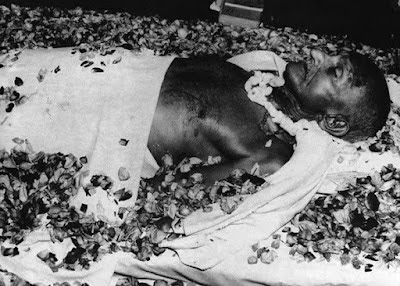
Body of Indian leader Mahatma Gandhi lies in state at Birla House in New Delhi.

“In politics you cannot follow nonviolence. You cannot follow honesty. Every moment you have to give a lie. Every moment you have to take a bullet in hand and kill someone.” -  Gopal Godse,  co-conspirator in Gandhi's assassination.

Mohandas K. Gandhi and his assassin Nathuram Godse

“Darkness cannot drive out darkness: only light can do that. Hate cannot drive out hate: only love can do that. The beauty of nonviolence is that in its own way and in its own time it seeks to break the chain reaction of evil”  - Martin Luther King Jr.,  Where do we go from here: Chaos or Community, 1967  

Seventy five years ago on January 30, 1948, Mohandas Gandhi was shot three times in the chest and killed by Hindu nationalist Nathuram Godse at 5:17pm. Godse was part of a team of assassins that had tried 10 days earlier to bomb and kill Gandhi.

Reverend King Jr.'s home after the bombing.

Sixty seven years ago on January 30, 1956, Martin Luther King Jr.'s home was bombed, damaging his home, but thankfully not harming his "wife, Coretta Scott King, who was inside with the couple’s seven-month-old daughter Yolanda." The bomb threats would continue, but his commitment to nonviolence did not waiver. He was a disciple of Mohandas Gandhi.

Both men faced numerous death threats, imprisonment, and assassination attempts, but maintained their commitment to nonviolence.

Despite his successful struggle for independence and the establishment of the world's largest democracy, Gandhi was gunned down as he went to worship, after repeated assassination attempts. They murdered Gandhi because they did not believe India could survive with Gandhi promoting Satyagraha and a Muslim state next door. Gopal Godse, a co-conspirator and brother of the assassin Nathuram Godse, quoted in Time magazine in February 2000: “In politics you cannot follow nonviolence. You cannot follow honesty. Every moment you have to give a lie. Every moment you have to take a bullet in hand and kill someone.” Gopal Godse, the last living conspirator in the Gandhi assassination died in 2005.

Killers’:(1st row, from L) Nathuram, Apte, Karkare; (2nd row) Badge, Madanlal, Gopal; (3rd row) Shankar, Savarkar 

Communists view nationalists as a threat to their revolutionary project, and nationalists often have a critical view of Marxism-Leninism, but they both agreed in their hostility to Mohandas Gandhi. The nationalists were open and transparent about their evil intent, but the communists had more guile, and their reasons for rejecting him more complex. 

The Soviet press published an article written by S.M. Vakar in 1948 following Gandhi's assassination on January 30, 1948 titled "The Class Nature of the Gandhi Doctrine" subtitled "Gandhi as a Reactionary Utopian" in the Soviet philosophy journal Voprosy filosofii (Questions of Philosophy). The Marxist Leninist argument was outlined as follows:
Although Gandhi regarded the union and independence of the Indian peoples as his goal, his reactionary-Utopian social theory and the reformist methods of struggle connected with it caused his activity to fail in facilitating overthrow of the colonial yoke [...] The social essence of the Gandhi doctrine and its fundamentally reactionary role in the history of India's national liberation movement has hardly been treated in Marxist literature. Yet this doctrine still retards the development of class awareness among the Indian masses.
 What was this social essence of Gandhian thought that so troubled the Marxist Leninists in the Soviet Union? First, the reformist methods of struggle referred to in the above quote was nonviolent resistance, and secondly his social theory rejected class struggle as another manifestation of destructive violence. On September 11, 1906 a new word came into existence that would give a better understanding of Gandhi's social theory and method of struggle which he described as:
'Satyagraha.' Truth (Satya) implies love, and firmness (agraha) engenders and therefore serves as a synonym for force. I thus began to call the Indian movement 'Satyagraha,' that is to say, the Force which is born of Truth and Love or non-violence, and gave up the use of the phrase 'passive resistance,' in connection with it, so much so that even in English writing we often avoided it and used instead the word 'Satyagraha' itself or some other equivalent English phrase.

 The Marxist-Leninists embrace revolutionary violence and a movement led by a small vanguard of intellectuals and professional revolutionaries that carry out the changes "necessary" by whatever means necessary and reject nonviolence as naive. They follow the doctrine of  Vladimir Lenin as presented in his 1902 revolutionary tract, "What is to be done."


Over a century has passed since both sets of ideas were articulated and implemented around the world. Maria J. Stephen and Erica Chenoweth conducted a systematic examination of the strategic effectiveness of both violent and nonviolent campaigns using data from 323 campaigns conducted between 1900 and 2006. [1] Their findings show that major nonviolent campaigns were successful 53% of the time, compared to 26% for major violent campaigns and 7% for terrorist campaigns.

Today, India with all its flaws is the world's largest democracy with a growing economy that presents new competitive challenges to the developed world and Communism has amassed a body count of 100 million dead and counting. It would appear that Gandhi's criticisms of the communists were prescient:

"The socialists and communists say, they can do nothing to bring about economic equality today. They will just carry on propaganda in its favor and to that end they believe in generating and accentuating hatred. They say, when they get control over the State, they will enforce equality. Under my plan the State will be there to carry out the will of the people, not to dictate to them or force them to do its will." - Mohandas Gandhi

"It is my firm conviction that if the State suppressed capitalism by violence, it will be caught in the coils of violence itself, and will fail to develop non-violence at any time. The State represents violence in a concentrated and organized form. The individual has a soul, but as the State is a soulless machine, it can never be weaned from violence to which it owes its very existence." - Mohandas Gandhi

It is Satyagraha that is relevant today in 2023 and offers an alternative to the conflagrations suffered in the 20th century and the wars that plague the world now. Gandhi's Satyagraha is a call to principled non-violence, but even pragmatists and realists looking over the historical record cannot fail to be influenced by the fact that non-violent civic resistance works and offers a better chance of a better life for more people.

Reverend King's family hold a wake for the martyred civil rights leader

This is not an approach for the timid. Martin Luther King Jr., a Gandhi disciple, followed this path, accomplishing much for African Americans in the United States, but he did not live to see his 40th birthday; he was assassinated by a white racist on April 4, 1968 at the age of 39. 

The following is a 2018 documentary by Deutsche Welle about Mohandas Gandhi's assassination.
It is also offered in Spanish

Sunday, January 30, 2022

74 years ago today Mohandas Gandhi was assassinated

"We are ruthless and ask no quarter from you. When our turn comes we shall not disguise our terrorism." - Karl Marx, Marx-Engels Gesamt-Ausgabe, vol. vi pp 503-5 (The final issue of Neue Rheinische Zeitung, 18 May 1849)

Mohandas K. Gandhi and his assassin Gopal Godse,

 
“In politics you cannot follow nonviolence. You cannot follow honesty. Every moment you have to give a lie. Every moment you have to take a bullet in hand and kill someone.” -  Gopal Godse,  co-conspirator in Gandhi's assassination, Time Magazine, February 2000.

"Terrorism and deception are weapons not of the strong but of the weak." - Mohandas K. Gandhi

Seventy four years ago Mohandas Gandhi was shot three times in the chest and killed by Hindu nationalist Gopal Godse at 5:17pm. Godse was part of a team of assassins that had tried 10 days earlier to bomb and kill Gandhi.

Body of Indian leader Mahatma Gandhi lies in state at Birla House in New Delhi.

Gandhi despite his successful struggle for independence and the establishment of the largest democracy on the planet was felled, after repeated assassination attempts they gunned him down as he went to worship. They murdered the independence leader because they did not believe that India could survive with Gandhi promoting Satyagraha and a Muslim state next door. Gopal Godse, a co-conspirator and brother of the assassin Nathuram Godse, argued as late as February 2000 in a Time magazine interview that: “In politics you cannot follow nonviolence. You cannot follow honesty. Every moment you have to give a lie. Every moment you have to take a bullet in hand and kill someone.”
 
Communists view nationalists as a threat to their revolutionary project, and nationalists often have a critical view of Marxism-Leninism, but they both agreed in their hostility to Mohandas Gandhi.
The nationalists were open and transparent about their evil intent, but the communists had more guile, and their reasons for rejecting him more complex. 
 
The Soviet press published an article written by S.M. Vakar in 1948 following Gandhi's assassination on January 30, 1948 titled "The Class Nature of the Gandhi Doctrine" subtitled "Gandhi as a Reactionary Utopian" in the Soviet philosophy journal Voprosy filosofii (Questions of Philosophy). The Marxist Leninist argument was outlined as follows:
Although Gandhi regarded the union and independence of the Indian peoples as his goal, his reactionary-Utopian social theory and the reformist methods of struggle connected with it caused his activity to fail in facilitating overthrow of the colonial yoke [...] The social essence of the Gandhi doctrine and its fundamentally reactionary role in the history of India's national liberation movement has hardly been treated in Marxist literature. Yet this doctrine still retards the development of class awareness among the Indian masses.
What was this social essence of Gandhian thought that so troubled the Marxist Leninists in the Soviet Union? First, the reformist methods of struggle referred to in the above quote was nonviolent resistance and secondly his social theory rejected class struggle as another manifestation of destructive violence. On September 11, 1906 a new word came into existence that would give a better understanding of Gandhi's social theory and method of struggle which he described as:
'Satyagraha.' Truth (Satya) implies love, and firmness (agraha) engenders and therefore serves as a synonym for force. I thus began to call the Indian movement 'Satyagraha,' that is to say, the Force which is born of Truth and Love or non-violence, and gave up the use of the phrase 'passive resistance,' in connection with it, so much so that even in English writing we often avoided it and used instead the word 'Satyagraha' itself or some other equivalent English phrase.
The Marxist-Leninists embrace revolutionary violence and a movement led by a small vanguard of intellectuals and professional revolutionaries that carry out the changes "necessary" by whatever means necessary and reject nonviolence as naive. They follow the doctrine of  Vladimir Lenin as presented in his 1902 revolutionary tract "What is to be done."


Over a century has passed since both sets of ideas have been set out and applied around the world. An analysis done by Maria J. Stephen and Erica Chenoweth systematically explores the strategic effectiveness of both violent and nonviolent campaigns using data on 323 campaigns carried out between 1900 and 2006.[1] Their findings demonstrate that major non-violent campaigns were successful 53% of the time versus only 26% for major violent campaigns and terrorist campaigns had a dismal 7% success rate.

Today, India with all its flaws is the world's largest democracy with a growing economy that presents new competitive challenges to the developed world and Communism has amassed a body count of 100 million dead and counting. It would appear that Gandhi's criticisms of the communists were prescient:
"The socialists and communists say, they can do nothing to bring about economic equality today. They will just carry on propaganda in its favor and to that end they believe in generating and accentuating hatred. They say, when they get control over the State, they will enforce equality. Under my plan the State will be there to carry out the will of the people, not to dictate to them or force them to do its will." - Mohandas Gandhi

"It is my firm conviction that if the State suppressed capitalism by violence, it will be caught in the coils of violence itself, and will fail to develop non-violence at any time. The State represents violence in a concentrated and organized form. The individual has a soul, but as the State is a soulless machine, it can never be weaned from violence to which it owes its very existence." - Mohandas Gandhi
It is Satyagraha that is relevant today in 2022 and offers an alternative to the conflagrations suffered in the 20th century and the wars that plague the world now. Gandhi's Satyagraha is a call to principled non-violence but even pragmatists and realists looking over the historical record cannot fail to be influenced by the fact that non-violent civic resistance works and offers a better chance of a better life for more people.

Below is a 2018 documentary by Deutsche Welle about the assassination of Mohandas Gandhi. It is also available in Spanish.