"The first victory we can claim is that our hearts are free of hatred. Hence we say to those who persecute us and who try to dominate us: ‘You are my brother. I do not hate you, but you are not going to dominate me by fear. I do not wish to impose my truth, nor do I wish you to impose yours on me. We are going to seek the truth together’. THIS IS THE LIBERATION WHICH WE ARE PROCLAIMING."
Oswaldo José Payá Sardiñas (2002)
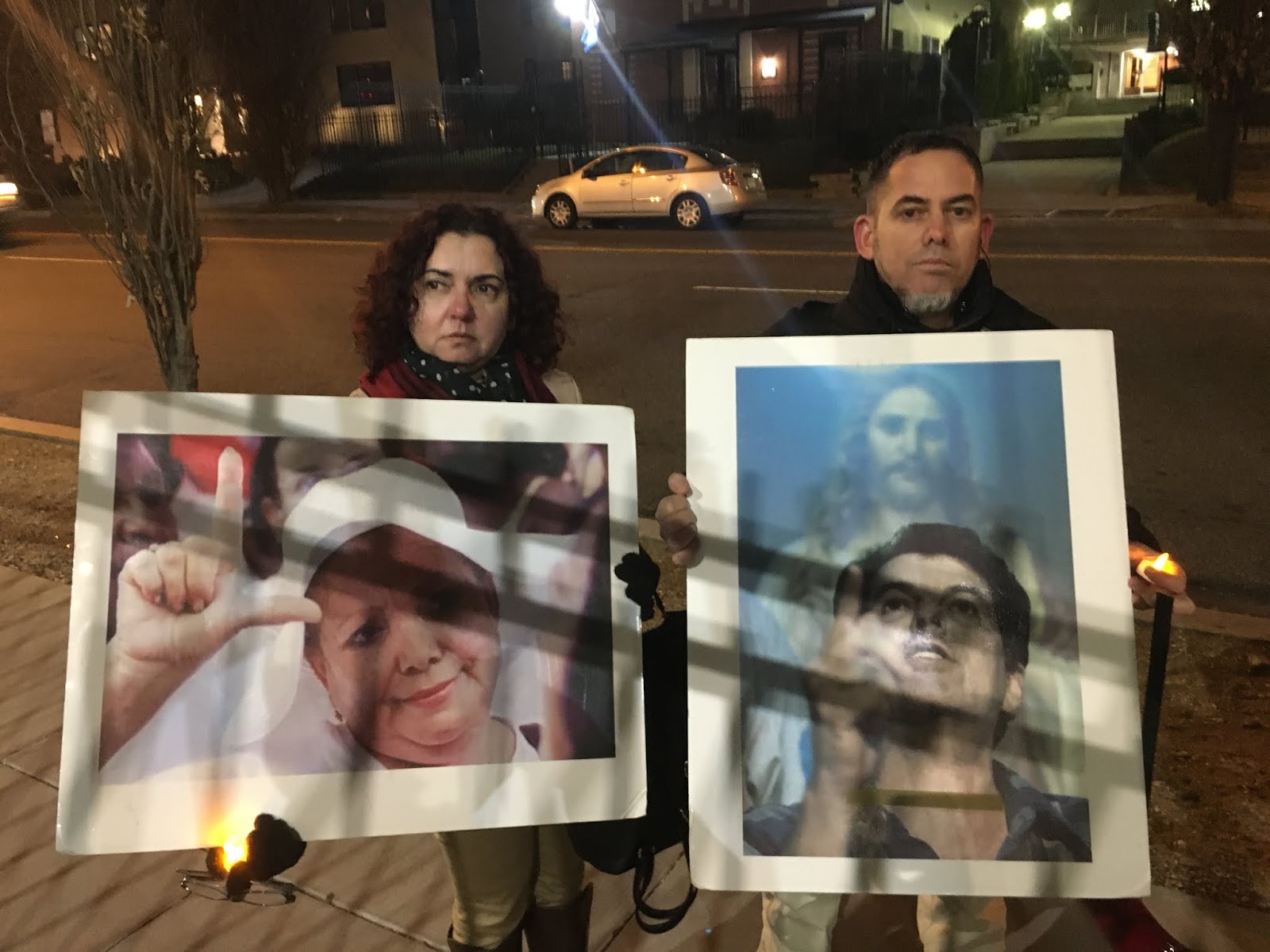
Last night on February 20, 2020 human rights activists gathered outside of the Cuban Embassy in Washington DC in a silent vigil for justice to remember Orlando Zapata Tamayo killed by the Castro regime on February 23, 2010 while on hunger strike, and the four members of Brothers to the Rescue shot down by the Castro regime MiGs on February 24, 1996, while Armando Alejandre Jr. (45 years old), Carlos Alberto Costa (29), Mario Manuel de la Peña (24), and Pablo Morales (29) were in two planes engaged in a search and rescue flight for rafters.
Others carried photos of Laura Pollán and Oswaldo Payá martyred by the Castro regime in 2011 and 2012 respectively.
The Center for a Free Cuba obtained a permit from the Washington DC Metro Police to hold the vigil, and the Free Cuba Foundation publicized the event.
The silent vigil began at 7:00pm and concluded with a prayer by Mario Felix Lleonart Barroso for Orlando Zapata Tamayo, Armando Alejandre Jr., Carlos Alberto Costa, Mario Manuel de la Peña, Pablo Morales, and other martyrs of the regime, and for the freedom of the Cuban people.
On Sunday, February 23 at 3:00pm, the time Orlando Zapata Tamayo died, there will be a vigil at the Bay of Pigs Monument (Torch) on Cuban Memorial Boulevard located at 806 SW 13th Ave, Miami, FL 33135. Details on the vigil were announced on WWFE 830 AM. by Mercedes Perdigón of Exilio Unido in an interview with Carlos Santana.
On Monday, February 24, at 3:00pm friends and families of Armando Alejandre Jr., Carlos Alberto Costa, Mario Manuel de la Peña, and Pablo Morales, and members of the FIU community will gather and hold a vigil to remember them and silently demand justice 24 years after the shoot down.
The vigil will take place at Florida International University ( University Park campus) located at 11200 SW 8th St, Miami, FL 33199 at the main fountain next to the Main Library and Student Union. The silent vigil take place start at 3:21pm and end at 3:27pm, the times the two Brothers to the Rescue planes were destroyed by missiles launched from Castro's MiGs killing Armando, Carlos, Mario, and Pablo. This vigil has been taking place at FIU annually since 1996.
Human rights heroes to spotlight Algeria, China, Cuba, Hong Kong, Iran, Malawi, Mauritania, Pakistan, and Venezuela. This is the 12th time that human rights defenders are gathering at this important shadow human rights summit. It was broadcast live on February 18, 2020 over the live stream video below.
Cuba was highlighted during the summit with a presentation by Laritza Diversent of Cubalex. She described how her legal aide service was shut down by the secret police, and how the dictatorship made threats against her person for being a human rights defender. Below is a quote taken twitter earlier today.
"In Cuba, the public prosecutor interrogated us as if we were terrorists. We feared having a trial without due process. We feared ending up in prison and not being able to do our work." #GS2020
Liberal International also reported over Twitter on her presentation and the fact that free legal advice is not one of the 240 services permitted by the Cuban government.
Cuban #HumanRights lawyer & activist, Laritza Diversent, addresses hundreds attending the @GenevaSummit where she explains that in #Cuba, "being a lawyer that offers free legal advice is NOT among the 240 services that citizens are 'allowed' to offer."#GS2020#LIHRCpic.twitter.com/KaB7hZxQKK
Venezuela was featured with political leaders of the interim government, intellectuals, and Rosa Orozco, the mother of Geraldine Moreno, a Venezuelan martyr. The 23 year old university student and athlete, who was shotrepeatedly in the face byBolivarian National Guardmembers onFebruary 19, 2014during a protestin Venezuela. Geraldine died three days later on February 22, 2014. Six years later, her mom continues to demand justice.
“I lost my daughter and endured the absence of justice. This is my double tragedy." #GS2020#Venezuela
- Rosa Orozco, mother of Geraldine Moreno, killed by the Bolivarian National Guard in Venezuela pic.twitter.com/5kX4YVO6vh
"There may be times when we are powerless to prevent injustice, but there must never be a time when we fail to protest." - Elie Wiesel, Nobel Lecture 1986
Ideas have consequences, often rooted in actions that continue to have ripple effects across time. The Brothers to the Rescue nonviolent constructive program that began in 1991, saving thousands of lives in the Florida Straits, is still having positive impacts today.
Resisting injustice often comes at a cost, and Cubans and Cuban-Americans have suffered for their defense of human rights. This cost is raised when international solidarity declines and the dictatorship believes that it can operate with impunity.
Mario de la Peña, Carlos Acosta, Armando Alejandre and Pablo Morales were blown out of the sky by two missiles launched by a Cuban MiG at 3:21pm and 3:27pm on February 24, 1996 on the orders of Raul Castro that destroyed two Brothers to the Rescue planes engaged in search and rescue of Cuban rafters in international airspace in the Florida Straits.
Despite the danger, Brothers to the Rescue would continue its search and rescue missions for another seven years, ending in 2003. Jose Basulto in 2010, who was in the lone plane that returned on the day of the shoot down, remained committed, “today we are sharing a message that people can solve their own problems. You also can be Brothers to the Rescue and create your own help organizations.” Basulto estimates that Brothers to the Rescue "saved some 4,200 rafters fleeing Cuba during the 1990s," and he added, "the experience of saving someone in the Straits of Florida was something that stays with you – we were hunting to save lives.”
This civic movement was engaged in what Mohandas Gandhi described as a constructive program. The Metta Center, an organization that provides educational resources on the safe and effective use of nonviolence, says that "it describes nonviolent action taken within a community to build structures, systems, processes or resources that are positive alternatives to oppression. It can be seen as self-improvement of both community and individual."
Brothers to the Rescue created a community structure where pilot volunteers representing 19 different nationalities flew over the Florida Straits searching for Cuban rafters for over a decade.
Fourteen years separate these five martyrs joined together in their nonviolent resistance to injustice in Cuba, and the positive defense of human rights combined with moments that U.S. outreach to the dictatorship, along with a distancing from Cuban democrats, led to their murders by the Castro dictatorship.
Dr.
Oscar Elias Biscet sought to promote human rights organizing "Friends of
Human Rights" teach-ins. State security blocked them holding one at the home of
Raúl Arencibia Fajardo on December 6, 2002. Oscar Biscet, Orlando Zapata, Virgilio Marante
and 12 others held a sit-in in the street in protest and chanted "long
live human rights" and "freedom for political prisoners." They were allarrested.
Orlando Zapata Tamayo was released on March 8, 2003, but Biscet, Marante Güelmes, and Arencibia Fajardo remained jailed. On the March 20, 2003 while taking part in a fast at the
Jesús Yánez Pelletier Foundation, in Havana, to demand the release of his three colleagues. Orlando was taken to the
Villa Marista State Security Headquarters and remained jailed for the rest of his life.
The Castro regime announced on February 23, 2010 that Orlando Zapata
Tamayo had died in their custody. Imprisoned since 2003 he had suffered
physical and psychological torture over seven years, and while on his
final hunger strike was denied water by prison officials contributing to
his death. The Global Nonviolent Action Database described what happened in greater detail:
"To further discourage Tamayo, the prison director, Major Filiberto
Hernández Luis, denied him water for 18 days, taking away his only
sustenance. The forced dehydration induced a kidney failure, and Tamayo
was taken to Amalia Simoni Hospital in Camaguay where he was fed
intravenously against his will. Tamayo’s condition worsened when he
developed pneumonia in the hospital bed and was transferred to a
hospital at Combinado del Este prison, which did not have the capacity
to treat him."
It happened while the Obama Administration
sought to improve relations with the Castro regime, refused to meet with
Cuban dissidents in 2009, and did not make the release of Alan Gross,
an American taken hostage in Cuba in December 2009, a priority. This
signaled to the Castro regime that Orlando Zapata Tamayo could die in 2010,
and it would not effect US-Cuba relations, and sadly they were right.
Laura Pollán marches with Orlando Zapata's mom Reina Luisa Tamayo in Cuba
Worse yet this failure of solidarity with Cuba's democratic opposition over the next two years would claim the lives of national opposition leaders Laura Inés Pollán Toledo, of the Ladies in White (2011) and Oswaldo José Payá Sardiñas and Harold Cepero Escalante, of the Christian Liberation Movement (2012). Both had mourned and protested the death of Orlando Zapata Tamayo in 2010.
Oswaldo Payá remembered Orlando Zapata Tamayo in February 2010
On February 3, 2015, Rosa María Payá testifying before the Senate Foreign Relations Committee indicted the indifference of the US government and the international community: "The Cuban government wouldn’t have dared to carry out its death threats against my father if the U.S. government and the democratic world had been showing solidarity. If you turn your face, impunity rages."
However the power of nonviolence is so great that even without the support of Western democracies Cubans "can solve their own problems" and create their own help organizations that save thousand of lives and through an act of nonviolent resistance force the dictatorship to respond to Zapata's demands.
Cuban human rights defender Orlando Zapata Tamayo's hunger strike in 2009-2010 placed a national and international focus on human rights in Cuba that within two years led to the release of 75 other Cuban prisoners of conscience arrested along with him in March of 2003.
However the Castro regime is not a static entity and it responds with violence, and misinformation to cover up its misdeeds, crush dissent, and it is relentless. This is why it is important for human rights defenders and advocates of a free Cuba to be persistent, protest on important anniversaries, remember the martyrs, and let others continue to know what happened.
Vigil will be held again at Florida International University at 3pm on February 24th
The families of Mario de la Peña, Carlos Acosta, Armando Alejandre and Pablo Morales sued the Castro regime in the courts, denounced the freeing of Gerardo Hernandez in 2014 who was serving a life sentence for his role in the murder conspiracy that cost these four men their lives, and continue to observe at Florida International University on February 24th a silent vigil between 3:21pm and 3:27pm, the times both planes were shot down and hold Mass in their memory.
In 2010, the dictatorship tried to rewrite Orlando Zapata Tamayo's past denying that he was a dissident. This necessitated erasing their own propaganda attacks again him in prior years.
Holocaust survivor Elie Wiesel explained in his 1986 Nobel Lecture why it is important to remember: "To forget the victims means to kill them a second time. So I couldn't prevent the first death. I surely must be capable of saving them from a second death." This is why on Thursday, February 20, 2020 at 7:00pm there will be a vigil in memory of Orlando Zapata Tamayo on the 10th anniversary of his untimely death and the four Brothers to the Rescue members, Mario de la Peña, Carlos Acosta, Armando Alejandre and Pablo Morales, killed 24 years ago.
Truth and memory for those killed in defiance of the attempt by the dictatorship to whitewash and forget.
The United States since 2000 has not provided credits to the Castro regime and maintained a cash in advance trade arrangement for the purchase of agricultural and pharmaceutical products. This protects U.S. taxpayers from having to subsidize the Cuban dictatorship when it defaults on its financial obligations. Their European, Latin American and Asian counterparts cannot say the same to their respective taxpayers.
Under this cash in advance agreement American companies sold over $6.3 billion to the Castro regime and have gotten paid. Despite billions in debt forgiveness on its restructured debt less than five years ago by the Paris Club, the Cuban dictatorship in 2019 again defaulted on its payments, reported Reuters on February 11, 2020.
How did the Castro regime raise the money to purchase U.S. goods?
James Prevor, President and Editor in Chief of the publication Produce Business in the October 2002 article, Cuba Caution, reported that Cuba "had exhausted all its credit lines and, at best, was simply rotating the accounts. When the opportunity came to buy from the United States, Cuba simply abandoned all those suppliers who supported the country for 40 years and began buying from us."
The suppliers were not the ones impacted by Cuba's failure to pay its debts, the taxpayers of the suppliers' home countries were the one's left holding the bag. The dirty little secret is that profit is private but risk has been socialized in what amounts to a perversion of capitalism.
On November 1, 2013 the government of Mexico announced that it was ready to waive 70 percent of a debt worth nearly $500 million that Cuba owes it. The former president of Mexico Vicente Fox protested the move stating: “Let the Cubans get to work and generate their own money…They’re normally like chupacabras. The only thing they’re looking for is someone to give them money for free.”
“Let the Cubans get to work and generate their own money…They’re normally like chupacabras." - President Vicente Fox
In December 2015 it was announced that Spain would forgive $1.7 billion that the Castro regime owes it. In December of 2013, Russia and Cuba quietly signed an agreement to write off $29 billion of Cuba's debt to the former superpower. Western governments pursued Cuban maritime debts seizing Cuban vessels and negotiating payment through Canadian courts.
The 2015 debt restructuring accord between Cuba and the Paris Club, according to Reuters, "forgave $8.5 billion of $11.1 billion, representing debt Cuba defaulted on in 1986, plus charges."
The 19-member Paris Club owed money by Cuba is comprised of Australia, Austria, Belgium, Canada, Denmark, Finland, France, Britain, Italy, Japan, the Netherlands, Spain, Sweden and Switzerland. Companies, with the exception of American companies, doing business with Cuba when they are not paid pass the costs off to their respective governments, who in turn pass the costs off to taxpayers.
This is something to consider when the Chamber of Commerce argues that U.S. laws should be changed and the United States should join the long line of governments seeking to collect from the Castro regime, a deadbeat dictatorship.
Lastly, it is important to note that the U.S. Census Bureau documented the collapse of trade in goods with Cuba under the Obama thaw and have actually improved during the Trump Administration, despite tightened sanctions.
"Gentlemen,he who is herewill goouttomorrow to find abetter future." - Bassil Alejandro Dacosta, age 24 , over Facebook on February 11, 2014. He was murdered the next day by the Maduro regime.
Robert Redman and Bassil Alejandro Dacosta murdered six years ago today
Six years ago today nonviolent student protesters Bassil Da Costa and Robert Redman were gunned down on
February 12, 2014 in Venezuela, while engaged in
nonviolent street protests against the government of Nicolas Maduro.
Robert Redman was shot and killed hours after he had carried Bassil, who
had also been shot and died earlier that same day, and tweeted about it.
"TodayI was hit witha rockintheback, ahelmet in mynose. I swallowed tear-gas, carried thekid who died, and what did you do?" - Robert Redman, age 28 over twitter on February 12, 2014
On February 12, 2014 Venezuela's National Youth Day millions of young students took to the streets to nonviolently protest "the social and
economic crisis caused by the illegitimate government that Venezuela has
today."
Robert Redman with other youths carrying Bassil Dacosta on February 12, 2014.
Young
Venezuelans inside and outside of the country mobilized in a coherent
and sustained effort to expose the
anti-democratic nature of the Maduro regime. A full and brief
explanation was offered by Andreina Nash at the time in the video
titled: What's going on in
Venezuela in a nutshell.
The violence had escalated in the days prior to February 12th. OnFebruary 11, 2014 in an update via twitter from Roderick Navarro and Guido Mercado they reported: wounded by bullets today: Jorge Monsalve 20 years old,
Franco Perez 15 years old
(Thorax), Pedro Alison 24 years old (Left arm), Anny Paredes 36 years old (Abdomen).
Bassil da Costa, Geraldine Moreno, Génesis Carmona, Ender Peña, Kluivert Roa, Paola Ramírez, Daniela Salomón, Lisbeth Ramírez y muchos otros son los nombres de los caídos, a quienes se les rinde honor cada 12 de febrerohttps://t.co/MacPlsuRo3
Six years later and across Venezuela the youth still remember the
fallen and the Maduro regime's repressive forces who murdered them. They
have not forgotten and it marked a before and after in the history of
the South American country. Ana Karina Garcia over twitter stated in
Spanish that, " February 12, 2014 marked us as a generation. Bassil Da
Costa, Juancho Montoya and Robert Redman were murdered by the tyranny
while they were in the streets demanding a country of opportunities.
#AHeroIsNotForgotten"

 Last night on February 20, 2020 human rights activists gathered outside of the Cuban Embassy in Washington DC in a silent vigil for justice to remember Orlando Zapata Tamayo killed by the Castro regime on February 23, 2010 while on hunger strike, and the four members of Brothers to the Rescue shot down by the Castro regime MiGs on February 24, 1996, while Armando Alejandre Jr. (45 years old), Carlos Alberto Costa (29), Mario Manuel de la Peña (24), and Pablo Morales (29) were in two planes engaged in a search and rescue flight for rafters.
 Others carried photos of Laura Pollán and Oswaldo Payá martyred by the Castro regime in 2011 and 2012 respectively.






 Posts
Posts

