"The first victory we can claim is that our hearts are free of hatred. Hence we say to those who persecute us and who try to dominate us: ‘You are my brother. I do not hate you, but you are not going to dominate me by fear. I do not wish to impose my truth, nor do I wish you to impose yours on me. We are going to seek the truth together’. THIS IS THE LIBERATION WHICH WE ARE PROCLAIMING."
Oswaldo José Payá Sardiñas (2002)
Three Cuban women are on hunger strike in front of the United Nations in New York City. There names are Anisley Pérez, Niurka Prestamos and Yamisderky Pelier, They are on a hunger strike until a United Nations official meets with them and recognizes that there is a humanitarian emergency underway in Cuba. They traveled from Miami to New York City and initiated the hunger strike on Saturday, August 28, 2021.
They are not alone. Seven human rights organizations on July 13, 2021 issued a call for international solidarity with Cubans and denounced violent repression on the Island.
Among the organizations are the Christian Democrat Organization of
America, UN Watch, Christian Solidarity Worldwide, Victims of Communism,
the International Society for Human Rights, and the Forum for Religious
Freedom - Europe and among the five points agreed to, the fifth was a request for a humanitarian corridor.
"We ask for the opening of a humanitarian channel, independent of the
Cuban state, which allows the arrival of food and medicines directly to
the people, understanding that on numerous previous occasions the Cuban
government has blocked and confiscated the aid collected and sent in the
past.”
If you are in the New York City area, or can get up there for a few days, these women need help to maintain their hunger strike. They are exposed to the elements, and need water. Now is the time for solidarity.
Prior to the march I reflected on its significance, and the importance and power of nonviolence. The power idea that opened the reflection was taken from the late Czech dissident Václav Havel:
"If there is to be any chance at all of success, there is only one
way to strive for decency, reason, responsibility, sincerity, civility
and tolerance, and this is decently, reasonably, responsibly, sincerely,
civilly, and tolerantly."
Below is an earlier and shorter version of theProActivo Miami video. Please let us know which is your favorite.
"The struggle of man against power is the struggle of memory against forgetting." - Milan Kundera
Eighty two years ago on August 23, 1939 the world was shocked to learn that
Communist Russia and Nazi Germany had signed a non-aggression pact, the Molotov-Ribbentrop
pact. It was named after their respective foreign ministers, Vyacheslav
Molotov and Joachim von Ribbentrop. Observers would have been even more
horrified had they known of the secret protocols that divided Eastern Europe between the two totalitarian regimes. What they called a "peace treaty" in reality was a war treaty.
Rolling Soviet tanks and Nazi motorcyclists in Poland (September 1939).
Nine days later on September 1, 1939 at 4:45 am Nazi Germany invaded Poland and World War II started. Sixteen days later the Soviet Union exercising its secret agreement with the Nazis invaded Poland from the East
and met their German allies in the middle of Poland.
Nazi and Soviet soldiers greet one another in Poland (1939)
On September
22, 1939 the German Nazi army joined with the Soviet Communist army in a military parade in Brest-Litovsk and the two sides celebrated together. Soviet Foreign MinisterVyacheslav Molotov in a October 31, 1939 speech spoke candidly about the Nazi-Communist alliance, and ridiculed its victims.
"The ruling circles of Poland boasted quite a lot about the ‘stability’
of their state and the ‘might’ of their army. However, one swift blow to
Poland, first by the German Army and then by the Red Army, and nothing
was left of this ugly offspring of the Versailles Treaty which had
existed by oppressing non-Polish nationalities."
Approximately 230,000 Polish soldiers and officers and thousands of military
service representatives were taken captive by the Russians. The Soviet precursor to the KGB was the NKVD. "From October 1939, the delegated NKVD officials from Moscow heard the
prisoners, encouraged them to cooperate and collected data. Only a few
of the prisoners agreed to collaborate. The commanding officers’ reports
included opinions about hostile attitudes of the Poles and a minimal
chance of them being useful to the USSR authorities."
The decision to shoot the prisoners was signed on March 5, 1940 by seven members of the All- Union
Communist Party (Bolsheviks) authorities: Joseph Stalin, Lavrentiy
Beria (proposer), Kliment Voroshilov, Vyacheslav Molotov, Anastas
Mikoyan, Mikhail Kalinin and Lazar Kaganovich.
Thousands of Polish Army officers and intellectual leaders were taken into the Katyn Forest near Smolensk in the Soviet Union, shot in the back of the head or in the neck and buried in mass graves.
Soviet Foreign Minister Vyacheslav Molotov meets with Adolf Hitler (1940)
Soviet Foreign Minister Vyacheslav Molotov in a speech delivered on August 1, 1940 while the Soviet Union was then still allied with Nazi Germany continued to describe their military alliance as a "non-aggression pact."
"A radical change for the better in the relations between the Soviet
Union and Germany found its expression in the non-aggression pact signed
last August. These new, good relations between the USSR and Germany
have been tested in practice in connection with events in former Poland,
and their strength has been sufficiently proved."
Communist morality has no problem with any of it because as the communist revolutionary Vladimir Lenin observed in a speech to Russian communist youth on October 2, 1920:
"The class struggle
is continuing and it is our task to subordinate all interests to
that struggle. Our communist morality is also subordinated to
that task. We say: morality is what serves to destroy the old
exploiting society and to unite all the working people around
the proletariat, which is building up a new, communist society."
Both ideologies sought to destroy the old existing order and replace it with a new one. The Nazis with a society based in ideas of racial purity and the Communists with the destruction of all existing class structure. On the surface these ideas are in conflict, but in practical terms both sought to destroy the existing social and political order.
The same people who would join Hitler's brown shirts were also susceptible recruits to join Antifa. Communists viewed
the SA as a "proletarian-revolutionary paramilitary wing"of the Nazi
movement and susceptible to being recruited to the communist cause. The case of Richard Scheringer,
a supporter of Adolf Hitler and army officer who converted to communism
in the early 1930s is a high profile example of this.
Richard Scheringer: From Nazi to Communist
Harvey
Klehr, the Andrew W. Mellon Professor of Politics and History, Emeritus,
at Emory University, described how communists had mistakenly viewed the
Nazis as a means to achieving power
and undermining capitalist democracies. Antifa identified all political
parties that were not communist as fascist. This meant that social
democrats, centrist political parties, and conservative parties were
together with the Nazis all labeled fascist.
This was the
Comintern's class against class approach and fractured any potential
broad anti-Nazi coalition.
"Adolf
Hitler’s rise to power in 1932 had been immeasurably aided by the German
communists' steadfast support for the Comintern tactic of “class
against class,” which demanded no cooperation with other anti-Nazi
forces. German communists blithely insisted that Hitler’s triumph would
be evanescent—summarized in their optimistic slogan, Nach Hitler, kommen
wir ('After Hitler, us').
The Molotov-Ribbentrop pact is this strategy but on a grander scale. Let
the Western democracies and the Nazis exhaust each other in the
conflict and then seize everything. Victor Davis Hanson, a Senior Fellow
at the Hoover Institution. reported that "Stalin shipped huge supplies of food and fuel for the German war effort against the West."
Soviet and Nazi soldiers fraternize after conquering Poland in 1939
The
Communist International (Comintern) issued new orders to their members once the non-aggression
pact was made public. Professor Klehr described the new directive.
Good
communists were ordered to oppose anyone intending to stand in Hitler’s
way. With Ribbentrop’s second visit to Moscow at the end of September
and the signing of a German-Soviet Treaty of Friendship, the Comintern
emphasized that the primary adversary was those countries that were at
war with Germany, and those socialists and social democrats fighting
against fascism. Germany had concluded a pact with the USSR, while
“reactionary” England, at the helm of a vast colonial empire, was the
“bulwark of capitalism.” Thus, communist parties in England and France
were ordered to call for the defeat of their countries—ordered, in other
words, to officially embrace treason.
According to Klehr, Nazi reports confirmed that Communists were fulfilling their part of the agreement siding against Western Democracies.
A June 1940 Gestapo report approvingly noted that the Soviet government
was favorably disposed to the Third Reich and had endorsed its
invasions of the Scandinavian states and Belgium and Holland “as
necessary and proper.” The report went on to note that the Comintern had
avoided open attacks on Germany, and that the parties and publications
allied with the Comintern were not pushing for communists to struggle
against National Socialism or denounce fascism.
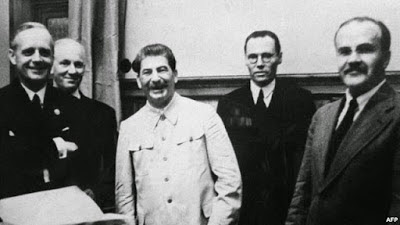
Nazi Foreign Minister Ribbentrop, Joseph Stalin, and Soviet foreign minister, Molotov
"Stalin was shocked; he had received a plethora of warnings of an imminent invasion – notably from Winston Churchill, informed by Britishintelligence
briefings. The communist dictator had refused to believe them,"
reported Agence France Press. Stalin preferred to rely on Hitler's assurances.
Today, communist apologists will continue to defend Stalin and attempt to cover up this history of collaboration between the Soviet Union and Nazi Germany. It may also explain the real reason behind attacks on the legacy of Winston Churchill. His observation on the relationship between the Communists and the Nazis in his bookThe Second World War, Volume 1, The Gathering Storm (1948) is damning and accurate.
"Fascism was the shadow or ugly child of communism… As Fascism sprang
from Communism, so Nazism developed from Fascism. Thus were set on foot
those kindred movements which were destined soon to plunge the world
into more hideous strife, which none can say has ended with their
destruction."
The Molotov-Ribbentrop Pact and the reckless strategy pursued by Stalin and the Communist International cost 22 to 28 million Russian lives alone in World War Two, and nearly led to the Nazi conquest and occupation of the Soviet Union.
It also led to Poland spending another half century under Soviet domination and Lithuania, Latvia and Estonia territories absorbed by the Soviet Union. A conquest that arose out of the Hitler-Stalin pact that endured following the end of WW2.
It was a nonviolent movement thirty two years ago that liberated the Baltic nations. The Baltic Way brought an end to this part of the Nazi-Soviet
non-aggression pact.
The Baltic Way brought an end to one key element of Molotov Ribbentrop
On June 4, 1989 the Solidarity labor movement won in free elections and the Polish people finally regained their sovereignty
after nearly 50 years under Soviet domination. They did it
nonviolently.
So did the people of the Baltic states when two million
Latvians, Lithuanians and Estonians joined hands together in a giant
human chain stretching 370 miles on August 23, 1989. Fifty years to the
day after the treaty that brought them so much grief had been signed.
This history must not be forgotten. The Spanish scholar George Santayana understood that "those who cannot remember the past are condemned to repeat it."
Across the world in Europe and the Americas Black Ribbon Day continues to be remembered with acts of remembrance. Today at 3:00pm at the Legislative Assembly in Alberta Canada there will be a Black Ribbon Day commemoration. The Honourable Nathan Cooper, Speaker of the Legislative Assembly of Alberta, will host the event and made the following video.
Over social media the Lithuanian Foreign Ministry offers an overview of the Hitler-Stalin Pact.
On August 23, 1939, two totalitarian states – Nazi Germany and the Soviet Union – concluded a notorious Non-Aggression pact, which paved the way for #WWII and its consequences - millions murdered, tortured, exiled, occupied states, and many years of the Cold War tensions. pic.twitter.com/95rFRmUhBV
The Inimitable #BalticWay - a chain of 2 mil. people, 600km long, connecting Lithuania, Latvia and Estonia 32 years ago. The purpose of this peaceful political demonstration was to show that the aspirations for freedom and democracy in the #Baltic countries were never quenched. pic.twitter.com/liwzSIgyJ4
In the post I expressed "this is a freedom movement led by young Cubans and Cuban Americans with a presence on social media on Instagram, Facebook, and Twitter." This was confirmed at the end of the march when the organizing team came out onto the stage.
Cuban Freedom March organizers take a bow at the end of the march
Today's march gave me hope in the Havelian sense, and I trust that I was not alone.It was a hot, humid, and sunny day. The march began at Our Lady of Charity, known by Cubans as the Ermita de la Caridad located on 3609 S. Miami Avenue Miami, FL 33133 to Domino Park located at 801 SW 15th Ave. Miami, FL 33135 in a 2.9 mile walk along 17th Avenue.
Chants of "No to Communism", "Down with the dictatorship", "Freedom for Cuba", "If Cuba is in the street, so are we!" and many more heard through the streets of Miami this morning and afternoon concluding with a rally at Domino Park.
A new generation of activists has responded to the events of July 11th and their call to action is a persistent one that has taken to the streets in Washington DC, Los Angeles, and Miami. However, they go beyond physical spaces to cyberspace and engaging in the realm of ideas.
Earlier I described how this gives me "hope in the Havelian sense" for the future of Cuba. Below share the definition provided by the Czech dissident leader, later president of the Czech Republic Václav Havel in his 1990 book Disturbing the Peace.
“Hope, in
this deep and powerful sense, is not the same as joy that things are
going well, or willingness to invest in enterprises that are obviously
headed for early success, but rather an ability to work for something
because it is good, not just because it stands a chance to succeed. The
more unpromising the situation in which we demonstrate hope, the deeper
that hope is. Hope is not the same thing as optimism. It is not the
conviction that something will turn out well, but the certainty that
something makes sense, regardless of how it turns out."
Listen to the voices of the new generation pay tribute to those who came before them.
A full recording of the event is available on Youtube by Dariel Hernandez. Below are some pictures from the march today.
The event closed with a call for spiritual unity by Grecia Ordoñez and Mack Lorén singing a mashup of Guantanamera and Patria y Vida that was emotionally impacting.
"If there is to be any chance at all of success, there is only one way to strive for decency, reason, responsibility, sincerity, civility and tolerance, and this is decently, reasonably, responsibly, sincerely, civilly, and tolerantly" - Václav Havel
The Cuban Freedom March arrives in Miami, Florida today on August 22, 2021 with a march from la Ermita de la Caridad to Domino Park. The protest starts at 10:00am. Organizers have carried out successful marches in Washington DC, and Los Angeles.
Logistics for today's non-violent protest march in Miami
On August 11, 2021 the leader of this movement, Alian Collazo, moderated a conversation on "what's really happening in Cuba" that is necessary viewing to listen to different perspectives, from young Cuban and Cuban American voices both inside and outside of Cuba.
This is a freedom movement led by young Cubans and Cuban Americans with a presence on social media on Instagram, Facebook, and Twitter.
This is a means to demonstrate continued support for human rights and freedom in Cuba through the nonviolent exercise of an important and fundamental right: peaceful assembly.
YA VIENE LLEGANDO! Nos vemos mañana Miami!
We cannot let the fire burn out. 62+ years of oppression ends NOW! We will not stop until a free Cuba!
The values expressed by this youth movement thus far are in agreement with the values expressed by the San Isidro Movement, the Patriotic Union of Cuba, the Ladies in White and the Liberation Christian Movement in Cuba.
The pro-democracy movement in Cuba is a nonviolent movement, and within the spectrum of nonviolent actions there are at least 198 identified by the nonviolence theoretician Gene Sharp.
Strategic nonviolence takes a pragmatic approach that is based on being more effective then violence, especially when confronting brutal dictatorships, like the Castro regime.
Non-violent resistance is an armed struggle but its weapons are not deployed to do violence or kill. These arms are psychological, social, economic and political weapons. Gene Sharpargues with much evidence
"that this is ultimately more powerful against oppression, injustice
and tyranny then violence. Historical studies are cited that demonstrate
the higher success rates
of nonviolent movements when compared against violent ones:
University Academics Maria J. Stephan and Erica Chenoweth in their 2008 study "Why Civil Resistance Works: The Strategic Logic on Nonviolent Conflict"
compared the outcomes of 323 nonviolent and violent resistance
campaigns from 1900 to 2006. They found that major nonviolent campaigns
have achieved success 53 percent of the time, compared with just under
half that at 26 percent for violent resistance campaigns. Finally there
study also suggests “that nonviolent campaigns are more likely than
violent campaigns to succeed in the face of brutal repression.”
Therefore, if you want to help Cubans on the island than you owe it to them and to yourself to listen to them, review what they have done in the past, are doing today, the repression suffered, and learn as much as you can about the philosophy and strategy of nonviolence they have embraced for decades.
Beginning in the 1970s a nonviolent human rights movement emerged in the prisons and would win some battles
against the dictatorship using grassroots civic resistance tactics and
endure to the present day inspiring millions of Cubans on the island and
around the world.
Transnational assistance to Cuban nonviolent
activists have been measures of concrete solidarity with the Cuban
people that draws howls from the dictatorship and their allies, but
gratitude from most Cubans.






 Posts
Posts

