
International Day Against Torture
Today we learned the good news that Ariel Ruiz Urquiola stopped his hunger and thirst strike five days after he had started it. He had been trying to draw the attention of the Office of the High Commissioner for Human Rights to speak to him.
He sat there just a short distance from the Wilson Palace, all day and all night in the street, waiting. What would drive a sane man to such extreme and desperate action? Ariel has a PhD in biology. He is an environmentalist, but because of his independent spirit he was banned from teaching and became a farmer. His sister, Omara Ruiz Urquiola, was also targeted, and in her case life saving treatment was compromised to punish her.
In May 2018, Ariel was arbitrarily detained, sentenced and jailed from early May to early July 2018. He was subjected to cruel and unusual punishment during his imprisonment. For example, according to him and the Frankfurt based International Society for Human rights, that has examined Ariel's claims, there is convincing
evidence that he was infected with HIV by Cuban officials during
his time in prison.
Today, June 26th is the International Day in Support of Victims of Torture and sadly there are many in Cuba who are torture victims.
The United Nations Convention against Torture and Other Cruel, Inhuman or Degrading Treatment or Punishment (1984), defines "torture" as "any act by which severe pain or suffering, whether physical or mental, is intentionally inflicted on a person for such purposes as obtaining from him or a third person information or a confession, punishing him for an act he or a third person has committed or is suspected of having committed, or intimidating or coercing him or a third person, or for any reason based on discrimination of any kind, when such pain or suffering is inflicted by or at the instigation of or with the consent or acquiescence of a public official or other person acting in an official capacity. It does not include pain or suffering arising only from, inherent in or incidental to lawful sanctions."
What allegedly has been done to Ariel Ruiz Urquiola and his sister rises to the level of torture, but they are not alone. There is a history in Cuba of prisoners and dissidents being denied health care as punishment or being purposefully misdiagnosed.
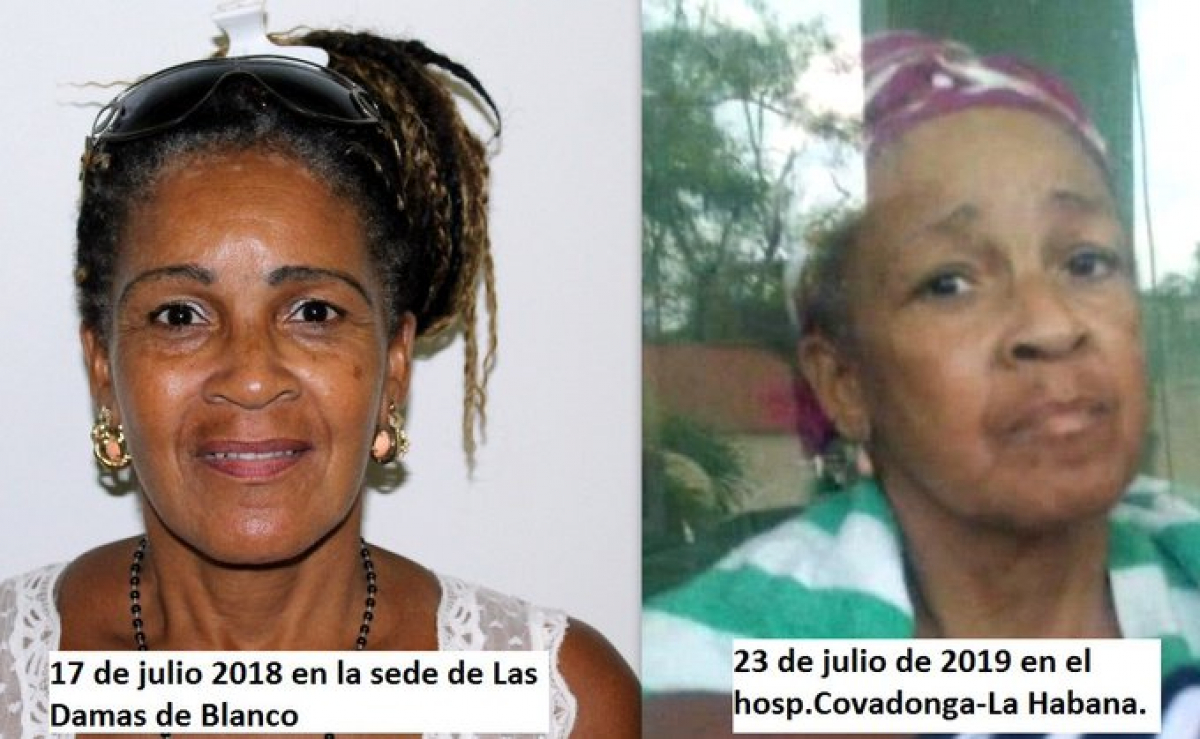
Xiomara de las Mercedes Cruz was arrested on April 16, 2016 for speaking out during a human rights demonstration in Havana's Central park. She was placed on parole in January of 2018. She was re-arrested in mid-September 2018 under the charge of being "threatening." On September 19, 2018 she was tried and sentenced to one year and four months in prison. She was sent to a prison 400 kilometers from her home. This was an added hardship for her family to visit her, and keep an eye on her well being.
Xiomara was sent to a punishment cell for at least 10 days for speaking to her daughter over the phone.
Over the course of one year in custody of the Castro regime her health radically declined. Rashes that appeared on her body in June 2019 that Cuban medical doctors in Ciego de Ávila claimed to be unable to diagnose. She was able to finally obtain medical care in the United States in January 2020 when she was near death, and has remained months in intensive care.
Dr. Alfredo Melgar, a specialist in Internal Medicine and lead doctor treating Xiomara Cruz Miranda, in a May 2020 interview, believes that she was exposed while in the Cuban prison to "various chemicals." Cuban doctors in the island, at varying times, told her she was either suffering from Tuberculosis or lung cancer as her condition continued to worsen. Dr. Melgar affirms that these substances had possibly caused irreversible lung damage.
Sirley Ávila León was a delegate to the Municipal Assembly of People’s Power
in Cuba from June 2005, for the rural area of Limones until 2012 when
the regime gerrymandered her district out of existence. Cuban officials removed her from her position because she had fought to reopen a
school in her district, but been ignored by official channels and had
reached out to international media. Her son, Yoerlis Peña Ávila, who had
an 18 year distinguished career in the Cuban military was forced out
when he refused to declare his mother insane and have her committed to a
psychiatric facility.
Sirley joined the ranks of the democratic opposition and repression against her increased dramatically. On May 24, 2015 she was the victim of a brutal machete attack carried out by Osmany Carriòn, with the complicit assistance of his wife, that led to the loss of her left hand, right upper arm nearly severed, and knees slashed into leaving her crippled.
This attack, she believes, was done on the orders of the secret police. Following it she did not receive adequate medical care and was told quietly by medical doctors in Cuba that if she wanted to get better that she would need to leave the country.
On March 8, 2016 she arrived in Miami and began a course
of treatments over the next six months during which she was able to
walk once again although still limited due to her injuries. She returned
to Cuba on September 7, 2016 only to find her home occupied by
strangers and her attacker free and bragging that he would finish the
job. She moved in with her mother and within a short time a camera and
microphone were set up across from her mother's home on a post.
Threats
against Sirley's life intensified leading her to flee Cuba to the
United States and request political asylum on October 28, 2016.
Cuban dissident and former prisoner of conscience Omar Pernet Hernández passed away in Louisville, Kentucky on October 7, 2017. Beginning in 1965 at age 18 he was imprisoned for the first time in Cuba for political reasons.
Years later in an interview
he would sum up his life in Cuba: "I was tortured in Castros' jails in
four processes since 1965, when I was going to turn 19 years old."
During his last imprisonment he described how doctors engaged in malpractice against him following a car accident while he was being transferred from one prison to another that left him crippled.
These practices began in the first years of the Castro regime. The case of Amado Rodriguez who was born in Santiago de Cuba, Cuba in 1943 illustrates this. At
13, he joined the 26th of July Movement against the Batista regime and
was later sent into exile to save his life. At the height of the
revolution, he returned and became an activist against the Castro
regime.
He was arrested and spent a total of 23 years as a political prisoner during two different terms. He was 18 years old when he was first arrested in 1961 and sentenced to 30 years, of which he served 18. Four years later, Amado was arrested and sentenced to 15 years. He was released in 1989 and sent directly to the United States after serving five years, four of which he spent in solitary confinement.
Amado Rodriguez was considered a prisoner of conscience by Amnesty International and other human rights organizations. His release was the result of personal visits and petitions to the Cuban government from representatives of Amnesty International, Human Rights Watch, the Red Cross International, the UN High Commissioner for Human Rights and a US Senator.
Amado described how by June of 1985 he was the only "plantado" prisoner at Boniato prison in jail cell #2 a small sealed punishment cell. He was only in underwear isolated without knowing whether it was day or night. Nine months later he was moved to a sealed cell within the Boniato prison were prison officials placed him on a new minimal caloric consumption diet but by October of 1986 since he refused to break he was subjected to the use of handcuffs and placed in stress positions.
Physical and psychological torture and the denial of medical care or even water as punishment has proven fatal in the past.
Cuban prisoner of conscience Orlando Zapata Tamayo died on
February 23, 2010 after years of torture, and a prolonged water only
hunger strike.Prison authorities, in an effort to break him, denied him water over the course of more than two weeks on and off.
On the day Orlando Zapata died, Cuban opposition leader Oswaldo Payá Sardiñas in a heartfelt message explained the circumstances surrounding the Cuban human rights defender's untimely death:
Orlando managed to smuggle a letter out following a brutal beating it was published in April of 2004:
In 1992 Sebastian Arcos Bergnes
was charged with "enemy propaganda" and "inciting rebellion," he was
sentenced to four years and eight months in prison. Amnesty
International recognized him as a prisoner of conscience. Sebastian was
transferred to Ariza
Prison in Cienfuegos Province,
more than 130 miles from Havana, where he was imprisoned alongside
dangerous criminals and systematically denied medical attention. In 1993 the regime offered Sebastian a deal: He would be released
immediately if he only agreed to leave the island for good. Sebastian
rejected the deal, choosing
prison in Cuba over freedom in exile.
After a prolonged international campaign Sebastian Arcos was released in 1995. A few weeks after his release, Arcos was diagnosed with a malignant tumor in the rectum, for which he had previously been denied medical care in prison. After a Cuban doctor was fired from his post for diagnosing Arcos, he traveled to Miami for further care. In 1996, Sebastián Arcos Bergnes testified before the UN Human Rights Commission in Geneva, Switzerland:
The International Center for Transitional Justice explains on its website that "truth can help victims to find closure by revealing the details of the events they suffered, such as the fate of forcibly disappeared loved ones or why certain people were targeted for abuse. Moreover, knowing the truth about past events enables proper mourning practices, essential to most cultures, helping to achieve personal and communal healing."
Most Cuban victims of torture remain unknown, but there are high profile cases that are the tip of the iceberg. Above is a partial sampling of some of those cases. Others are mentioned in the 1987 documentary Nobody Listened (Nadie Escuchaba) that covered the first three decades of the current regime.
Below, in Spanish are a series of interviews of torture victims in Cuba in 2020. The Castro regime has remained constant in the use of sophisticated methods of torture to maintain power through fear.
 |
| Ariel Ruiz Urquiola suspended hunger and thirst strike today in Geneva |
He sat there just a short distance from the Wilson Palace, all day and all night in the street, waiting. What would drive a sane man to such extreme and desperate action? Ariel has a PhD in biology. He is an environmentalist, but because of his independent spirit he was banned from teaching and became a farmer. His sister, Omara Ruiz Urquiola, was also targeted, and in her case life saving treatment was compromised to punish her.
 |
| Omara Ruiz Urquiola with her brother Ariel |
"All the officers of the U.N. Human Rights Office pass by & look at me, including High Commissioner Michelle Bachelet, but none asks how I am."— Hillel Neuer (@HillelNeuer) June 25, 2020
—Cuban environmentalist & former political prisoner Ariel Ruiz Urquiola, on 4th day of hunger strike for human rights victims in Cuba pic.twitter.com/R2y2U9D0cJ
Today, June 26th is the International Day in Support of Victims of Torture and sadly there are many in Cuba who are torture victims.
The United Nations Convention against Torture and Other Cruel, Inhuman or Degrading Treatment or Punishment (1984), defines "torture" as "any act by which severe pain or suffering, whether physical or mental, is intentionally inflicted on a person for such purposes as obtaining from him or a third person information or a confession, punishing him for an act he or a third person has committed or is suspected of having committed, or intimidating or coercing him or a third person, or for any reason based on discrimination of any kind, when such pain or suffering is inflicted by or at the instigation of or with the consent or acquiescence of a public official or other person acting in an official capacity. It does not include pain or suffering arising only from, inherent in or incidental to lawful sanctions."
What allegedly has been done to Ariel Ruiz Urquiola and his sister rises to the level of torture, but they are not alone. There is a history in Cuba of prisoners and dissidents being denied health care as punishment or being purposefully misdiagnosed.
 |
| Xiomara de las Mercedes Cruz Miranda less than a year in a Cuban prison. |
Xiomara was sent to a punishment cell for at least 10 days for speaking to her daughter over the phone.
Over the course of one year in custody of the Castro regime her health radically declined. Rashes that appeared on her body in June 2019 that Cuban medical doctors in Ciego de Ávila claimed to be unable to diagnose. She was able to finally obtain medical care in the United States in January 2020 when she was near death, and has remained months in intensive care.
 |
| Xiomara de las Mercedes Cruz in December 2019 |
 |
| Sirley Avila Leon: Before and after the attack. |
Sirley joined the ranks of the democratic opposition and repression against her increased dramatically. On May 24, 2015 she was the victim of a brutal machete attack carried out by Osmany Carriòn, with the complicit assistance of his wife, that led to the loss of her left hand, right upper arm nearly severed, and knees slashed into leaving her crippled.
This attack, she believes, was done on the orders of the secret police. Following it she did not receive adequate medical care and was told quietly by medical doctors in Cuba that if she wanted to get better that she would need to leave the country.
 |
| Sirley Avila Leon in 2016 shortly after arriving in the USA unable to bend her knees |
 |
| Sirley Avila Leon in Washington DC in 2019 |
Cuban dissident and former prisoner of conscience Omar Pernet Hernández passed away in Louisville, Kentucky on October 7, 2017. Beginning in 1965 at age 18 he was imprisoned for the first time in Cuba for political reasons.
 |
| Omar Pernet Hernández August 15, 1945 - October 7, 2017 |
During his last imprisonment he described how doctors engaged in malpractice against him following a car accident while he was being transferred from one prison to another that left him crippled.
Omar Pernet: Look, the meaning of this, is that this type of boot that you see here....I will show it to you again. This boot was fitted for me in Cuba and it began to damage my hips because one, the left, is longer than the right. Then, one hip went like this 0:30 (shows the way hip is going up). Then, here in Spain, they said I couldn't go on wearing those boots, and they asked me to cut them down, and told me to make the ones I'm wearing. These I'm wearing now are stabilizing my hips.
INT: "How is it possible, since the Cuban doctors are so excellent normally, at least that's what the Cubans say, and promote throughout the world. That they should be so wrong? And hurt you so much? How many months did you stay that way in Cuba?"
OP: Well, in 2005, on the 5th of April, I began to wear these boots until the 17-18. I stayed like that until the 3rd of March of 2008 using those boots. These I'm wearing now are different, from Spain. " Stands up, 2:06, shows. "The only thing they did was to slap a cast on. They had me on a cast from the tips of my toes up to my neck for 18 months. The doctors here [in Spain] say they don't find any logic to it. That it was intolerable, the amount of time I spent in those conditions. The cast was removed twice, and each time it was to break my leg again."Omar Pernet Hernández was 72 years old when he passed away, a victim of cancer. He had spent 22 years in Castro's prisons for defying the communist regime and lived in forced exile for the final nine years of his life. He had been jailed in four different instances beginning with being sent to a forced labor camp for refusing military service, then jailed for trying to first leave Cuba, then jailed again for "enemy propaganda" when he denounced prison conditions, and finally sentenced to 25 years in prison for gathering signatures for Project Varela, a petition drive to reform Cuban laws to bring it in line with international human rights standards.
 |
| Cuban torture survivor Amado Rodriguez |
He was arrested and spent a total of 23 years as a political prisoner during two different terms. He was 18 years old when he was first arrested in 1961 and sentenced to 30 years, of which he served 18. Four years later, Amado was arrested and sentenced to 15 years. He was released in 1989 and sent directly to the United States after serving five years, four of which he spent in solitary confinement.
Amado Rodriguez was considered a prisoner of conscience by Amnesty International and other human rights organizations. His release was the result of personal visits and petitions to the Cuban government from representatives of Amnesty International, Human Rights Watch, the Red Cross International, the UN High Commissioner for Human Rights and a US Senator.
Amado described how by June of 1985 he was the only "plantado" prisoner at Boniato prison in jail cell #2 a small sealed punishment cell. He was only in underwear isolated without knowing whether it was day or night. Nine months later he was moved to a sealed cell within the Boniato prison were prison officials placed him on a new minimal caloric consumption diet but by October of 1986 since he refused to break he was subjected to the use of handcuffs and placed in stress positions.
Physical and psychological torture and the denial of medical care or even water as punishment has proven fatal in the past.
 |
| Orlando Zapata Tamayo: Victim of prolonged torture |
On the day Orlando Zapata died, Cuban opposition leader Oswaldo Payá Sardiñas in a heartfelt message explained the circumstances surrounding the Cuban human rights defender's untimely death:
Orlando Zapata Tamayo, died on this afternoon, February 23, 2010, after suffering many indignities, racist slights, beatings and abuse by prison guards and State Security. Zapata was killed slowly over many days and many months in every prison in which he was confined. Zapata was imprisoned for denouncing human rights violations and for daring to speak openly of the Varela Project in Havana's Central Park. He was not a terrorist, or conspirator, or used violence. Initially he was sentenced to three years in prison, but after successive provocations and maneuvers staged by his executioners, he was sentenced to more than thirty years in prison.He was moved around several prisons, including Quivicán Prison, Guanajay Prison, and Combinado del Este Prison in Havana. Where according to Amnesty International on October 20, 2003 Orlando was dragged along the floor of Combinado del Este Prison by prison officials after requesting medical attention, leaving his back full of lacerations.
 |
| Reina Luisa Tamayo with her son's blood stained shirt |
My dear brothers in the internal opposition in Cuba. I have many things to say to you, but I did not want to do it with paper and ink, because I hope to go to you one day when our country is free without the Castro dictatorship. Long live human rights, with my blood I wrote to you so that this be saved as evidence of the savagery we are subjected to...There have been other cases were medical treatment was denied as punishment with fatal results.
 |
| Sebastián Arcos Bergnes in front of his home on May 31, 1995 following his release |
After a prolonged international campaign Sebastian Arcos was released in 1995. A few weeks after his release, Arcos was diagnosed with a malignant tumor in the rectum, for which he had previously been denied medical care in prison. After a Cuban doctor was fired from his post for diagnosing Arcos, he traveled to Miami for further care. In 1996, Sebastián Arcos Bergnes testified before the UN Human Rights Commission in Geneva, Switzerland:
My name is Sebastián Arcos Bergnes, and I am the Vice-president of the Cuban Committee for Human Rights, a non-governmental organization founded in Cuba in 1976 to observe the respect for the Universal Declaration of Human Rights in the island.
On the 15 of January 1992 I was arrested in my home by the Cuban political police; the second time in ten years. On October of that year I was sentenced to 4 years and eight months in prison for the sole crime of reporting to this Commission the violations of human rights committed by the government of my country. The labor of those volunteers of this Commission inside of Cuba are considered by the government as "enemy propaganda."
I will not enter into the details concerning the multiple irregularities of the judicial process always against me, nor about the conditions that I had to tolerate for more than three years. I will refer solely to one aspect of this my last experience in Cuban prisons.
When I was arrested in January of 1992, I enjoyed excellent general health for a man my age, 60 years then. I weighed around 170 pounds, and ran 5 to 6 kilometers every morning. Eight months later, when after a campaign of denunciations of my family I was transferred finally to a military hospital, I'd lost over 30 pounds and suffered from multiple ailments.
My stay in the hospital was not long. In December of 1992 I was transferred to the Prison of Ariza in the Province of Cienfuegos, over 300 km from my home and my relatives. All of the medical treatments indicated by specialists of the military hospital were immediately suspended. During the next 30 months that I spent in Ariza my state of health worsened considerably, and I was systematically denied access to the medications that my family sent me.
During those 30 months only occasionally did I see inexperienced doctors that gave me incomplete medical exams and additionally lacked the medication to prescribe me. I have in my possession a detailed chronology of my repeated denunciations concerning the abandonment of my health by the Cuban authorities.
In February of 1994, in an attempt to refute my denunciations, the Cuban government presented before this Commission a strip of video filmed without my knowledge, in which I appeared to be undergoing a medical exam. That was the second and last time that I was taken to the hospital, that time for a cardiological exam which had been ordered with urgency on three previous occasions.
In mid - 1994 I commenced to suffer pains in my left leg, which later spread to the rest of my extremities. After a rapid examination, a doctor in the prison determined that I suffered from polineutritis -a deficiency illness very common in the Cuban jails, and he prescribed treatment with vitamins. The pain continued with me for nearly a year later when I was liberated as a result of a gesture of the humanitarian organization France Liberte.
A few days after being liberated the pain worsened suddenly. Many weeks later I had to be urgently admitted to the hospital, were a doctor (friend) discovered that I had a malignant tumor in the rectum. Finally I had to leave Cuba to receive medical treatment in Miami, where my children live. The medical team which examined me in Mercy Hospital diagnosed a rectal tumor of 8 cm of diameter, with more than a year and a half of growth, with metastasis in the bones of the pelvis. At only 4 cm from the anal sphincter, the tumor could have been easily detectable with a simple feel of the area which is included in a basic medical exam for any man over 50 years old. Attached here are medical diagnosis which confirm what I've been saying.
These conclusions put the Cuban government in a difficult juncture. Or the Cuban government didn't know of the existence of the tumor, and in that case they recognize that they did not give me adequate medical assistance; or I'm lying and the Cuban government did know about the tumor and hid that knowledge for more than a year.Or the Cuban government recognizes itself guilty of criminal negligence in my case, or it recognizes itself guilty of an attempted premeditated homicide against my person.
Mr. President:
Before I finish, I would like to make clear that mine is not an isolated case, but only an example of the regular practice of Cuban authorities in their treatment of prisoners of conscience. Out of the group of 6 political prisoners liberated by the Cuban government after the requests of France Liberte, only two enjoyed good health. In addition to my own case, Reinaldo Figueredo has cancer in his vocal chords, Luis Enrique Gonzalez Ogra has pancreatic cancer, and Ismael Salvia Ricardo is nearly blind. Terrible nutrition, crowded and unsanitary cells, housing with common violent criminals, violent repression, and reluctant medical assistance - if any- are the norm and not the exception in Cuban prisons.
Because of all this, Mr. President, it is urgent that this Commission demand of the Cuban government that it permit without restriction the International Red Cross to all the Cuban prisons, and that Cuba comply with the international statutes about prisoners and the treatment of prisoners. This is the least we can do in the short run to avoid that cases like mine be repeated, in which medical assistance came-tragically-when it was already far too late.Sebastián Arcos Bergnes died in Miami surrounded by relatives on December 22, 1997.
The International Center for Transitional Justice explains on its website that "truth can help victims to find closure by revealing the details of the events they suffered, such as the fate of forcibly disappeared loved ones or why certain people were targeted for abuse. Moreover, knowing the truth about past events enables proper mourning practices, essential to most cultures, helping to achieve personal and communal healing."
Most Cuban victims of torture remain unknown, but there are high profile cases that are the tip of the iceberg. Above is a partial sampling of some of those cases. Others are mentioned in the 1987 documentary Nobody Listened (Nadie Escuchaba) that covered the first three decades of the current regime.
Below, in Spanish are a series of interviews of torture victims in Cuba in 2020. The Castro regime has remained constant in the use of sophisticated methods of torture to maintain power through fear.





 Posts
Posts

