Showing posts with label internet. Show all posts

Thursday, August 19, 2021

Castro dictatorship passes regulations further criminalizing online content, further restricting internet access

Less than two years ago the Castro regime was already criminalizing online content.

Committee to Protect Journalists, August 19, 2021

Cuba passes regulations criminalizing online content, further restricting internet access

Police officers in Havana on July 12, 2021. Govt passed new restrictions on internet content. (Reuters/Alexandre Meneghini) 

Miami, August 19, 2021 — The Committee to Protect Journalists today condemned the enactment of new telecommunications regulations in Cuba that will further censor information on the island, and called for their immediate repeal.

On August 17, the Cuban government enacted new regulations that criminalize the sharing of “false” and “offensive” information online, and grant authorities expanded powers to restrict online speech, according to the text of the regulations and press reports.

“With this new set of vaguely defined internet regulations, Cuban authorities are clearly seeking to bar the country’s citizens from expressing their discontent and accessing information freely online,” said CPJ Latin America and Caribbean Senior Researcher Ana Cristina Núñez. “No matter how many new laws and decrees Cuban authorities pass, however, Cubans have the right to unfiltered and unbiased news. These regulations should be repealed immediately.”

The director of cybersecurity for the Cuban Ministry of Communications, Pablo Domínguez Vásquez, said in a press conference that the new rules empowered the government to document cybersecurity breaches, and said that “when these people [perpetrators] are identified and they are in the country, penalties will be imposed,” according to press reports.

The regulations include Decree 35 on “Telecommunications, Information and Communication Technologies and the Use of the Radioelectric Spectrum,” Resolutions 105, 107, and 108, pertaining to cybersecurity and network usage, and Decree 42, relating to information and communications technologies.

Article 69 of Decree 35 empowers the state telecom monopoly ETECSA to shut down networks and services that transmit information that is false; offensive or harmful to human dignity; against personal and family privacy; against collective safety, general welfare, public morality, or respect for public order; or which constitutes “a means to commit illicit acts.”

Article 53(b) of Decree 42 obliges internet service providers to suspend, in coordination with authorities, the service or terminate the contract of users who transmit such information.

The regulations do not define “false information” or terms such as “collective safety, general welfare and public morality.” The regulations state that they may be applied regardless of other criminal, civil, or administrative actions against suspects for those actions.

Resolution 105 lists online offenses including the “dissemination of false news” and “defamation with an impact on the country’s prestige,” as well as “harmful diffusion,” which it defines as the dissemination of content that “incites demonstrations or other acts that can affect public order.”

That resolution also covers “cyberterrorism,” which it says includes actions whose purpose is to subvert the constitutional order; suppress or seriously destabilize the operation of political institutions, economic, and social structures of the state; or to compel public institutions to do so.

Resolution 105 does not enumerate any specific penalties for those offenses.

“With these rules, the Cuban regime is legalizing internet blackouts, and the possibility of cutting off access to the internet and mobile phone services in a personalized way,” Norges Rodríguez, director of the Cuban digital rights project YucaByte, told CPJ in a phone interview.

Cuban authorities have previously interrupted internet service for the entire island and for specific users, as CPJ has documented. The new regulations follow anti-government protests in July, during which protestors shared videos of the demonstrations online, and the government interrupted access to the internet and social media platforms, as CPJ documented at the time. Authorities have imprisoned people for sharing those videos, according to media reports.

These new regulations add to the government’s control over social media content under Decree 370 of 2019, which bans disseminating “information contrary to the social interest, morals, good manners and integrity of people” on public networks, and which has been used to persecute journalists, as CPJ has documented.

“These new regulations are now being integrated into the strategy of the Cuban regime regarding the internet: on the one hand it opens access to the web, but on the other it accompanies it with legal and technical mechanisms that allow for the implementation of censorship,” Rodríguez said. “This is a farce.”

CPJ emailed the Cuban Ministry of Communications for comment, but did not immediately receive any reply.

https://cpj.org/2021/08/cuba-passes-regulations-criminalizing-online-content-further-restricting-internet-access/

Friday, July 5, 2019

Castro regime begins to adopt Communist China's model of control and repression on the internet

Objectives remain the same, but the tactics have changed.

Big Brother took over the internet in China and in Cuba.
The dictatorship in Cuba is shifting tactics on controlling the internet, but their 2011 declaration of cyberwar has not been abandoned. In the past it denied access now it seeks to control it. Decree 68 issued on July 4, 2019 "prohibits Cuban citizens from running websites hosted outside of the country." The Cuban-based online publication 14ymedio, that will be effected negatively by this new law they reported on as follows:
This Thursday, the authorities published a set of laws "on the computerization of society in Cuba" that have as their objective, "to elevate technological sovereignty for the benefit of society, economy, security and national defense" and "counteract cybernetic attacks".
This approach mirrors that of China which "seeks to further restrict already the country’s already tightly controlled Internet—further curbing online news reporting and putting Party-appointed editors in charge."

The Castro regime often changes tactics but only in service of an overall strategy to maintain power.  Havana banned the sale of computers in 2002 in Cuba. Here is what the Inter-American Commission on Human Rights reported at the time:
On January 16, 2002, a decree was approved by the Ministry of Domestic Commerce prohibiting the sale of personal computers to individuals.  According to an article published on March 25 in the digital periodical wired.com, Decree 383/2001 prohibits "the sale of computers, printers, duplicating machines, photocopiers, or any other instrument for large-scale printing" to any association, foundation, nonprofit civil organization, or individual.  In cases where the purchase of such equipment or related spare parts or accessories is considered indispensable, authorization must be requested from the Ministry of Domestic Commerce.
This runs counter to the postulates made by some that over time more media necessarily means less controlled media," and that "the Communist regime remains, but Cuba is no longer frozen in time."

The restriction on the purchase of computers was lifted by Raul Castro in 2008 after six years and was hailed as progress.

The Committee to Protect Journalists in 2011 listed the Castro regime as one of the online oppressors that used the denial of access as their chief mean of controlling the internet. Evidence in 2012 for this was to be found with regards to both internet and cell phones. Cuba had the lowest internet and cell phone coverage in the hemisphere.

Now Cubans will have access to internet and cell phone coverage but content will be controlled by the Castro regime, which is copying Chinese model of control and repression on the internet.

The Golden Shield appears to be arriving in Cuba. Will Google be complicit in erecting this system of repression in control as American tech companies did in China 20 years ago? Or will Cuba complete its adoption of the China model and ban Twitter, Google and Facebook?

Time will tell.

Thursday, September 29, 2016

Committee to Protect Journalists issues report on internet access and journalism in Cuba

"The restrictions also mean that despite the rise of independent journalism and blogging in Cuba, there are often more readers outside the country than on the island."- Committee to Protect Journalists

Illustration points to important division in Cuba with regards to internet
The Castro regime appears to be changing tactics in their control and censorship of the internet. The Committee to Protect Journalists have published an important and detailed report by Alexandra Ellerbeck titled: Connecting Cuba: Staying connected in an offline world  that is too long to reproduce here but is available online.

However the Committee to Protect Journalists offers the following recommendations, although brief, shed light on the lack of freedoms on the ground in Cuba:

To the Cuban government
  1. Implement constitutional and legal reforms to ensure full respect for freedom of expression and to allow journalists to work freely without fear of reprisal.
  2. Amend the restrictive legal framework that bans privately owned media ownership and ensure freedom of speech and the press in accordance with the International Covenant on Civil and Political Rights, to which Cuba is a signatory.
  3. Allow the creation of press cooperatives or privately owned media so that journalists are not forced to operate in a legal limbo.
  4. Foster an environment that encourages the state press to operate independently and report critically.
  5. End the practice of summonses, brief detentions, and harassment of independent journalists.
  6. Make internet access more affordable and extend connectivity to the internet without restrictions.
  7. Accept the 2015 request by David Kaye, the U.N. special rapporteur on the promotion and protection of the right to freedom of opinion and expression, for an invitation to visit Cuba as part of his mandate.

To the Organization of American States

  1. Request authorization for the Special Rapporteur for Freedom of Expression to conduct a mission to Cuba to assess the state of press freedom and freedom of expression, and report its findings and recommendations publicly.
  2. Ensure any dialogue with Cuba regarding its participation in the multilateral body includes consideration of its press freedom record, including harassment and intimidation of journalists, summonses, and brief detentions.

Tuesday, August 16, 2016

Google slammed at Cuban National Gathering in Puerto Rico

 Cuban democrats reach consensus and denounce Google's complicity with the Castro regime.

II Cuban National Gathering in Puerto Rico
The second Cuban National Gathering in Puerto Rico gathered Cubans together from inside and outside of Cuba representing over 70 organizations to discuss the future of Cuba and how to better coordinate their efforts towards a democratic Cuba.


On April 8, 2016 this blog reported "Google goes along with Internet censorship in Cuba in order to have a presence there" and over the past weekend in Puerto Rico at this gathering of Cubans from the island and the diaspora a declaration was made public and the following was agreed to on item 4:
 Denounced the indifference of the company Google in violation of its code of corporate conduct and demanded that it establish a correct policy to provide wireless internet service with no censorship and without dependence on the regime in benefit of the Cuban people.
Hopefully this will send a message to Google and other internet companies wanting to collaborate with the dictatorship in Cuba as many did (and do) in communist China that they will also face public scrutiny and criticism.

Friday, April 8, 2016

Google goes along with Internet censorship in Cuba in order to have a presence there

Told you so...
Google + Kcho Mor center in Havana, a Google-sponsored techn zone & hotspot. (Photo 14 y Medio)

 Capitol Hill Cubans yesterday reported the following on the presence of Google in Cuba:
Reports from Cuba have noted that the center has been given priority use by Ministry of the Interior ('MININT') officials and trainees. The MININT is home to Castro's intelligence services. Thus, the Google + Kcho Mor center has become a playground for Cuba's spies and future cyber-warriors. Furthermore, after passing various security checks, when regular Cubans finally get to enter the center, they are treated to censored online access. Webpages like Cubaencuentro, Revolico and 14ymedio remain blocked. Thus, Google has now officially become an extension of Cuba's censors.
This should not come as a surprise and back in 2011 I pointed out the following:
American companies such as Microsoft, Nortel, Cisco and Sun-Microsystems collaborated extensively with the Chinese communists to set up an intranet that blocks free access to internet to hundreds of millions of Chinese. American technology companies identified and located Chinese dissidents for the regime who imprisoned and tortured them. For example, according to Amnesty International, Chinese journalist Shi Tao is serving 10 years in jail after Internet company Yahoo! gave the authorities his personal email account-holder information.

American tech firms, such as Narus, aided the Mubarak regime in Egypt during its brutal crackdown tracking Egyptian activists during the Arab Spring and has also been suspected of helping Libya track dissidents.

The difference between Cuba and these other countries is that due to economic sanctions - some US technology corporations were blocked from doing the same sordid business with the Castro regime. Of course that does not mean that other companies from other countries are not already engaged in those practices. At the time of the 2003 Black Cuban Spring the Italian company, Telecom Italia, provided technology that was used to track activists that used the internet in a "counterrevolutionary manner."

Internet apartheid its not just a Cuban thing but thanks to US sanctions at least US companies do not have carte blanche to do the same thing in Cuba that they are doing in China, Syria, Egypt and in so many other places around the world. Unfortunately, there are other companies in Cuba collaborating and doing it.


In March of 2015 I went further into analyzing the shortcomings of those who see technology as a panacea in resisting totalitarian regimes:
Technology is neutral, and repressive regimes have contracted Western companies to place draconian controls on the internet that are used to target activists. Amnesty International identified "Cisco Systems, Microsoft, Nortel Networks, Websense and Sun Microsystems" as having "provided technology which has been used to censor and control the use of the Internet in China." These repressive applications of new technologies have been transferred to other dictatorships.

Many experts, like the ones apparently operating in the State Department, argue of the importance of conditions such as: a large middle class, internet penetration or some minimum annual level of income.

However, Srdja Popovic, a cofounder and key figure in the Serbian resistance movement “Otpor!” that toppled Slobodan Milosevic nonviolently in 2000 disagrees with the above line of argument and makes the case that the most important thing that you can do is to build up the skills of activists because they are the ones who make the change. Conditions are important to take into consideration when activists are formulating their strategy but they do not define success.
Now thanks to President Obama's new Cuba policy it appears that American companies such as Google are collaborating with the dictatorship in setting up sophisticated censorship capabilities and giving Cuba's secret police priority access to control what Cubans will see when surfing the internet.  This opens the door to American high tech companies propping up and modernizing totalitarianism in Cuba as they did in China.


If the above analysis is incorrect then please provide your counter-argument in the comments section below.

Monday, November 30, 2015

The New York Times editorial board gives the Castro regime advice on how to lobby Congress

 Technology is neutral, and repressive regimes with the help of Western companies have used it to hang on to power.


The New York Times editorial board today is at it again providing advice to the dictatorship in Cuba on how to prolong its existence this time by achieving its long term political goal of lifting the embargo through partnering with a technology firm to overwhelm congressional opposition:
"Partnering with Google, which has enormous lobbying clout in Washington, could advance Havana’s goal of building enough political support in Congress to repeal the embargo and would make it harder for a future president to dial back the restoration of diplomatic ties that Mr. Obama set in motion last year."
 As has occurred before The New York Times omits and distorts key facts such as the circumstances surrounding Cuba plugging into the global cable network in 2013 enabling high-speed connections that have not reached the average Cuban. First it was President Obama who on April 13, 2009 directed the Secretaries of State, Treasury, and Commerce to take the needed steps to:
  • Authorize U.S. telecommunications network providers to enter into agreements to establish fiber-optic cable and satellite telecommunications facilities linking the United States and Cuba.
  • License U.S. telecommunications service providers to enter into roaming service agreements with Cuba’s telecommunications service providers.
  • License U.S. satellite radio and satellite television service providers to engage in transactions necessary to provide services to customers in Cuba.
  • License persons subject to U.S. jurisdiction to activate and pay U.S. and third-country service providers for telecommunications, satellite radio and satellite television services provided to individuals in Cuba.
  • Authorize the donation of certain consumer telecommunication devices without a license.
Despite this unilateral liberalization by the Obama administration, tt was the Castro regime that showed no interest in a fiber-optic cable linking the United States and Cuba from Key West in 2009 not the Cuban embargo. Instead the Cuban dictatorship went with a fiber-optic cable linking Cuba and Venezuela that required a much longer distance of cable to link the two countries. This was completed in 2013, but high speed internet access has not reached the average Cuban in 2015.

The regime may now have to abandon the its chief strategy of denying Cubans access to internet in order to pursue opportunities to enrich the dictatorship. However the Cuban government still has at least nine other tactics used by other repressive regimes to limit the internet's liberating potential: web blocking, precision censorship, infrastructure control, cyber attacks on exile run sites, malware attacks, internet kill switches, detaining bloggers, violence against online journalists, and criminalizing uncensored access to internet.

 Unfortunately, US technology firms such as Google, Microsoft, Yahoo, Sun Micro Systems and others have shown in markets such as mainland China a willingness to cooperate with totalitarian regimes and use technology to modernize their repressive system. It is up to human rights defenders and democrats to hold them accountable and expose them when they do wrong while at the same time encouraging them to pursue approaches that live up to the liberating potential of the internet.

Sadly, the visit of a Google executive to Cuba in 2014 did not inspire much confidence. Executive chairman of Google Eric Schmidt already had past associations with Sun Microsystems, the company that played an important role in erecting the Great Firewall in China that the Google executive now condemns and also Google's own past assistance of Chinese censorship both of which were condemned by Amnesty International.

Even more disturbing was the Google executive's reflections on his Cuba visit that made clear the Cubans had been effective at selling their Potemkin Village fiction as fact with such passages:
The two most successful parts of the Revolution, as they call it, is the universal health care free for all citizens with very good doctors, and the clear majority of women in the executive and managerial ranks in the country.  Almost all the leaders we met with were female, and one joked with us that the Revolution promised equality, the macho men didn’t like it but “they got used to it”, with a broad smile.
First the health care system in Cuba during the years of massive Soviet subsidies may have been something else, but the present one is a disaster. Even the public health infrastructure is a mess as the ongoing cholera outbreak is but one high profile example.

For a more complete overview that places the island's current reality into a historical context Schmidt would be well served to read Health, Politics, and Revolution in Cuba Since 1898 by Katherine Hirschfeld, an anthropologist who spent a lot of time in Cuba that describes how her idealistic preconceptions were dashed by 'discrepancies between rhetoric and reality,' she observed a repressive, bureaucratized and secretive system, long on 'militarization' and short on patients' rights.

However, that was not as shocking as Schmidt's second claim that another "successful" part of the Revolution is that: "Women are in the executive and managerial ranks." Mr Schmidt should take a closer look at the history of violence visited upon women who dissent and speak their minds in Cuba.

On May 24, 2015 Sirley Ávila León was the victim of a machete attack
The New York Times has not reported on the plight of reformer turned opposition figure Sirley Ávila León, an ex-delegate of the People’s Assembly (Poder Popular) of Majibacoa who joined the democratic opposition after efforts to keep a school open in her community. Official channels ignored Sirley's requests and when she went to the international media she was removed from office. Following escalating acts of repression by state security the mother of two, Sirley Ávila León, age 56, was gravely wounded in a machete attack on May 24, 2015 at 3:00pm by Osmany Carrión who had been "sent by state security thugs" and that the aggression "was politically motivated." She suffered deep cuts to her neck and knees, lost her left hand and remains completely incapacitated.

Remaining silent before these ongoing atrocities while engaging in "happy talk" on how a Stalinist regime can collaborate with U.S. technology firms to overcome economic sanctions which limit its ability to make mischief will not assist a democratic transition in Cuba, but do just the opposite - prolong the life of a totalitarian dictatorship.

This has been seen elsewhere, and apparently The New York Times would like to repeat it in Cuba. Technology is neutral, and repressive regimes have contracted Western companies to place draconian controls on the internet that are used to target activists. Amnesty International identified "Cisco Systems, Microsoft, Nortel Networks, Websense and Sun Microsystems" as having "provided technology used to censor and control the use of the Internet in China." These repressive applications of new technologies have been transferred to other dictatorships and now with the help of the The New York Times editorial board arriving in Cuba.

This should not be surprising considering the history of The New York Times with regards to left wing totalitarian regimes and propaganda role that assisted in empowering Fidel Castro in the 1950s and presently using a former Cuban intelligence agent, who remains an apologist for the Castro regime as a source. However it is important to highlight the facts and confront the omissions, and inaccuracies of what is supposed to be the newspaper of record.

Monday, October 28, 2013

Watch Yoani Sánchez on livestream now at Stanford University addressing censorship in Cuba

"Reporting from Cuba: How Pixels are Bringing Down the Wall of Censorship" with Yoani Sánchez today Monday, October 28, 2013 - 7:30pm - 9:00pm Eastern Standard Time


Co-sponsored by The Center on Democracy, Development, and the Rule of Law, the Association for Liberation Technology, the Center for Latin American Studies and the Stanford Human Rights Center

Yoani Sánchez was born in 1975 in a tenement in Central Havana and, on starting school, she proudly put the Little Pioneer scarf around her neck, vowing to “Be like Che!” Fourteen when the Berlin Wall fell, her adolescence was marked by what Fidel Castro called “a special period in a time of peace,” a time of terrible scarcity and broad disillusionment.

At the University of Havana Yoani’s incendiary thesis, Words Under Pressure: A Study of the Literature of the Dictatorship in Latin America, eliminated the idea of an academic career. Already married—to Reinaldo Escobar, an ousted-journal­ist-turned-elevator-mechanic—and a mother, she cobbled together a living as a Spanish teacher and tour guide. In 2002, Yoani decided to emigrate, but in 2004 she returned to Cuba. “I promised myself that I would live in Cuba as a free person, and accept the consequences,” she said. All of her work since then has been a keeping of that promise.

Yoani launched her blog, Generation Y, in April of 2007; later that year a Reuters article brought her to the attention of the world. In 2008 she won Spain’s Ortega y Gasset Prize for digital journalism and Time magazine named her one of the 100 most influential people in the world. Recognition and awards followed, including an interview with Barack Obama, posted in her blog, and nomination by the Norwegian government for the 2012 Nobel Peace Prize.

Yoani is now the journalist she always wanted to be, one deeply immersed in technology. She started The Blogger Academy in her apartment in Havana and runs frequent courses in Twitter. She has published a manual on WordPress, and she works as a correspondent for Spain’s El Pais newspaper. Yoani plans to launch a newspaper in Havana, and is currently working toward that goal.


When: Monday, October 28; 4:30- 6:00 p.m. (Pacific Standard Time) 7:30pm - 9:00pm EST
Where: Bechtel Conference Center, Encina Hall
Open to the public, RSVP required by Friday, October 25. To RSVP, please visit: http://cddrl.stanford.edu/events/reporting_from_cuba_how_pixels_are_bringing_down_the_wall_of_censorship/
Speaker
Yoani Sanchez - Blogger "Generation Y", Journalist and Publisher in Cuba

Saturday, October 26, 2013

Yoani Sánchez addresses Google Ideas on Disconnected Dissent in Cuba

Both cell phone and internet usage in Cuba are highly restricted with very low numbers of users compared with the rest of the hemisphere. Yoani Sánchez discusses how Cubans try to circumvent this.


Google Ideas - Conflict in a Connected World - Disconnected Dissent

How does a digital activist function in a country where there is no Internet? Yoani Sánchez shared her personal story. Yoani Sánchez, Blogger and Activist

Wednesday, June 26, 2013

Google satellites potentially a challenge to totalitarian rule


"Between the cable and the wall! So is the governmentt of Cuba with Google satellites to give Internet to users who do not have access." ... "Official spokesperson said we'll have Internet at home by end of 2014. I think it will be before that with Google Satellites :-)" - Yoani Sanchez, over twitter on June 26, 2013

First four google satellites launched to provide internet to remote locations
As has been the case for the past 35 years with the founding of the Cuban Committee for Human Rights inside of Castro's prisons, change is taking place in Cuba despite the best laid plans of the Castro dictatorship. The Committee to Protect Journalists in 2011 listed the Cuban totalitarian regime as one of the online oppressors that uses the denial of access as their chief mean of controlling the internet..

The latest evidence for this is to be found with regards to the internet and cell phones. Cuba has the lowest internet and cell phone coverage in the hemisphere. Nevertheless, inventive Cubans have found the way to circumvent government controls and get access, however limited , to both.

The Cuban government and its agents of influence try to blame economic sanctions for their policy of limiting and controlling information but the facts do not back them up.

President Obama on April 13, 2009 directed the Secretaries of State, Treasury, and Commerce to take the needed steps to:
  • Authorize U.S. telecommunications network providers to enter into agreements to establish fiber-optic cable and satellite telecommunications facilities linking the United States and Cuba.
  • License U.S. telecommunications service providers to enter into roaming service agreements with Cuba’s telecommunications service providers.
  • License U.S. satellite radio and satellite television service providers to engage in transactions necessary to provide services to customers in Cuba.
  • License persons subject to U.S. jurisdiction to activate and pay U.S. and third-country service providers for telecommunications, satellite radio and satellite television services provided to individuals in Cuba.
  • Authorize the donation of certain consumer telecommunication devices without a license.
It was the Cuban government that showed no interest in a fiber-optic cable linking the United States and Cuba in 2009 not the Cuban embargo. Instead it went with a fiber-optic cable linking Cuba and Venezuela. Meanwhile internet access has not improved for the average Cuban.

Now officials are announcing that this is going to change, but it is interesting to note that the news arrives at the same time that Google has launched satellites to bring inexpensive internet to people in remote areas, including Cuba.

The regime is no doubt trying to figure out how to jam the Google satellites, or restrict the content that reaches Cubans while at the same time waging a cyberwar against what it perceives as its ideological adversaries. Perhaps one way to do it is to finally allow regular Cubans to enjoy improved internet connectivity via the cable from Venezuela that they have firm control over. Although, the regime may have to abandon the its chief strategy of denying Cubans access to internet they have at least nine other tactics used by other repressive regimes to limit the internet's liberating potential: web blocking, precision censorship, infrastructure control, cyber attacks on exile run sites, malware attacks, internet kill switches, detaining bloggers, violence against online journalists, and criminalizing uncensored access to internet ( ask Alan Gross about that last one.)

Tuesday, May 28, 2013

Cell phone usage in Cuba and in Haiti

 1 out of 10 Cubans has a cell phone in Cuba versus 4 out of 10 Haitians in Haiti
Man rents cell phone chargers in Port-au-Prince  Reuters/Eduardo Munoz
 Some argue that comparing Cuba with the United States or other developed economies such as Chile is unfair. One wonders how they will react to the following comparison between Cuba and Haiti?

In 2012, Cuba a country with a population of 11 million had 1.3 million cellphones; while Haiti a country with a population of 10 million had 4.2 million cellphones. Breaking it down on a per capita basis: 42% of Haitians in Haiti have cell phones whereas in Cuba only 12% of Cubans have cell phones.

The numbers above are taken from CIA world factbook on the Science Daily website. Havana times based out of Cuba places the number of cell phones in Cuba at 1.6 million as of May 2013.

And, before the Pavlovian response kicks in the U.S. embargo has nothing to do with it. Treasury Department regulations with regards to telecommunications in Cuba are self-explanatory:

1. U.S. telecommunications services providers are authorized to engage in all
transactions incident to the provision of telecommunications services between
the United States and Cuba, the provision of satellite radio or satellite
television services to Cuba, and the provision of roaming services involving
telecommunications services providers in Cuba. Please see: 515.542(b).

2. Section 515.542(c) authorizes persons subject to U.S. jurisdiction to
contract with and pay non-Cuban telecommunications services providers for
services provided to particular individuals in Cuba (other than certain
prohibited Cubans). For example, an individual in the United States may pay a
U.S. or third-country telecommunications company to provide cellular telephone
service for a phone owned and used by that individual's friend in Cuba.
Likewise, a U.S. telecommunications services provider may enter into a contract
with a particular individual in Cuba to provide telecommunications services to
that individual.

3. Transactions incident to establishing facilities to provide
telecommunications services linking the United States and Cuba, including
fiber-optic cables and satellite facilities, are authorized pursuant to:
515.542(d)(1). OFAC also may issue specific licenses on a case-by-case basis
authorizing transactions incident to establishing facilities to provide
telecommunications services linking third countries and Cuba in certain
circumstances pursuant to': 515.542(d)(2). 
The Cuban government only allowed the sale of cell phones to every day Cubans in 2009. Whereas the Bush Administration lifted restrictions on cell phones being shipped to Cuba in 2008, when Raul Castro allowed Cubans to own them. The liberalization of U.S. regulations in telecommunications has continued under the Obama Administration.

Saturday, December 3, 2011

The Castro regime's declaration of cyberwar

Translation: "Alternative media and social networks. New scenarios of political communication in the digital environment."


The dictatorship in Cuba has a fiber optic cable linked to Venezuela to increase both speed and internet traffic entering and leaving Cuba. Despite some optimistic predictions this has not translated into any change for most Cubans. A few in the Ministry of the Interior and other elements of the totalitarian apparatus do have high speed connections but the rest remain as they were before. Now the Cuban regime is harnessing this high speed connection to up the tempo in its online information war against dissent. The Cuban government has launched its own version of Facebook calling it the "Social Network" that works within the Cuban intranet.

The Cuban dictatorship's Facebook clone has the same name as the 2010 movie about Facebook.

If you think Facebook violates privacy then you'll be horrified by the Cuban government's so-called "Social Network." No doubt the monitoring of members using the service will have an even more sinister application. Users on the island beware.

There is an offensive underway to try to counter independent voices in Cuba and to pursue propaganda campaigns by the dictatorship. Yoani Sanchez on December 2 in a column titled "Dictated Hashtags" reproduced the final declaration of a meeting organized by the Castro regime which is an essence a declaration of cyberwar against dissent.

Final Declaration of the International Workshop “Alternative media and social networks, new scenarios of political communication in the digital realm.” Havana, November 29-30, 2011.

Delegates from Argentina, Brazil, Canada, Cuba, Ecuador, El Salvador, Spain, USA, France, Guatemala, Italy, Mexico, Nicaragua, Palestine, Venezuela, participants in the International Workshop “Alternative media and social networks, new scenarios of political communication in the digital realm,” Havana, November 29-30, 2011, present the following:

  1. Create a directory of contacts with participants of the event to allow us to connect in real time and face attacks against our countries, alert us to different topics and place our messages. This directory will be sent via email. (Ventanapolitica@yahoo.es)
  2. Articulate a collaborative network, starting with the participants in this international workshop, that allow us to socialize content, information, contacts and experiences to work on Internet platforms and tools, on the basis of a defined political strategy. Its expression on the Web will be the www.ventanapolitica.wordpress.com blog.
  3. Work together synergistically on the overall campaign.
  4. Generate actions to enhance the continuous updating and training in the effective use of new technologies in the context of hypermedia, support the creation of multidisciplinary teams and the use of online tools and services such as videoconferencing, online courses, and others.
  5. Create a multidisciplinary group, including technical experts, that allow us to assess able all the proposals we articulate emanating from the network.
  6. Support the reissue of events like the World Bloggers Meeting or this Workshop on Alternative Media and Social Networking.
  7. Promote the creation of quality content, that allow us to overcome our shortcomings in technological development.
  8. Support the incorporation into the network of younger generations and transform them into active progressive forces in these new platforms.
  9. Work together to design communication projects in social networks and other media that include the variety of themes, media and channels, as well as different audiences.
  10. Intensify work and research, in order to design and create our own alternatives (such as platforms, support, and even information security services) that allow us technological independence from the empires of capitalist production.
  11. Express our solidarity and support with the newspaper La Jornada, a publication that has been maligned by the magazine Letras Libres which has accused this prestigious Mexican publication, without arguments or evidence, of being complicit in terrorism.
  12. The theme of the five Cubans unjustly sentenced in the United States must be an axis of permanent struggle. And it will be efficient if we always keep in our minds that each one of us could be in their place. Every Cuban could be one of the 5. Demand the return of the 5 Cuban heroes to their homeland. Send a daily Twitter message in favor of their release. Create and utilize the following hashtags: #FreetheFive #Liberenlos5ya, #LosCinco, #TheFive.
  13. Convert the interventions of Aylin, Rosa Aurora and Olguita into a group of tweets that are socialized at once.
  14. Explore with our respective responsible government bodies responsible the appropriateness of the mechanisms of integration that exist or are now being born in Latin America and the Caribbean to give priority to the issue of Communication and especially to the alternative media and social networks for the dissemination of the new reality to our geographical area.

Thursday, November 17, 2011

Internet Apartheid: Its not just a Cuban thing

Amnesty International has highlighted five countries where your online comments can land you in jail: Azerbaijan, China, Egypt, Syria, and Vietnam. Out of the five countries only Syria (as of April 29, 2011) has sanctions leveled against it.

The other four countries have "normalized" relations with the United States. In the case of Cuba trying to provide Cubans with wireless internet connections is grounds for imprisonment. The lack of internet connectivity in Cuba has nothing to do with economic sanctions but everything to do with Cuban government policy.

In the case of Azerbaijan, China, Egypt, Syria, and Vietnam there are attempts to censor what is on the internet and to imprison those within their national territories that express critical opinions online. The Cubans also have to deal with an intranet but in addition are restricted access to the internet.

Yoani Sanchez over twitter expressed the everyday reality for Cubans on November 15, 2011:
Know why I can't use Twitter from the world wide web or read your messages online? Because I'm not politically correct or a foreigner.

Did you know a foreign resident in Cuba can contract home internet connection and a Cuban cannot? That is why I tweet through sms!

No foreign blogger would lend to a alternative blogger an Internet connection. But Twitter allows publishing by SMS. Long live the smoke signals!

That is why I will not stop tweeting nor of training my countrymen to publish on the web even without an Internet connection.

Internet and life! We will Twitter!
Internet apartheid exists in Cuba. Foreigners and members of the regime elite have internet access in their homes, but not the average Cuban. Whats the difference between Cuba and these other countries? US sanctions limit the role of American companies in Cuba but not in Azerbaijan, China, Egypt, Syria, and Vietnam.

Some internet companies have sold their souls for profits from repressive regimes.

In Syria where the United Nations reported in November that 3,500 Syrians have been extra-judicially executed by the Assad regime. At the same time American companies have blocked the internet and assisted the Assad regime in the persecution of the Syrian people. US senators want answers about the complicity of US companies.

Its not the first time. American companies such as Microsoft, Nortel, Cisco and Sun-Microsystems collaborated extensively with the Chinese communists to set up an intranet that blocks free access to internet to hundreds of millions of Chinese. In addition, American companies identified and located Chinese dissidents to the regime who were imprisoned and tortured. For example, according to Amnesty International, Chinese journalist Shi Tao is serving 10 years in jail after Internet company Yahoo! gave the authorities his personal email account-holder information.

American companies, such as Narus, aided the Mubarak regime during its brutal crackdown earlier this year tracking Egyptian activists during the Arab Spring and has also been suspected of helping Libya track dissidents.

The difference between Cuba and these other countries is that because of economic sanctions - some US technology corporations were blocked from doing the same sordid business on the communist island. Of course that does not mean that other companies from other countries are not already engaged in those practices. At the time of the 2003 Black Cuban Spring the Italian company, Telecom Italia, provided technology that was used to track activists that used the internet in a "counterrevolutionary manner."

Internet apartheid its not just a Cuban thing but thanks to US sanctions at least US companies do not have carte blanche to do the same thing in Cuba that they are doing in China, Syria, Egypt and in so many other places around the world. Unfortunately, there are other companies in Cuba collaborating and doing it.

Friday, October 28, 2011

Silicon Valley Standard

A Magna Carta for the Internet Age?


One of the objectives of the Silicon Valley Human Rights Conference is the creation of a Silicon Valley Standard (SVS). This is a principled statement incorporating the issues discussed at the 2011 Silicon Valley Human Rights Conference. The document includes 15 principles based on the 15 workshop topics covered at the conference.

The document is designed to complement other existing frameworks and uses the international human rights framework as its foundation. These principles served as a useful basis for discussion during the panels and represent a standard, which we hope the Information and Communications Technology (ICT) sector will use after the conference.

1. Technology and Revolutions: Technology companies play an increasingly important role in enabling and supporting the end user’s capacity to exercise his or her rights to freedom of speech, access to information, and freedom of association. ICT companies should respect those rights in their operations and also encourage governments to protect human rights through appropriate policies, practices, legal protections, and judicial oversight.

2. On Human Rights: In both policy and practice, technology companies should apply human rights frameworks in developing best practices and standard operating procedures. This includes adhering to John Ruggie’s Protect, Respect, and Remedy framework outlined in the UN Guiding Principles on Business and Human Rights.

3. Frontline Lessons from Other Sectors: Technology companies should look to the innovative examples and incorporate important lessons from other sectors, such as the apparel and extractive industries. The experiences of these sectors can and should guide them as they develop their human rights policies. These must be reflected in their operating practices in a transparent and accountable manner.

4. On Internet Regulation: To ensure innovation and the protection of human rights, internet regulation should only take place where it facilitates the ongoing openness, quality, and integrity of the internet and/or where it enables or protects users’ ability to freely, fully, and safely participate in society. To achieve this end, it is critical that ICT corporations engage in multistakeholder dialogue.

5. Human Rights by Design: During the research, development, and design stages, technology companies should anticipate how and by whom their products and services will be used. Developing a human rights policy and engaging in due diligence at the earliest stages helps companies prevent crises, limit risk, and enable evidence-based assessment of company activities and reporting.

6. Encryption of Web Activity: Effective internet security is essential to ensuring freedom of speech, privacy, and the right to communicate. Technology companies must provide a basic level of security (e.g., HTTPS and its improvements) to their users by default and resist bans and curtailments of the use of encryption.

7. Getting Practical: Technology companies should implement human rights-respecting policies and practices in their day-to-day operations. These companies should utilize multi-stakeholder and cross-sector dialogues to review challenges faced within their markets with a view to improve their best practices.

8. Coding for Human Rights: Recognizing the human rights implications in code, engineers, developers, and programmers should ensure that technology is used in the exercise of fundamental freedoms, and not for the facilitation of human rights abuses. Technology companies should facilitate regular dialogue between engineers, executive leadership, and civil society to ensure that all parties are informed of the potential uses and abuses of their technologies.

9. Social Networking: Social networking platforms are both increasingly important to their users’ capacity to communicate and associate online and are most used when customers trust the service’s providers. When companies prioritize the rights of their customers, it is good for the long-term sustainability of their business, their brand, and their bottom line.

10. Intermediary Liability: In an era of computer-mediated communications, freedom of speech, association, and commerce increasingly depend on internet intermediaries (e.g., broadband service providers, web hosting companies). These intermediaries should not be required to determine the legality of, or held liable for, the content they host.

11. Legal Jurisdiction in a Borderless Virtual World: To foster the continued growth of an open and interconnected internet, technology companies should work alongside governments and civil society to ensure that users’ rights are protected to the fullest extent possible. Governmental mandates that infringe upon freedom of expression and other human rights should be interpreted so as to minimize the negative impacts of these rules and regulations.

12. Visual Media and Human Rights: Technology companies should pay special attention to the unique human rights challenges of visual media technologies and content — especially on issues such as privacy, anonymity, consent, and access.

13. Social Media in Times of Crisis: Technology companies should resist efforts to shut down services and block access to their products, especially during times of crisis when open communications are critical. Blanket government surveillance of corporate networks should be resisted. Moreover, the burden of proof for privacy-invasive requests should lie with law enforcement authorities, who should formally, through court processes based on probable cause and rule of law, request a warrant for each individual whose information they would like to access.

14. Privacy: Technology companies should incorporate adequate privacy protections for users by default. Furthermore, technology companies should resist over-board requests from governments to reveal users’ information, disclose no more information about their users than is legally required, and inform their users so that they can choose to legally respond to these requests. Furthermore, technology companies should be transparent about how user data is collected, processed, and protected — including disclosures of unauthorized access to user data.

15. Mobile and Telcos: Telecommunications companies must protect their users’ fundamental human rights, including support for the protection of human rights in their operating licenses, and ensure that the free flow of communication is not curtailed or interfered with, even in times of crisis.

Access is an international NGO that promotes access to the internet as a means to free, full, and safe participation in society and the realization of human rights. To learn more, please visit: https://www.accessnow.org or email: info@accessnow.org.

Wednesday, October 26, 2011

The new human right that defends old human rights: internet access

Reflections from the live stream of the Silicon Valley Human Rights Conference

2011 will hopefully be looked back as the year when both the right to internet access and the threat to internet freedom were both recognized and tech companies collaborating with human rights organizations set out standards to address the problem and uphold a fundamental right. Only time will tell if human rights defenders working with tech companies can ensure that the internet be a space where freedom of expression exists along with a right to privacy. Today, both are under serious assault.

On May 16, 2011 Frank LaRue, the United Nations Special Rapporteur on the Promotion and Protection of the Right to Freedom of Opinion and Expression, presented a report that recognizes:
While blocking and filtering measures deny users access to specific content on the Internet, states have also taken measures to cut off access to the Internet entirely. The Special Rapporteur considers cutting off users from internet access, regardless of the justification provided, including on the grounds of violating intellectual property rights law, to be disproportionate and thus a violation of article 19, paragraph 3, of the International Covenant on Civil and Political Rights.
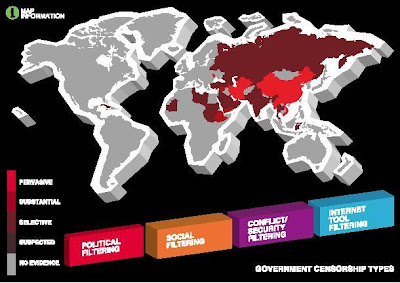
In the map above from AccessNow there is one country in the Western Hemisphere that selectively filters political content that has been identified and that is Cuba. In addition the regime has done everything possible to limit access to the populace.

The first lesson is that technology today is neutral. The same face book page that assists activists in organizing can also assist repressive regimes in both identifying them and where they can put their hands on them. Until now, for the most part, the technologies that human rights defenders have used on the internet were not specifically designed with human rights in the minds of the developers.

Hopefully, that will change. Today there are companies that have and are collaborating both with human rights activists and human rights violators. There are companies that develop software to spy on citizens and censor internet content. Human rights defenders have been identified by some of these companies for repressive regimes leading to their detention, imprisonment, torture and death. Other companies have completely cut off service and sent out threatening messages for the regime in power at a moment of crisis.

For example, in Egypt Vodafone complied with Egyptian government demands to cut off internet access and sent out pro-regime text messages during the uprising there. Anti-virus and filtering software company McAfee (now owned by Intel) worked hand-in-hand with the ben Ali regime in Tunisia to help it block unwanted websites. In China, Yahoo offered information on Chinese dissidents that led to their imprisonment. Cisco provides some of the critical technology behind the Great Firewall of China, the filters that blocks citizens from reaching the uncensored Internet and is in talks to provide the networking equipment that will enable an extensive surveillance system in China that will employ hundreds of thousands of cameras.


Video streaming by Ustream
Panel on Visual media technologies, content and human rights at Silicon Valley Human Rights Conference

Over two days on October 25th-26th, 2011 at the Mission Bay Conference Center, San Francisco the Silicon Valley Human Rights Conference was held with both the sponsorship and participation of Google, Facebook, Yahoo!, Mozilla, Skype and other technology companies. Summaries and some of the videos of the various workshops are available online and are required viewing both for techies and human rights defenders.

Brett Solomon, executive director of Access Now, the New York nonprofit that organized the Conference was cited in the San Francisco Chronicle laying out whats at stake:
"One of the key things we're trying to do is to put a name on this issue, to recognize that companies' technologies and platforms have human rights implications. ... They have to fully recognize in advance that they can't make decisions without considering how these technologies are going to play out in people's real lives. ...Sometimes it can be a question of life or death."
Over the course of the two days there were a lot of panels that focused on defense: protecting privacy, ethical business practices, informing users of the dangers of having their identities and locations exposed to human rights violators and technologies used to spy on and censor them. However, one panel that caught my attention because it went on the offensive was the one on Visual media technologies, content and human rights. Panelists included: Sam Gregory : Program Director, Witness.org,Thor Halvorssen : Founder, Oslo Freedom Forum, Hans Eriksson : Founder/ Executive Chairman, Bambuser, Sameer Padania : CEO, Macroscope (moderator) and Steve Grove : Head of News and Politics, YouTube.

An excerpt of the conversation transcribed by Katherine Maher is reproduced below:
Sam Gregory: A lot of video shot on mobile leaks a lot of information about where people are. And there were Egyptian activists who chose to show their locations–Wael Abbas (@waelabbas) wanted people to see his location, so he could demonstrate where there were roadblocks. There is a flip side. You know, if you’re in Syria, you don’t want to be geolocated, you might not want to be visible in the frame, and you might not want to have the background imagery in the frame. We know there are 5 people who want to be seen but a ton of people who do not want to be seen on youtube. And with certain things, like anonymizing your IP address, is easy, but anonymizing video is a big challenge. You have to go into your FinalCut Pro and try to obscure the identities. This is a major challenge. As Alaa (@alaa) highlighted in opening speech, the activist from Egypt said, activists are only 1% of the users, but these issues should be relevant for the other 99%. For those not in Syria, those who might not be out, those who are subject to domestic violence, for example and don't want to have their images shared all over the net.

[...]

Hans
Eriksson: We don’t force people to give away information whatsoever when registering and broadcasting. But the challenge is, how do you educate the user? For example, Egypt again - Ramy Raoof (@ramyraoof) did tremendous work creating manuals in Arabic about how to be safe using Bambuser, and distributing this in all possible ways. We want you to be safe using Bambuser. I don’t know if it is relevant to users in North Africa or the Middle East, but we’re a Swedish company, and we have fair legislation, we’re a democracy, and our servers are protected under Swedish law. Its a difficult question you want to get it out and be anonymous at the same time. One request we’ve had from quite a few is that, they have poor connections, or no connections, but we want to use Bambuser. We do live broadcasting, but now, starting next week, we’ve created an offline opportunity for recording and uploading. And really, this is 99% percent in response to our users in North Africa and the Middle East. We are a private company want people to see Bambuser as a full video service, whether you have a data connection or not.

Thor Halvorssen: One of the main problems is a resource problem. Witness puts cameras everywhere, but of course, there are a number of places they cannot put cameras, they can’t fund being everywhere. There are 6 or 7 countries that have no internet whatsoever. A great example of places to have cameras would be Cuba, another great example is North Korea. Sometimes video takes months to travel out, and it become difficult to know who actually took the video, and what you’re really looking at specifically other than a human rights violation. What do we do with this? So one suggestion for what companies can continue to do might be to start assigning by topic–for instance if a general election is going to take place next year in 3 different countries in Africa and 2 countries in Latin America this is something that from a human rights perspective is absolutely essential. To be able to have citizen journalists rather than electoral observers. If it can be put together, rather than curating a whole bunch of news, the elections in such and such a place, just have a place for raw footage from a certain location, like elections. So rather than look at things like armed conflict, which is difficult to look at, video, and Transparency brought by this is far beyond what international observers can do in regards to instantaneous attention. A 5 minute clip from one country, can end up opening a Pandora’s Box questioning about what really happened that puts aside political considerations of international observers. If we declare this election fraudulent we are going to have fighting in the streets. What are we going to do? This were the crowd is much wiser than some appointed political actors.

[...]

Thor Halvorssen: People who go on the streets, and are willing to die, often say, by all means, go put my image out there, I’m willing to to this. And if the Bahraini government goes ahead and persecutes them, it gives us yet another opportunity to highlight that hypocrisy and violence. I’m a believer of the more, the better–when you start using the argument of privacy, that’s the same opportunity that governments user to censor. more information may be messy, but censorship is invariably messier.

Hans Eriksson: Of all the hundreds of thousands of videos from the Arab Spring on Bambuser, we yet to have one take down request. It’s possible many people don’t know they’re on video. But this is where the importance of education comes in. The cameras are all around, they’re closer than you think.

Sam
Gregory: People choose to take risks, but at the moment, they don’t really have options about how to take them. It’s important to remember that the Arab Spring is really just the tip of the iceberg on human rights. Sex workers fighting police violence in Macedonia, elderly who face physical abuse, sexual violence in South Africa–these are the other stories. I think people need additional controls of how these images are used. I do agree, in the broader sense, that more cameras are good. And that informed consent and privacy are inversely proportional to power.

This is just one small excerpt there was much more that is worth reviewing and reflecting on over the two days of the conference.

The consequences of recognizing the right to internet access as a fundamental human right and the decision of some members of Silicon Valley to commit to taking human rights into account while developing products can have a huge impact. It wouldn't be the first time. The personal computer pioneered by the likes of Steve Jobs and Steve Wozniak, the founders of Apple Computer, in the mid 1970s took computing power that had been for decades controlled by government and large corporations and turned it over to individuals in their homes. Witness was founded in 1992 by Peter Gabriel with the aim of turning the cameras around on Big Brother and monitoring those in power and the abuses they commit against the individual by empowering individuals with cameras. Both decisions to take action on behalf of the individual by a small group of individuals changed the world for the better. Let us hope that it is now repeated in 2011.

The stakes are high. Although the international community recognizes the right to internet access. It is endangered around the world with governments using the internet to spy on citizens, setting up firewalls to censor what users have access to and using kill switches to turn off internet access in the midst of a political crisis. Will tech companies assist in defending the right to uncensored/unmonitored internet access or continue in business with those who seek to undermine what is now recognized as a human right? The Silicon Valley Human Rights Conference offers hope that a number of technology companies are willing to take human rights into consideration.