Showing posts with label Cuba policy. Show all posts

Thursday, December 14, 2017

Obama's Cuba policy legacy three years later: brain damaged diplomats, microwaves and the sounds of crickets

2014 Change in policy worsened relations with Cuba.

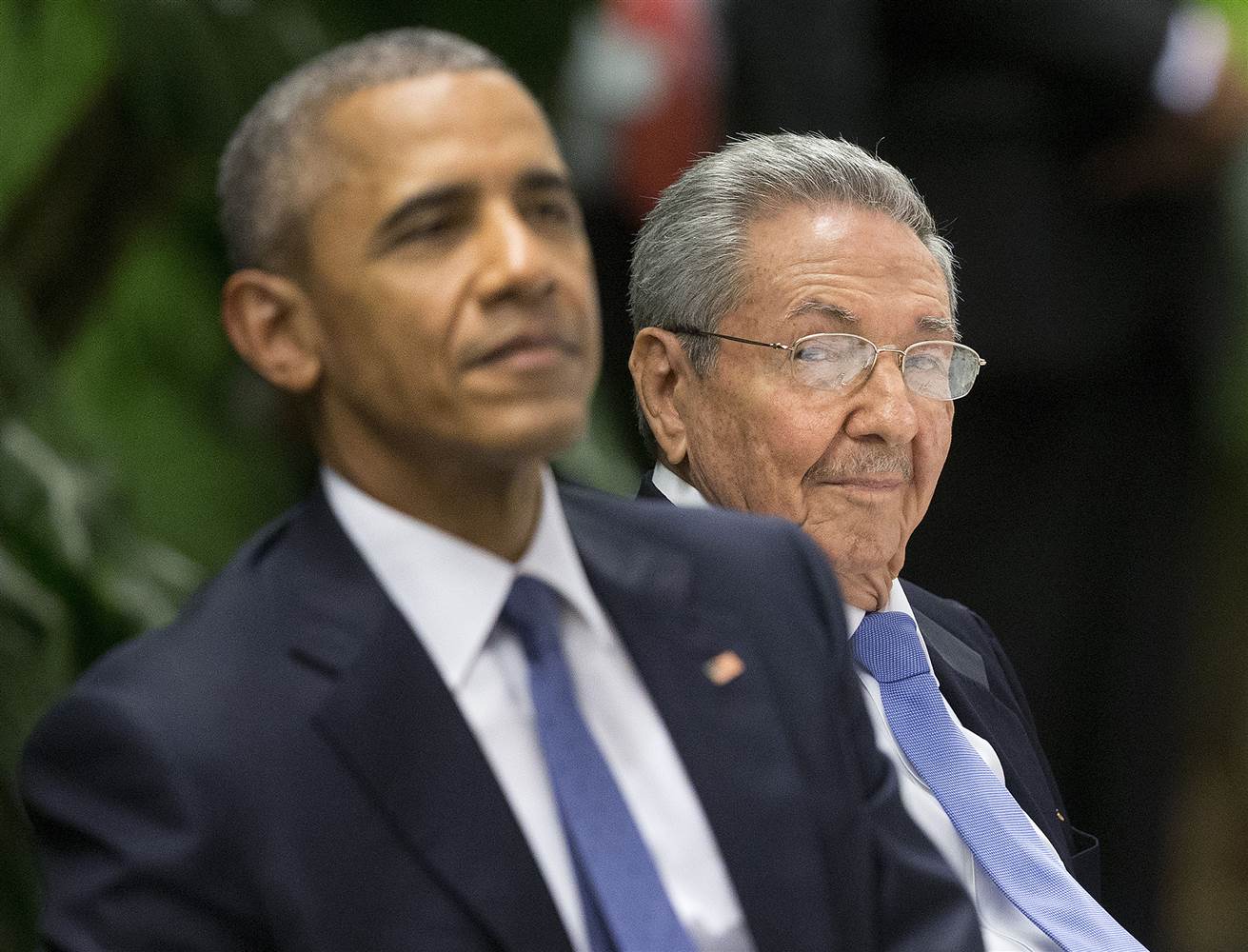
President Barack Obama with General Raul Castro in 2016
President Obama announced his new Cuba policy on December 17, 2014 to great fanfare but downplayed commuting the sentences of three Cuban spies, including Gerardo Hernandez who was serving a life sentence for his role in a murder conspiracy that claimed four innocent lives in 1996 and freed them the same day. 

The argument at the time was that this opening would lead to normalized and improved relations between Cuba and the United States.

On May 29, 2015, despite a long history of sponsoring terrorism, the Obama State Department removed Cuba from the list of state sponsors of terrorism. In November of 2017 former Cuban diplomat, Jose Antonio "Tony" Lopez was linked to terrorists responsible for the June 17, 2017 bombing in Bogota, Colombia that killed three and injured nine according to prosecutors in the South American country. A mother of one of the accused denied her son's involvement in the attack but confirms the link with the former Cuban diplomat.

Commerical center in Bogota, Colombia where bomb went off in June 2017
Human rights violations escalated over the remainder of the Obama Administration and trade between the two countries collapsed. Three years later the U.S. Embassy in Havana is mothballed and two dozen diplomats have been seriously injured. 

The Obama Administration's Cuba policy marked two years on December 17, 2016 and  American diplomats had already been suffering brain injuries. U.S. diplomats in Havana started being harmed in attacks in November of 2016. Despite that on December 7, 2016 the United States and Cuba held their fifth Bilateral Commission meeting where they celebrated progress on U.S.-Cuba relations, and signed 11 non-binding agreements on health, the environment, counter-narcotics, and other areas of cooperation.  

No word on these attacks. On January 2, 2017 Cuban troops in Havana marched in a parade over which Castro presided chanting that they would repeatedly shoot President Obama in the head so many times that they would make a “hat of lead to the head.” Despite that on January 12, 2017 the Obama Administration provided further concessions to Cuba gutting the Cuban Adjustment Act and ending the Cuban Medical Professional Parole Program that had bothered General Castro for years.  

On January 16, 2017 the Obama State Department issued a statement that "the United States and Cuba [had] signed a bilateral Law Enforcement Memorandum of Understanding to deepen law enforcement cooperation and information sharing." American diplomats were suffering serious harm, including mild traumatic brain injury, permanent hearing loss that included loss of balance, headaches, and brain swelling. Yet, according to The Wall Street Journal no complaint was made until February of 2017 but the attacks on American diplomats continued until August 2017. Cuban officials at first said they did not know what was going on, and later claimed that the noises were crickets and the injuries imaginary.
Medical experts discovered changes in the brains of US and Canadian diplomats.
However the injuries are very real. "Medical experts discovered changes in the brains of US and Canadian diplomats, which fueled growing skepticism that some kind of sonic weapon was involved. Medical testing revealed the embassy workers developed changes to the white matter tracts." Professor James Lin, an expert in Electrical Engineering, at the University of Illinois at Chicago,  made the case that weaponized microwaves may be behind the attacks in Cuba.

This raises some difficult questions. Did the Obama Administration by downplaying the past crimes of the Castro regime lead the regime to calculate that it could get away with attacking or allowing diplomats to be attacked? Did downplaying the attacks on diplomats in Cuba in November and December of 2016 lead to others being harmed in 2017? 

Microwaves going through walls

Thursday, December 29, 2016

The vote by Miami's Cuban Americans was a referendum on Obama's Cuba policy

My last word on the 2016 election


On December 16, 2016 The Miami Herald published a story with a headline reading as a question: Was vote by Miami’s Cuban community a referendum on Obama’s policy?  that was two separate articles in one. The first part contained statements by elected representatives affirming that the Cuban American vote was a referendum on Obama's Cuba policy. U.S. Rep. Ileana Ros-Lehtinen, a Miami Republican. stated it simply: “Within the Cuban-American community, the presidential election results demonstrate a direct rebuke of Obama’s Cuba policy reversal.”

The rest of the article read like a press release from the anti-Embargo lobby that ignored some essential facts contained within the polls cited. Prior to Donald Trump changing his position on September 17, 2016 from lukewarm support for Obama Cuba policy to promising to roll it back his support ranged from 35 to 37% based on two polls takes months apart. The FIU Cuba Poll was taken between July 11 and August 12, 2016 with a random sample of 1,000 Cuban Americans residing in Miami - Dade County. According to Tim Padgett in his September 15, 2016 article  "FIU Poll Of Miami Cubans Shows Strong Support For Obama Normalization Policy" only 35% of Cuban Americans were going to vote for Donald Trump according to the poll with a margin of error of 3 percent. This number tracks with the 37% support for Donald Trump in the Moreno Poll of 400 likely Miami-Dade Cuban American voters conducted between April 21 - 23, 2016 that had a three point margin of error.

The Bendixen-Amandi poll with +/- 3.99 margin of error conducted between October 15 - 17, 2016 placed Trump's support among Cuban Americans at 47%. I have raised questions in the past about Bendixen - Amandi and their shilling for the anti-embargo crowd, but even here looking at a 10 to 12 point shift demonstrates that the before and after on the Trump Cuba policy shift did have an impact.

Even more telling is what the Clinton campaign did after Trump shifted on Cuba policy airing radio advertisements in early October 2016 accusing Mr. Trump of violating the Cuban embargo.  The Trump candidacy should not be simply compared with previous Republican presidential candidates because the others had supported maintaining sanctions on the Castro regime throughout the entire campaign. Another factor was that with the exception of Kerry in 2004 since 1992 the Democratic candidates for president including Obama in 2008 and 2012 have also supported sanctions. However the actions taken by the Obama Administration on Cuba in October of 2016 placed Cuba on the campaign agenda and Trump's change on Cuba policy created a stark contrast with Hillary Clinton that helped him win more Cuban American votes.

Following the election a precinct analysis looking at where Cuban Americans voted the most in the 2016 election concluded that 58% of Cuban Americans voted for Donald Trump in the 2016 election. There has been an effort by Cuban Americans who have vigorously supported Obama's Cuba policy to downplay the Cuban American vote and the impact of the new Cuba policy on that vote.


Friday, November 11, 2016

Cuba policy and the 2016 election in Florida

"Soon someone will come out with another push poll telling us Cuban Americans support Obama Cuba policy. Forget polls and watch the elections." - Frank Calzon, over twitter on November 8, 2016


Bay of Pigs Veterans endorsed Donald Trump
The usual suspects are trying to diminish the message sent by Cuban American voters this past Tuesday. The argument made is that Miami-Dade County went massively for Hillary Clinton and at the same time use a poll circulated by the radical National Council of La Raza called Latino Decisions to claim that Cuban Americans voted massively Democrat, but they have an ideological agenda not served by Trump doing better than expected among "Latinos." Furthermore they claim that votes for Trump were not necessarily related to Cuba policy but the facts say otherwise.

First the well respected Pew Research Center placed Latino support for Donald Trump at 29% who outperformed Mitt Romney (who got 27% in 2012). According to exit polls Trump got 54% of the Cuban American vote, but the actual vote may have been higher.

Secondly, the turn out in Miami-Dade County was due to the Hillary Clinton campaign having a fully developed Get Out the Vote Effort and infrastructure that got out more of the vote than Obama in 2012. The Trump campaign did not have that but still Donald Trump in 2016 got slightly more votes than Mitt Romney got in 2012 (333,666 vs 332,981).

However what is left out in this "analysis" is that statewide the margin that won Donald Trump Florida and the presidency was just 119,970 votes. It also ignores how critics of President Obama's Cuba policy won big in Miami-Dade County.

Donald Trump, perhaps looking at the same flawed polls claiming that Cuban Americans supported Obama's Cuba policy gave it luke warm support and in May of 2016 was polling 33% among Cuban Americans. This changed radically in mid September when Mr. Trump contrasted himself from Hillary Clinton promising to overturn Obama's Cuba policy if human rights did not improve on the island. His change on Cuba policy was welcomed by Congressman Mario Diaz - Balart.

How the Hillary Clinton campaign responded during the past two months: downplaying her anti-embargo position, a hit piece in Newsweek and putting out radio ads accusing Trump of violating the Cuban Embargo and partisans going after him with the same message on social media. This was obviously done to peel off Cuban American support. They of course ignored that President Bill Clinton in the 1990s like President Barack Obama today was encouraging businesses to explore business opportunities in Cuba, loosening economic sanctions and shook hands with a Castro.


Mr. Trump responded by doubling down and pledging his support for a free Cuba and in October he was endorsed by the Bay of Pigs Veteran Association. This was the first time in the organization's history that they had endorsed a presidential candidate. Over twitter both he and Governor Mike Pence tweeted their support for freedom in Cuba.

The Obama administration issuing a Presidential policy directive on United States-Cuba Normalization on October 14th that called for US intelligence agencies to share information with the Castro dictatorship's secret police outraged many. Add to that the failure of the Obama administration to defend current US law at the United Nations by abstaining in a vote on the Cuban embargo and repeating regime talking points angered many. By October 27, 2016 polls placed the Cuban American vote at 52% which was a 15 point shift.

There was a final factor that was death of Janet Reno on the eve of the election brought back the traumatic Elian Gonzalez episode to many Cuban Americans in Miami. On that same day Mary O'Grady asked in The Wall Street Journal: "Will Obama's Cuba Policy Lose Florida for Clinton?" and the answer a day later was, despite the claims of the anti-embargo lobby and the National Council of La Raza, was an unequivocal yes.

Obama's Cuba policy and Hillary Clinton's strident support for it were profoundly unpopular with Cuban American voters and contributed to a Trump victory in Florida on November 8th.

Like it or not the claims made by some that the Cuban American community had changed and politicians could support rapprochement with the Castro regime and not suffer on election day were wrong and contributed 29 electoral votes to President Elect Donald Trump.

Consider the following breakdown. Pew placed the number of Cuban American voters in 2012 at 771,000. The Associated Press in a video report offered a lower estimate for the Cuban American vote citing a source that said 8% of over 8 million votes in FL would be Cuban American which would total 640,000.

Using the above numbers and looking at the shift in support for Donald Trump in May 2016 when he supported Obama's Cuba policy and was getting between 33% and 37% of the Cuban American vote compared to October 2016 when he rejected the White House's Cuba policy and saw his support rise to 52%.

Lowest range of Cuban American support shifting before and after was 96,000 votes and the highest range was 146,490. The average of the two was 121,245 votes. Considering that Mr. Trump won Florida by just 119,970 and the importance of this shift in the Cuban vote over Cuba policy shows that it was decisive in delivering the 270 electoral votes.

Conclusion: Obama Cuba policy cost Hillary Clinton the White House.

Wednesday, September 28, 2016

Will Obama Administration Cuba policy legacy project throw Clinton under the bus?

Will President Obama's move to name an Ambassador to Embassy in Havana hurt Hillary Clinton in Florida?

Will President Obama's announcement cost Hillary Florida?
42 days before election day President Obama made a fateful decision that could impact the outcome of the Presidential election in Florida when he announced yesterday afternoon that “Today, I am proud to nominate Ambassador Jeffrey DeLaurentis to be the first U.S. Ambassador to Cuba in more than 50 years." 

Cuba, so far this election cycle has not been high on the radar, but with this announcement the Obama Administration's controversial Cuba policy will be debated and at a time when polls indicate that the race in Florida is tightening the Cuban American vote could be decisive in swinging the state and its 29 electoral votes.

Lets review for a moment some of the outcomes of the Obama Administration's Cuba policy:
1. Dissidents murdered by the dictatorship within a worsening human rights situation. 
2. Trade between the United States and Cuba has collapsed under the Obama Administration to levels not seen since 2002. 
3. Castro regime power and influence projected further into Latin America with devastating results in Venezuela and Nicaragua. 
4. Mass exodus from Cuba with tens of thousands of Cubans fleeing the island because they see that the Castro regime is being assisted by the White House in a generational succession of the Castro family. 
5. Military and Castro family further expanding control over the economy. 
6. Discrimination against Cuban American by American corporations trying to satisfy demands of the Castro dictatorship. 
7. China, North Korea, Russia and Iran strengthening ties with the Castro regime to levels not seen in years. 
8. Cuba seized a U.S. Hellfire missile in 2014 while secret negotiations were underway and refused to return it until the Wall Street Journal broke the story in early 2016.  
This is most likely the reason why Donald Trump reversed his support for the Obama Cuba policy on September 16, 2016 describing Obama's deal as "one-sided" and benefiting "only the Castro regime," and met with Cuban American and Venezuelan American leaders in Miami yesterday promising results in improving the situation in Cuba and Venezuela with a smarter and more assertive American foreign policy under a Trump administration. 

President Obama could have nominated DeLaurentis after November 8th and avoid heightening the focus on his Cuba policy in the Cuban American community and potentially harming Hillary Clinton. Bendixen-Amandi polls and the FIU Poll with dubious methodology have tricked more than one politician into believing that the Cuban-American community has changed and that backing a policy that legitimizes the Castro regime while human rights worsen on the island will not reflect negatively their support.

President Obama did not take that chance when he was running for the White House in 2008 and 2012 but is apparently willing to risk Hillary's prospects in 2016.

The number 42 was revealed by the late British author Douglas Adams in his Hitchhiker's trilogy to be the answer "to life, the universe and everything," but the joke was that it didn't make sense without knowing and understanding what the question was. 

In 42 days however the Obama White House and the Clinton campaign will have a definitive answer on how Cuba policy impacts the Cuban American vote and in a tight race the outcome may not lead to much laughter or celebration in either quarter.

Meanwhile the debate begins:

Friday, September 16, 2016

Clinton, Trump and Cuba Policy: Only poll that counts is the one on Election Day

Obama's Cuba policy will be weighed at the polls in November

Donald Trump repudiated Obama Cuba policy today in Miami, FL
The 2016 presidential election was going to be a wash on Cuba policy with both Hillary Clinton and Donald Trump supporting Obama's failed Cuba policy. Until today when Mr. Trump in Miami announced that he had changed his mind on the President's Cuba policy. CNN reported on what the GOP presidential candidate said today in South Florida:
Trump -- speaking in a state with a heavy Cuban voting bloc -- characterized Obama's deal as "one-sided" and benefiting "only the Castro regime."
"But all of the concessions that Barack Obama has granted the Castro regime were done with executive order, which means the next president can reverse them. And that is what I will do unless the Castro regime meets our demands," Trump said Friday.
"Those demands will include religious and political freedom for the Cuban people and the freeing of political prisoners," Trump said.
This new contrast over Cuba will test the FIU poll of Miami Cubans and their supposed strong support for Obama's Cuba policy. Recall that Marco Rubio who has repudiated the Obama Cuba policy lost across the state of Florida in the Republican primary but won Miami-Dade County handily with the Cuban American vote. Trump's about face on Cuba policy will be good news for the GOP in South Florida where Cuban Americans upset over the December 17, 2014 announcement now have a candidate that they can support.  Jorge Perez, a prominent businessman promoting engagement with the Castro dictatorship, lost influence with candidate Trump over Cuba policy.

This will also turn around the erosion in support for the Republican Party by Cuban American voters. The bottom line is that like the Asian American vote, the Cuban American vote is profoundly anti-communist and in the case of Cuba taking a tough stand on the Castro brothers will deliver votes.

The Trump phenomenon is a rejection of the professional political class, of which Hillary Clinton is a paradigmatic example, due to the economic pain of the middle class.  In an anti-establishment year the GOP nominee holds the trump card as the non-politician in the race for the White House.

Now Cuban-Americans have a choice and not an echo on Cuba policy this November. This is good news for the United States and for GOP prospects in South Florida.

I still have my concerns with the Trump candidacy over issues of torture, complimenting Vladimir Putin and the Chinese communists, but at least on Cuba policy voters now have a clear choice.


Monday, August 1, 2016

Fruits of Obama's Cuba Policy: Democracy's downward spiral fully manifests in Nicaragua

 Democracy's continued decline in Latin America

Daniel Ortega has dismantled the last vestiges of democracy in Nicaragua (Photo Tim Rogers)
 Over a year ago predicted that the human rights situation and democracy would not only continue to deteriorate but accelerate as a result of the Obama administration's Cuba policy that disregarded democratic norms and embraced the dictatorship in Cuba. The situation in Venezuela continues to deteriorate with hunger riots breaking out and a mass exodus of Venezuelans to Columbia seeking food while political repression increases in the country. Now the policy's impact can be seen in Nicaragua, along with the continued denial of that reality by the American embassy there. Opposition lawmakers have been ousted by an electoral authority controlled by president Daniel Ortega. Ortega has also announced that he will not permit foreign observers into Nicaragua to monitor the November 6 presidential and legislative elections. This has been a process that has been observed in this blog in the past.

Tim Rogers, a past sympathizer with the Sandinista revolutionaries describes the situation in Nicaragua today in a July 30, 2016 Fusion essay:
Since returning to office nearly a decade ago, Ortega has methodically and completely dismantled Nicaragua’s fragile institutional democracy from within and reshaped the laws in a way that support his personal aspirations to create a one-party system that he can govern unopposed till death do they part. By hook and crook, Ortega and his lackeys have taken control of all four branches of government, implemented a repressive zero-tolerance policy for street protests, and rewritten the constitution to eliminate checks and balances.

Ortega put the final nail in the coffin of Nicaragua’s democratic pluralism on Friday, when his sycophants in the Supreme Electoral Council ordered the ouster of 28 opposition lawmakers and substitute lawmakers from the National Assembly. Now Ortega doesn’t face any political opposition, symbolic or otherwise, and can run unopposed for another re-election in November. The Sandinistas argue that the death blow to the opposition was legal, and they should know since they wrote the laws. So congratulations, comandante, you’ve finally got your dream of turning Nicaragua into your family farm.
 Rogers, goes on to describe the U.S. response to this emerging dictatorship in Nicaragua:

The U.S. doesn’t seem to care, either. Thirty years after spending more than $1 billion to fund an illegal counterrevolutionary war against the Sandinista government in the 1980s, the U.S. doesn’t even seem to acknowledge what’s going on in Nicaragua anymore. In fact, as Ortega’s party was finalizing its power grab on Friday afternoon, the U.S. Embassy was sending out a press release congratulating itself for a successful business “networking” grip-and-grin they hosted to “contribute to the economic development of the country.” The U.S. Embassy couldn’t appear more disconnected from Nicaragua’s political reality if it were operating in a parallel galaxy.

[...]

Putting out cookies and coffee for business innovators to speed network while the country’s democracy goes completely off the rails just outside the embassy gates reminds us that the United States’ priorities in the world are oftentimes different than advertised. Washington, D.C. likes to think it’s a beacon for freedom and democracy, but the light it’s tending to on the hill shines for business and trade. But in the long run, economic development needs rule of law. Even the country’s private sector, which has been allied with Ortega since 2007, knows that what’s coming isn’t good for business. COSEP, the country’s largest business chamber, released a communique on Friday night fretting about “political stability,” the “weakening of a representative democracy,” and “social cohesion.”
 Consider for a moment that the President of the United States calls Dictator Raul Castro "President", treats him has an equal and organized an official state visit to Cuba legitimizing the oldest dictatorship in Latin America. Why wouldn't other aspiring despots take notice and act accordingly? Events in Venezuela and Nicaragua will be repeated elsewhere as the fruits of the Obama administration's Cuba policy become evident and Latin America implodes. The only question remaining is will President Obama be visiting Daniel Ortega in Nicaragua to help consolidate his dictatorial rule there?

Then Cuba and Nicaragua vs Now Cuba, Nicaragua and Venezuela

Friday, April 15, 2016

Obama Cuba Policy Fails Accumulating

 Segregation Cruise and Cuba's 401 Kilo Cocaine Shipment

Carnival CEO on the right signs agreement with Castro regime

Carnival Cruise Line reached an agreement with the Castro regime on March 21, 2016 to sail to Cuba from the United States, but in order to conduct their core mission they had to agree to a policy of the Cuban dictatorship that bans all Cubans from traveling into the island by boat. This systematically discriminates against all Cubans born on the island whether or not they are citizens of another country. However some Cubans can fly into and out of Cuba on a plane. This updated version of separate but equal was approved by the Obama Treasury Department on July 7, 2015.

On December 17, 2014 President Obama announced that he was charting a new course on Cuba in a little over a year it has led to a return of 1890s style segregation but based on national origin not race. This is doubly ironic: First this step back to the 1890s has happened on the watch of the first African American President of the United States. Furthermore that Arnold Donald, the CEO of Carnival Corporation who signed this separate and unequal arrangement is also African American. This is the stuff of a Monty Python sketch. Secondly that legal segregation established as the law of the land in 1896 with Plessy vs Ferguson and ended in 1954 with Brown vs the Board of Education. would now return to the United States in 2016.

However the other Cuba policy failure is no laughing matter. The Obama administration has expanded collaboration with the Castro regime in sharing drug intelligence information that can have deadly consequences while disregarding the Cuban dictatorships long drug trafficking history.
EFE news agency reported this afternoon:
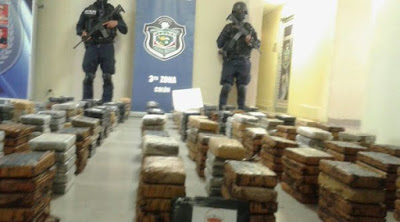
Police officers, in coordination with anti-drug authorities in Panama, seized 401 kilos of cocaine from Cuba, in an action carried out in the Caribbean city of Colón, 80 kilometers north of the capital, said an official source. The illicit substance that was found in a container in a port town, camouflaged between tanks of molasses, came from Cuba and was bound for Belgium, reported the National Police of Panama (PN). The drug was seized under the so-called operation "Caña Brava" by agents of the Colón area police zone of the Directorate of Police Intelligence.
This is also reminiscent of the tactics used by the Cuban government in covering up tons of weapons in 2013 under bags of sugar that were bound for North Korea in violation of international sanctions.

401 kilos cocaine from Cuba being smuggled to Belgium
Meanwhile the State Department released its human rights report on Cuba, that although omitting particularly brutal acts by the regime in 2015, showed things had gotten worse.

Will this lead the United States to change policy or will the White House only double down on this failed policy as the disasters continue to pile up and diminish President Obama's legacy? This is what happens when you normalize relations and go into business with an abnormal regime.


Friday, April 8, 2016

Google goes along with Internet censorship in Cuba in order to have a presence there

Told you so...
Google + Kcho Mor center in Havana, a Google-sponsored techn zone & hotspot. (Photo 14 y Medio)

 Capitol Hill Cubans yesterday reported the following on the presence of Google in Cuba:
Reports from Cuba have noted that the center has been given priority use by Ministry of the Interior ('MININT') officials and trainees. The MININT is home to Castro's intelligence services. Thus, the Google + Kcho Mor center has become a playground for Cuba's spies and future cyber-warriors. Furthermore, after passing various security checks, when regular Cubans finally get to enter the center, they are treated to censored online access. Webpages like Cubaencuentro, Revolico and 14ymedio remain blocked. Thus, Google has now officially become an extension of Cuba's censors.
This should not come as a surprise and back in 2011 I pointed out the following:
American companies such as Microsoft, Nortel, Cisco and Sun-Microsystems collaborated extensively with the Chinese communists to set up an intranet that blocks free access to internet to hundreds of millions of Chinese. American technology companies identified and located Chinese dissidents for the regime who imprisoned and tortured them. For example, according to Amnesty International, Chinese journalist Shi Tao is serving 10 years in jail after Internet company Yahoo! gave the authorities his personal email account-holder information.

American tech firms, such as Narus, aided the Mubarak regime in Egypt during its brutal crackdown tracking Egyptian activists during the Arab Spring and has also been suspected of helping Libya track dissidents.

The difference between Cuba and these other countries is that due to economic sanctions - some US technology corporations were blocked from doing the same sordid business with the Castro regime. Of course that does not mean that other companies from other countries are not already engaged in those practices. At the time of the 2003 Black Cuban Spring the Italian company, Telecom Italia, provided technology that was used to track activists that used the internet in a "counterrevolutionary manner."

Internet apartheid its not just a Cuban thing but thanks to US sanctions at least US companies do not have carte blanche to do the same thing in Cuba that they are doing in China, Syria, Egypt and in so many other places around the world. Unfortunately, there are other companies in Cuba collaborating and doing it.


In March of 2015 I went further into analyzing the shortcomings of those who see technology as a panacea in resisting totalitarian regimes:
Technology is neutral, and repressive regimes have contracted Western companies to place draconian controls on the internet that are used to target activists. Amnesty International identified "Cisco Systems, Microsoft, Nortel Networks, Websense and Sun Microsystems" as having "provided technology which has been used to censor and control the use of the Internet in China." These repressive applications of new technologies have been transferred to other dictatorships.

Many experts, like the ones apparently operating in the State Department, argue of the importance of conditions such as: a large middle class, internet penetration or some minimum annual level of income.

However, Srdja Popovic, a cofounder and key figure in the Serbian resistance movement “Otpor!” that toppled Slobodan Milosevic nonviolently in 2000 disagrees with the above line of argument and makes the case that the most important thing that you can do is to build up the skills of activists because they are the ones who make the change. Conditions are important to take into consideration when activists are formulating their strategy but they do not define success.
Now thanks to President Obama's new Cuba policy it appears that American companies such as Google are collaborating with the dictatorship in setting up sophisticated censorship capabilities and giving Cuba's secret police priority access to control what Cubans will see when surfing the internet.  This opens the door to American high tech companies propping up and modernizing totalitarianism in Cuba as they did in China.


If the above analysis is incorrect then please provide your counter-argument in the comments section below.

Saturday, March 19, 2016

Some observations on President Obama's upcoming trip to Cuba

Ominous clouds on the eve of an official visit

President Obama's official visit to Cuba: Legitimizing Castro or helping democrats?
President Barack Obama arrives in Cuba on March 20, 2016 with his family for an official visit to the Castro dictatorship in the administration's continuing effort to make the new United States policy towards the country irreversible after he leaves office.  However, history has demonstrated that engaging dictatorships inevitably has profoundly negative consequences despite the best intentions. The last U.S. president to visit Cuba was Calvin Coolidge in 1928.

The stated goals of the Obama administration's Cuba policy are that this will change perceptions in the region, present opportunities for increased economic engagement between the United States and Cuba while helping to improve the lives of Cubans on the island setting the stage in the future for a democratic transition.


Despite these goals the results have been a worsening human rights situation in Cuba, a collapse in trade between Cuba and the United States to its lowest level since 2002, and a new refugee exodus from the island. Compared to the previous policy, the Obama administration's new Cuba policy has been a failure. The number of politically motivated arbitrary detentions in Cuba have increased more than four-fold during the Obama administration.


Ideas have consequences and the premise upon which the Obama administration's Cuba policy was announced on December 17, 2014 that the United States from 1961 until 2014 had an unchanging policy of isolating Cuba is not true.


Obama policy follows same failed approach as Carter and Clinton
President Jimmy Carter between 1977 and 1980 undertook a policy of engagement with the Castro regime that ended the travel ban, opened the U.S. Interests Section ( a de facto embassy) and saw formal high level negotiations between the United States and Cuba. The policy resulted in the Mariel exodus, reversals of U.S. national interests in Latin America with the rise of the Sandinista regime in Nicaragua and a regional conflict throughout Central America, and Cuban troops engaged in open warfare in Africa. Ronald Reagan reversed this failed policy in 1982.

President Bill Clinton between 1993 and 2000 pursued a policy of engagement with the Castro regime. In 1994 the Clinton administration initiated regular contacts between the U.S. and Cuban military that included joint military exercises at the Guantanamo Naval base. ( Despite his rhetoric George W. Bush continued the practice during his presidency.) During this period of "constructive engagement" brutal massacres of Cubans such as the July 13, 1994 "13 de Marzo" tugboat massacre and the February 24, 1996 Brothers to the Rescue shoot down took place. The shoot down involved two planes blown to bits over international airspace by Cuban MiGs killing three American citizens and a Cuban resident who were engaged in the search and rescue of Cuban rafters. Since it occurred while President Clinton was seeking re-election and his only options were to do nothing, military action, or toughen sanctions he opted for the latter signing the Cuban Libertad Act of 1996

However, once re-elected to a second term President Clinton set out again to normalize relations. The first sitting president to shake hands with Fidel Castro on September 6, 2000 was Bill Clinton. One month later he signed  Trade Sanctions Reform and Export Enhancement Act (TEFRA) that opened trade between the Castro regime and U.S. companies. Opposition in congress led to that trade not being subsidized by U.S. taxpayers by not providing government backed credits ensuring that business would be cash and carry.

Third time, so far, is not the charm
The Obama administration's attempt to normalize relations with the Castro regime began in 2009. On April 13, 2009 the Obama Administration eased travel restrictions to Cuba put in place during the Bush Administration and paved the way for American telecommunications firms to begin providing service for Cubans. A few days later on April 18, 2009 addressing Latin American and Caribbean leaders at the Summit of the Americas in Trinidad and Tobago President Obama declared:
"The US seeks a new beginning with Cuba. [...]I know there is a longer journey that must be traveled to overcome decades of mistrust, but there are critical steps we can take toward a new day."

In June of 2009 President Obama snubbed the 2009 winners of the NED Democracy Award which were five leaders of Cuba's pro-democracy movement earning a rebuke in The Washington Post. On December 5, 2009 Alan Gross, a United States citizen was arrested in Cuba and was held as a hostage until December 17, 2014 when the Cuban dictatorship's demands were met and all of the five Cuban spies, including Gerardo Hernandez serving a double life sentence for espionage and his role in the conspiracy to murder three U.S. citizens and once resident on February 24, 1996, were back in Cuba. Two days later, President Obama tried to downplay the February 24, 1996 Brothers to the Rescue shoot down ignoring the well documented evidence that it was a premeditated act of state terrorism.

Between June of 2009 and December 17, 2014 high profile Cuban dissidents were killed under suspicious circumstances in Cuba, but the drive to normalize relations meant that there were no consequences for the dictatorship and the killings continued generating a body count. Beginning with Orlando Zapata Tamayo on February 23, 2010 and peaking with the suspicious deaths of Ladies in White founder,  Laura Inés Pollán Toledo on October 14, 2011 and Christian Liberation Movement leaders, Oswaldo Payá Sardiñas and Harold Cepero Escalante on July 22, 2012.

Unfortunately, since December 17, 2014 the Obama administration's actions have had and will continue to have negative consequences for both Cubans and Americans by embarking on a series of actions that ignore the nature of the regime in Cuba while undermining human rights.

Policy empowers Castro regime not Cubans
On January 27, 2015 the Spanish newspaper ABC reported that the Castro regime, in collaboration with Venezuela, was providing protection for drug traffickers traveling between Venezuela and the United States. According to news accounts the son of the Cuban ambassador to Venezuela, Germán Sánchez Otero, was using PDVSA planes to smuggle drugs with the United States as the final destination. Wikileaks revealed that the United States and Cuba, since at least 2009 have been "cooperating" on drug trafficking. Fox News Latino has published favorable reporting on this relationship as recently as January 12, 2015. The DEA is now collaborating with the Castro regime and sharing information despite the dictatorship's continued involvement in drug trafficking.

Removing Cubans from the list of state sponsors of terrorism on May 29, 2015 was not a symbolic act as some have claimed. This move provides the regime with more financial resources to engage in activities that destabilize U.S. national security interests, closes a door to victims to seek justice in the courts, and does not bode well for the future.

On July 20, 2015 at the State Department, Rosa Maria Payá Acevedo attended a press conference with Secretary of State John Kerry and Castro's foreign minister Bruno Rodriguez. Rosa Maria had proper accreditation as a member of the press. Rear Admiral John Kirby,  the State Department spokesman, took Rosa Maria aside and warned her that she would be physically removed if she asked any questions or caused any kind of disturbance. This was most likely done to appease the Castro regime's foreign minister.

On July 27, 2015 the Obama administration watered down the State Department's human trafficking report for political aims that included ignoring the severity of sex trafficking in Cuba and the use of slave labor.

Secretary of State John Kerry did not invite Cuban human rights defenders to the flag raising ceremony at the U.S. Embassy in Havana on August 14, 2015. The State Department argued that it was a government to government affair and that there was not enough space to accommodate the dissidents but did have room to fly down a plane load of lobbyists.  Journalist Andres Oppenheimer laid out the consequences of this snub: "Kerry’s trip to Havana didn’t break new ground on human rights even symbolically, and in effect hurt Cuba’s fledgling internal opposition by making it look irrelevant in the eyes of many Cubans."

The Obama administration claims to have met with "Cuban American leaders" to listen to their concerns regarding Cuba policy on March 16, 2016 but not one elected Cuban American official, Democrat or Republican, was invited nor prominent Cuban American critics of his policy.  Formulating Cuba policy while ignoring dissenting views is a recipe for disaster and the worsening situation in Cuba demonstrates that failure.

Violence and killing of dissidents and fleeing refugees continues

Sirley Ávila León: Holds state security responsible for May 2015 machete attack
 Sirley Ávila León, an ex-delegate of the People’s Assembly (Poder Popular) who in 2012 led a battle against the authorities of Las Tunas for a school in her town that led her to join the opposition was gravely wounded in a machete attack orchestrated by State Security on May 24, 2015. She suffered deep cuts to her neck, knees, arms and lost her left hand. She denounced that they are trying to be rid of her and that officials on several occasions pressured her son (now ex-military) to commit her to a mental hospital arguing that dissenting from the system was insane. This attack followed a pattern of escalating repression that in addition to a beating by state security agents, included cows and pigs attacked with machetes, and arson. Sirley then added “I reaffirm that this is something that was prepared against me for some time.” Ávila is accusing Cuban state security of being behind the machete attack.

Yuriniesky Martínez with his dad, son, and on (right) how he was found
On April 9, 2015 Yuriniesky Martínez Reina (age 28) was shot in the back and killed by state security chief Miguel Angel Río Seco Rodríguez in the Martí municipality of Matanzas, Cuba for peacefully trying to leave Cuba. A group of young men were building a boat near Menéndez beach to flee the island, when they were spotted trying to leave and were shot at by state security.

Unfortunately, with President Obama's new Cuba policy, American taxpayers will be joining their European and Latin American counterparts in subsidizing the Cuban military and security who also happen to run the tourism industry in the country.

American taxpayers will be left to pick up the tab
Under the U.S. embargo American companies made $5.2 billion dollars in cash and carry trade with Cuba. At the same time with normal relations and financial institutions providing credits several countries according to the Paris Club lost $15 billion to Cuba. Under the Obama administration's push for normalization trade between Cuba and the United States has steadily collapsed. The high point of trade between the two countries was the last year of the Bush administration (2008) when it peaked at 711.5 million dollars. Trade between the United States and Cuba in 2015 totaled 180.3 million dollars the lowest figure since 2002.

According to polls conducted by the International Republican Institute in 2008 and 2011 only a minority of Cubans (3% to 8%) in the island do not blame the embargo as the source of their ills but low salaries and high cost of living.

The Obama Treasury Department on January 27, 2016 joined France and the rest of the world in legalizing financing of transactions between U.S. companies and the Castro regime.  The Cuba policy the Obama administration is abandoning has protected U.S. taxpayers. In the future in real terms trade between U.S. companies and the Cuban dictatorship will be negative, as it has been for the French, the Spanish, the Mexicans, the Russians, the Canadians and many others.

The bottom line
On three occasions American presidents have sought to normalize relations with the Castro dictatorship and on three occasions the outcome has been: a worsened human rights situation in Cuba, U.S. national security interests negatively effected and a migration crisis. The Obama administration is correct about one thing: "We cannot keep doing the same thing and expect a different result." 

On January 19, 1928 President Calvin Coolidge and the First Lady visited Cuba and met with General Gerardo Machado who at the time was transforming his rule into Cuba's first dictatorship. The aftermath of the Coolidge visit saw Cuba deeply entrenched in its first dictatorship, rising political violence under Machado's dictatorial rule. Let us hope that President Barack Obama and the First Lady's visit to Cuba in 2016 does not lead to a similar result.