Showing posts with label Obama Administration. Show all posts

Saturday, March 4, 2017

President Obama's goodbye gift to General Raul Castro: Whitewashing Cuba's drug trafficking record

Reality check on the Castro regime's continuing links to drug trafficking

Diosdado Cabello target of the DEA with General Raul Castro and his Foreign Minister
Only ignorance of history and hemispheric realities could lead one to believe the newest and last claims by the Obama Administration with regards to Cuba and it is not the first time. For example, the Obama State Department played politics with human trafficking to portray the Cuban government in a more positive light that drew criticism from human trafficking experts that it had been politicized. They are now doing the same with drug trafficking in the just released 2017 International Narcotics Control Strategy Report (INCSR) where on page 142 made the following extraordinary claim:
"Cuba Despite its proximity to the largest exporters of illegal drugs in the hemisphere and the U.S. market, Cuba is not a major consumer, producer, or transit point of illicit narcotics. Cuba’s domestic production and consumption remain low due to active policing, strict sentencing, and nationwide prevention and public information programs."

No mention made in the report or in The Miami Herald of the Panamanian police seizing more than 400 kilograms of cocaine in a Cuban ship on its way to Belgium in April of 2016.

At the same time the report recognizes that out of the world wide list of  22 "major illicit drug producing and/or drug - transit countries" identified and notified to Congress by the President on September 14, 2015 includes regimes with close ties to the Castro regime, its military and intelligence services: Bolivia, Ecuador, Nicaragua,and Venezuela.  The report also identifies that out of these 22 countries "three have 'failed demonstrably' during the previous 12 months to adhere to their obligations under international counternarcotics agreements" and they are "Bolivia, Burma, and Venezuela."


Drug trafficking and consumption are out of control and the regime in Cuba has a long history of being implicated in the narcotics trade not only for the hard currency but to do harm to the United States as both an existential and ideological enemy.

Cocaine shipment from Cuban ship hidden under molasses discovered in Panama
Castro's ties to Colombian and Venezuelan drug trafficking
 It is important to recall that Cuba was placed on the list of state sponsors of terrorism on March 1, 1982, less than three months after the US State Department confirmed that the Cuban government was using a narcotics ring to funnel both arms and cash to the Colombian M19 terrorist group then battling to overthrow Colombia’s democratic government.

General Raul Castro has played a high profile role in mediating the peace negotiations between the Santos government and the Fuerzas Armadas Revolucionarias de Colombia (Revolutionary Armed Forces of Colombia) FARC in Colombia. FARC are known for funding their conflict with Cocaine production. The State Department's report offers ominous news on Cocaine production in Colombia:
 The United States estimates that the area devoted to coca cultivation in Colombia increased 42 percent in 2015 to 159,000 ha from 112,000 ha in 2014, returning to cultivation levels last seen in Colombia in 2007. 
Jackson Diehl in The Washington Post reported on the Venezuela, FARC, Cuba trafficking axis on May 24, 2015 in the article "A drug cartel’s power in Venezuela":
Ever since Colombian commandos captured the laptop of a leader of the FARC organization eight years ago, it’s been known that Chávez gave the Colombian narcoguerrillas sanctuary and allowed them to traffic cocaine from Venezuela to the United States with the help of the Venezuelan army. But not until a former Chávez bodyguard [ Leamsy Salazar] defected to the United States in January did the scale of what is called the “Cartel of the Suns ” start to become publicly known.
[...]

The day after Salazar’s arrival in Washington, Spain’s ABC newspaper published a detailed account of the emerging case against Cabello, and last month, ABC reporter Emili Blasco followed up with a book laying out the allegations of Salazar and other defectors, who say Cuba’s communist regime and the Lebanese militia Hezbollah have been cut in on the trafficking. That was followed by a lengthy report last week in the Wall Street Journal that said Cabello’s cartel had turned Venezuela into “a global hub for cocaine trafficking and money laundering.”
Worse yet American diplomats also know that the Castro regime provides safe haven for the FARC in Cuba because it has appeared in Wikileaks. The close relationship between the regimes in Havana and Caracas has been long and well documented. Tens of thousands of Cuban advisers have been operating in Venezuela for years.

General Manuel Noriega with the late Fidel Castro
Manuel Noriega and the trouble with engaging corrupt dictators in the drug fight
Unfortunately overlooking sordid practices of dictators for perceived short term political gains has a long history in US foreign policy. The DEA celebrated Panamanian strong man Manuel Noriega's fight against drug trafficking before he was indicted for drug trafficking generating a crisis that ended with a military invasion, scores of Panamanians dead and General Noriega in US custody and placed on trial. 

General Manuel Noriega mug shot

Noriega's link to Castro and Cocaine
During General Manuel Noriega's 1992 trial information emerged publicly implicating the Castro regime that Sun Sentinel reported at the time:

"Federal prosecutors say Noriega traveled to Havana to ask [Fidel] Castro to mediate a potentially deadly dispute with top members of Colombia`s Medellin cocaine cartel. They say the cartel chiefs were upset because a major drug lab had been seized in Panama despite payment of millions of dollars in protection money to Noriega. According to the Noriega indictment, Castro negotiated a peace accord between the cartel and Noriega at the 1984 meeting. The allegation forms a cornerstone of the racketeering and drug trafficking charges against Noriega."
At the same time convicted cartel leader Carlos Lehder directly implicated Raul Castro and U.S. fugitive Robert Vesco "to route cocaine flights through Cuba." Capitol Hill Cubans blogged how two years later, a federal indictment listed General Raul Castro as part of a conspiracy that smuggled seven and a half tons of cocaine into the United States over a 10-year period but the Clinton administration overruled prosecutors


WGBH Frontline Documentary: Cuba and Cocaine
In a 1991 Frontline documentary, Cuba and Cocaine, U.S. Coast Guard Lt. Commander Jeff Karonis, stated, "We would observe in the middle of the day an air drop going on inside Cuban waters. The scenario would be for a small twin-engine airplane with maybe 1,000 to 2,000 pounds of cocaine to fly over Cuba, drop the drugs to a predesignated rendezvous point to several boats. Then it would exit back down off Cuba, and many times a Cuban military vessel would be in the immediate vicinity, right on scene with them.''

In 1989, a federal grand jury indicted Robert Vesco for arranging safe passage for drug planes over Cuban airspace after obtaining approval from Cuban authorities.

According to the 1989 indictment, Reinaldo Ruiz was allowed to land planes in Cuba to refuel after dropping drug cargo off the Cuban coast. Drug-smuggling motorboats would come from Florida to pick up the cargo, and Cuban Coast Guard radar monitored U.S. Coast Guard cutters to help the smugglers evade them. The indictments demonstrated the foolishness of sharing intelligence on drug operations with Havana.

In 2014 Juan Reinaldo Sanchez who served as a bodyguard to Fidel Castro for 17 years published a book of memoirs "The Double Life of Fidel Castro." He passed away a year after releasing the book. In the book Reinaldo Sanchez described a meeting in 1988 between Fidel Castro and his Minister of the Interior, General José Abrantes in which Castro asked the recording equipment be turned off:

The interview seemed to go on forever . . . one hour went by, then two. And so, as much out of curiosity as to kill the time, I put on the listening headphones and turned Key No. 1 to hear what was being said on the other side of the wall. Their conversation centered on a Cuban lanchero (someone who smuggles drugs by boat) living in the United States, apparently conducting business with the government. And what business! Very simply, a huge drug-trafficking transaction was being carried out at the highest echelons of the state. Abrantes asked for Fidel’s authorization to bring this trafficker temporarily to Cuba as he wanted to have a week’s vacation in his native land, accompanied by his parents, in Santa María del Mar — a beach situated about 12 miles east of Havana where the water is turquoise and the sand as fine as flour. For this trip, explained Abrantes, the lanchero would pay $75,000 — which, at a time of economic recession, wouldn’t go amiss . . . Fidel was all for it.
 The Castro regime has a long established record of deceit and should not be underestimated. Drugs are flooding into the United States at unprecedented levels fueling overdoses and an epidemic endangering American lives. Sharing drug intelligence with the Castro regime, considering its history is madness. Whitewashing Cuba's drug trafficking record to do it is a disservice to the American people.

Tuesday, January 24, 2017

Bitter Harvest: One hundred years of communism and the Ukraine

Remembering Holodomor and the ongoing Russian occupation of Ukraine today


2017 marks the one century mark since the first communist regime took power in Russia and created the Soviet Union. Next month on February 24, 2017 the film Bitter Harvest brings to the big screen one of the great unknown crimes of the 20th Century the Holodomor against the people of Ukraine carried out by Josef Stalin.


According to the website Remembering Holodomor the word itself is based on two Ukrainian words: holod – ‘hunger, starvation,famine,’ and moryty – ‘to induce suffering, to kill’).  This was an act of genocide against the Ukrainian people, committed by the Soviet Communist regime in 1932–33.

The Soviet Union was brought to an end in 1991, but today a former KGB officer rules Russia with an iron fist and with the "flexibility" of the Obama Administration invaded Ukraine and occupied and annexed Crimea in 2014.


Ceasefire Zone tells the story of what happened in Ukraine in 2014 through the eyes of Carlos Gonzalez, a news correspondent there on the ground. He is crowdfunding to complete the documentary.

Past is prologue to the present that also defines the future. The tragic history and present of Ukraine must be remembered, denounced and the continuing plight of the Ukrainian people recognized. 

Tuesday, August 9, 2016

#CubaPolicyFail: Castro regimes blames Obama for surge in Cuba migration

Cuban exodus due to Obama embracing Castro regime not any change in migration policy

Seeking a better life outside of Cuba (Al Jazeera)
 The Castro regime on August 7, 2016 made the claim that Cubans fleeing the dictatorship were "victims of the politicization of the migration issue by the US government which stimulates illegal and unsafe immigration."  However there has been no change in U.S. migration policy towards Cuba to explain the surge in migration. What that there has been is the legitimization of the Castro regime by the Obama administration since December 17, 2014, doubled down on with an official visit to Cuba in March and the fear by every day Çubans that this new policy will perpetuate the dictatorship for another generation.

Cubans are fleeing Cuba because they want to be free and be the authors of their own destiny not subject to the whims of the Castro family. This is why so many young people are fleeing the island. Twice before the United States sought to embrace the Castro dictatorship and normalize relations with it at the expense of the freedom of the Cuban people during the Carter and Clinton administrations.  In both cases human rights worsened in Cuba and tens of thousands of Cubans fled the island. The pattern repeats itself again with the Obama administration. As The White House pursued normalization (2014 - 2016) with the Castro regime 114,132 Cubans fled Cuba for the United States and the number is rising.


Meanwhile U.S. bankers met in Havana with the Castro dictatorship's banking officials that have an interesting relationship with medicare fraud and money laundering.

Cubans are many things, but they are not stupid, and they realize that the United States and many countries around the world have embraced the dictatorship abandoning their aspirations for freedom. This is why they are leaving Cuba in mass.

The Castro regime like a broken clock has got it half right. The Obama administration is partially responsible for the surge in migration from Cuba, but the main reason is that the Castro regime has turned Cuba into a hellhole.


Saturday, March 5, 2016

Obama administration says human rights a priority in Cuba but actions say otherwise

The Obama administration talks the talk but doesn't walk the walk on human rights in Cuba.
State Department spokesman John Kirby threatening Rosa María Payá
The State Department Spokesperson John Kirby at the Daily Press Briefing in Washington, DC on March 4, 2016 made the following remarkable statement that contradicts the actions of the Obama administration on Cuba since December 17, 2014.
"On human rights, there’s no question that we continue to have concerns about the human rights issue in Cuba, and we’ve been very candid and frank about that, publicly and privately. There still remains concerns that we have about it. [...] So we’re still going to highlight it as an issue of concern; we’re still going to talk about it; we’re still going to raise our concerns with Cuban officials about it going forward. Because that’s what you do when you are working towards the full normalization of diplomatic relations in a country like Cuba."
The above rhetoric does not match up with the actions of the State Department and the Obama administration and here are a few high profile examples since December 17, 2014:
1. President Obama's announcement that he and the First Lady would be traveling to Cuba for a two-day visit beginning on March 21st to meet with "President Raul Castro" was not a step forward but a huge step backward to the days when U.S. presidents embraced and legitimized Latin American military despots. 
2. Secretary of State John Kerry did not invite Cuban human rights defenders to the flag raising ceremony at the U.S. Embassy in Havana on August 14, 2015. The State Department argued that it was a government to government affair and that there was not enough space to accommodate the dissidents. and journalist Andres Oppenheimer laid it out: "Kerry’s trip to Havana didn’t break new ground on human rights even symbolically, and in effect hurt Cuba’s fledgling internal opposition by making it look irrelevant in the eyes of many Cubans."
3. On July 27, 2015 the State Department's human trafficking report was watered down for political aims including ignoring the severity of sex trafficking in Cuba and the use of slave labor by the Castro regime. Major League Baseball is now floating a proposal that would make it a partner of the dictatorship in exploiting baseball players. Politicizing the report undermines the credibility of the United States on human rights around the world.

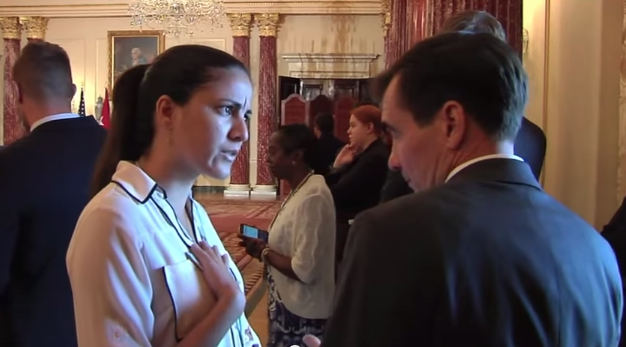
4. On July 20, 2015 at the State Department, Rosa Maria Payá Acevedo attended a press conference with Secretary of State John Kerry and Castro's foreign minister Bruno Rodriguez. Rosa Maria had proper accreditation as a member of the press. Rear Admiral John Kirby,  the State Department spokesman, took Rosa Maria aside and warned her that she would be physically removed if she asked any questions or caused any kind of disturbance. This was most likely done to appease the Castro regime's foreign minister.

5. Releasing Castro spies on December 17, 2014 serving life prison sentences, including one of them imprisoned for conspiracy to murder three U.S. citizens and one permanent resident. Two days later in a press conference, President Obama described the premeditated act of state terrorism carried out on Fidel and Raul Castro's orders on February 24, 1996 as a "tragic circumstance" while ignoring the open indictments on members of the Cuban military directly involved in the shoot down by U.S. courts. These actions encourage impunity and does not prioritize human rights.
The human rights situation in Cuba during the Obama administration has deteriorated and there is a body count that has coincided with the normalization drive that began in 2009 and continues to the present. The number of arbitrary detentions in Cuba have grown more than four fold between 2,074 politically motivated arbitrary detentions in 2010 compared to 8,616 detentions in 2015. The first two months of 2016 have seen a total of 2,555 arbitrary detentions.


The reality is that human rights in Cuba is not a priority for the Obama administration, but rather lifting the economic embargo and having a photo-op in Cuba later this month for his Presidential library. Truly hope I'm wrong but the record over the past seven years says otherwise.

Saturday, January 23, 2016

Legacy of Obama's Cuba Policy: Americans taken hostage, become bargaining chips

The cost in American lives and freedom is rising


Taken hostage in Iran and swapped by Obama Administration for Iranian criminals
The day that President Obama announced the administration's new Cuba policy and drive to normalize diplomatic relations the following observation was made on this blog:
First the news that three spies who had spied on military installations and congressmen on American soil, that had plotted terrorist acts in the United States, and were implicated in the February 24, 1996 murder of three American citizens and one American resident were freed in a swap to return to Cuba sends a terrible message. 
This led to the following prediction being made with regards to the Castro regime's behavior in the future:
Regime hardliners have won, thanks to the Obama Administration's actions today. Kidnapping an American and holding him for ransom for five years has paid off.  Moderate elements within the dictatorship, seeking to transition Cuba into a responsible member of the family of nations, will have to continue to remain silent and wait.
Over the past year there was an escalation in violent repression and a ten fold increase in religious repression in Cuba.  Worse yet, we now have learned that the Cuban government had obtained control of a Hellfire missile in 2014 that somehow ended up in Cuba. Despite repeated requests by the Obama Administration the weapon has not been returned as of today.
One day later on December 18, 2014 in another blog post explained how the behavior of the Obama administration would make American lives less secure:
Unfortunately, the consequences for Cuba and the Americas with these moral compromises by the Obama Administration will be "big and dangerous ones" generating new problems and challenges.  Make no mistake the message to enemies of the United States yesterday was crystal clear: Take an American hostage and hang on to him for years until your demands are met and you'll get what you want. It sets a terrible and dangerous precedent.
2015 and 2016 are shaping up to be difficult years for Americans traveling abroad. Consider the following: Kayla Jean Mueller, an aide worker captured in Northern Syria in 2013 was killed while in captivity on February 6, 2015. She had been repeatedly raped by the leader of the Islamic State of Iraq and Syria. She is the fourth American to die in ISIS captivity since August 2014.


Kayla Jean Mueller taken hostage by ISIS, raped and killed
 Two American citizens Scott Darden, a 45-year-old working for a New Orleans logistics firm, and Sam Farran, a 54-year-old security consultant from Michigan were taken on March 27, 2015 and held for six months as hostages in Yemen before being released. At the same time as the Obama administration did before with Cuba swapping innocent hostages for convicted criminals he did it again in Iran. Politico reported on January 16, 2016 that:
As part of a prisoner swap with Iran, President Barack Obama granted clemency to seven men of Iranian origin either facing criminal charges in U.S. courts or already serving time in U.S. prison, an American official confirmed Saturday.
The deal led to the release of four Americans being held in Iran: Washington Post journalist Jason Rezaian as well as Amir Hekmati, Saeed Abedini and Nosratollah Khosravi-Roodsari, the official said. In a move that was not part of the prisoner deal, the Iranians have also released a fifth American in their custody, student Matthew Trevithick.
 The message remains clear: If the United States is holding criminals that another power wants then all it has to do is take innocent Americans hostage and exchange them. Meanwhile in Iran, Robert Levinson, a retired FBI agent and contractor for the CIA who was kidnapped while working in Iran in 2007, and after appearing three years later in a video and then a series of photos made by his captors, he hasn’t been heard from since. The Obama administration has remained silent on his plight.With this new approach criminals, terrorists and intelligence officers are exchanged for innocent American hostages. The latest is a young student taken after a five day trip to North Korea:
A University of Virginia student honored as an “intellectual risk-taker” has been arrested in North Korea, its state-run media said Friday, accusing the American of an unspecified “hostile act” against the state. Otto Frederick Warmbier, 21, was detained Jan. 2 at Pyongyang airport as he prepared to leave after a five-day trip over the New Year’s holiday, said Gareth Johnson of Young Pioneer Tours, the agency that organized the trip. This was four days before North Korea conducted its latest nuclear test, and makes Warmbier the third Westerner known to be held in North Korea — a move that is certain to elevate already-high tensions with Washington.
 There is already speculation that North Korea wants to use the student as a bargaining chip. It has worked before in Cuba, Iran and with the hermit kingdom itself. A bad time to be an American traveling abroad. This is the end result of normalizing relations with abnormal regimes.

Hostage in North Korea: Otto Frederick Warmbier, age 21


Wednesday, December 2, 2015

Castro regime announces Cuban doctors will have to request permission to travel

2013 "Migration Reform" in Cuba: New rules to achieve the same result 
 
Cubans outside the Ecuadorian embassy in Havana, Cuba

News wire services reported today that Cuba's "communist authorities said Tuesday that from December 7 doctors will again be required to ask permission to travel abroad for private reasons." According to these press sources this is news because it runs counter to 2013 "reforms", but back in a 2013 post titled "New rules for the same old game" quoted the January 11, 2013 CNN report on restrictions maintained by the Castro regime:
Specifically, the Labor and Social Security Ministry defined categories of Cubans whose travel would be restricted. They include those who may be "criminally prosecuted, are subject to military service or (are denied) for reasons of defense and national security." "Also on the list are citizens who have obligations with the state or are not authorized under rules designed to preserve the skilled workforce and protect official information," read the Prensa Latina story.
Cubans do not only face restrictions to leave Cuba but also to return and visit their homeland. Between 70,000 and 300,000 Cubans are banned by the Castro regime from returning to their homeland reported The Miami Herald on August 15, 2011 in an article titled Many Cuban expatriates can't go home again.  A friend, born in Cuba, that I went to college with was not able to travel to Cuba when her grandmother died. It wasn't the US embargo that stopped her but the Castro regime that denied her request. No reason given. Many Cubans are afraid to speak freely about the reasons they left the island out of a fear that if they give a political motive they will never be allowed to return. A high profile example of a Cuban woman not allowed to return to Cuba to visit her dying father played out over social media in the latter half of 2013 and was reproduced, in part, in PanAm
Post's The Canal
Blanca Reyes had requested on July 22, 2013, permission to return to her homeland to visit her ailing 93-year-old father. However, on August 13, 2013, a Cuban consulate official denied her that opportunity. Two months later on October 13, 2013 Blanca tweeted:
My dad fractured his hip, they are going to operate, and Cuban government denies me entrance to see him. He is 93 years old.
In a later tweet she raised an important question:
Unable to enter your home, Cuba, can someone explain that? I address the people who still support the Cuban Government.
Two days later on October 15, 2013, Blanca tweeted the sad news that the father and daughter would never again to be reunited:
My father died today in Cuba did not see him for 9 years the Cuban government stopped me. UNTIL WHEN MY GOD?
Despite the regime’s propaganda offensive and media hype, the right to travel freely remains non-existent in Cuba. In this particular case, they denied a daughter the opportunity to say goodbye to her dad.
This so-called migration "reform" is an example of what martyred dissident leader Oswaldo Payá referred to as "fraudulent change." Giving the illusion of an opening while the Stalinist character of the dictatorship remained intact benefited the regime from decreased international scrutiny and increased its legitimacy abroad. Sadly, the reality has been very different. Cubans are no freer to travel now than before January 1, 2013,  it remains up to the whims of the dictatorship. 

Tony Diaz Sanchez, former prisoner of conscience and Christian Liberation Movement Leader on December 1, 2015 over Facebook summed up the current news coverage best: "The 201[2] 'reform' of the immigration law made clear that the 'state' could prevent the departure of any person for the 'public interest'.  If this already exists as law, then this with the doctors is nothing new, just smoke and mirrors."

Back in October of 2012 when the regime announced the new regulations I provided the following analysis:
The Castro dictatorship in 2012 is once again demonstrating that it is a master of distraction highlighting a new migration law with new rules that achieve the same result: travel in and out of Cuba is to be administered by the Ministry of the Interior and professionals such as medical doctors do not have freedom to travel. The infamous white card, an exit visa, that Cubans need to exit their own country will according to the regime announcement be replaced in 2013 with new more stringent requirements for the passport.

What do the authorities hope to accomplish with this so-called reform that the regime says will come into effect on January 1, 2013? First, one of the long term objectives of the dictatorship is eliminating the 1966 Cuban Adjustment Act which grants Cuban refugees special immigration privileges for fleeing a totalitarian dictatorship where the freedom of travel is nonexistent. Floating the threat of a slow motion Mariel is meant to pressure U.S. lawmakers into eliminating a law that demonstrates that the Castro regime is different from every other country in the hemisphere.  
All I can say now is, told you so. The human rights situation continues to deteriorate in Cuba as violence and repression escalates and now the United States faces the latest Cuban manufactured migrations crisis thanks to the inept foreign policy of the Obama administration. Cuba will not change for the better until the system created by the Castro brothers is replaced with a democratic system in which the rule of law is respected. Tourists will not achieve this change and the record in other totalitarian regimes indicates that if anything they will provide hard currency to the most repressive elements in Cuba that run the tourism industry.

Monday, November 30, 2015

The New York Times editorial board gives the Castro regime advice on how to lobby Congress

 Technology is neutral, and repressive regimes with the help of Western companies have used it to hang on to power.


The New York Times editorial board today is at it again providing advice to the dictatorship in Cuba on how to prolong its existence this time by achieving its long term political goal of lifting the embargo through partnering with a technology firm to overwhelm congressional opposition:
"Partnering with Google, which has enormous lobbying clout in Washington, could advance Havana’s goal of building enough political support in Congress to repeal the embargo and would make it harder for a future president to dial back the restoration of diplomatic ties that Mr. Obama set in motion last year."
 As has occurred before The New York Times omits and distorts key facts such as the circumstances surrounding Cuba plugging into the global cable network in 2013 enabling high-speed connections that have not reached the average Cuban. First it was President Obama who on April 13, 2009 directed the Secretaries of State, Treasury, and Commerce to take the needed steps to:
  • Authorize U.S. telecommunications network providers to enter into agreements to establish fiber-optic cable and satellite telecommunications facilities linking the United States and Cuba.
  • License U.S. telecommunications service providers to enter into roaming service agreements with Cuba’s telecommunications service providers.
  • License U.S. satellite radio and satellite television service providers to engage in transactions necessary to provide services to customers in Cuba.
  • License persons subject to U.S. jurisdiction to activate and pay U.S. and third-country service providers for telecommunications, satellite radio and satellite television services provided to individuals in Cuba.
  • Authorize the donation of certain consumer telecommunication devices without a license.
Despite this unilateral liberalization by the Obama administration, tt was the Castro regime that showed no interest in a fiber-optic cable linking the United States and Cuba from Key West in 2009 not the Cuban embargo. Instead the Cuban dictatorship went with a fiber-optic cable linking Cuba and Venezuela that required a much longer distance of cable to link the two countries. This was completed in 2013, but high speed internet access has not reached the average Cuban in 2015.

The regime may now have to abandon the its chief strategy of denying Cubans access to internet in order to pursue opportunities to enrich the dictatorship. However the Cuban government still has at least nine other tactics used by other repressive regimes to limit the internet's liberating potential: web blocking, precision censorship, infrastructure control, cyber attacks on exile run sites, malware attacks, internet kill switches, detaining bloggers, violence against online journalists, and criminalizing uncensored access to internet.

 Unfortunately, US technology firms such as Google, Microsoft, Yahoo, Sun Micro Systems and others have shown in markets such as mainland China a willingness to cooperate with totalitarian regimes and use technology to modernize their repressive system. It is up to human rights defenders and democrats to hold them accountable and expose them when they do wrong while at the same time encouraging them to pursue approaches that live up to the liberating potential of the internet.

Sadly, the visit of a Google executive to Cuba in 2014 did not inspire much confidence. Executive chairman of Google Eric Schmidt already had past associations with Sun Microsystems, the company that played an important role in erecting the Great Firewall in China that the Google executive now condemns and also Google's own past assistance of Chinese censorship both of which were condemned by Amnesty International.

Even more disturbing was the Google executive's reflections on his Cuba visit that made clear the Cubans had been effective at selling their Potemkin Village fiction as fact with such passages:
The two most successful parts of the Revolution, as they call it, is the universal health care free for all citizens with very good doctors, and the clear majority of women in the executive and managerial ranks in the country.  Almost all the leaders we met with were female, and one joked with us that the Revolution promised equality, the macho men didn’t like it but “they got used to it”, with a broad smile.
First the health care system in Cuba during the years of massive Soviet subsidies may have been something else, but the present one is a disaster. Even the public health infrastructure is a mess as the ongoing cholera outbreak is but one high profile example.

For a more complete overview that places the island's current reality into a historical context Schmidt would be well served to read Health, Politics, and Revolution in Cuba Since 1898 by Katherine Hirschfeld, an anthropologist who spent a lot of time in Cuba that describes how her idealistic preconceptions were dashed by 'discrepancies between rhetoric and reality,' she observed a repressive, bureaucratized and secretive system, long on 'militarization' and short on patients' rights.

However, that was not as shocking as Schmidt's second claim that another "successful" part of the Revolution is that: "Women are in the executive and managerial ranks." Mr Schmidt should take a closer look at the history of violence visited upon women who dissent and speak their minds in Cuba.

On May 24, 2015 Sirley Ávila León was the victim of a machete attack
The New York Times has not reported on the plight of reformer turned opposition figure Sirley Ávila León, an ex-delegate of the People’s Assembly (Poder Popular) of Majibacoa who joined the democratic opposition after efforts to keep a school open in her community. Official channels ignored Sirley's requests and when she went to the international media she was removed from office. Following escalating acts of repression by state security the mother of two, Sirley Ávila León, age 56, was gravely wounded in a machete attack on May 24, 2015 at 3:00pm by Osmany Carrión who had been "sent by state security thugs" and that the aggression "was politically motivated." She suffered deep cuts to her neck and knees, lost her left hand and remains completely incapacitated.

Remaining silent before these ongoing atrocities while engaging in "happy talk" on how a Stalinist regime can collaborate with U.S. technology firms to overcome economic sanctions which limit its ability to make mischief will not assist a democratic transition in Cuba, but do just the opposite - prolong the life of a totalitarian dictatorship.

This has been seen elsewhere, and apparently The New York Times would like to repeat it in Cuba. Technology is neutral, and repressive regimes have contracted Western companies to place draconian controls on the internet that are used to target activists. Amnesty International identified "Cisco Systems, Microsoft, Nortel Networks, Websense and Sun Microsystems" as having "provided technology used to censor and control the use of the Internet in China." These repressive applications of new technologies have been transferred to other dictatorships and now with the help of the The New York Times editorial board arriving in Cuba.

This should not be surprising considering the history of The New York Times with regards to left wing totalitarian regimes and propaganda role that assisted in empowering Fidel Castro in the 1950s and presently using a former Cuban intelligence agent, who remains an apologist for the Castro regime as a source. However it is important to highlight the facts and confront the omissions, and inaccuracies of what is supposed to be the newspaper of record.

Sunday, November 8, 2015

Rising repression in Cuba met by indifference from the U.S. State Department

State Department official explains human rights not a priority in Cuba as situation there worsens

Family of three arrested during 2015 Papal visit denounce the Castro regime today.

More than 200 activists detained today in Cuba for peacefully assembling and three days ago on November 5, 2015 two activists, Geovanys Izaguirre Hernandez and Laudelino Rodriguez Mendoza, were sentenced to six months in prison following a summary judgement.

The human rights situation in Cuba continues to deteriorate and the regime's behavior overseas remains as hostile to U.S. interests as ever but the drive to embrace the dictatorship by the Obama administration continues. Ambassador David Thorne, a senior adviser to Secretary of State John Kerry from Havana on November 3, 2015 explained the Obama administration's priority in Cuba is not human rights.
"As in other parts of the world, we are really trying to also say: Let's find out how we can work together and not always say that human rights are the first things that we have to fix before anything else."
Unfortunately, not making human rights a priority in foreign policy when dealing with foreign regimes has had catastrophic consequences for the United States in the past. The direction taken by the Obama administration in Cuba does not serve U.S. interests or the aspirations of Cubans to live in freedom. In short it is shaping up to be a disastrous failure.

Thursday, November 5, 2015

Freedom House President Questions Upgrading Cuba in 2015 Trafficking Report

Further evidence that 2015 Trafficking in Persons Report was politicized with respect to Cuba.

“The U.S. Anti - Trafficking Report and Diplomacy: Sustaining Candor and Credibility” 

Written Testimony by Mark P. Lagon 
President, Freedom House 

House Committee on Foreign Affairs Subcommittee on Africa, Global Health, Global Human Rights, and International Organizations 

Hearing: “ Demanding Accountability : Evaluating the 2015 Trafficking in Persons Report ” 

November 4 , 2015

Excerpt from full statement:

Cuba was upgraded to Tier 2 Watch List. With a diplomatic opening unmatched by any political opening, Freedom House ranks Cuba as Not Free. Some might claim a past downward political bias against Cuba in U.S. trafficking assessments was removed with the diplomatic opening. I do not look at the past that way.

The grounds for an upgrade are deeply questionable. The Report says:
  • “The penal code does not criminalize all forms of human trafficking” on paper, not to speak of enforcement. 
  • The Cuba regime did not even dissemble and claim any “efforts to prevent forced labor” nor “any trafficking - specific shelters. ” 
It is far - fetched to suppose that there is no forced lab or in state enterprises or for political prisoners in one of the world’s few remaining Marxist - Leninist states. Also, a burgeoning sex industry – welcoming sex tourism – fuels exploitation , despite steps the Report notes taken by Cuba to address sex trafficking .

Source: http://docs.house.gov/meetings/FA/FA16/20151104/104161/HHRG-114-FA16-Wstate-LagonM-20151104.pdf

Monday, March 9, 2015

Technology's double-edge sword in a democratic struggle

In a conversation over twitter on February 8, 2015 expressed the following controversial and perhaps counter-intuitive idea: "Experience with activists in Egypt left me skeptical of the technology panacea." Below is the case for my skepticism. Today, a version of this essay was published in The Canal, the Panam Post Blog 

Raul Castro, Hosni Mubarak, and Ban Ki-Moon at Non-Aligned Movement
Listening to U.S. officials discussing Cuba one is struck by the simultaneous discourse of expanding support for civil society using high technology while appearing to deemphasize the role of political opposition activists. This policy is not unique to Cuba. It has also been seen elsewhere, Egypt being a recent high profile example. Furthermore the emphasis on internet technology overlooks the role that companies such as Yahoo and Google have played in China to censor information and target dissidents for the dictatorship there in order to conduct business.

The United States in 2012 initiated Civil Society 2.0 which promotes blogging, texting, building a website, and operating in social networks as "capacity building." However in countries such as Egypt and even more so in Cuba where the vast majority of Cubans do not have access to cell phones (only 15% out of 11 million), much less internet (only 5% out of 11 million) how does this initiative build up the capacity of civil society to mobilize democrats?

Prior to the uprising in Egypt in 2010 I had blogged to raise awareness on the plight of bloggers, activists and journalists who had been arbitrarily detained. In late 2011 and early 2012 over the course of a month in Egypt, observing the first and third round of parliamentary elections, meeting with different stake holders ranging from: academics, human rights defenders, and bloggers to opposition political figures, revolutionaries in Tahrir Square, and the military the picture that emerged was not the popular narrative circulating in the press at the time.

Activists on twitter and bloggers were successful in generating attention internationally on what was taking place in Egypt, but in conversations with activists on the ground the role of cell phones and Facebook were not as advertised by some. Egyptian state security monitored the cell phones and communications over social media. These patterns of espionage utilizing high technology to target activists is not unique to Egypt. Activists understanding this provided disinformation via these channels while using low tech means to reach out and mobilize Egyptians that were not as susceptible to monitoring. 

However this was not the greatest oversight by policy makers and activists on the ground, but the failure to provide capacity training to democrats on how to mobilize effectively and the training on how to conduct an effective political campaign. This failure to work with the democratic political opposition in Egypt left a vacuum that was filled quickly by the well financed Muslim Brotherhood and the Nour Party ( an even more extreme Islamist party backed by Gulf Arab states) that dominated in the parliamentary elections. The Egyptian military stepped back and allowed the Muslim Brotherhood to rule in an increasingly undemocratic manner alienating vast sectors of Egyptian society leading to another round of mass protests in June of 2013 that ended in the restoration of military rule in a coup and the outlawing of the Muslim Brotherhood.

Technology is neutral, and repressive regimes have contracted Western companies to place draconian controls on the internet that are used to target activists. Amnesty International identified "Cisco Systems, Microsoft, Nortel Networks, Websense and Sun Microsystems" as having "provided technology which has been used to censor and control the use of the Internet in China." These repressive applications of new technologies have been transferred to other dictatorships.

Many experts, like the ones apparently operating in the State Department, argue of the importance of conditions such as: a large middle class, internet penetration or some minimum annual level of income.

However, Srdja Popovic, a cofounder and key figure in the Serbian resistance movement “Otpor!” that toppled Slobodan Milosevic nonviolently in 2000 disagrees with the above line of argument and makes the case that the most important thing that you can do is to build up the skills of activists because they are the ones who make the change. Conditions are important to take into consideration when activists are formulating their strategy but they do not define success.

The Obama administration's Cuba policy focused on credits, micro-enterprises, travel and internet will not lead to a democratic opening in Cuba either in the short, medium or long term. Instead it will serve as a distraction that will prolong the life of the dictatorship in Cuba and the Castro regime's power and influence abroad. At the same time democratic opposition leaders who are a threat to the dictatorship will continue to be targeted and eliminated. When the day arrives and the Castro regime enters an existential crisis the lack of support for political opposition activists will guarantee the failure of the stated policy goal of the United States: a nonviolent transition to democracy.

Furthermore, If democratic US leaders continue the example set by House Minority Leader Nancy Pelosi - who led a Congressional delegation last month and met with high-level officials of the dictatorship, but did not meet with Cuban democrats or human-rights defenders - then they will be undermining democrats and legitimizing autocrats. As was the case in Egypt, under-trained democrats with few resources will be no match for the anti-democratic, authoritarian, or totalitarian alternatives that present themselves with the backing of outside powers such as Russia or China that have strategic interests in Cuba.

Needless to say, that will not serve the just interests of the United States, nor of any other democracies in the region.