"The first victory we can claim is that our hearts are free of hatred. Hence we say to those who persecute us and who try to dominate us: ‘You are my brother. I do not hate you, but you are not going to dominate me by fear. I do not wish to impose my truth, nor do I wish you to impose yours on me. We are going to seek the truth together’. THIS IS THE LIBERATION WHICH WE ARE PROCLAIMING."
Oswaldo José Payá Sardiñas (2002)
Bloodshed in Nicaragua continues: Doctors fired for treating wounded anti-government protesters.
Students, and journalists among the 448 killed during anti-government protests
Today thousands of Nicaraguans are marching in Managua in support of the Bishops mediating the conflict that began on April 18, 2018 when the Ortega regime sent paramilitaries and Sandinista militants to violently put down peaceful protests and shutting down the free press. At least 448 killed over a hundred days of protests in Nicaragua.
Letter of dismissal for Nicaraguan doctor
Agence France Press reported yesterday that more than a dozen doctors, nurses, and technical staff in a public hospital in Nicaragua were fired because they treated wounded anti-government protesters. The Associated Press reported that eight public hospital doctors in Nicaragua said Friday that they have been
fired after violating alleged orders not to treat wounded protesters
opposing President Daniel Ortega’s government.
Bloody Alliance in Nicaragua: Ortega, Castro and Maduro
Daniel Ortega and the Sandinista Party are not alone in their bloody crackdown but also torture victims reported hearing Cuban and Venezuelan accents in secret prisons. Raul Castro on July 26th linked up the three countries saying: "For us, the same as for Venezuela and Nicaragua, it's very clear that
the noose is tightening, and our people need to be ready to respond to
every challenge with unity."
How the São Paulo Forum sees itself
On July 16-17, 2018 in Havana, Cuba the São Paulo Forum celebrated the victory at the ballot box of Andrés Manuel López Obrador (AMLO) in Mexico, and unconditionally defended Daniel Ortega and the Sandinista regime in Nicaragua despite the ongoing massacres of anti-government protesters.
In 1990 following a request made by Fidel Castro to Lula Da Silva the
Sao Paulo Forum was established with the goal: “To reconquer in Latin
America all that we lost in East Europe.” The FSP is a communist network
comprised of over 100 left wing political parties, various social
movements, and guerrilla terrorist organizations such as the Fuerzas
Armadas Revolucionarias de Colombia (FARC) and the Chilean Movimiento de la Izquierda Revolucionaria (MIR)
Wounded anti-government protester
This network is actively supporting Ortega's bloody regime and will be growing stronger later this year with the new government in Mexico.
Former Mexican Foreign Minister Jorge Castañeda revealed how the AMLO victory in Mexico will impact on events in Nicaragua and the timing for a solution. The new government takes power on December 1st. At best an Andrés Manuel López Obrador will return to a pre-2000 non-intervention policy in the region or at worse actively supporting the Ortega regime and their Cuban allies. Basically Nicaraguan democrats have until December to resolve the situation in their country or be prepared for an even longer and harder slog with a major country that is now backing them either going to the sidelines or joining the other side.
Silent marches and vigils for Maduro's victims in Venezuela
"No more murders in Venezuela"
The Maduro regime is killing young Venezuelans in order to provoke a violent response for the opposition. It is a trap for the opposition as was seen in Syria. A civic movement abandoning nonviolence and fighting the regime militarily is taking the fight to ground where the dictatorship has the advantage. Rather than falling into the trap, nonviolent opposition is organizing a
nonviolent silent march later today to remember those killed and demand justice.
"Silent march in honor of our fallen"
Mobilizing millions of Venezuelans to nonviolently resist the Maduro dictatorship has a better chance of forcing a democratic transition and the ouster of the regime. The alternative would be civil war and the odds are it would lead to the permanence of the Maduro regime with the aide of Cuban soldiers and intelligence assets.
Paola Ramírez and Carlos Moreno both shot in the head on April 19, 2017 in Venezuela.
Shooting young Venezuelans in the head to terrorize demonstrators and provoke a response has been a Maduro regime tactic since at least February 2014.
Beginning on February 12, 2014 regime agents shot Bassil Alejandro Dacosta, age 24 in the head. One of the young students who carried Bassil off after he was shot was Robert Redman, age 28, who reported later that day over twitter: "TodayI was hit witha rockintheback, ahelmet in mynose. I swallowed tear-gas, Carried thekid who died, and what did you do?"
That same day he was also gunned down by Maduro's colectivos, working
in concert with his security forces, and murdered. The killings continued.
Some of the young Venezuelans shot in the head by Maduro's agents
A high profile killing that shocked the world was the murder of a local beauty queen. Génesis Carmona wasmarchingat approximately 4:00pmon TuesdayFebruary 18, 2014, nearCedeñoAvenue and the intersection of Carabobo,when a group of masked gunmen on motorcycles opened fire on the demonstrators. Génesiswas shot inthe head in the leftoccipitalregion.She wasa modelwho had won theMissTourismCarabobo beauty pageant in 2013.There have been dozens more executed by Maduro regime agents in an effort to terrorize and either silence or provoke nonviolent protesters.
March of silence for the fallen on Saturday, April 22nd at 10am
Families of the victims have pursued justice and had some successes, but much remains to be done to end impunity and hold those responsible accountable. This morning beginning at 9:00am silent marches and rosaries will be held in Acarigua and Araure while an hour later marches will begin in other parts of Venezuela. Demonstrators are asked to dress in white.
March of silence in honor of the fallen. Saturday, April 22, 2017 at 10am
Those of us who advocate for nonviolence in Venezuela have an obligation to speak out and denounce the violence visited on non-violent opponents by the Maduro regime and their Cuban handlers. Those engaged in violence need to understand that sooner or later they will have to answer for their crimes in a court of law.
"They did not die. They murdered them."
Please use the hashtags #MarchaDelSilencioand #SilentMarch along with #Venezuela and share pictures of those killed by Maduro. Tragically, there are many to choose from. They must be not be forgotten.
Vigil for the fallen in Anzoategui, Venezuela last night
“Satisfaction lies in the effort, not in the attainment, full effort is
full victory.” - Mohandas Gandhi
It was a Tuesday in Caracas with the sun showing brightly down Leopoldo Lopez stood next to a statue of Jose Marti addressing a multitude of Venezuelans calling on them to nonviolently resist the dictatorship in Venezuela. At the same time this courageous man announced that although knowing that he did not expect justice from the legal system controlled by the Maduro regime that he would turn himself in to demonstrate the dictatorial nature of that regime.
Tens of thousands gathered to support Leopoldo Lopez and many shouted that he not turn himself in and would have defended him with violence, but the opposition leader counseled self-restraint, discipline, nonviolence and before he turned himself in to regime security forces addressed his supporters:
"Well
brothers and sisters I ask you to continue in this fight and do not leave
the street, to assume our right to protest, but to do it in peace and
without violence, I ask that us, all of us that are here, all of the
Venezuelans that want a change, to get informed, educated, organized,
and to execute non-violent protests, the protests of masses, and the
will of souls and hearts that want to change, but without hurting your neighbor. " [...] "I am
now about to proceed to go towards the squad where the National Guard is
to turn myself in. (One of the reporters yells: " COME ON MAN DON'T
TURN YOURSELF IN") I am going to do it. I thought about it a lot. I'd
like to let you know that these past few days, I had a lot of time to
think, analyze, listen to the radio, watch TV or read what I haven’t for
a while, speak with my family, and the option I had was to leave the
country, but I will never leave, never. The other option, was to stay
hidden in secrecy, but that choice could leave doubts among
some, including some who are here now that we have something to hide. We
have nothing to hide, I have not committed any crimes, I am not a
criminal, I
do not have to hide, then the other option is to turn my self in, and I
ask you, and beg you with my heart, that when I pass by and turn myself
in, that you keep calm, we have no other option. I do not want any
more violence or confrontation, so I ask for your understanding, for
your organization
and your discipline."
One year 6 months 24 days after his arrest and all that time spent behind bars Leopoldo Lopez was subjected to a political show trial and sentenced to 13 years and 9 months in prison on September 10, 2015 in what can only be described as a mockery of justice. On August 18, 2016
the appeal was rejected by the regime controlled court. and the imprisoned Venezuelan opposition leader went on to make a number of observations regarding his case:
Only in a dictatorship can it be considered a crime being committed to achieve the best Venezuela. It has always been clear to me that there will be no judge or any court of this dictatorship that will grant me freedom. With our case the unjust justice has been laid bare in front of Venezuelans and the world ... Ironic. One of the judges today executioner, Jimai Montiel, was that boy who sang to Pope John Paul II in 1985. Brothers, Venezuelans,
I ask that we turn all our indignation into action and mobilization!
They can't break our fighting spirit! They can't force Venezuelans to submit! Let us go forth to conquer change and democracy. At this time, the solidarity that I ask is with our beloved Venezuela!
Being taken to hearing where he is appeal was rejected
The Indian nonviolent independence leader Mohandas Gandhi wrote that
"Nonviolence implies voluntary submission to the penalty for
non-co-operation with evil." This is what Leopoldo Lopez did on
February 18, 2017 in Venezuela and has continued to do so for the past
three years behind bars.
On the eve of marking three years unjustly imprisoned Leopoldo Lopez was able to get a message out over twitter calling on his fellow Venezuelans to continue non-violently resisting the dictatorship in Venezuela:
Tomorrow 18F, we return to the streets, without violence, but firm. Worker, student, housewife, businessman all together! Let us begin a new stage of democratic resistance. Restoring freedom and democracy depends on our commitment. Brothers and sisters, I invite you to resist, to fight and to conquer our
rights, our freedom and our progress. Strength Venezuela,
Strength and Faith.
1,579,680 minutes have ticked by for Leopoldo Lopez over the past three years imprisoned and separated from his family but with his continuing nonviolent defiance and call to action these past three years are an ongoing full victory that has exposed the dictatorial nature of the Maduro regime and inspired friends of freedom everywhere.
Cuban dissidents march for Leopoldo Lopez's freedom in Cuba in 2014
Despite the dangers today across Venezuela there are many citizens taking to the streets demanding freedom for Leopoldo Lopez and for Venezuela. The trending topic in Venezuela is #NoMasDictaduraEnVzla [ No More Dictatorship in Venezuela].
Protests for Leopoldo and a free Venezuela today
Today let us raise our voices and demand freedom for Leopoldo Lopez and for Venezuela.
Youth leader Ana Karina Garcia giving thanks to Venezuelans participating in the protests outlined over twitter the next steps the opposition will be taking: today they go to the National Assembly, on Friday a national general strike has been called and on November 3rd a march on Miraflores.
In Miami and in over 60 cities around the world protests where held in solidarity with the protesters in Venezuela using the hashtag #ConVenezuela (#WithVenezuela).
Last night Venezuelans gathered in Miami to show their support for a free Venezuela
There are times when one must speak out because to remain silent is to be complicit in a great crime. Over the past 16 years the Chavista regime in Venezuela has undermined democracy and the rule of law in that country while erecting a totalitarian regime there. Too many continue to pretend that Venezuela is still a democracy and keep silent. However the facts speak otherwise and we owe it to courageous democratic Venezuelans not only to speak out but to take a stand for freedom in Venezuela.
Last night imprisoned opposition leader Leopoldo Lopez was able to get a message out over twitter reaffirming his commitment to nonviolence as the means to achieve a better Venezuela and calling on his fellow citizens to take to the streets of Caracas today, dressed in white and nonviolently in their exercise of their fundamental rights. Recall his final speech in freedom it remains extremely relevant today.
As I write these lines, in Venezuela journalists continue to be expelled from the country, armed raids by Maduro's political police are being carried out against the nonviolent political opposition, and confirmed that 37 Venezuelans arbitrarily detained over the past 48 hours leading up to today's protest. Among them, Yon Goicoechea, a youth leader and the 2008 Milton Friedman Prize Laureate.
What drives the dissatisfaction with the Maduro regime? Consider the following:
Hugo Chavez undermined the rule of law when in 2009 over television he denounced a judge's legal decision that followed both Venezuelan and international law to release an individual who had been arbitrarily detained and called for the judges imprisonment. The judge was jailed, raped, and today is still fighting a legal battle over that arbitrary and criminal act by the late President Hugo Chavez.
Chavez regime's arbitrary seizure of private property and campaign of slander led Franklin Brito, a biologist to engage in a series of hunger strikes to demand his rights. He died on August 30, 2010 while being held in custody.
Under Nicolas Maduro the targeting of the nonviolent democratic opposition has intensified as his popularity has plummeted.
44 students were killed while peacefully protesting the Maduro regime in 2014. Many were shot in the head by snipers and paramilitary armed groups called colectivos that work in coordination with the Chavista intelligence service and military.
There are prisoners of conscience in Venezuela who are jailed simply for wanting a better Venezuela and being willing to use nonviolent and constitutional means to achieve it. The European Parliament recognizes that there are 2,000 people arbitrarily detained for political reasons in Venezuela. Their names need to known and remembered and not just the high profile names such as: Caracas Mayor Antonio Ledezma (2015), former mayor of the Caracas municipality of Chacao Leopoldo Lopez (2014), Popular Will party activists Francisco Márquez and Gabriel San Miguel (2016) but those who are not known such as Vasco Da Costa (2014), Araminta González, who is a victim of torture (2014) and many more.
This is why we need to stand with Caracas today, denounce the Maduro regime, and support the Venezuelan people's recall effort to rid themselves legally and constitutionally of Nicolas Maduro and the Chavista regime. In Miami on Saturday September 3rd at 3:00pm at the Freedom Tower will be an opportunity to demonstrate solidarity with Caracas and free Venezuelans.
Venezuelans in sixty cities around the world are organizing solidarity events around the hashtag #ConCaracas which translates to English #WithCaracas beginning on September 1, 2016 and ending on September 4, 2016.
*AMSTERDAM*Thursday 1, 6:00pm, Location: to be determined.
Voting in Venezuela is a militarized process full of irregularities
Armed forces sent to "guard" the electoral process in Venezuela
Today's vote in Venezuela is important but it won't be the decisive factor in restoring democracy in that country. If the opposition truly believe that the majority voting against Maduro's political party, the PSUV will alone end his dictatorship then they have lost before the first ballot was cast. On Tuesday, December 1st on his weekly television show Nicolas Maduro spoke clearly on how he would respond to an opposition victory in the legislative elections: "I will never allow this to happen, ever. I would go out on the streets and fight side by side with the people." His government's approval ratings are languishing around 22 percent but may narrow the opposition's margin of victory or yet "win" the vote today through massive fraud. Even if he were to lose in the elections Maduro has declared: "Were we to lose, which I find unimaginable, I will govern with the people in a civilian-military alliance." Civil society and the democratic opposition need to do much more to ensure that the votes of Venezuelans today and their right to vote are respected. These are contested elections in a country with an anti-democratic regime in power.
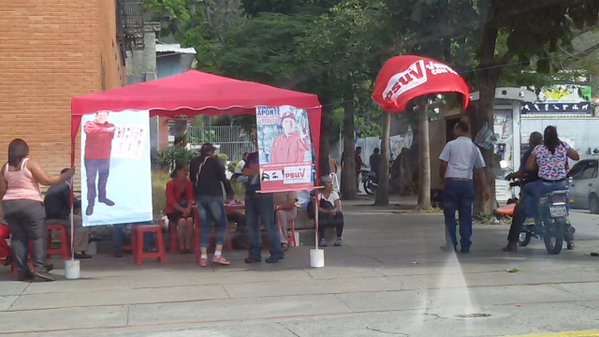
Maduro's PSUV campaigning on election day in violation of the law
The Maduro regime has demonstrated once again today that it does not respect the rule of law when it comes to the ruling party and its own regime. There have been reports that the military have blocked entry of opposition poll watchers to the polling stations. According to Venezuelan electoral law campaigning should have ended on Thursday night at midnight, but Maduro's political party has set up campaigning tents near voting centers today drawing complaints from citizens in Caracas, La Florida, and elsewhere. Reports have emerged of voting centers with broken equipment and voter intimidation by PSUV supporters. Attorney Edicson Cubillan and Franklin Gavidia of the opposition Democratic Unity were detained in Aragua when they opposed massive "assisted voting."
(1) Ballot positioning: theruling partyis highlightedin the firstballotbox,themain opposition partygetslostamong countlesssquares, colorsand symbols of minor parties. (2)Mainstream mediacontrolledby Maduro.Since 2000 theInter-American Commission on Human Rightsand the SpecialRapporteur on Freedom ofExpression,have reiteratedthe lack of freedomof expression inVenezuela. On November 30, 2015 international reporters were required to sign a good conduct pledge before the election.
(3) Politicalviolenceand intimidation are constant.Opposition candidateLuis Manuel Diaz was assassinated.President NicolasMadurosaid thatthe murder ofDiaz was due toa clashbetween gangs. (4.) Maduro set the clock back in Latin America three decades, when he did not accept international election observation. (5) LeopoldoLopez,one of the leadingopposition leaders remains in prisondespite complaintsfrom the UN,the IACHR andhuman rights organizations.Next to him areabout seventyothersmade up ofpolitical leadersand students.Lopez wassentenced to 13 years,9 months, 7 days and12 hoursin prison in a political show trial. (6) Severalopposition leadershave been declaredineligible tobe candidatesin the elections by Maduro including popular candidates Leopoldo Lopez Mendoza and more recently María Corina Machado. Regional human rights courts found Maduro's disqualification procedure running afoul of the American Convention.
(7) State of siege extended to 23 municipalities in the states of Zulia, Tachira and Apure, prohibiting, among others the rights to public assembly, of transit and to demonstrate peacefully. In these municipalities the military is the "sole authority" that responds directly to Nicolas Maduro who appointed them.
These are some of the reasons that international organizations have expressed their concerns about today's legislative elections and are trying to assist with observers. María Corina Machado over twitter yesterday explained the stakes: "Win by a landslide or a monumental fraud will be done that we will not accept."
Lilian Tintori, the wife of Venezuelan prisoner of conscience Leopoldo
López Mendoza, successfully held simultaneous nonviolent protests at the
United Nations in New York City and in Caracas to demand that human
rights be respected in Venezuela and that all prisoners of conscience in Venezuela be freed. Over twitter today she announced:
"To protest for our rights is not only a right it is our obligation! Today I go to the United Nations. Venezuela our callisto a nonviolent andpeaceful protest. TodayI go to the United Nations for myhuman rights. Human rightsbelong to us, they are not negotiatedandare enshrined inour constitutionand in the United Nations."
Letter turned into the United Nations in Caracas today
In Caracas, Lilian Tintori met with United Nations officials and turned in the above letter demanding the release of political prisoners and measures to restore human rights and democratic norms in Venezuela. Demonstrations in solidarity with these demands also erupted in Mexico.
Protest in Mexico for human rights in Venezuela on September 26, 2014
The Office of the Special Rapporteur for Freedom of Expression
of the Inter-American Commission on Human Rights (IACHR) on September 22, 2014 expressed "its
deepest concern for the deterioration of the right to freedom of
expression in Venezuela in light of the recent events that took place in
that country. These events include the continued stigmatization by
high-level public officials of critical media outlets and journalists,
punitive lawsuits and the dismissal of journalists, and the reported
blocking of the internet signal of media outlets."
The New York Times Editorial Board published an editorial on September 20, 2014 titled, "Venezuela's Crackdown on Opposition" highlighting among other travesties the show trial of opposition leader, Leopoldo López that has been underway since July 2014.
The struggle for freedom and human rights in Venezuela continues.
"Living the abuse of a dictatorship leads me to have an unwavering commitment to achieve democracy." - Leopoldo López Mendoza, Venezuelan prisoner of conscience September 17, 2014
For Freedom: Protest Against Maduro Friday Sept. 26 at 12 noon at the UN in NYC
Lilian Tintori, the wife of Venezuelan prisoner of conscience Leopoldo López Mendoza, has called for simultaneous nonviolent protests at the United Nations in New York City and in Caracas to demand that human rights be respected in Venezuela.
Ten days ago on September 16, 2014 addressing the UN Human Rights Council I named the first students extrajudicially executed by Venezuelan government agents in February of 2014: Bassil Dacosta, Robert Redman, Génesis Carmona and Geraldine Moreno and went on to recall that "[s]ince February 12, 2014 forty three youths have been killed while
protesting rising insecurity and vanishing rights in their country. Over
5000 have been injured and 3,000 arbitrarily detained."
"Freedom for all the youths and students jailed"
Now is the time to stand up and nonviolently protest and demand that those responsible for the killings be brought to justice and those arbitrarily detained such as Leopoldo López Mendoza.
Although I am far away from Caracas and New York City tomorrow the Venezuelan men and women who continue to be unjustly imprisoned and those peacefully protesting for them will be in my thoughts and prayers.
All to the UN this Friday September 26 at 11am in Caracas
"TodayI was hit witha rockintheback, ahelmet in mynose. I swallowed tear-gas, Carried thekid who died, and what did you do?" - Robert Redman, age 28 over twitter on February 12, 2014 shortly before he was shot and killed.
Roberto Redman (center) carrying Bassil Alejandro Da Costa on February 12
February 12, 2014 is a day that needs to be remembered, not only in Venezuela, but wherever people of goodwill are to be found. Students were gunned down in cold blood that day by state security agents of the Maduro regime for nonviolently protesting in defense of their rights.
JanethFrias, the mother of Bassil Alejandro DaCosta, said her son"wanted to go outto protest for hismother whohad been waiting forfour monthsfor an operation and there were no suppliesfor the surgery."
Bassil Alejandro Dacosta(age 24) shot and killed on February 12, 2014
Robert Redman, in the picture above carrying shooting victim, Bassil
Alejandro Da Costa on February 12, 2014 tweeted: "TodayI was hit witha rockintheback, ahelmet in mynose. I swallowed tear-gas, Carried thekid who died, and what did you do?" He was 28 years old.
He had carried the lifeless body of Bassil Alejandro Da Costa Frias who had been shot by Venezuelan security. Hours after tweeting the above message, Roberto Redman was also shot in the head and extrajudicially executed by Maduro's security forces.
Six
months later and the words of Robert Redman, a young man who put his
life on the line for a better Venezuela, remain a powerful indictment both of a tyrannical regime and those who remain apathetic before its unjust actions.
Robert Redman shot and killed on February 12, 2014
Forty one more would be killed over the next six months for peacefully exercising their rights and many shot in the head like Robert and Bassil. They must be remembered, their sacrifice honored and the call for justice for them and their families echoed around the world.
"Prosecutors, Judges Complicit in Rights Violations" - Human Rights Watch
NBP detain a demonstrator at protests in Caracas, Venezuela, 3/22/14 AP
May 5, 2014
This 103-page report documents 45 cases from
Caracas and three states, involving more than 150 victims, in which
security forces have abused the rights of protesters and other people in
the vicinity of demonstrations. Security forces have also allowed armed
pro-government gangs to attack unarmed civilians, and in some cases
openly collaborated with the gangs.
The accounts of the victims in these 45 cases—together
with corroborating evidence assembled from a diverse range of
sources—provided credible evidence that more than 150 people were victims
of serious abuses in related incidents. (For more on how we conducted our
research and documented cases, see the “Methodology”section
in this report.)
In most of the cases we documented, security forces employed
unlawful force, including shooting and severely beating unarmed individuals.
Nearly all of the victims were also arrested and, while in detention, subjected
to physical and psychological abuse. In at least 10 cases, the abuses clearly
constituted torture.
In all three states, as well as in Caracas, security forces
allowed armed pro-government gangs to assault unarmed civilians, and in some
cases openly collaborated with them in the attacks, our research found.
The Venezuelan government has characterized the protests
taking place throughout the country as violent. There is no doubt that some
protesters have used violence, including throwing rocks and Molotov cocktails
at security forces. More than 200 security force members and government
officials have been injured in the context of the protests, and at least nine
have died, according to the government. All crimes—including those
committed against security forces, protesters, and bystanders—require
rigorous investigation, and those responsible should be brought to justice.
Moreover, security forces have a responsibility to detain people caught in the
act of committing crimes.
However, in the 45 cases of human rights violations we
documented, the evidence indicated that the victims of unlawful force and other
abuses were not engaging in acts of violence or other criminal activity at the
time they were targeted by Venezuelan security forces. On the contrary,
eyewitness testimony, video footage, photographs and other evidence suggest
victims were unarmed and nonviolent. Indeed, some of the worst abuses we
documented were committed against people who were not even participating in
demonstrations, or were already in detention and fully under the control of
security forces.
The nature and timing of many of these abuses—as well
as the frequent use of political epithets by the perpetrators—suggests
that their aim was not to enforce the law or disperse protests, but rather to
punish people for their political views or perceived views.
In many instances, the aim of the abuse appears to have been
to prevent individuals from documenting the tactics being employed by security
forces, or to punish those attempting to do so. In 13 of the cases we
investigated, security forces targeted individuals who had been taking
photographs or filming security force confrontations with protesters.
Roughly
half of these individuals were professional journalists, while the other half
were protesters or bystanders using cell phones to document use of force by
security forces.
In addition to the unlawful use of force and arbitrary
arrests, nearly all of the 45 cases involved violations of due process
guarantees. These included holding detainees incommunicado, denying them access
to lawyers until minutes before they were presented to judges, and in several
cases planting evidence on them before charging them with crimes. Judges often
confirmed charges against detainees based on dubious evidence presented by
prosecutors, without subjecting the evidence to rigorous review or inquiring
into how suspects presented before them had sustained visible injuries.
Prosecutors and judges routinely turned a blind eye to
evidence suggesting that detainees had been subject to abuses while in
detention, such as ignoring obvious signs of physical abuse, or interrogating
detainees in military installations, where it was clear they did not have
access to lawyers.
"Today Venezuelan workers nationwide march with the students! We all want the same thing! Freedom!" - Gabriel Lugo, student leader over twitter on May 1, 2014
Workers and students joined together in a common front to march for
their rights today on May 1, 2014 and in protest against the Maduro
regime. On April 28, 2014 Leopoldo Lópezfrom prison backed the May Day march: "This May 1st lets all go out to protest. Never have there been so many reasons for our workers to manifest themselves." Leopoldo's wife Lillian took part in the march and called for continued action. On April 30, 2014 students, labor unions and guilds gathered together and mobilized tens of thousands for the May Day march with the hashtag: #thestreetwillnotbesilenced. During today's protests dozens of demonstrators were detained by Maduro's security forces. In addition and ominously two human rights organizations had their offices raided today. Today, jailed opposition leader Leopoldo López made public the following letter outlining the situation and calling for a common resistance front.
Leopoldo López in Ramo Verde prison
LETTER TO VENEZUELAN WORKERS ON THEIR DAY
From
the military prison in Ramo Verde, where I am unjustly imprisoned by a
dictatorship that seeks to silence legitimate protest by workers
through blackmail, judicial persecution and labor militias I want to
extend my message of firmness and support in the struggle for their claims that is also our struggle. On May 1, 1886 , in the city of Chicago, a front of workers began a day of nonviolent protests in favor of a maximum 8-hour workday under the slogan "eight
hours for work, eight hours for sleep and 8 hours for the family. " This peaceful protest was brutally repressed and its leaders executed. But
the force of reason ended by imposing itself over the logic of force and a few
years later workers won a resounding victory when most of the laws in
the world consecrated the 8-hour work day and May 1 went on record as the day of the workers.
One
hundred and twenty eight years later the government of Nicolás Maduro persecutes, fires and jails workers who refuse to give up their freedoms
of association, collective bargaining and protest as mechanisms to
improve their living conditions amidst the resounding failure of the
socialist economic model and its legacy of inflation, shortages, destruction of national
employment and criminalization of public protest including those of the workers. The minimum wage, even after the insufficient increase announced by Maduro, is the lowest in the region. 85 dollars compared to 487 in Panama , 300 in Colombia, 338 in Ecuador, 265 in Peru and 171 dollars in Bolivia. Only in Cuba , where workers are unfortunately a sort of slave labor
exploited by the Cuban government , the minimum wage is lower than in
Venezuela (10 dollars) .
The shortage exceeds 30 percent and workers and their families are denigrated and make long lines to buy commodities. Inflation in food reaches the inhuman figure of 80 percent. In
recent months, it has paralyzed much of the national productive
apparatus as a result of the lack of foreign currency that for years were
devoted to an unsustainable expansion of imported consumer goods at the
expense of domestic production. Today, the dictatorship mocks employers and employees in the national
economy with promises of a currency that never arrives while there are plants stopped and
workers in their homes.
It
is the consequence of an economic production model at odds with production and
national employment and addicted to imports that has served to buy the
loyalty of governments who, in exchange for getting markets for their
products, are willing to tolerate in Venezuela an autocratic regime they would never accept in their countries. I do not hesitate to say that the big losers of the disaster of Maduro have been Venezuelan producers and workers. But its not only the dismal performance of the dictatorship, which should unite in this fight. It is above all the systematic violations of freedom of Venezuelan workers , especially our public workers union. The
right to bargain collectively in the State is in practice suspended and who raise their voices for the enforcement of contracts or the
precarious state of public companies are dismissed, prosecuted and
jailed . Representatives of the workers are marginalized from the social dialogue.
The
vast majority of workers rejected the application of a socioeconomic
model that keeps basic political and trade union freedoms confiscated. They are trying to impose in Venezuela the Chinese - Cuban model: cheap labor and without rights in service to the State and international capital.
Trade union freedom can only exist in the context of a democratic and
pluralistic model of labor relations in the framework of the Rule of Law
that guarantees the full exercise of all civil liberties and rights of
all. Trade union freedom is an illusion when one is before a government that in addition to
employer is labor inspector, judge, police and electoral rector and
uses all its power to destroy the autonomy of trade unions and place them in service of the failed project . I
am convinced that economic and social progress of all Venezuelans is
only possible to achieve in a climate of civil liberties and that necessarily
involves the articulation of all political and social forces in a common
front that would achieve a substitution of the dictatorship led by Nicolás Maduro, through peaceful and constitutional means . Workers and students must be at the forefront of the front along with the political parties. Today those of us who believe and are ready to defend freedom must unite in the same struggle . Freedom is indivisible and only fighting for it together can we conquer it. Freedom
when it starts to disappear when it is most needed, and in Venezuela the lack of
freedoms is a reality that affects millions of Venezuelans
every day. Let us unite in one front in the same struggle and in the same purpose:
that all rights be for all the people , without exceptions and without
privileges.






 Posts
Posts

