Saturday, June 16, 2012

21 years later: Nobel Lecture by Aung San Suu Kyi


Photo: Htoo Tay Zar, OpenMyanmar Photo Project Creative Commons Attribution-Share alike 3.0


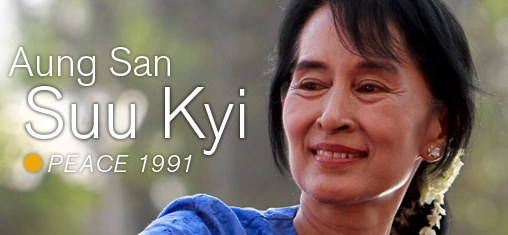
Aung San Suu Kyi, awarded the 1991 Nobel Peace Prize for her non-violent struggle for democracy and human rights, is finally in Oslo, Norway, to deliver her Nobel Lecture.


Burmese democracy leader, Aung San Suu Kyi was under house arrest and unable to collect the award in 1991. The Nobel Lecture will be delivered on Saturday 16 June 2012, at 7:00am EST. Watch the lecture live below. 


 Nobel Lecture by Aung San Suu Kyi, Oslo, 16 June, 2012

Your Majesties, Your Royal Highness, Excellencies, Distinguished members of the Norwegian Nobel Committee, Dear Friends,

Long years ago, sometimes it seems many lives ago, I was at Oxford listening to the radio programme Desert Island Discs with my young son Alexander. It was a well-known programme (for all I know it still continues) on which famous people from all walks of life were invited to talk about the eight discs, the one book beside the bible and the complete works of Shakespeare, and the one luxury item they would wish to have with them were they to be marooned on a desert island. At the end of the programme, which we had both enjoyed, Alexander asked me if I thought I might ever be invited to speak on Desert Island Discs. “Why not?” I responded lightly. Since he knew that in general only celebrities took part in the programme he proceeded to ask, with genuine interest, for what reason I thought I might be invited. I considered this for a moment and then answered: “Perhaps because I’d have won the Nobel Prize for literature,” and we both laughed. The prospect seemed pleasant but hardly probable.

(I cannot now remember why I gave that answer, perhaps because I had recently read a book by a Nobel Laureate or perhaps because the Desert Island celebrity of that day had been a famous writer.)
In 1989, when my late husband Michael Aris came to see me during my first term of house arrest, he told me that a friend, John Finnis, had nominated me for the Nobel Peace Prize. This time also I laughed. For an instant Michael looked amazed, then he realized why I was amused. The Nobel Peace Prize? A pleasant prospect, but quite improbable! So how did I feel when I was actually awarded the Nobel Prize for Peace? The question has been put to me many times and this is surely the most appropriate occasion on which to examine what the Nobel Prize means to me and what peace means to me.

As I have said repeatedly in many an interview, I heard the news that I had been awarded the Nobel Peace Prize on the radio one evening. It did not altogether come as a surprise because I had been mentioned as one of the frontrunners for the prize in a number of broadcasts during the previous week. While drafting this lecture, I have tried very hard to remember what my immediate reaction to the announcement of the award had been. I think, I can no longer be sure, it was something like: “Oh, so they’ve decided to give it to me.” It did not seem quite real because in a sense I did not feel myself to be quite real at that time.

Often during my days of house arrest it felt as though I were no longer a part of the real world. There was the house which was my world, there was the world of others who also were not free but who were together in prison as a community, and there was the world of the free; each was a different planet pursuing its own separate course in an indifferent universe. What the Nobel Peace Prize did was to draw me once again into the world of other human beings outside the isolated area in which I lived, to restore a sense of reality to me. This did not happen instantly, of course, but as the days and months went by and news of reactions to the award came over the airwaves, I began to understand the significance of the Nobel Prize. It had made me real once again; it had drawn me back into the wider human community. And what was more important, the Nobel Prize had drawn the attention of the world to the struggle for democracy and human rights in Burma.

We were not going to be forgotten.

To be forgotten. The French say that to part is to die a little. To be forgotten too is to die a little. It is to lose some of the links that anchor us to the rest of humanity. When I met Burmese migrant workers and refugees during my recent visit to Thailand, many cried out: “Don’t forget us!” They meant: “don’t forget our plight, don’t forget to do what you can to help us, don’t forget we also belong to your world.” When the Nobel Committee awarded the Peace Prize to me they were recognizing that the oppressed and the isolated in Burma were also a part of the world, they were recognizing the oneness of humanity. So for me receiving the Nobel Peace Prize means personally extending my concerns for democracy and human rights beyond national borders. The Nobel Peace Prize opened up a door in my heart.

The Burmese concept of peace can be explained as the happiness arising from the cessation of factors that militate against the harmonious and the wholesome. The word nyein-chan translates literally as the beneficial coolness that comes when a fire is extinguished. Fires of suffering and strife are raging around the world. In my own country, hostilities have not ceased in the far north; to the west, communal violence resulting in arson and murder were taking place just several days before I started out on the journey that has brought me here today. News of atrocities in other reaches of the earth abound. Reports of hunger, disease, displacement, joblessness, poverty, injustice, discrimination, prejudice, bigotry; these are our daily fare. Everywhere there are negative forces eating away at the foundations of peace. Everywhere can be found thoughtless dissipation of material and human resources that are necessary for the conservation of harmony and happiness in our world.

The First World War represented a terrifying waste of youth and potential, a cruel squandering of the positive forces of our planet. The poetry of that era has a special significance for me because I first read it at a time when I was the same age as many of those young men who had to face the prospect of withering before they had barely blossomed. A young American fighting with the French Foreign Legion wrote before he was killed in action in 1916 that he would meet his death:  “at some disputed barricade;” “on some scarred slope of battered hill;” “at midnight in some flaming town.” Youth and love and life perishing forever in senseless attempts to capture nameless, unremembered places. And for what? Nearly a century on, we have yet to find a satisfactory answer.

Are we not still guilty, if to a less violent degree, of recklessness, of improvidence with regard to our future and our humanity? War is not the only arena where peace is done to death. Wherever suffering is ignored, there will be the seeds of conflict, for suffering degrades and embitters and enrages.

A positive aspect of living in isolation was that I had ample time in which to ruminate over the meaning of words and precepts that I had known and accepted all my life. As a Buddhist, I had heard about dukha, generally translated as suffering, since I was a small child. Almost on a daily basis elderly, and sometimes not so elderly, people around me would murmur “dukha, dukha” when they suffered from aches and pains or when they met with some small, annoying mishaps. However, it was only during my years of house arrest that I got around to investigating the nature of the six great dukha. These are: to be conceived, to age, to sicken, to die, to be parted from those one loves, to be forced to live in propinquity with those one does not love. I examined each of the six great sufferings, not in a religious context but in the context of our ordinary, everyday lives.

If suffering were an unavoidable part of our existence, we should try to alleviate it as far as possible in practical, earthly ways. I mulled over the effectiveness of ante- and post-natal programmes and mother and childcare; of adequate facilities for the aging population; of comprehensive health services; of compassionate nursing and hospices. I was particularly intrigued by the last two kinds of suffering: to be parted from those one loves and to be forced to live in propinquity with those one does not love.

What experiences might our Lord Buddha have undergone in his own life that he had included these two states among the great sufferings? I thought of prisoners and refugees, of migrant workers and victims of human trafficking, of that great mass of the uprooted of the earth who have been torn away from their homes, parted from families and friends, forced to live out their lives among strangers who are not always welcoming.

We are fortunate to be living in an age when social welfare and humanitarian assistance are recognized not only as desirable but necessary. I am fortunate to be living in an age when the fate of prisoners of conscience anywhere has become the concern of peoples everywhere, an age when democracy and human rights are widely, even if not universally, accepted as the birthright of all. How often during my years under house arrest have I drawn strength from my favourite passages in the preamble to the Universal Declaration of Human Rights:
……. disregard and contempt for human rights have resulted in barbarous acts which have outraged the conscience of mankind, and the advent of a world in which human beings shall enjoy freedom of speech and belief and freedom from fear and want has been proclaimed as the highest aspirations of the common people,
…… it is essential, if man is not to be compelled to have recourse, as a last resort, to rebellion against tyranny and oppression, that human rights should be protected by the rule of law . . .

If I am asked why I am fighting for human rights in Burma the above passages will provide the answer. If I am asked why I am fighting for democracy in Burma, it is because I believe that democratic institutions and practices are necessary for the guarantee of human rights.

Over the past year there have been signs that the endeavours of those who believe in democracy and human rights are beginning to bear fruit in Burma. There have been changes in a positive direction; steps towards democratization have been taken. If I advocate cautious optimism it is not because I do not have faith in the future but because I do not want to encourage blind faith. Without faith in the future, without the conviction that democratic values and fundamental human rights are not only necessary but possible for our society, our movement could not have been sustained throughout the destroying years. Some of our warriors fell at their post, some deserted us, but a dedicated core remained strong and committed. At times when I think of the years that have passed, I am amazed that so many remained staunch under the most trying circumstances. Their faith in our cause is not blind; it is based on a clear-eyed assessment of their own powers of endurance and a profound respect for the aspirations of our people.

It is because of recent changes in my country that I am with you today; and these changes have come about because of you and other lovers of freedom and justice who contributed towards a global awareness of our situation. Before continuing to speak of my country, may I speak out for our prisoners of conscience. There still remain such prisoners in Burma. It is to be feared that because the best known detainees have been released, the remainder, the unknown ones, will be forgotten. I am standing here because I was once a prisoner of conscience. As you look at me and listen to me, please remember the often repeated truth that one prisoner of conscience is one too many. Those who have not yet been freed, those who have not yet been given access to the benefits of justice in my country number much more than one. Please remember them and do whatever is possible to effect their earliest, unconditional release.

Burma is a country of many ethnic nationalities and faith in its future can be founded only on a true spirit of union. Since we achieved independence in 1948, there never has been a time when we could claim the whole country was at peace. We have not been able to develop the trust and understanding necessary to remove causes of conflict. Hopes were raised by ceasefires that were maintained from the early 1990s until 2010 when these broke down over the course of a few months. One unconsidered move can be enough to remove long-standing ceasefires. In recent months, negotiations between the government and ethnic nationality forces have been making progress. We hope that ceasefire agreements will lead to political settlements founded on the aspirations of the peoples, and the spirit of union.

My party, the National League for Democracy, and I stand ready and willing to play any role in the process of national reconciliation. The reform measures that were put into motion by President U Thein Sein’s government can be sustained only with the intelligent cooperation of all internal forces: the military, our ethnic nationalities, political parties, the media, civil society organizations, the business community and, most important of all, the general public. We can say that reform is effective only if the lives of the people are improved and in this regard, the international community has a vital role to play. Development and humanitarian aid, bi-lateral agreements and investments should be coordinated and calibrated to ensure that these will promote social, political and economic growth that is balanced and sustainable. The potential of our country is enormous. This should be nurtured and developed to create not just a more prosperous but also a more harmonious, democratic society where our people can live in peace, security and freedom.

The peace of our world is indivisible. As long as negative forces are getting the better of positive forces anywhere, we are all at risk. It may be questioned whether all negative forces could ever be removed. The simple answer is: “No!” It is in human nature to contain both the positive and the negative. However, it is also within human capability to work to reinforce the positive and to minimize or neutralize the negative. Absolute peace in our world is an unattainable goal. But it is one towards which we must continue to journey, our eyes fixed on it as a traveller in a desert fixes his eyes on the one guiding star that will lead him to salvation. Even if we do not achieve perfect peace on earth, because perfect peace is not of this earth, common endeavours to gain peace will unite individuals and nations in trust and friendship and help to make our human community safer and kinder.

I used the word ‘kinder’ after careful deliberation; I might say the careful deliberation of many years. Of the sweets of adversity, and let me say that these are not numerous, I have found the sweetest, the most precious of all, is the lesson I learnt on the value of kindness. Every kindness I received, small or big, convinced me that there could never be enough of it in our world. To be kind is to respond with sensitivity and human warmth to the hopes and needs of others. Even the briefest touch of kindness can lighten a heavy heart. Kindness can change the lives of people. Norway has shown exemplary kindness in providing a home for the displaced of the earth, offering sanctuary to those who have been cut loose from the moorings of security and freedom in their native lands.

There are refugees in all parts of the world. When I was at the Maela refugee camp in Thailand recently, I met dedicated people who were striving daily to make the lives of the inmates as free from hardship as possible. They spoke of their concern over ‘donor fatigue,’ which could also translate as ‘compassion fatigue.’ ‘Donor fatigue’ expresses itself precisely in the reduction of funding. ‘Compassion fatigue’ expresses itself less obviously in the reduction of concern. One is the consequence of the other. Can we afford to indulge in compassion fatigue? Is the cost of meeting the needs of refugees greater than the cost that would be consequent on turning an indifferent, if not a blind, eye on their suffering? I appeal to donors the world over to fulfill the needs of these people who are in search, often it must seem to them a vain search, of refuge.

At Maela, I had valuable discussions with Thai officials responsible for the administration of Tak province where this and several other camps are situated. They acquainted me with some of the more serious problems related to refugee camps: violation of forestry laws, illegal drug use, home brewed spirits, the problems of controlling malaria, tuberculosis, dengue fever and cholera. The concerns of the administration are as legitimate as the concerns of the refugees. Host countries also deserve consideration and practical help in coping with the difficulties related to their responsibilities.

Ultimately our aim should be to create a world free from the displaced, the homeless and the hopeless, a world of which each and every corner is a true sanctuary where the inhabitants will have the freedom and the capacity to live in peace. Every thought, every word, and every action that adds to the positive and the wholesome is a contribution to peace. Each and every one of us is capable of making such a contribution. Let us join hands to try to create a peaceful world where we can sleep in security and wake in happiness.

The Nobel Committee concluded its statement of 14 October 1991 with the words:
“In awarding the Nobel Peace Prize ... to Aung San Suu Kyi, the Norwegian Nobel Committee wishes to honour this woman for her unflagging efforts and to show its support for the many people throughout the world who are striving to attain democracy, human rights and ethnic conciliation by peaceful means.” 
 When I joined the democracy movement in Burma it never occurred to me that I might ever be the recipient of any prize or honour. The prize we were working for was a free, secure and just society where our people might be able to realize their full potential. The honour lay in our endeavour. History had given us the opportunity to give of our best for a cause in which we believed. When the Nobel Committee chose to honour me, the road I had chosen of my own free will became a less lonely path to follow. For this I thank the Committee, the people of Norway and peoples all over the world whose support has strengthened my faith in the common quest for peace.

Thank you.

Copyright © The Nobel Foundation 2012

Thursday, June 14, 2012

Cuban dissident's testimony that led to his beating and arrest

Transcript from last week's testimony in the Senate Foreign Relations Committee by Cuban pro-democracy leader Jorge Luis Garcia Perez "Antunez" first published online by Capitol Hill Cubans. Castro regime's response to this testimony was to beat up Antunez and his wife then disappear the opposition leader for four days before international outrage was able to obtain his release. Antunez now faces charges of "resistance," "disobedience" and "spreading false information."

Jorge Luis Garcia Perez "Antunez" file photo Reuters

JORGE LUIS GARCIA PEREZ "ANTUNEZ": Good afternoon, everybody. Good afternoon, Mrs. Jacobson, assistant secretary of state, Senator Menendez and everybody else present here. Very special greetings to my friend, Normando Hernandez Gonzalez, who is there with you.

It makes me very proud and excited to see Normando Hernandez Gonzalez there today because we shared political prisons. We both suffered beatings, oppression and hunger. He is like the best example of our homeland because he is a self-taught journalist that used to disseminate information in the prison. And I am very proud to see him represent us there today because he suffered all the oppression with a lot of dignity and decorum.

Something very important that my colleague Sarah Marta Fonseca just said was that we found out about this event with very short notice. And I think that shows the degree of oppression that we are under. And that speaks volumes of the repression that we feel. I had to, like she said, walk kilometers, hide behind trees and bushes, as if I was some kind of criminal, to attend an event that, in any other free and democratic country in the world, would be an everyday thing.

But thank God and thanks to the interests section for all the support given to us, we are here. It's been hard, but we are here and we are involved. I want you to know that a few days ago, as a result of brutal repression in an act of repudiation, I witnessed the death of Antonia Rodríguez Mirabal in the city of Santa Clara where a group of pro-democratic, peaceful activists, myself included, were gathered to talk about liberty, freedom, justice and human rights.

But that's not all, Mr. Senator. At this very moment, there's a black woman that has been on hunger strike for several days in Santa Clara. And hear me out here: Ms. Damaris Moya Portieles is on a -- thank you -- is on a hunger strike because the political police threatened to sexually abuse and rape her six-year-old daughter.

And we're not talking about the Cuba from before 1959 or any other country in Latin America or the South Africa of Botha. We're talking about the Cuba of the 21st century when horrible killings happen, such as the ones of Mr. Zapata Tamayo, Wilmar Villar Mendoza, Juan Wilfredo Soto and abuela -- which is grandmother -- Antonia.

And we need to bear in mind that no increase in remittances, no increase in the number of trips, no increase in the cultural exchanges can speed up the democratization process in our country. This only serves to strengthen the repression and to grant impunity to the people that commit these acts of repression.
It has been proven that -- and for this, I have my witnesses here, this Cubans that recently left the island, Mr. Normando Hernandez Gonzalez and my colleague here, Sarah Marta Fonseca -- that these increases in trips both from North Americans to Cuba and Cubans themselves have not helped at all with the democratic process in our country because those persons come to our country on matters that have nothing to do with what we're doing.

I would like to clarify that I fully respect President Barack Obama's Administration, and I know that everything that they are doing is with their best intentions. And both the Democratic and the Republican Parties are allied to the cause of liberty in Cuba. But Mr. Senators, when the opposition is increasing, both in qualitative as well as in quantitative terms, when there is an increase in the number of public protests all over the country, this is the time and these are the opportunities to support the resistance forces.

This is because the Cuban resistance forces are embarked on a head-on battle with the state. We suffer beatings. We suffer undue treatment -- harassment even -- in our own homes, torture and all kinds of systematic violations of our human rights.

To conclude, because I have already said a lot and those who spoke before me have done so very eloquently -- maybe even more so than me -- like Jose Marti said, the truth is to be said, not to be hidden.
And in this regard and in terms of the visas, I find Mariela Castro's visit to the United States being an official functionary of the regime that oppresses, that kills and that harasses the Cuban people, a complete insult and an utter offense to us. Now, Mariela Castro is out there visiting the United States.

And I would like to ask: Could we, the opponents in Cuba, the leaders of different organizations and different initiatives, go to the United States and return to the island freely?

Thank you very much.

Wednesday, June 13, 2012

Antunez released in Cuba

Jorge Luis Garcia Perez "Antunez" released

Thanks to internal and external acts of solidarity, Jorge Luis Garcia Perez "Antunez" was released this morning after being held incomunicado since June 9, 2012.  At the same time the Castro regime's response during this episode illustrates a number of important points. First, it sought to provoke a violent response from "Antunez" by beating both him and his wife down. Secondly, when it failed to accomplish that it manufactured the claim of bombs and devices in an effort to link nonviolent activists. Third, it sought to shut down all cell phone communications in order to isolate opposition activists.


Senator Bob Menendez reacts to arrest of Antunez.

Thanks to international attention placed on this particular case by US Senators protesting the imprisonment of a witness who testified before their committee and international press attention. Bloggers spread the word through the internet. The regime was pressured into releasing the activist.


CNN report on Antunez case

On Thursday June 7, 2012 at the US Senate Committee on Foreign Relations held a hearing on The Path to Freedom: Countering Repression and Strengthening Civil Society in Cuba. During this hearing three Cuban dissidents on the island spoke: Jose Daniel Ferrer Garcia of the Cuba Patriotic Union, Sara Marta Fonseca Quevedo of the National Civic Resistance Front, Cuban Pro-Democracy Leader, Jorge Luis Garcia Perez "Antunez" of the Frente Nacional de Resistencia Civica y Desobediencia Civil Orlando Zapata. 


Two days following the hearing, on Saturday, June  9, 2012 Jorge Luis Garcia Perez "Antunez" was beaten to unconsciousness, arrested and disappeared.  The Cuban Democratic Directorate reported his wife's observations on her husband's detention:
The Cuban Resistance leader Jorge Luis Garcia Perez “Antunez”, who was violently arrested on June 9th along with two other members of the Resistance, has been declared missing. Antunez was transferred out of the Police Unit and headquarter of State Security to an unknown location at around 7 pm of the same day, according to his wife Yris Perez Aguilera. “My name is Yris Tamara Perez Aguilera, wife of former political prisoner Jorge Luis Garcia Perez Antunez. This Saturday, June 9th, my husband, Loreto Hernandez Garcia and Jonniel Rodriguez Riverol were taken to the police unit of Placetas after a brutal beating at the hands of the political police. All of this occurred at around 3:30 pm. After this, at around 4 pm, Yaite Cruz Sosa, Dora Perez Correa, Arturo Conde Zamora and I decided to head out to said police unit. After walking just one block from my home, the police intercepted and arrested us. I was once again beaten by agent Isachi under the orders of State Security agent and Chief of Confrontation in Placetas, better known as ‘Cabo Pantera’. They handcuffed me and took me to the police unit”, explained Perez Aguilera, who was released during the afternoon of Sunday, June 10th 2012. The wife of Antunez narrated how she was aggressively beaten in the head once in the police unit. Upon hearing this, her husband and the other detainees- among them common prisoners- began to shout in protest. It was at this moment in which a group of prison guards presented themselves in the cell where Antunez was being held and began to attack him with pepper spray, leaving him unconscious on the floor.
"Antunez" had previously served 17 years and 38 days for calling for democratic reforms in a public space in Cuba in 1990. He was released in 2007 and since then has continued his dissident activities in Cuba.

Detentions and harassment of activists continue as does the need for international solidarity.

Wednesday, June 6, 2012

23 years after the Tiananmen Square Crackdown in China

Human Rights are still nonexistent in China

Residents of Hong Kong remember June 4, 1989 victims

Twenty three years later the men who committed a slaughter of nonviolent demonstrators remain free with impunity and some of those who peacefully demonstrated are still in prison today. Requests by the United States and France for these prisoners of conscience to be released are rejected. Another after unjustly serving 22 years in prison and one year out of prison has been found dead under suspicious circumstances.


The events of that day are systematically censored and scrubbed from publications and the internet.  Internet censorship by the Chinese communist regime does everything possible to erase the hope of the Tiananmen Square demonstrations and the brutal crackdown that began on June 4, 1989. The numbers 6, 4, and 89 have been censored along with "today."


Despite that cracks of light break through exposing the fear of the dictatorship. The Shanghai stock index fell 64.89 points on the anniversary of the massacre. On top of that the Shanghai Composite Index opened at 2346.98 on the this the 23rd anniversary.


These are two creative examples of nonviolent resistance that break through the censorship and remember the victims of an atrocious crime. In Hong Kong, tens of thousands turned out to remember the thousands of victims of the Tiananmen crackdown.


Li Wangyang, labor activist and former prisoner of conscience found dead


At the same time an ominous death underlined the observance of this grave injustice, Li Wangyang, 62, a labor activist from Hunan province who led workers in sympathy protests during the 1989 student demonstrations in 1989 and served 22 years in prison. He was found early Wednesday morning hanging by a bedsheet from security bars over  a window. Officials said it was suicide. The evidence indicates otherwise.

Li, who was  blind and mostly deaf, could not and would not have killed himself. According to a family member: "He could barely hold a bowl without his hands shaking. I can’t imagine how he could have tied his sheets into a knot," said Zhao. He noted that there were guards assigned to the hospital to watch Li.  "How could this happen when there were security guards watching him? We have many questions."
Like the Ladies in White in Cuba the Tiananmen Mothers are working for justice for their loved ones and homeland while seeking freedom for those unjustly imprisoned. Below is their letter on the 23rd anniversary of that horrible day.

Never Forget.

Commemorating the 23rd Anniversary
of the Passing of the Victims of the 1989 June Fourth Crackdown
May 31, 2012
This year marks the 23rd anniversary of the passing of the victims of the 1989 June Fourth crackdown. This autumn, the Communist Party of China (CPC) will hold its 18th National Congress.
We recall that 10 years ago, the new administration of President Hu Jintao and Premier Wen Jiabao was established during the 16th Party Congress. At that time, we, the Tiananmen Mothers, solemnly issued the following appeal to the new session of the CPC Central Committee:
We sincerely appeal to the Party’s new Central Committee to take the opportunity of resolving the June Fourth issue to allay the people's discontent, defuse a crisis, achieve reconciliation between the government and the people, and systemically prevent large-scale social unrest from occurring.
If the Party acknowledges not in words but in practice that democracy and human rights are the universal values pursued by modern, civilized people, and are the only way in which China can modernize, then we as Chinese citizens would have reason to look forward to this: that the new Central Committee will use the courage and vision responsible for the long-term interests of the country and people to re-evaluate June Fourth and put a decisive end to the obsolete one-party dictatorship system, thereby promoting and proceeding in comprehensive reform politically, economically, and socially.
A pity! These ten years passed like a dream.
Ten years ago, the Party and country's leaders at least verbally acknowledged that democracy and human rights were universal human values. But today, the mainstream media and the Internet in mainland China have swept “universal values” into the garbage heap, not to mention the idea that democracy and human rights are the only way for China to modernize. A just resolution of the June Fourth issue remains far off as well. When looking to the future, people feel utterly helpless and confused.
People also notice that the problems raised by the Tiananmen Mothers in those early years have not lessened; rather, they have increased and intensified at a rapid pace. China's violations of human and civil rights have reached an extreme level, the gap between rich and poor has widened dramatically, systemic corruption is out of control, the moral bottom line is near collapse, sudden mass incidents keep occurring again and again.... Maintaining stability has become China's top priority in order to preserve the firmness of the ruling party’s power. The massive institutional damage to the Chinese nation over this past decade is incalculable.
China has experienced rapid economic development during Hu Jintao and Wen Jiabao’s term. This could have provided a golden opportunity to initiate systemic political reform and a just resolution to the problems that have remained after June Fourth. However, the ossified bureaucrats, with Hu Jintao at the helm, kept to the beaten path and let the historic opportunity for a peaceful transformation over these ten years slip by for nothing.
In this oppressive and stagnant political climate, Wen Jiabao alone has repeatedly called for political reform, saying that there is no other choice but to move forward with reform and that stagnation and decline provide no prospects for the future. He went so far as to echo Deng Xiaoping on his Southern Tour in 1992: “To not pursue reform and opening up will lead only to a dead end.” During the National People’s Congress (NPC) and Chinese People’s Political Consultative Conference (CPPCC) sessions earlier this year, Wen also said, “Without successful political reform, the gains we have made in our economic reform may be lost, and such historical tragedies as the Cultural Revolution may happen again in China.” His words sounded truthful, and his tone was earnest. But even as our fellow countrymen admired what he said, it also made us feel that it was more talk than promise.
As if this were a deliberate recitation, a March 20 article in the Financial Times reported that in recent years, Wen Jiabao has proposed redressing June Fourth on three separate occasions in secret meetings with the CPC leadership. Each time, his proposal was blocked by his colleagues. This kind of rumor also makes people wonder.
While Wen Jiabao’s discussion about redressing June Fourth cannot be verified, we hope that his calls for political reform are genuine. But even if they were, what can be done in reality?
China's current political system is convoluted, and the slightest change in any one part can affect the entire system. In China today, the special interest group cannot be destabilized by any one influential person. Its interests have been maximized and solidified and are well networked. The group resembles the four great clans shielded by the “Official’s Protective Charm” in the classic novel A Dream of the Red Chamber. Under the Charm, these clans “were closely connected, all got hurt when any one of them got hurt, all received honor when any one of them was honored, helped one another to conceal things, and looked after one other.” In the eyes of the people, even if Wen Jiabao were genuinely proposing to redress June Fourth, he would still have to retreat when he runs into this “Official’s Protective Charm.” At best, his would be nothing more than an effort to secure a decent reputation posthumously.
As could be expected, Wen Jiabao lamented the difficulties of reform in a press conference during the NPC and CPPCC sessions: “Reform will not be able to succeed without the consciousness, the support, the enthusiasm, and the creativity of our people.” This is tantamount to telling the people that they cannot rely on the CPC leadership, or the few uncorrupt leaders within the Party, to implement reform. Rather, they can only rely on the vast power of the people and the pressure from them. Historical experience has made clear for a long time that Chinese people experienced an awakening through the violent storm of 1989. The unprecedented enthusiasm and creative spirit demonstrated by the millions of people in Tiananmen Square have long been entered into the annals of history. Scenes of that storm are still fresh in the mind of every eyewitness. The fact is that the people's awakening, enthusiasm, and creative spirit were crushed to pieces by the tanks and machine guns of those with might. Not long after, people were forced to forget, to gradually erase the events from their memory. We believe that the only way forward for China's rulers is to atone and make up for the sins of their past. There is no other way. It is never too late to salvage the situation.
Our demands are the same as always. So long as the Tiananmen Mothers exist, our struggle for justice will not cease. So long as we can protest, our three demands—for truth, compensation, and accountability—will remain. We will not give up, and we will not change.
May the souls of the victims of June Fourth soon rest in peace!
[Full list of signers available here]

Friday, June 1, 2012

Cuba's Syrian problem: Torture and Mass Killings

We have just heard several council members defend and justify the actions of Syria's regime. In doing so, they breach their pledge to promote human rights, and place their own membership credentials in question. - Hillel Neuer, UN Watch, March 1, 2012 addressing the UN Human Rights Council

Houla: a mass grave for victims of massacre – Syrian forces are accused of killing over 100 people, including women and children. Photograph: AFP
Earlier today in Geneva, Switzerland at the United Nations Human Rights Council where a Special Session on the deteriorating human rights situation in Syria with a special focus on the massacre in El-Houleh the Cuban regime and its allies took a stand against holding the Syrian regime accountable for its gross and systematic human rights abuses.

One week ago today al-Assad's militias and troops in Syria carried out a massacre of more than 108 people in El-Houleh. Most of the victims were women and children. International monitors who visited the town made preliminary findings pointing to the Syrian regime.  


Statement by High Commissioner for Human Rights, Navi Pillay (delivered on her behalf by Marcia Kran, OIC, OHCHR) - 19th Special Session of the Human Rights Council on the "deteriorating human rights situation in the Syrian Arab Republic and the recent killings in El-Houleh" made on June 1, 2012.


The regime in Cuba presided over for the past 53 years by Fidel and Raul Castro has engaged in the systematic and wholesale violation of human rights in Cuba while at the same time collaborating with many of the worse human rights violators around the world in a sinister coalition of impunity.

Bashar Hafez al-Assad and Raul Castro 

The Castro dictatorship has been a steadfast apologist for systematic human rights violations not only with friendly regimes such as China, Venezuela, Syria, Libya, Ethiopia, Sri Lanka and Iran but also with adversaries such as the military junta in Argentina and in the beginning even with their supposed enemy the United States over Guantanamo.

This is not a coincidence but a strategy for the dictatorship's survival. 


Bashar Hafez al-Assad and Fidel Castro

Despite the debate over Syria at the United Nations Human Rights Council having exposed the brutal nature of the regime and its allies to the world. The apologists continue to argue that things have changed in Cuba while in reality it remains the same. Time and time again the Cuban dictatorship has defended murderous regime's such as their Syrian allies. Twenty three years ago on June 4  it was the Cuban regime in Havana that expressed support for Beijing's slaughter of protesters in Tiananmen Square with the Cuban foreign minister commending Chinese authorities for "defeating the counterrevolutionary acts."


Only three countries voted not to condemn the al-Assad and his regime in Syria at the UN Human Rights Council today: China, Cuba and Russia. All three regimes have been documented as committing atrocities, but will focus on China and Cuba. 37 Cubans mostly women and children were massacred on July 13, 1994 by Castro regime agents who sank their tugboat while trying to flee the island. Thousands of Chinese students and workers massacred in Beijing on June 4, 1989 following the student protests in Tiananmen Square.  This leads to a question: How are these countries members of the United Nations Human Rights Council? Russia has thousands of nuclear weapons and China is a huge economic power both leave a big foot print in the world and their presence can be explained through brute power, but what about Cuba? This places the regime in Cuba in a precarious position. The torture and murder of Cuban nationals is their Syrian problem and is placing the Cuban dictatorship under increased scrutiny.