Showing posts with label Burma. Show all posts

Sunday, June 30, 2024

Carlos Alberto Montaner April 3, 1943 – June 30, 2023

“There is a secret family of victims of totalitarianism, which can be the families in Burma or the victims in North Korea or in Iran or in Cuba. We feel a special bond with them because we belong to the same family.” - Carlos Alberto Montaner, (2011)

Carlos Alberto Montaner

One year ago today Carlos Alberto Montaner shuffled off this mortal coil after a long and debilitating illness. The Center for a Free Cuba released the following statement on the same day.

The death of Carlos Alberto Montaner in Spain after a long illness is a great loss for Cubans in the island and around the world who benefited from his tireless efforts to denounce the crimes of the Cuban regime. It is also a loss for millions of people worldwide whose struggle for human rights he defended in his many books, columns, and thousands of articles that appeared in major newspapers on three continents. Carlos Alberto was a champion for the victims of communism and oppression, and he urged the international community to assist them.

The chairman of the Center for a Free Cuba, Guillermo Marmol, stated: “Carlos Alberto Montaner served for many years on the Center’s research council where he made significant contributions to the Center’s policies, publications, and research. We are confident that it will not be long before the extent, significance, and importance of Carlos Alberto Montaner’s life is fully known in Cuba itself.”

The Center for a Free Cuba extends its deepest condolences to Linda, his widow; to Carlos and Gina, his children; and to his family, colleagues and friends. 

 The life he lived could have been very different, if at age 17 Carlos Alberto had not successfully escaped from an arbitrary detention in 1960, found protection in an Embassy, and months later was able to leave Cuba.

A year later, and the loss of this great man of letters is still felt. Three days ago, Alvaro Vargas Llosa paid homage to Carlos Alberto Montaner and observed that despite having had success in life, following his death his legacy has grown larger, and more impactful.

His writings, and interviews remain even more relevant, and important today.

For example, on April 4, 2007, Helen Aguirre Ferré interviewed Carlos Alberto Montaner on GBH, public television, about communism in Cuba. This analysis is still applicable today, but he had refined his stance by 2014.

Carlos Alberto Montaner contributed an article to the New York Times published on October 13, 2014 in which he made the case against normalizing diplomatic relations with Cuba. He Tweeted it out one week after President Obama announced the normalization of relations with Cuba. 


Below is the article Carlos Alberto Tweeted out ten years ago this December. Time proved him right. 


New York Times, October 13, 2014

Cuba Doesn’t Deserve Normal Diplomatic Relations

By Carlos Alberto Montaner

Carlos Alberto Montaner is a Cuban-born author, journalist and syndicated columnist. His work appears in The Miami Herald and other publications throughout Latin America, the United States and Spain. His latest novel is "Tiempo de Canallas." He is on Twitter.

The United States should not normalize diplomatic relations with Cuba for several reasons.

First, the Cuban government has been officially declared “a state sponsor of terrorism" by the State Department. It's inconceivable to oppose the terrorists in the Middle East while treating them normally in the United States' neighborhood.

There's also a bipartisan consensus in Washington against the Castro regime. All three Cuban-American senators and four Cuban-American representatives, Democrats and Republican, agree that sanctions should be maintained. They are the best interpreters of the opinion of the almost three million Cubans and descendants of Cubans living in the United States.

Cuba systematically engages in undermining the interests of the United States. It is an ally of Iran, North Korea (to whom it furnishes war matériel), Russia, Syria, the FARC terrorists in Colombia and Venezuela. The F.B.I. recently warned that Cuban intelligence is trying to recruit people in the academic world as agents of influence. It once infiltrated them into the Pentagon and the State Department; today, they are in prison.

The Cuba dictatorship continues to violate human rights and shows no intention to make amends. The small economic changes it has made are directed at strengthening the regime. Why reward that behavior? During the entire 20th century, the U.S. was (rightfully) reproached for maintaining normal relations with right-wing dictatorships. For the first time, the U.S. maintains a morally consistent position in Latin America and should not sacrifice it.

A reversal of policy would be a cruel blow against the Cuban democrats and dissidents who view the United States as their only dependable ally in the world. Normalizing relations would be the proof needed by the Stalinists in the Cuban government to demonstrate that they don't have to make any political changes to be accepted. Not to mention a premature reconciliation without substantial changes would also be a harsh blow to the reformists in the Cuban government who are pressuring toward a democratic opening.

https://www.nytimes.com/roomfordebate/2014/10/12/should-the-us-normalize-relations-with-cuba/cuba-doesnt-deserve-normal-diplomatic-relations?smid=tw-share


Linda and Carlos Alberto Montaner

Tuesday, September 20, 2016

President Obama Mentions Burma, Cuba at Final UN Address as President

Burma and Cuba: Contrasting approach to sanctions yields contrasting results

President Obama addresses the UN General Assembly earlier today
 Today at the United Nations, President Barack Obama gave his final address to the General Assembly as President and mentioned Myanmar (Burma) and Cuba twice:
We opened relations with Cuba, helped Colombia end Latin America’s longest war, and we welcome a democratically elected leader of Myanmar to this Assembly. [...]
I remember the young entrepreneurs I met who are now starting new businesses in Cuba, the parliamentarians who used to be just a few years ago political prisoners in Myanmar.
Hopefully the war in Colombia has come to an end, but with Raul Castro serving as a mediator skepticism about the long term prospects for peace are not unreasonable. However studying the contrast in US policy towards the military regimes in Burma and Cuba along with the differing outcomes teaches an important lesson. Dictatorships do not fall or leave of their own accord, but respond to pressures both internal and external that demand change. This can best be seen by the outcomes in Burma and Cuba with regards to U.S. foreign policy.

President Obama on April 3, 2009 loosened economic sanctions, beginning a series of unilateral concessions with the dictatorship in Cuba that would have dire consequences for democrats in Cuba. As the President extended a hand to the Castro dictatorship he withdrew it from Cuban democrats. President Obama refused to meet in June of 2009 with the winners of the National Endowment for Democracy’s Democracy Award who happened to be five Cuban dissidents. This was the first time in five years that the President of the United States had not met with the award laureates.

Meanwhile in Burma sanctions were maintained without changes until 2012 and improvement of relations and lifting sanctions made contingent upon democratic reforms. Aung San Suu Kyi was finally released from a total of 15 years house arrest on November 13, 2010.  She made the case for maintaining sanctions until serious democratic reforms were finally underway.

The response by the Cuban government to the overtures of the Obama administration in December of 2009 was to take Alan Gross, an American citizen hostage. The administration responded with initial silence and it took American diplomats 25 days to visit the arbitrarily detained American. On January 14, 2011 with Gross still arbitrarily detained in Cuba the President loosened travel restrictions on travel to the island to an extent not seen in a decade.

The concessions and the cold shoulder to Cuban dissidents sent a clear message to the dictatorship that would be devastating for the prospects of a nonviolent and democratic transition in Cuba.

 Rising levels of violence against  nonviolent activists and the suspicious deaths of human rights defenders: Orlando Zapata Tamayo (February 23, 2010), Daisy Talavera de las Mercedes Lopez (January 31, 2011) , Juan Wilfredo Soto Garcia (May 8, 2011), Laura Inés Pollán Toledo (October 14, 2011), Wilman Villar Mendoza (January 19, 2012), Sergio Diaz Larrastegui (April 19, 2012), Oswaldo Payá Sardiñas (July 22, 2012) and  Harold Cepero Escalante (July 22, 2012).

Both Laura Pollán and Oswaldo Payá each had the international recognition and ability to lead a democratic transition in Cuba. Oswaldo Payá had forced the dictatorship to change the Cuban constitution in 2002 in reaction to Project Varela, a citizen initiative demanding legal reforms within the existing system, and Laura  Pollán through constant street demonstrations achieved the freedom of scores of Cuban prisoners of conscience in 2010.

Meantime in Burma Aung San Suu Kyi's party the National League for Democracy boycotted the 2010 elections but in 2012 won a stunning victory in another round of elections. Only then did the United States loosen sanctions.
 
In contrast the Cuba policy of unilateral concessions was escalated on December 17, 2014 with the release of three Cuban spies (including Gerardo Hernandez serving a life sentence for murder conspiracy), the promise of ending all economic sanctions and followed months later by removing the Castro regime from the list of state sponsors of terrorism despite ample reasons to be kept on it.

The White House and Cuba held secret negotiations for 18 months before the December announcement. Coinciding with the start of these negotiations in June of 2013 were a series of machete attacks against opposition activists by regime agents. Not to mention that the Cuban government during these negotiations in 2014 got its hands on a U.S. Hellfire missile and refused to return it to the United States until the story broke in 2016.

Burma in 2016 has Aung San Suu Kyi as the elected leader of her country and representing it at the United Nations and meeting with President Obama at the White House on September 15, 2016.  The White House is now calling for the complete lifting of sanctions on Burma but some Burmese democrats warn that it would be a mistake.

At the same time Cuba in 2016 finds tens of thousands fleeing Cuba having lost hope that a democratic transition is imminent, and the Castro regime is breaking new records in religious repression and arbitrary detentions. President Obama and his family visited Cuba between March 20 - 22, 2016 and legitimized Raul Castro and his heir apparent Alexandro Castro Espin in a formal meeting. This broke a tradition beginning in 1969 of not granting official visits to dictators in the Western Hemisphere.

Despite the unilateral loosening of sanctions on the Castro regime, trade between the United States and Cuba has imploded to levels not seen since 2002, and economic control is being centralized in the military. Despite President Obama's claims at the United Nations There are less Cubans who are "self-employed" workers in Cuba today than in 2014 but Castro's military monopolies are expanding and consolidating control over the entire economy.

Hope exists in Burma despite many continuing obstacles while despair is widespread in Cuba among those who want to live in freedom. However Castro's military-intelligence apparatus is optimistic in getting everything they want. Gerardo Hernandez, the Cuban spy sentenced to life in prison for murder conspiracy and freed by Obama as part of his deal with Raul Castro reflects this view: "We are going to have diplomatic relations with the United States without having ceded one iota."


Tuesday, August 4, 2015

Obama's International Legacy: Watering down human trafficking report for political considerations

Covering up human trafficking for tyrants and despots worldwide

 (L-R) Obama joins hands with Burma, China tyrants & Malaysia's PM + Raul Castro
 Nice to see the mainstream media catching up and breaking an important story. Last week on July 28, 2015 this blog reported on how the State Department was undermining the integrity of the Trafficking in Persons Report by politicizing it when it took Cuba off the list of worse offenders. According to Reuters, in the Special Report: State Department watered down human trafficking report by Jason Szep and Matt Spetalnick, it is even worse that initially imagined:
In the weeks leading up to a critical annual U.S. report on human trafficking that publicly shames the world’s worst offenders, human rights experts at the State Department concluded that trafficking conditions hadn’t improved in Malaysia and Cuba. And in China, they found, things had grown worse.
The State Department’s senior political staff saw it differently — and they prevailed.
A Reuters examination, based on interviews with more than a dozen sources in Washington and foreign capitals, shows that the government office set up to independently grade global efforts to fight human trafficking was repeatedly overruled by senior American diplomats and pressured into inflating assessments of 14 strategically important countries in this year’s Trafficking in Persons report.
In all, analysts in the Office to Monitor and Combat Trafficking in Persons - or J/TIP, as it’s known within the U.S. government — disagreed with U.S. diplomatic bureaus on ratings for 17 countries, the sources said.
The analysts, who are specialists in assessing efforts to combat modern slavery - such as the illegal trade in humans for forced labor or prostitution - won only three of those disputes, the worst ratio in the 15-year history of the unit, according to the sources.
As a result, not only Malaysia, Cuba and China, but countries such as India, Uzbekistan and Mexico, wound up with better grades than the State Department’s human-rights experts wanted to give them, the sources said. (Graphic looking at some of the key decisions here: reut.rs/1gF2Wz5)
This may seem like another small compromise to having the U.S. Interests Section re-designated an Embassy in Havana but it once again returns me to the words of Vaclav Havel nearly six years ago. Back in 2009, President Barack Obama had backed out of meeting with the Dalai Lama due to an upcoming trip to China, Havel offered the following reflection on October 12, 2009 at the Forum 2000 conference:
I believe that when the new Laureate of the Nobel Peace Prize postpones receiving the Dalai Lama until after he has accomplished his visit to China, he makes a small compromise, a compromise which actually has some logic to it. However, there arises a question as to whether those large, serious compromises do not have their origin and roots in precisely these tiny and very often more or less logical compromises.
 Now the State Department's human trafficking report will be taken less seriously than it may have been in the past and the authority of the United States on this subject is now lessened than it was before. What impact will this reduced authoritative and moral stature have on victims of the trafficking around the world? What other unintended consequences will it generate.

Tuesday, March 10, 2015

Bloody Tuesday in Burma

Students and monks brutally beaten down today in Burma


Students in Burma have been protesting a new education law that they say limits academic freedom in their country. Today the students were brutally beaten down by police along with monks and journalists. Police detained more than 100 people while dispersing demonstrators who had been protesting for more than a week.

More than 100 students and monks beaten and detained today in Burma
 The Burmese regime needs to drop all charges against the arrested students, and unconditionally free any students still in detention. There also needs to be an investigation that holds accountable those responsible for the violence today and institutionalize nationwide measures to prevent recurrence of similar incidents.

Tuesday, July 1, 2014

Eric Schmidt's Potemkin Village Tour: North Korea, Burma and Cuba

"You can make money without doing evil." - ( #6 of Ten things we know to be true by Google)


Executive chairman of Google Eric Schmidt's world tour of Potemkin Villages in order to preach the virtues of "free and open" internet to totalitarian regimes has reached Cuba. The tour began with a visit to North Korea. In a November 4, 2013 interview with the Wall Street Journal, Eric Schmidt,  who visited North Korea in January of 2013 said that around one million people have mobile phones in North Korea  (out of a population of 24 million ) but without roaming and extremely limited by normal standards in the free world.  In 2012, Cuba a country with a population of 11 million had 1.3 million cellphones. First the Bush Administration and later the Obama Administration pursued policies in Cuba to encourage cell phone ownership and increased telecommunications and internet access by loosening sanctions.

Schmidt's remarks upon his return from North Korea focused more on the technical, but his daughter, Sophie,  who accompanied him on the trip offered a more informal and informative take on the visit. In March of 2013 the Google executive visited Burma (Myanmar) and in the above mentioned November 4 interview had announced that his next stop would be Cuba. Despite the announcement the press have called his June 2014 visit to Cuba "a secret."

When I first heard of the visit through twitter and learned that the Google executive had visited with dissident blogger and journalist Yoani Sanchez in Havana, Cuba to discuss the internet was pleased that a foreign visitor had gone beyond the official program to speak with someone with a different point of view. This was a good thing.

Nor was I surprised by Schmidt's position on sanctions in general and on Cuba in particular and everyone is entitled to their opinion. Taking into consideration his past association with Sun Microsystems, the company that played an important role in erecting the Great Firewall in China that the Google executive now condemns and also Google's own past assistance of Chinese censorship both condemned by Amnesty International.

However, the claim that "Cuban-American youth all support normalization of relations" is factually incorrect. I am sure that the Young Leaders Group , a group of Cuban American youth who support sanctions would be happy to meet with the Google chairman and present their point of view.  Another inaccuracy was the listing of state terror sponsors. Unfortunately, the Bush Administration removed North Korea from the list of state sponsors of terrorism, but Cuba does remain ( and has helped its North Korean ally smuggling weapons in violation of  international sanctions). The Castro regime has a long history of sponsoring and engaging in terrorism which explains why Cuba remains on the list.

Additionally, reading his personal reflections came to the conclusion that  I had wished Schmidt had spoken more to Yoani Sanchez about the reality of life in Cuba. Because when I read the following excerpt from his reflections on his Cuba visit it became clear to me that the Cubans had been more effective at selling their Potemkin Village than their North Korean friends:
The two most successful parts of the Revolution, as they call it, is the universal health care free for all citizens with very good doctors, and the clear majority of women in the executive and managerial ranks in the country.  Almost all the leaders we met with were female, and one joked with us that the Revolution promised equality, the macho men didn’t like it but “they got used to it”, with a broad smile.
First the health care system in Cuba during the years of massive Soviet subsidies may have been something else, but the present one is a disaster. Even the public health infrastructure is a mess as the ongoing cholera outbreak is but one high profile example.

For a more complete overview that places the island's current reality into a historical context Schmidt would be well served to read Health, Politics, and Revolution in Cuba Since 1898 by Katherine Hirschfeld, an anthropologist who spent a lot of time in Cuba that describes how her idealistic preconceptions were dashed by 'discrepancies between rhetoric and reality,' she observed a repressive, bureaucratized and secretive system, long on 'militarization' and short on patients' rights.

However, that was not as shocking as Schmidt's second claim that another "successful" part of the Revolution is that: "Women are in the executive and managerial ranks."

Between 1959 and the present date the Castro brothers have ruled Cuba in the longest lasting dictatorship in Latin America. The Cuban parliament has no real power other than to rubber stamp the decisions of the Castro brothers. Meanwhile throughout Latin America women have been elected to the presidency of their respective countries: In Argentina, Cristina Fernández de Kirchner entered office on December 10, 2007; In Brazil, Dilma Rousseff was elected on October 31, 2010; In Chile, Michelle Bachelet was elected on March 11, 2006 and returned to office in 2014; In Costa Rica, Laura Chinchilla Miranda was elected on May 8, 2010; In Nicaragua Violeta Chamorro entered office on April 25, 1990. How can one claim that women have a greater level of political participation in government if they have no political power and are, like their male counterparts, rubber stamping decisions by the Castro brothers and a small military clique, composed of elderly white males, that run the economy?

The statistics that place women in high percentages in the professions and technical workers fails to look at the context in Cuba where these professions do not pay a living wage. In the 2004 book, After Castro: Legacies, Challenges, and Impediments, Edward Gonzalez reports on page18 that “Education has become superfluous. Teachers, doctors and other professionals have abandoned their peso-dominated, low paying careers in the state sector to earn dollars as taxi-drivers, small entrepreneurs, hustlers and prostitutes.” In a July 11, 1992 speech, Fidel Castro sought to put the best spin possible on a terrible situation stating:

"There are no women forced to sell themselves to a man, to a foreigner, to a tourist. Those who do so do it on their own, voluntarily, and without any need for it. We can say that they are highly educated hookers and quite healthy, because we are the country with the lowest number of AIDS cases. There are nearby countries which have tens of thousands of AIDS cases. Therefore, there is truly no tourism healthier than Cuba's."
The jobs sought after in Cuba are the ones that place Cubans in contact with foreigners with hard currency. Professionals in the state sector depending on pesos literally go hungry. That a majority of them are women is tragic.

Finally women who are leaders and are well respected, but have an independent power base  are slandered by the Cuban dictatorship and their lives are in danger.  Laura Pollán, one of the founders of the Ladies in White in March of 2003 and its chief spokeswoman, earned admiration inside of Cuba and internationally. She fell suddenly ill and died within a week on October 14, 2011, in a manner that a Cuban medical doctor described as “painful, tragic, and unnecessary.” This was just days after the Ladies in White declared themselves a human rights organization dedicated to the freedom of all political prisoners. Regime agents had repeatedly assaulted Laura and injected her with unknown substances during protests in the months preceding her sudden death.  Incidentally, Yoani Sanchez reported on Sunday over her twitter account that six Ladies in White had been arrested while peacefully exercising their rights.

In conclusion to anyone considering the Potemkin Village tour be it to Burma, China, Cuba or North Korea please consider reading Paul Hollander's Political Pilgrims: Western Intellectuals in Search of the Good Society that studies and catalogs the strategies and tactics that these regimes use to control what one sees visiting their respective countries and what the unintended consequences are for its victims: i.e. the people who have to live there.

Principled engagement is looking at things as they are and trying to improve them otherwise when traveling to these places, and turning a blind eye, to engage in commerce can lead to unintended and horrible consequences. In the case of China  a Great Firewall built with the aide of American technology companies that cuts off millions of Chinese from the free flow of information.

Tuesday, April 29, 2014

Cuba Sanctions: The Importance of Right Intentions and Moral Means


“The salvation of this human world lies nowhere else than in the human heart, in the human power to reflect, in human meekness and human responsibility.” - Václav Havel


It has been said that "the road to Hell is paved with good intentions," but often times they are selfish motives disguised as good intentions. Furthermore, Mohandas Gandhi understood that there is no such thing as the "ends justifying the means" when he wrote: “They say, 'means are, after all, means'. I would say, 'means are, after all, everything'. As the means so the end.” Immoral means lead to immoral ends no matter what the "good intentions" might be under the guise of the supposed end objective.

Right Intention means neither pursuing policies out of a desire for revenge nor collaborating with evil in the pursuit of profit. Mohandas Gandhi said that “Real noncooperation is noncooperation with evil, and not with the evildoer” and  Michael Nagler in  The Nonviolence Handbook: A Guide for Practical Action reproduced Gandhi's explanation on how he would apply it in a real world scenario: 
“If we were a free country, things could be done nonviolently to prevent the Japanese from entering the country. As it is, nonviolent resistance could commence the moment the Japanese effect a landing. Thus, nonviolent resisters would refuse them any help, even water. For it is no part of their duty to help anyone to steal their country. But if a Japanese had missed his way and was dying of thirst and sought help as a human being a nonviolent resister who does not regard anyone as his enemy, would give water to the thirsty one. Suppose the Japanese compel resisters to give them water, the resisters must die in the act of resistance.” 
This was seen in action in Czechoslovakia when Soviet troops invaded in 1968 and Czechs disobeyed but at the same time tried not to harbor anger toward the soldiers as people. Gene Sharp calls it an example of a Civilian Based Defense.  

What does this have to do with the question of economic sanctions on Cuba? 

Everything. 

What is the intention behind those who advocate in favor of or against sanctions? People of good will with good intentions can be found on both sides of the debate. However, people of ill will can also be found on both sides of the debate as well. 

Economic sanctions are a tool found in the arsenal of nonviolent action. However, the aim of sanctions should be twofold: 1) to prevent cooperation with evil and to avoid generating debt against the citizenry. 2) The aim of sanctions should be to minimize the evils done by the oppressor not harming the already suffering population. 

A strategy of sanctions that seeks to harm the population into revolt is immoral as is playing the humanitarian card to lift sanctions and enter into business with the oppressor.

A brief history of sanctions on Cuba

What is known as the Cuban Embargo began On January 3, 1961 when President Dwight D. Eisenhower suspended trade with Cuba, a few days after his administration broke diplomatic relations with the country. The embargo on Cuba since its inception has meant restrictions on trade and travel to the island by U.S. citizens and in practice has been a partial embargo. Over the decades these sanctions have been loosened and tightened depending on the circumstances at the time.

An actual embargo would mean that there is a complete ban on or prohibition of trade by the United States with Cuba. This is not the case. What you have in Cuba is a partial embargo which is exactly the same in definition as economic sanctions. Between January 2000 and December 2012 according to the United States Census Bureau there has been $4,318,906.00 in U.S. trade in goods with Cuba.


The ban on U.S. imports from Cuba remains but U.S. exports to Cuba have been going on since 1992 with the amounts dramatically increasing since 2002 reaching its peak in exports to Cuba under the Bush Administration in 2008. Despite loosening restrictions further under the Obama Administration trade with Cuba has dropped to 363.3 million dollars in 2011 and figures for 2012 show a slight improvement with total sales to the island at $337.5 million as of September. This is not a total embargo but a partial one in which the United States is one of Cuba’s top trading partners.

Meanwhile countries that do not have sanctions in place, which includes restrictions on granting credits such as Russia, Venezuela, China, Japan, Spain, Argentina, France, Romania, Brazil, Italy, and Mexico are owed billions of dollars. Russia is forgiving $29 billion dollars of debt that the Castro regime owed it and Mexico is waiving 487 million dollars of debt owed by the regime in Havana. Where do you think the United States would be on this list if sanctions were lifted and credits became available to the Castro regime? How much would U.S. taxpayers have to shell out?

At the same time Cuban exiles, many committed to maintaining economic sanctions against the dictatorship, are also a main source of remittances to their families on the island totaling hundreds of millions of dollars per year.  The intention of the embargo on Cuba is not to harm Cubans but to limit hard currency to the dictatorship.  The aim of the embargo initially, during the Cold War, was to penalize the Castro regime for seizing U.S. properties and limit its ability to fund armed guerrillas and terrorist groups in the region aimed at toppling friendly governments. With the exception of the Sandinistas in Nicaragua in 1979 this policy was a success in the Americas.


Following the collapse of the Soviet Union changes were made to sanctions policies that sought in the 1992 Torricelli Bill and 1996 Helms Burton Bill to make clear that sanctions would remain in effect until all political prisoners were freed, the government tolerated a political opposition and free elections were held. Funds were also set aside by Congress to assist through development assistance independent civil society. In addition Congress in the 1980s established Radio/TV Marti to break the information monopoly of the dictatorship. Also in the late 1980s the United States led an effort at the U.N. Human Rights Commission to expose the systematic human rights abuses on the island and hold the Cuban dictatorship to greater scrutiny.
 

The result of what amounted to a tightening of sanctions and redirecting them from Cold War considerations to a pro-democracy effort combined with diplomacy was to provide protection to Cuban dissidents on the island, along with the means to reach the populace via radio while also setting up licensing to permit the sending of humanitarian and technical assistance to dissidents by civil society groups in the United States. This led to the growth of the pro-democracy movement on the island and greater support for it internationally.

Policies have consequences: The Obama Administration
The loosening of sanctions and the lower profile on the international front has meant that the regime has not had to face the same level of accountability that it did back in 2003 for example. During the Black Cuban Spring of 2003 the international community’s response caught the Castro dictatorship by surprise with a sustained campaign to release 75 Cuban prisoners of conscience arrested during the March 18 crackdown and sentenced up to 28 years in prison.


None of the 75 are serving their sentences in a Cuban prison today. However, today in Vietnam there are still at least 70 prisoners of conscience imprisoned despite normalized relations with the United States. So what have we witnessed in Cuba over the past four years with the Obama Administration's Cuba policy? The deaths, under suspicious circumstances, of national opposition figures such as Laura Inés Pollán Toledo and Oswaldo José Payá Sardiñas; The deaths of Orlando Zapata Tamayo and Wilman Villar Mendoza, human rights defenders on hunger strike in the custody of the Cuban authorities; and, an increase both in the number of detentions and the degree of violence used against nonviolent activists.

Another is that of American Alan Gross, arrested on December 3, 2009 and sentenced to 15 years in a Cuban prison. He spent 25 days in a Havana jail before being visited by a U.S. diplomat. By that time Alan Gross had been approached by a Cuban “attorney” who just happened to be representing five Cuban spies imprisoned in the United States for espionage and conspiracy to commit murder. Alan Gross’s supposed crime: Attempting to provide Internet access to the local Jewish community in Cuba. The reality is that he is a pawn of the Castro regime to be used in pressuring concessions from the Obama Administration.
The Administration dangled several offers to the Castro regime and made a unilateral concession: 

  • Take Cuba off the list of state sponsors of terrorism. 
  • Waive probation for one of five Cuban agents convicted of espionage in the United States that planned at least one terrorist attack in the United States and provided intelligence that led to the downing of two US civilian planes over international airspace on February 24, 1996 killing four.  
  • Cuba democracy programs would no longer be about promoting democracy but "building civil society."
  • The White House and Senator John Kerry pushed to unilaterally cut money for the Cuba democracy programs and freeze their funding. 
On the other side of the ledger the Cuban dictatorship did not suffer any repercussions for arbitrarily detaining a U.S. citizen. Alan Gross remains incarcerated to this day and December 3, 2013 marked his fourth year in captivity as an American hostage of the Castro regime. Looking beyond Cuba to China, Vietnam, and Burma, we are presented with a cautionary tale on lifting sanctions unconditionally. In China and Vietnam the United States lifted sanctions, effectively de-linking human rights considerations from economic ones. The result has been a deterioration of human rights standards in both countries. 

The Bush Administration took North Korea off the list of state sponsors of terrorism and the result has been a more belligerent regime that has threatened to attack the U.S. mainland with Nuclear weapons. Furthermore, during the the Obama Administration it was discovered that the Castro regime was providing arms to North Korea in violation of international sanctions. This is not an argument for taking Cuba off the list of state sponsors of terrorism but returning North Korea to the list.

In Burma, on the other hand, where sanctions were maintained, there have been signs of improvement in rights protections. The military junta, after years of trying to manipulate its way out from under them, has had to recognize the political opposition and provide a space for them in Burma's parliament. Things are still far from perfect, but there is hope that serious and permanent reforms are underway. The ability of Aung San Suu Kyi to run for public office, and for an independent press to begin to operate in Burma following decades of systematic censorship and control, are both positive signs. Aung San Suu Kyi has been clear about the importance of sanctions and of confronting those that would engage the dictatorship at the expense of the human rights of the Burmese people:

“Investment that only goes to enrich an already wealthy elite bent on monopolizing both economic and political power cannot contribute toward égalité and justice, the foundation stones for a sound democracy. I would therefore like to call upon those who have an interest in expanding their capacity for promoting intellectual freedom and humanitarian ideals to take a principled stand against companies that are doing business with the Burmese military regime. Please use your liberty to promote ours.” 
Prominent Cuban-American businessmen have also spoken out against unconditionally lifting sanctions in Cuba, stating in a letter titled “Commitment to Freedom” that “absent the dismantling of the totalitarian apparatus on the island, along with the unconditional release of all political prisoners and the restoration of fundamental human rights, there should be no U.S. unilateral concessions to the Castro regime." They, like Aung San Suu Kyi believe that it is unprincipled for companies to do business with a dictatorship exploiting the suffering of an oppressed people. Things are improving in Burma on the human rights front, while relations are worsening in China and Vietnam. Linking human rights with economic engagement has been a winning formula in Burma- and there’s hope that it can be in Cuba as well.

Wednesday, December 18, 2013

Aung San Suu Kyi remembers Václav Havel two years after his passing

"May truth and love triumph over lies and hatred." - Václav Havel

Aung San Suu Kyi on the significance of Václav Havel
 What would be the best way to remember Václav Havel on the second anniversary of his passing? Some began a new tradition last year, inspired by the beginning of his presidency, when Havel appeared in public several times wearing noticeably short trousers, of wearing rolled up trousers and are repeating it again this year.  Perhaps another would be by listening to the words of one of the individuals who represent a movement that sought to live in truth and counted on the Czech dissident's support. On September 15, 2013 at the Prague Crossroads in the opening ceremony of the 17th Forum 2000, Aung San Suu Kyi spoke about her appreciation for President Václav Havel and his active solidarity over the decades for freedom in Burma. Below is the video and text from the event.


Aung San Suu Kyi: Thank you. It is indeed a signal honor to be able to speak some words of appreciation about the late President Václav Havel, a great man and a true friend of the movement for democracy in Burma. He kept the flame of hope alive for us during our most difficult times, and we will never forget him.

So much has been said about him and written about him that there is very little, I feel, that I can contribute towards his memory, but yet I would like to make an effort because what he did for Burma and for human rights and for democracy, all over the world, is so vast that I think there will never be a time when we can stop talking about it.

Of course, all of you know that it is thanks to him that I was awarded the Nobel Peace Prize and I have never made a secret of the fact that if instead of nominating me he had accepted the nomination for himself, he would have been the Nobel Peace [Prize] Winner of 1991. I will always believe that because I think that was the truth – and he believed in truth, facing the truth.

I have tried to look at different aspects of his life and of his work for human rights and for democracy and wondered how I would like him to be remembered in my country and in other countries where democracy and human rights are valued. I see him primarily as a man who loved freedom. That is so important for us – freedom – and when I say that he loved freedom, what I mean is that love entails cherishing, and cherishing entails enhancing. He loved freedom, he cherished freedom, and he enhanced freedom because he lived his ideas and his beliefs as few other people have lived.

When I was under house arrest for many years in Burma I knew that somewhere in the world there was a man who was speaking out for me and because of whom my freedom remained intact, in spite of physical detention. He made me feel free, because he was free and he believed in the right of every human being to freedom.

When I say that he cherished freedom I mean that he knew the value of freedom. He knew how to value freedom. He did nothing that would take away from the value of freedom. Many people have committed crimes in the name of freedom; this was not the kind of thing that Václav Havel ever did. Whatever he did enhanced the value of freedom, made us understand what freedom truly was.

The ultimate freedom was that of “living in truth,” the kind of freedom that can never be taken away from any of us. Because he believed in freedom, he believed in living in truth. If you cannot live in truth, if you cannot live as you believe you should live, you are not a free person, even if you are not physically detained in any way, even if you think you can do anything you like. But as long as you do not have courage to face the truth and live the truth, you cannot truly be a free person. And that is what he taught me, and I am sure he taught this to others as well: that to be completely free you have to be true to yourself and to your beliefs.

We in Burma have started out on the process of transition, which is why it is so appropriate that I should be able to come here today and thank the man who made it possible for us to keep alive our belief in our ability to effect transition from military dictatorship to democracy. We have not effected this transition yet. We are still in the process of trying. And if he were alive today and here with us, I am sure he would say to me – to all of you – it is not going to be easy but you persevere and you will get there. And this exactly what I believe. It is not going to be easy and we have just started out.

I have repeatedly spoken out against over-optimism because that could make us complacent. It could cause us to lose the way. It could cause us to stumble. We have to forge ahead with our eyes open, recognizing the difficulties that lie in our path and facing the truth as President Václav Havel would have wished us to do. I do not think he would have approved of blind optimism. He would have wished us to face our problems fairly and squarely and to cultivate the courage and the capacity to overcome these problems and meet our challenges successfully.

When I was under house arrest in Burma, I used to think of Czechoslovakia, as it was then, as a faraway friend on whom we could always rely in times of need. I knew that some of our dissidents were given sanctuary in your country, and I knew that all the time your leader was speaking out for us, for me, for our country, for democracy, for human rights. When I received his books – I was allowed to receive books from time to time – I read them avidly to try to find out how I too could survive the years of struggle as he survived, and that is when I understood that the ultimate freedom was to be able to live in truth. And that is what we are still trying to do in my country.

We want to live in truth. We want to live as we believe we should live as human beings, in harmony with one another, with courage, with hope and with the desire to share whatever goods may come our way with others – not just others in my country but with others all around the world. And now that I am here in Prague, I would like to share with you our deep gratitude to President Václav Havel and all those people in your country who have stood by us and who, I know, are still standing by us in this time of immense challenge.

Texto de discurso en castellano

Monday, September 16, 2013

17th Forum 2000 Conference: A Reflection

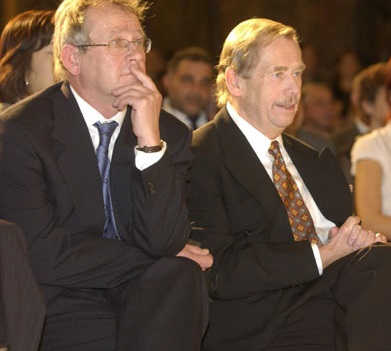
Oldřich Černý and Václav Havel
Returning to Forum 2000 four years after being a delegate in 2009 is a bittersweet affair. Bitter because the founder, Václav Havel is no longer with us and the years of unjust imprisonment under the communist regime shortened what still managed to be a long and fulfilling life. Its a bit selfish on my part because one knows that he lived a fully integrated life and was that rarest of things a great and good man. However, the absence of his moral authority and courage is sorely felt around the world. World politics is diminished by his absence. It is also bitter because of the passing of Oldřich Černý in 2012 the first Executive Director of Forum 2000 at the age of 65.


However it is also, sweet because despite these profound losses Forum 2000 continues and in 2013 counts with the presence of His Holiness the Dalai Lama, and Aung San Suu Kyi who both were championed by Havel until his final days. Folk singer Joan Baez who 50 years ago this year sang her songs of freedom for Martin Luther King Jr. as the Civil Rights Movement marched on Washington D.C. to guarantee voting rights for African Americans was there to celebrate the presence of Aung San Suu Kyi with song and later took part in a panel on civil society. Belarusian, Burmese, Chinese, Cuban, Ecuadorian, Egyptian, Venezuelan dissidents, former heads of state, philanthropists and intellectuals gathered to talk about the situations in their respective struggles and to exchange views. On Tuesday morning at 8:00am a working breakfast on "Challenges for Democracy in Latin America" will be held followed at 3:00pm with a panel that explores "Venezuela, Cuba: What Lies Ahead?"


A conservative intellectual heavyweight, Roger Scruton, was also present to weigh in on important matters globally in the panel on "Trust, the State, and the Rule of Law" and on Tuesday morning at 10:30am will look at the local in a panel on "Transforming Cities: Towards Smart Forms of Governance?"

Luckily, the conference is being recorded and placed on the web because a number of these important conversations are being held simultaneously at different venues in Prague and elsewhere in the Czech and Slovak Republics. It is available for thinking people around the world to engage in this important conversation about the future of our civilization.

Beyond the important achievement of creating a space of open dialogue for differing views to look at the world's problems there is also the generous spirit of the Forum that through first hand experience can be described as warm and embracing with a sense of humor. Friends, who although perhaps not in agreement meet in an atmosphere of respect to explore their differences and in doing so learn more about themselves and the other. It is a Havelian spirit.

Unfortunately, in today's news climate were trivia and distraction are often front page news, events such as Forum 2000 are poorly covered when one considers the importance of what is taking place here.


My commitment to this initiative of Havel and Černý remains firm and hope that others will take it upon themselves, both citizens and policy makers to join the conversation thinking about the long term and about the common good.

It is what both Václav Havel and Oldřich Černý did until their dying days. Their example should inspires others and make the world a better place over the long term. The bottom line is that with the freedom found in living in truth comes the responsibility to do what you can to make this world a better place for the next generation. During the current Forum 2000 Conference: Societies in Transition it was said that the Czech transition is still underway after more than twenty years. The preservation and expansion of freedom is ongoing process that must be affirmed and defended. In a real sense every country is in the process of transition. The difficult question one must ask: Is the society undergoing a transition to more or less freedom and decency?

Please consider becoming a friend of Forum 2000 with concrete and regular support by following Forum 2000 on Twitter, watching the remaining Forum 2000 events on September 17 and 18th, and letting others know about this treasure trove of accumulated wisdom that is just one of the many positive legacies of  Václav Havel and Oldřich Černý.

One side note walking into the top gallery of the Prague Crossroads prior to the Opening Ceremony and seeing a broken heart suspended on the far wall brought back the feelings of loss and mourning for a great friend of oppressed peoples around the globe. However, with the continuing existence of Forum 2000 it can be affirmed that the heart, although battered by the loss of a friend continues to beat on.


Sunday, December 23, 2012

Embargoing Human Rights for Trade? The Sanctions Paradox

 Laura Inés Pollán Toledo in Cuba  and Aung San Suu Kyi in Burma
 The Obama Administration has continued to extend a hand to the Cuban regime and has little to show for it, except increased repression, the deaths of high profile activists, and an American citizen rotting in a Cuban prison. There is no reason to suppose that further unilateral concessions will produce a different outcome.

Sanctions are the last nonviolent way of seeking to change an unjust system by refusing to cooperate with tyranny. When discussing the Cuban embargo in the mass media these two aspects are rarely, if ever, touched upon. Academics and the lobbyists for big business, such as USA Engage, often claim that sanctions never work; rather, it is economic engagement that leads towards greater respect for human rights.

However, recent history in China, Burma, and Vietnam indicate otherwise. This disconnect from reality stems from two factors: self-interest and a reading of power dynamics that ignores people power in favor of focusing on regime elites.

In a New York Times article entitled "Easing of Restraints in Cuba Renews Debate on U.S. Embargo," Carlos Saladrigas claims that “maintaining this embargo, maintaining this hostility, all it does is strengthen and embolden the hard-liners . . . what we should be doing is helping the reformers.” Essentially, Mr. Saladrigas argues that lifting sanctions would weaken and dissuade hardliners while at the same time benefiting reformers. Over the past four years the Obama Administration has loosened economic sanctions on Cuba.

If Mr. Saladrigas is correct, we should observe former outsiders in the regime tackling and winning policy discussions, but that has not been the case. On the human rights front the situation has actually deteriorated. One of the policy objectives of the Castro regime both internally and internationally is to portray itself as David against Goliath. Despite having normal trade relations, Hugo Chavez has undertaken the same kind of campaign in Venezuela. Often times the U.S. State Department has fallen short of explaining the sanctions policy fully or for that matter defending it in a vigorous manner at international forums. This has allowed the Cuban government a free hand in a sustained campaign to portray itself as a victim blaming all of its economic woes on the American blockade on Cuba.

Nevertheless as John Adams once observed, “Facts are stubborn things; and whatever may be our wishes, our inclinations, or the dictates of our passion, they cannot alter the state of facts and evidence.” The facts at present demonstrate that the arguments of the regime and its apologists do not hold up under scrutiny. First, one of the problems with the sanctions debate is that words are used interchangeably which are not synonymous while others that should be are not.

For example the Cuban government and many of its apologists use the terms blockade and embargo as if they were the same thing. At the same time the terms embargo and sanctions are viewed as somehow different. A blockade is specifically a military term that according to the Merriam-Webster Dictionary is “for the isolation by a warring nation of an enemy area (as a harbor) by troops or warships to prevent passage of persons or supplies.” In the case of Cuba there was only one time when a blockade was put in place and that was by President John F. Kennedy during the 1962 Cuban Missile Crisis beginning on October 22 and it was ended less than a month later on November 20, 1962.

What is known as the Cuban Embargo began On January 3, 1961 when President Dwight D. Eisenhower suspended trade with Cuba, a few days after his administration broke diplomatic relations with the country. The embargo on Cuba since its inception has meant restrictions on trade and travel to the island by U.S. citizens and in practice has been a partial embargo. Over the decades these sanctions have been loosened and tightened depending on the circumstances at the time.

An actual embargo would mean that there is a complete ban on or prohibition of trade by the United States with Cuba. This is not the case. What you have in Cuba is a partial embargo which is exactly the same in definition as economic sanctions. Between January 2000 and September 2012 according to the United States Census Bureau there has been $4,291,200,000.00 in U.S. trade in goods with Cuba.

The ban on U.S. imports from Cuba remains but U.S. exports to Cuba have been going on since 1992 with the amounts dramatically increasing since 2002 reaching its peak in exports to Cuba under the Bush Administration in 2008. Despite loosening restrictions further under the Obama Administration trade with Cuba has dropped to 363.3 million dollars in 2011 and figures for 2012 show a slight improvement with total sales to the island at $337.5 million as of September. This is not a total embargo but a partial one in which the United States is one of Cuba’s top trading partners.

At the same time Cuban exiles, many committed to maintaining economic sanctions against the dictatorship, are also a main source of remittances to their families on the island totaling hundreds of millions of dollars per year. The aim of the embargo initially, during the Cold War, was to penalize the Castro regime for seizing U.S. properties and limit its ability to fund armed guerrillas and terrorist groups in the region aimed at toppling friendly governments. With the exception of the Sandinistas in Nicaragua in 1979 this policy was a success in the Americas.

Following the collapse of the Soviet Union changes were made to sanctions policies that sought in the 1992 Torricelli Bill and 1996 Helms Burton Bill to make clear that sanctions would remain in effect until all political prisoners were freed, the government tolerated a political opposition and free elections were held. Funds were also set aside by Congress to assist through development assistance independent civil society. In addition Congress in the 1980s established Radio/TV Marti to break the information monopoly of the dictatorship. Also in the late 1980s the United States led an effort at the U.N. Human Rights Commission to expose the systematic human rights abuses on the island and hold the Cuban dictatorship to greater scrutiny.

The result of what amounted to a tightening of sanctions and redirecting them from Cold War considerations to a pro-democracy effort combined with diplomacy was to provide protection to Cuban dissidents on the island, along with the means to reach the populace via radio while also setting up licensing to permit the sending of humanitarian and technical assistance to dissidents by civil society groups in the United States. This led to the growth of the pro-democracy movement on the island and greater support for it internationally.

Policies have consequences

The loosening of sanctions and the lower profile on the international front has meant that the regime has not had to face the same level of accountability that it did back in 2003 for example. During the Black Cuban Spring of 2003 the international community’s response caught the Castro dictatorship by surprise with a sustained campaign to release 75 Cuban prisoners of conscience arrested during the March 18 crackdown and sentenced up to 28 years in prison.

None of the 75 are serving their sentences in a Cuban prison today. So what have we witnessed in Cuba over the past four years? The deaths, under suspicious circumstances, of national opposition figures such as Laura Inés Pollán Toledo and Oswaldo José Payá Sardiñas; The deaths of Orlando Zapata Tamayo and Wilman Villar Mendoza, human rights defenders on hunger strike in the custody of the Cuban authorities; and, an increase both in the number of detentions and the degree of violence used against nonviolent activists.

Over the past four years there has been a dramatic increase in the number of arbitrary detentions in Cuba: from 870 in 2009 to 5,625, thus far, in 2012. One example of this disturbing trend is the death of Juan Wilfredo Soto Garcia from pancreatitis, caused by the brutal beating he received from Cuban government agents.

Another is that of American Alan Gross, arrested on December 3, 2009 and sentenced to 15 years in a Cuban prison. He spent 25 days in a Havana jail before being visited by a U.S. diplomat. By that time Alan Gross had been approached by a Cuban “attorney” who just happened to be representing five Cuban spies imprisoned in the United States for espionage and conspiracy to commit murder. This Cuban attorney represented Alan Gross before his show trial and later appeals. Alan Gross’s supposed crime: Attempting to provide Internet access to the local Jewish community in Cuba. The reality is that he is a pawn of the Castro regime to be used in pressuring concessions from the Obama Administration.

The Administration dangled several offers to the Castro regime and made a unilateral concession: 
  • Take Cuba off the list of state sponsors of terrorism. 
  • Waive probation for one of five Cuban agents convicted of espionage in the United States that planned at least one terrorist attack in the United States and provided intelligence that led to the downing of two US civilian planes over international airspace on February 24, 1996 killing four.  
  • Cuba democracy programs would no longer be about promoting democracy but "building civil society."
  • The White House and Senator John Kerry pushed to unilaterally cut money for the Cuba democracy programs and freeze their funding. 
On the other side of the ledger the Cuban dictatorship did not suffer any repercussions for arbitrarily detaining a U.S. citizen. Alan Gross remains incarcerated to this day and December 3, 2012 will mark his third year in captivity as an American hostage of the Castro regime. Looking beyond Cuba to China, Vietnam, and Burma, we are presented with a cautionary tale on lifting sanctions unconditionally. In China and Vietnam the United States lifted sanctions, effectively de-linking human rights considerations from economic ones. The result has been a deterioration of human rights standards in both countries. '

In Burma, on the other hand, where sanctions were maintained, there have been signs of improvement in rights protections. The military junta, after years of trying to manipulate its way out from under them, has had to recognize the political opposition and provide a space for them in Burma's parliament. Things are still far from perfect, but there is hope that serious and permanent reforms are underway. The ability of Aung San Suu Kyi to run for public office, and for an independent press to begin to operate in Burma following decades of systematic censorship and control, are both positive signs. Aung San Suu Kyi has been clear about the importance of sanctions and of confronting those that would engage the dictatorship at the expense of the human rights of the Burmese people:
“Investment that only goes to enrich an already wealthy elite bent on monopolizing both economic and political power cannot contribute toward égalité and justice, the foundation stones for a sound democracy. I would therefore like to call upon those who have an interest in expanding their capacity for promoting intellectual freedom and humanitarian ideals to take a principled stand against companies that are doing business with the Burmese military regime. Please use your liberty to promote ours.” 
Prominent Cuban-American businessmen have also spoken out against unconditionally lifting sanctions in Cuba, stating in a letter titled “Commitment to Freedom” that “absent the dismantling of the totalitarian apparatus on the island, along with the unconditional release of all political prisoners and the restoration of fundamental human rights, there should be no U.S. unilateral concessions to the Castro regime." They, like Aung San Suu Kyi believe that it is unprincipled for companies to do business with a dictatorship exploiting the suffering of an oppressed people. Things are improving in Burma on the human rights front, while relations are worsening in China and Vietnam. Linking human rights with economic engagement has been a winning formula in Burma- and there’s hope that it can be in Cuba as well.

Room for improvement

However, there are always opportunities for improving sanctions policies- seeking out approaches that make the people, and not the dictatorship, the priority. For example on August 4, 2011 the Obama Administration announced a ban on visas for people who the State Department finds have been involved in human rights violations. Unfortunately, since then we have seen that human rights violators of the Castro regime are immigrating to the United States. If this ban were applied vigorously to the hardline elements of the Cuban regime it would be positive step that would protect dissidents by holding abusers accountable and providing a penalty, but this ban also needs to be expanded to follow the path taken by the European Union when dealing with the Mugabe regime in Zimbabwe. Banning the relatives of the hard line elements of the dictatorship from visiting the United States would create greater pressures on the regime for change.

Unfortunately, what has gone on in practice is that the children and relatives of the hard liners have an easy time obtaining visas to the United States while the families of dissidents have a more difficult time.

There are two profoundly different visions of how to achieve positive change in Cuba. One views the populace and their representatives in the emerging independent civil society, or dissidents, as the protagonists of change. The second views regime elites and possible reformist elements within the dictatorship as the protagonists for change. The trouble with the latter view is that it often mistakes profiteering with progress, as China has demonstrated. This approach also undermines the morale of dissidents and the populace at large, thus emboldening the dictatorship. History has shown us that change occurs from the ground up. Thus, when sanctions are lifted in an effort to allow elements within the regime to reform, the action actually has the opposite effect. The paradox is that the most effective way to encourage reform is to empower dissidents by pressuring the regime with sanctions. If the current policy of loosening sanctions and not holding the regime accountable for its gross and systematic human rights violation, beyond pro-forma denunciations of atrocity after atrocity then things will get a lot worse and they will never improve for Cubans.

U.S. sanctions policy with regards to the dictatorship in Cuba was about containment of the exportation of the Cuban model throughout the hemisphere, and during the Cold War having Cuba serve as a drain on Soviet resources that contributed to its eventual bankruptcy. In the post Cold War years it shifted once again with a focus on human rights. The failure of the United States to do this in China, Cambodia, Venezuela and Vietnam with their deteriorating human rights situation is not that the policy in Cuba is incorrect as some would claim but that the policies in these other countries are profoundly immoral and ignore human rights concerns.  Instead these policies favor of short-term corporate economic interests that run counter to the interests of the majority of  U.S. citizens not to mention the long term economic well-being of the United States.