Showing posts with label Ecuador. Show all posts

Monday, April 3, 2017

Ecuador presidential election results contested and irregularities under the spotlight.

Defending the vote in Ecuador

Credible exit polls had Guillermo Lasso winning by 6.04%
Today Ecuadorians went to vote in their presidential election to determine who will be Rafael Correa's successor. President Correa has been in power for a decade presiding over the systematic gutting of the free press in Ecuador and his designated successor is Lenín Moreno.

The opposition candidate Guillermo Lasso won in credible exit polls by 53.02% vs. Moreno's 46.98%. Unfortunately the official election site apparently shut down for a bit and came back with numbers favoring the official candidate. There is a bit of deja vu observing this play out with the Venezuelan presidential election of 2012 between Nicolas Maduro and Henrique Capriles. Back then I made the following observation that also apply to Ecuador today: 
Winning the vote in Venezuela is not enough. Having an opposition structure in place to ensure that the vote and count is fair along with the capability to mobilize large numbers of people into a coherent strategy to ensure that the election results are recognized and that the election be seen not as the end of a dictatorship but as the beginning of a process of democratic transition.
However there is a key difference and that is that Candidate Lasso is not backing down, the way Capriles did, and is calling on his supporters to take to the streets while providing evidence over his twitter feed of irregularities in the election and denouncing vote fraud.
Translation of above embedded tweet: "This is just one example of ballots that show inconsistencies. They have changed our votes to theirs."

There is a nonviolent struggle underway in Ecuador to ensure that the vote be respected, irregularities examined (including in Miami), and a recount. Friends of freedom should maintain a focus on events unfolding in that South American nation.

The events in Venezuela over the past week with the Maduro regime's puppet Supreme Court stripping away the last pretense of a democracy may have negatively impacted Moreno at the polls today.


Wednesday, July 27, 2016

Regional human rights group calls attention to detentions/deportations of Cubans in Ecuador

Cubans arbitrarily detained in Ecuador and deported back to Cuba.

39 detained Cubans filed for an appeal, but unclear whether it'll be respected. (Actualidad Radio)

IACHR Expresses Concern Regarding Detentions and Deportations of Cuban Migrants in Ecuador

July 26, 2016

Washington, D.C. — The Inter-American Commission on Human Rights (IACHR) expresses its concern regarding the alleged eviction and arbitrary detention of nearly 150 people in Ecuador, as well as the alleged deportation of 121 Cuban migrants. The IACHR calls on the Ecuadorian State to adopt any measures that may be necessary to guarantee that all rights of migrant persons are respected, in particular their right to liberty, personal integrity, due process, and judicial protection, the right to seek and receive asylum, the principle of non-refoulement, and the right to family unity.

According to publicly available information, on July 6, 2016, the National Police of Ecuador, as part of a migration control operation, cleared out a camp that had been set up in Parque El Arbolito, in Quito. The eviction was reportedly carried out without warning, and a number of individuals said that they had been victims of acts of physical and psychological aggression and that their belongings had been confiscated. As a result of this operation, nearly 150 people—including children, adolescents, pregnant women, and elderly adults—reportedly were detained and transferred to a prison facility and an immigration detention center.

In addition, according to publicly available information, deportation hearings were held on July 7 and 8 at a court for minor offenses and juvenile offenders in Pichincha (Unidad Judicial de Garantías Penales, Contravenciones y Menores Infractores). According to Ecuador’s Interior Ministry, “of the first group of citizens of Cuban origin who attended the hearings, eight were released because they were part of a family unit, in other words, because they have Ecuadorian children. However, they should fix their immigration situation in order to obtain legal status in the country. Twenty-two individuals were released because they provided justification for their lawful stay in Ecuador.” A number of sources indicate that deportations of asylum seekers and refugees had been ordered. In addition, the Ombudsman’s Office of Ecuador expressed concern over the submission of such judicial decisions regarding deportations to a new, administrative jurisdiction, a situation that contravenes the principle of judicial independence.

According to information from the Ministry of the Interior, on July 9 the first group of 29 Cuban migrants were deported; on July 11 another 46 migrants were deported; and on July 13 a third group, for a total of 121 Cubans deported. According to publicly available information, the deportees were not properly notified of their deportation orders, and the time frames available to appeal these decisions had not been respected.

In keeping with its international human rights obligations, the Ecuadorian State should adopt all measures that may be necessary to ensure that racial profiling is not applied in the context of migration control operations. The State has a general obligation to respect all rights of migrant persons, including their right to live free of discrimination and free of all forms of violence and their right to personal integrity, personal liberty, family unity, and property.

The Commission observes with concern that the information it has suggests that the Ecuadorian State has made use of automatic immigration detention without first resorting to alternative measures. In that regard, the Commission calls to mind that immigration detention must be an exceptional measure, used only as a last resort and for the shortest period of time possible. In addition, when migrant persons are detained, States should adopt the necessary measures so that those who are detained have sufficient information regarding the nature of their detention, the reasons for it, the procedural guarantees or safeguards to which they are entitled, and the remedies available to appeal or challenge their detention. Moreover, States may not resort to immigration detention of children and their parents as a precautionary measure to protect the goals of an immigration process or procedures to determine refugee status.

The IACHR reiterates that, in keeping with international norms and standards, immigrants subject to proceedings that could lead to deportation must be afforded minimum guarantees. These include: (i) the right to be heard by the relevant authority in the context of the deportation proceeding and to have sufficient opportunity to exercise their right to a defense; (ii) the right to interpretation and translation; (iii) the right to have legal representation; (iv) the right to consular protection from the moment of detention; (v) the right to receive notification of a deportation order; (vi) access to an effective remedy to appeal a deportation decision; (vii) the right to appeal a deportation decision; and (viii) the right to suspension of deportation while the matter is under appeal.

The Commission calls to mind that the Ecuadorian State has the obligation to analyze, establish a basis for, and decide individually on each deportation that is carried out. At the same time, the Commission reiterates that the State has the obligation to respect the principle of non-refoulement and therefore not to deport to another country, whether or not it is the person’s country of origin, any foreigner whose rights to life, personal integrity, or personal liberty may be at risk of being violated. The principle of non-refoulement is the fundamental standard of protection of asylum seekers and refugees.     

A principal, autonomous body of the Organization of American States (OAS), the IACHR derives its mandate from the OAS Charter and the American Convention on Human Rights. The Inter-American Commission has a mandate to promote respect for human rights in the region and acts as a consultative body to the OAS in this area. The Commission is composed of seven independent members who are elected in an individual capacity by the OAS General Assembly and who do not represent their countries of origin or residence.

Wednesday, December 2, 2015

Castro regime announces Cuban doctors will have to request permission to travel

2013 "Migration Reform" in Cuba: New rules to achieve the same result 
 
Cubans outside the Ecuadorian embassy in Havana, Cuba

News wire services reported today that Cuba's "communist authorities said Tuesday that from December 7 doctors will again be required to ask permission to travel abroad for private reasons." According to these press sources this is news because it runs counter to 2013 "reforms", but back in a 2013 post titled "New rules for the same old game" quoted the January 11, 2013 CNN report on restrictions maintained by the Castro regime:
Specifically, the Labor and Social Security Ministry defined categories of Cubans whose travel would be restricted. They include those who may be "criminally prosecuted, are subject to military service or (are denied) for reasons of defense and national security." "Also on the list are citizens who have obligations with the state or are not authorized under rules designed to preserve the skilled workforce and protect official information," read the Prensa Latina story.
Cubans do not only face restrictions to leave Cuba but also to return and visit their homeland. Between 70,000 and 300,000 Cubans are banned by the Castro regime from returning to their homeland reported The Miami Herald on August 15, 2011 in an article titled Many Cuban expatriates can't go home again.  A friend, born in Cuba, that I went to college with was not able to travel to Cuba when her grandmother died. It wasn't the US embargo that stopped her but the Castro regime that denied her request. No reason given. Many Cubans are afraid to speak freely about the reasons they left the island out of a fear that if they give a political motive they will never be allowed to return. A high profile example of a Cuban woman not allowed to return to Cuba to visit her dying father played out over social media in the latter half of 2013 and was reproduced, in part, in PanAm
Post's The Canal
Blanca Reyes had requested on July 22, 2013, permission to return to her homeland to visit her ailing 93-year-old father. However, on August 13, 2013, a Cuban consulate official denied her that opportunity. Two months later on October 13, 2013 Blanca tweeted:
My dad fractured his hip, they are going to operate, and Cuban government denies me entrance to see him. He is 93 years old.
In a later tweet she raised an important question:
Unable to enter your home, Cuba, can someone explain that? I address the people who still support the Cuban Government.
Two days later on October 15, 2013, Blanca tweeted the sad news that the father and daughter would never again to be reunited:
My father died today in Cuba did not see him for 9 years the Cuban government stopped me. UNTIL WHEN MY GOD?
Despite the regime’s propaganda offensive and media hype, the right to travel freely remains non-existent in Cuba. In this particular case, they denied a daughter the opportunity to say goodbye to her dad.
This so-called migration "reform" is an example of what martyred dissident leader Oswaldo Payá referred to as "fraudulent change." Giving the illusion of an opening while the Stalinist character of the dictatorship remained intact benefited the regime from decreased international scrutiny and increased its legitimacy abroad. Sadly, the reality has been very different. Cubans are no freer to travel now than before January 1, 2013,  it remains up to the whims of the dictatorship. 

Tony Diaz Sanchez, former prisoner of conscience and Christian Liberation Movement Leader on December 1, 2015 over Facebook summed up the current news coverage best: "The 201[2] 'reform' of the immigration law made clear that the 'state' could prevent the departure of any person for the 'public interest'.  If this already exists as law, then this with the doctors is nothing new, just smoke and mirrors."

Back in October of 2012 when the regime announced the new regulations I provided the following analysis:
The Castro dictatorship in 2012 is once again demonstrating that it is a master of distraction highlighting a new migration law with new rules that achieve the same result: travel in and out of Cuba is to be administered by the Ministry of the Interior and professionals such as medical doctors do not have freedom to travel. The infamous white card, an exit visa, that Cubans need to exit their own country will according to the regime announcement be replaced in 2013 with new more stringent requirements for the passport.

What do the authorities hope to accomplish with this so-called reform that the regime says will come into effect on January 1, 2013? First, one of the long term objectives of the dictatorship is eliminating the 1966 Cuban Adjustment Act which grants Cuban refugees special immigration privileges for fleeing a totalitarian dictatorship where the freedom of travel is nonexistent. Floating the threat of a slow motion Mariel is meant to pressure U.S. lawmakers into eliminating a law that demonstrates that the Castro regime is different from every other country in the hemisphere.  
All I can say now is, told you so. The human rights situation continues to deteriorate in Cuba as violence and repression escalates and now the United States faces the latest Cuban manufactured migrations crisis thanks to the inept foreign policy of the Obama administration. Cuba will not change for the better until the system created by the Castro brothers is replaced with a democratic system in which the rule of law is respected. Tourists will not achieve this change and the record in other totalitarian regimes indicates that if anything they will provide hard currency to the most repressive elements in Cuba that run the tourism industry.

Wednesday, October 7, 2015

Press Freedom in Decline in the Western Hemisphere

Freedom in retreat?


"No country safe from the censorship power," concludes the IAPA

Charleston, SC (October 6, 2015).- The 71st General Assembly of the Inter American Press Association (IAPA ), which gathered more than 300 media executives and journalists, ended today after five days of sessions. The following document summarizes the debates and discussions that took place over press freedom in the Western Hemisphere.

CONCLUSIONS
of the 71th General Assembly
October 2 – 6, 2015
 
Unremitting violence against media outlets and journalists; the proliferation of laws, initiatives, and pressures from governments attempting to control the free flow of information both in the traditional media and on new media platforms; restrictions on access to public information; the discriminatory placement of government advertising; and greater concentration of media outlets in the hands of those with ties to governments. These were the warnings sounded most loudly by the publishers gathered at the 71st General Assembly of the Inter American Press Association.

No country in the Americas is safe from the wave of censorship that is spreading like a massive oil spill. This is true even in countries that have traditionally upheld press freedom, in some cases under the paradoxical pretext of promoting pluralism, of ensuring the “right to forget,” or of stopping “hate speech.” This, combined with the rising prominence of thugs affiliated with drug trafficking and urban gangs, poses clear risks for civil liberties, and for freedom of expression and freedom of the press in particular, and hence for the strengthening of democracy in the Americas.

The unlawful actions of organized crime, drug trafficking gangs, and parapolice groups — many of which have gone unpunished — have left a toll of 11 journalists killed since March 2015: three each in Brazil and Mexico, two in Guatemala, and one each in Colombia, Honduras, and the Dominican Republic. In Colombia, the statute of limitations ran out on two 1995 killings, although it should be noted that former Congressman Ferney Tapasco was convicted of ordering the murder of Orlando Sierra.

Various countries in the region saw physical assaults, attacks, acts of coercion and threats against journalists and media outlets for reasons related to their work. In Bolivia, three journalists were detained and temporarily jailed in retaliation for their reporting on government corruption. Acts of repression were directed against reporters covering elections in Guatemala and Argentina, and against those reporting on conflicts and social protests in Peru, Ecuador and Brazil.

In Venezuela, where the government is establishing totalitarian control over the media, 287 violations of press freedom have been documented so far this year, including assaults on journalists, efforts to criminalize the work of journalists, and restrictions on access to information. In a positive development, the Inter-American Court of Human Rights issued a ruling in early September ordering the return of equipment and licenses to RCTV, but this ruling has been ignored thus far by the administration of Nicolás Maduro.

In Cuba, despite the reestablishment of relations between the Cuban and U.S. governments, little progress has been made in freedom of expression, freedom of association, and freedom of the press, and two journalists remain behind bars. The methods of repression include censorship of critical websites, inspection of emails, suspension of mobile phone service, and physical and verbal attacks on activists and independent journalists.

In Ecuador, the climate of repression from oversight entities tasked with enforcing the Communication Act remains in place. Penalized media outlets and organizations invoked their constitutional right to resistance. A proceeding that would have dissolved FUNDAMEDIOS was dismissed, but the threats remain. The Saturday presidential addresses continue, in which those who dare to dissent from the government line are called out and stigmatized. In Argentina and Venezuela, the respective presidents abusively use national networks to air partisan propaganda and lambaste their critics.

Abuses and the discriminatory use of government advertising are on the rise in Argentina, Bolivia, Venezuela, Ecuador, and Mexico.

In the United States, the Justice Department revealed that in 2014 it issued two subpoenas and a search warrant, and that it twice authorized the questioning of media outlets and journalists. Two reporters who covered last year’s unrest in Ferguson, Missouri, were charged with “interference” and “trespassing.”

Restrictions on access to government-held information were exacerbated in Argentina, Canada, Colombia, Costa Rica, Ecuador, El Salvador, Haiti, Honduras, Jamaica, Panama, Paraguay, Trinidad and Tobago, Uruguay, and Venezuela.

In Chile, proposed laws could constitute severely undermine press freedom, including through interference in the editorial line of media outlets, restrictions on property rights and the undermining of the right to free enterprise, harm to journalistic enterprises and journalists, and restrictions on access to information.

In Panama, a bill currently under consideration would require journalists to be members of professional associations and would establish prison terms for illegally practicing journalism, among other serious restrictions. The investigations into illegal wiretappings of journalists are ongoing.

The concentration of media outlets in the hands of government entities or of people with ties to the government is an increasing phenomenon in the Americas. In Paraguay, for example, a business group linked to President Horacio Cartes purchased a group of media outlets, triggering controversy over the concentration of media in the hands of those close to the government. In Nicaragua, President Daniel Ortega maintains firm control over media outlets and journalists. Only one television station, one radio station, and one newspaper remain as independent media outlets; the remainder are owned by the Ortega family or by people close to them. Ecuadorian President Rafael Correa failed to fulfill his commitment to reprivatize the media outlets that had been expropriated by his administration. And Argentina has seen a proliferation of multimedia groups born and raised on government advertising, despite paltry audience numbers.

In Uruguay, the online surveillance program of the Interior Ministry has caused concern, and pending before the Supreme Court are 18 claims seeking to have the Law of Audiovisual Communication Services declared unconstitutional.

In Costa Rica, meanwhile, a proposed law on radio and television that was hostile to private enterprises and press freedom was set aside, and initiatives to regulate government advertising, decriminalize the work of journalists, and legalize community radio stations are under consideration. Still, free journalism continues to face a number of threats.

Also worth noting are the coordinated efforts of press freedom organizations in the region, such as the recently formed Quito Forum, which put forward an action plan to demand that press freedom be upheld in Ecuador.

http://www.sipiapa.org/en/no-country-safe-from-the-censorship-power-concludes-the-iapa/

Monday, September 16, 2013

17th Forum 2000 Conference: A Reflection

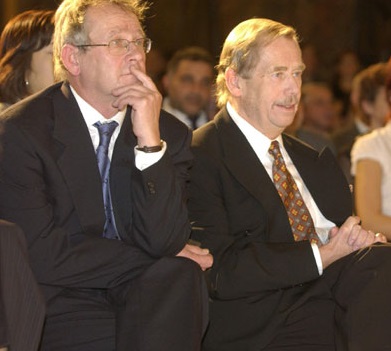
Oldřich Černý and Václav Havel
Returning to Forum 2000 four years after being a delegate in 2009 is a bittersweet affair. Bitter because the founder, Václav Havel is no longer with us and the years of unjust imprisonment under the communist regime shortened what still managed to be a long and fulfilling life. Its a bit selfish on my part because one knows that he lived a fully integrated life and was that rarest of things a great and good man. However, the absence of his moral authority and courage is sorely felt around the world. World politics is diminished by his absence. It is also bitter because of the passing of Oldřich Černý in 2012 the first Executive Director of Forum 2000 at the age of 65.


However it is also, sweet because despite these profound losses Forum 2000 continues and in 2013 counts with the presence of His Holiness the Dalai Lama, and Aung San Suu Kyi who both were championed by Havel until his final days. Folk singer Joan Baez who 50 years ago this year sang her songs of freedom for Martin Luther King Jr. as the Civil Rights Movement marched on Washington D.C. to guarantee voting rights for African Americans was there to celebrate the presence of Aung San Suu Kyi with song and later took part in a panel on civil society. Belarusian, Burmese, Chinese, Cuban, Ecuadorian, Egyptian, Venezuelan dissidents, former heads of state, philanthropists and intellectuals gathered to talk about the situations in their respective struggles and to exchange views. On Tuesday morning at 8:00am a working breakfast on "Challenges for Democracy in Latin America" will be held followed at 3:00pm with a panel that explores "Venezuela, Cuba: What Lies Ahead?"


A conservative intellectual heavyweight, Roger Scruton, was also present to weigh in on important matters globally in the panel on "Trust, the State, and the Rule of Law" and on Tuesday morning at 10:30am will look at the local in a panel on "Transforming Cities: Towards Smart Forms of Governance?"

Luckily, the conference is being recorded and placed on the web because a number of these important conversations are being held simultaneously at different venues in Prague and elsewhere in the Czech and Slovak Republics. It is available for thinking people around the world to engage in this important conversation about the future of our civilization.

Beyond the important achievement of creating a space of open dialogue for differing views to look at the world's problems there is also the generous spirit of the Forum that through first hand experience can be described as warm and embracing with a sense of humor. Friends, who although perhaps not in agreement meet in an atmosphere of respect to explore their differences and in doing so learn more about themselves and the other. It is a Havelian spirit.

Unfortunately, in today's news climate were trivia and distraction are often front page news, events such as Forum 2000 are poorly covered when one considers the importance of what is taking place here.


My commitment to this initiative of Havel and Černý remains firm and hope that others will take it upon themselves, both citizens and policy makers to join the conversation thinking about the long term and about the common good.

It is what both Václav Havel and Oldřich Černý did until their dying days. Their example should inspires others and make the world a better place over the long term. The bottom line is that with the freedom found in living in truth comes the responsibility to do what you can to make this world a better place for the next generation. During the current Forum 2000 Conference: Societies in Transition it was said that the Czech transition is still underway after more than twenty years. The preservation and expansion of freedom is ongoing process that must be affirmed and defended. In a real sense every country is in the process of transition. The difficult question one must ask: Is the society undergoing a transition to more or less freedom and decency?

Please consider becoming a friend of Forum 2000 with concrete and regular support by following Forum 2000 on Twitter, watching the remaining Forum 2000 events on September 17 and 18th, and letting others know about this treasure trove of accumulated wisdom that is just one of the many positive legacies of  Václav Havel and Oldřich Černý.

One side note walking into the top gallery of the Prague Crossroads prior to the Opening Ceremony and seeing a broken heart suspended on the far wall brought back the feelings of loss and mourning for a great friend of oppressed peoples around the globe. However, with the continuing existence of Forum 2000 it can be affirmed that the heart, although battered by the loss of a friend continues to beat on.
