Showing posts with label Lithuania. Show all posts

Friday, August 23, 2024

Solidarity and the Baltic Way: How nonviolence buried the last vestiges of the Molotov-Ribbentrop Pact

 "Nonviolence is a powerful and just weapon. which cuts without wounding and ennobles the man who wields it. It is a sword that heals." - Martin Luther King, Jr.

History weighs heavily in August of 2014: the 110th observance of the start of World War 1; eighty fifth anniversary of the signing of Molotov Ribbentrop, the treaty that triggered World War 2 by splitting Poland between Nazi Germany and the Soviet Union; 44 years on the 31 of August 1980 the Polish Solidarity union came into existence; and Cubans observed the 30th anniversary of a mass uprising in Havana known as the Maleconazo that sparked another huge exodus of tens of thousands of Cubans fleeing to freedom.

Within this somber month of needed reflection on what not to do there is an incident that took place that needs to be remembered on what needs to be done. In addition to dismembering Poland, the Molotov Ribbentrop Pact placed the Baltic States under Soviet control. A nonviolent moment thirty five years ago that ended up liberating Lithuania, Latvia and Estonia brought an end to this part of the Nazi-Soviet non-aggression pact and it was called the Baltic Way.

On June 4, 1989 the Solidarity labor movement won in free elections and the Polish people finally regained their sovereignty after nearly 50 years under totalitarian oppression. They did it nonviolently. So did the people of the Baltic states when two million Latvians, Lithuanians and Estonians joined hands together in a giant human chain stretching 370 miles on August 23, 1994. Fifty years to the day after the treaty that brought them so much grief had been signed. 

A number of excellent and well sourced websites describe and show with images and videos what happened on August 23, 1989. This is how the UNESCO website described it:

On 23 August 1939 foreign ministers of the USSR and Germany - Vyacheslav Molotov and Joachim von Ribbentrop, as ordered by their superiors Stalin and Hitler, signed a treaty which affected the fate of Europe and the entire world. This pact, and the secret clauses it contained, divided the spheres of influence of the USSR and Germany and led to World War II, and to the occupation of the three Baltic States - Estonia, Latvia and Lithuania. 

50 years later, on 23 August 1989, the three nations living by the Baltic Sea surprised the world by taking hold of each other's hands and jointly demanding recognition of the secret clauses in the Molotov-Ribbentrop pact and the re-establishment of the independence of the Baltic States. More than a million people joined hands to create a 600 km long human chain from the foot of Toompea in Tallinn to the foot of the Gediminas Tower in Vilnius, crossing Riga and the River Daugava on its way, creating a synergy in the drive for freedom that united the three countries.The Baltic Way was organized by the national movements of each of the Baltic States: the Popular Front of Estonia Rahvarinne, the Popular Front of Latvia and the Lithuanian Reform Movement Sąjūdis.

The Baltic Way brought important changes to the history of the world. This was achieved through social unity and through the joint commitment and confidence manifested by every individual in pursuing the common goal. This impressive act of non-violent protest and solidarity whilst keeping sovereignty was a living example of the culture of peace, opening up access to information and leading to the acknowledgement of the secret treaty and its hideous consequences for the whole world. It increased the opportunity for the national self-determination of Estonia, Latvia and Lithuania and encouraged democratic movements throughout the Soviet Union. The three Baltic States succeeded in gaining their freedom in a peaceful way, creating a precedent that was, and hopefully will be, followed by a number of countries all over- the triumph of humanity over totalitarianism.

Its a powerful testament that the liberation of Poland and the Baltic states from totalitarian occupation was achieved after fifty years through nonviolent resistance. Now in Lithuania, Latvia, and Estonia August 23rd has a double significance.

Today we gathered in Washington DC to remember and celebrate this enduring nonviolent victory, and its continuing lessons.

Thursday, January 13, 2022

January 13th is Freedom Defenders' Day in Lithuania: Remembering the successful nonviolent defense of Vilnius from Soviet tanks, and the 14 who died

 Remembering Lithuania's Freedom Defenders.

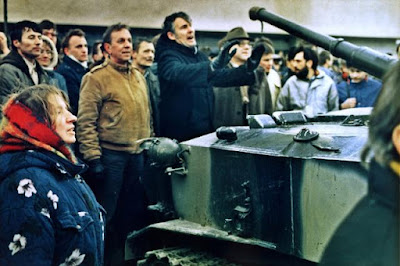
Group of Lithuanians block a Russian tank outside of Press House in Vilnius two days prior to attack by Russian forces on the TV tower during which 14 people died, January 1991. REUTERS/Peter Andrews

Lithuania has a long and important history. Today is one of those days that require remembrance. Vilnius has designated January 13th as Freedom Defenders' Day, in honor of the Lithuanian civilians who stood down Soviet forces in Vilnius. This was a non-violent victory over brute force that Putin, and other dictators would like to rewrite and disappear from the history books. This is why it is so important to remember.

On January 11, 1991 Soviet tanks had stormed Vilnius to stop Lithuanian independence taking the National Defense Department and the Press House. Crowds of Lithuanians gathered around important national institutions to block the advance of the Russian tanks. On January 13th the Soviet invaders attacked the Vilnius TV tower killing 14 Lithuanians and wounding many more. It did not have the desired effect. 

31 years ago on January 13, 1991, Lithuania declared its intention to be an independent state. Decades later the courage and sacrifice of those who were killed and wounded, nonviolently defending the Vilnius TV tower continue to be remembered and honored.

The President of the Republic of Lithuania Gitanas Nausėda today paid homage to Freedom Defenders that "stood unarmed against Soviet tanks defending independence and freedom."

Lithuania's history stretches back many centuries, and its people are distinct and separate from their Russian neighbors.  

The present day territory of Lithuania has been populated all the way back to 12,000 BC.  Between the 5th and 8th centuries tribal groups arrived, among them were the Lithuanians. The name Lithuania first appeared in 1009 in a written account of the St. Bruno Mission. The Grand Duchy of Lithuania (Magnus Ducatus Lithuaniae) appeared in world maps, on July 6, 1253 with the coronation of Mindaugas, ruler of  a unified Lithuania. Over the next five hundred years Lithuania would prosper and achieve great things, but in 1795 this Baltic state was occupied by Tsarist Russia, and would reappear on the map of Europe 123 years later on February 16, 1918.  Restored Lithuania 100 described the events  that led to this Baltic country rejoining the family of nations in the midst of World War One.

On 16 February 1918, 20 courageous, determined and trusted representatives of the Lithuanian nation signed the Act of Independence of Lithuania “re-establishing an independent state, based on democratic principles, with Vilnius as its capital city, severing all previous links with other states.” Having withstood the fight for independence against Bolsheviks and Polish invaders, Lithuania sealed its parliamentary democracy in the Constituent Assembly (Steigiamasis Seimas) in 1920.

This new period of freedom would be short lived. On June 15, 1940 the Soviet Union annexed Lithuania in the midst of the Second World War. The Soviet Union had allied with Nazi Germany on August 23, 1939 in a "non-aggression pact" that plotted the conquest and division of Poland and carved up spheres of influence that placed Lithuania in the Soviet sphere.  

Following the defeat of Nazi Germany in May 1945 the Soviet Union consolidated its Eastern European empire and reaffirmed its annexation of the Baltic states, including Lithuania. Forty four years later the nonviolent movement that had emerged years earlier in Poland at the Gdansk shipyards, along with new Soviet leadership reluctant to engage in new blood baths to maintain its rule, led to the beginning of the unraveling of the Soviet empire that on August 23, 1989 resulted in mass nonviolent protests across Estonia, Latvia, and Lithuania that became known as the Baltic Way.

However, Soviet designs on the Baltic states did not end in 1989, and if not for those Lithuanians who defended freedom 31 years ago on January 13, 1991 the world would not be observing three decades of Baltic independence. These nonviolent moments in 1989 and 1991 changed world history and these freedom defenders are rightfully remembered and celebrated.

Saturday, June 12, 2021

Cuba's victory at the European Parliament on June 10th and Castroism's double defeat

“If we take the widest and wisest view of a Cause, there is no such thing as a Lost Cause because there is no such thing as a Gained Cause. " - T.S. Eliot


Original source: CubaBrief 

Cuba won a victory at the European Parliament (EP) on June 10, 2021, and the Castro dictatorship, together with its allies, suffered a double defeat when the EP resolution on the human rights and political situation in Cuba (2021/2745(RSP)) passed with 386 voting for the resolution, 236 against the resolution, and 59 abstaining.

This was a victory for Cuba because the European Parliament acknowledged "the right of the Cuban people to demand the democratisation of their country through a dialogue with civil society and the political opposition in order to establish a roadmap towards democratic multi-party elections." This elected body recognized that the sovereignty of Cuba exists among all Cubans, not the dictatorship that has ruled them with force for 62 years. Furthermore this deliberative body outlined the present situation in the island nation, and the systematic absence of human rights.


The resolution also demanded action on the part of EU officials recognizing where true sovereignty lies. It "calls on the Vice-President of the Commission / High Representative of the Union for Foreign Affairs and Security Policy to acknowledge the existence of political opposition to the Cuban Government, and therefore to include it in the institutionalized, formal, open and public political dialogues between the EU and Cuba, upholding the pillars of the EU Political Dialogue and Cooperation Agreement (PDCA)." Something that they have refused to do under this agreement.

The EP resolution passed on June 10th strongly condemns the jailing of Cuban dissidents, the existence of political prisoners, and recognizes that the PDCA with Cuba has not led to "any substantial and tangible positive result for the Cuban people."

The resolution demands an "immediate repeal of Decrees 349 and 370 and other Cuban laws that violate freedom of expression;" and condemns "the systemic labor and human rights violations committed by the Cuban state against its healthcare personnel assigned to work abroad on the medical missions.”

The resolution also recognizes that "the imprisonment of Denis Solís González, Luis Robles Elizástegui, Maykel Castillo Pérez (‘Osorbo’)," ... "and more than 120 political prisoners and convicts of conscience, and all the arbitrary and repressive actions registered in April and June 2021, constitute a breach" of the agreement and a case of special urgency, as established in Article 85 (3b) of the PDCA; calls for the EU to convene an urgent meeting in this regard accordingly."

Rosa María Payá blasted EEAS's normalization of the Castro regime

This places the EU bureaucracy in the spotlight, and repudiates claims made in official documents that have drawn the ire of Cuban dissidents. Rosa María Payá and Cuba Decide in their January 2020 letter to the European Union cited the "EEAS’s 2016 Annual Human Rights and Democracy in the World report, which describes the island’s government regime with the following absurdity: 'Cuba is a one-party democracy, with elections that are held at the municipal, provincial, and national level.'

The European Parliament voiced its displeasure with the "current EU Ambassador in Havana [who] has publicly made statements affirming that ‘Cuba is not a dictatorship.’"

Three political groups, spanning from the center left to the right, sponsored the resolution and below are the Members who signed on representing their respective parties.

Leopoldo López Gil, Michael Gahler, Isabel Wiseler-Lima, Gabriel Mato, Antonio López-Istúriz White in name of the EPP Group

Javier Nart, Malik Azmani, Olivier Chastel, Dita Charanzová, Vlad Gheorghe, Klemen Grošelj, Karin Karlsbro, Moritz Körner, Karen Melchior, Urmas Paet, Frédérique Ries, Nicolae Ştefănuță, Hilde Vautmans in name of the Renew Group.

Anna Fotyga, Hermann Tertsch, Ryszard Czarnecki, Witold Jan Waszczykowski, Bogdan Rzońca, Assita Kanko, Charlie Weimers, Valdemar Tomaševski, Adam Bielan, Jadwiga Wiśniewska, Ryszard Antoni Legutko, Carlo Fidanza, Elżbieta Kruk, Raffaele Fitto, Elżbieta Rafalska, Ruža Tomašić in name of the ECR Group.

Missing where the Socialists & Democrats Group, and this is where the Castro dictatorship, together with its allies, suffered their second defeat.

Pilar Ruiz Huélamo, a member of the Socialists & Democrats Groups and Spain's PSOE Party in an e-mail communicated:

"PPE and RENEW have asked for a point in the next plenary session on the situation in Cuba, Borrell's statement with resolution. One of the points they want to denounce is the one described in this manifesto that 5 deputies have already signed. As you know, it will be difficult to stop it, we do not have a majority. I wonder if you want to notify the Cuban Embassy or that I notify Heidy. Borrell's cabinet is already aware. I take the email to make an appointment with Javier next week to discuss this issue and others if possible."

The response by Isabel Garcia Tamara, from Javier Moreno Sánchez's office, confirmed the collusion with the Castro regime when she instantly answers yes, that they will carry out the communication with Havana and the appointment with "JM", president of the PSOE in the European Parliament and president of the Friendship Group with Cuba. Mr. Moreno Sanchez is an avid defender of dictator Raúl Castro.

Below is the excerpt of the above mentioned e-mail that had circulated among members of the Socialists & Democrats Group that appeared in the Spanish Daily, ABC.


This led José Ramón Bauzá, a member of the Spanish centrist party Ciudadanos [Citizens] to write a letter to Josep Borrell Fontelles, the High Representative for Foreign Affairs and Security Policy for the European Union asking if his staff had been involved in trying to shut down debate on human rights in Cuba at the European Parliament.  

As time passes, the decision of Lithuania not to ratify the PDCA with Havana, is now viewed both as a historic act of solidarity with Cubans, and looking out for European interests. 

Free Cubans owe Lithuanians a debt of gratitude. When the rest of the European Union embraced the Castro regime in a EU-Cuba agreement that gutted human rights concerns it was the Lithuanian Parliament that stood alone in 2020 refusing to ratify it with leaders saying it would betray "Cuban political prisoners" and demanding a commitment to human rights and democracy for the Cuban people. 

On May 5, 2021 Congresswoman Nicole Malliotakis (NY-11) led her colleagues House Committee on Foreign Affairs Ranking Member Michael McCaul (TX-10), Congressman Carlos Gimenez (FL-26), and Congresswoman Maria Elvira Salazar (FL-27) introduced H.Res.440, commending Lithuania for refusing to ratify the European Union's (EU) Political Dialogue and Cooperation Agreement (PDCA) with Cuba.

Other EU states who ratified the PDCA with the best of intentions ended up providing millions in Euros to the Castro dictatorship, making the EU complicit in the repression of Cuban dissidents, the exploitation of Cuban workers, and the destabilization of democracy in Latin America. 

We hope that Lithuania will no longer be standing alone, and that other EU member states will join Vilnius in defending both the interests of Europe and the well being of 11 million Cubans, and to not confuse them with the dictatorship oppressing them. The June 10th resolution is a good start, but there is more to do in order to cut off funding to the dictatorship while finding avenues to help Cubans directly. 

Tuesday, February 16, 2021

Celebrating Lithuania's Independence Day today February 16th and giving thanks for their solidarity with free Cubans

Celebrating a Free Lithuania.

Vilnius castle tower at night in Lithuania

Present day territory of Lithuania has been populated all the way back to 12,000 BC.  Between the 5th and 8th centuries tribal groups arrived, among them were the Lithuanians. The name Lithuania first appeared in 1009 in a written account of the St. Bruno Mission. The Grand Duchy of Lithuania (Magnus Ducatus Lithuaniae) appeared in world maps, on July 6, 1253 with the coronation of Mindaugas, ruler of  a unified Lithuania. Over the next five hundred years Lithuania would prosper and achieve great things, but in 1795 this Baltic state was occupied by Tsarist Russia, and would reappear on the map of Europe 123 years later on February 16, 1918.  Restored Lithuania 100 described the events  that led to this Baltic country rejoining the family of nations in the midst of World War One.

On 16 February 1918, 20 courageous, determined and trusted representatives of the Lithuanian nation signed the Act of Independence of Lithuania “re-establishing an independent state, based on democratic principles, with Vilnius as its capital city, severing all previous links with other states.” Having withstood the fight for independence against Bolsheviks and Polish invaders, Lithuania sealed its parliamentary democracy in the Constituent Assembly (Steigiamasis Seimas) in 1920.

This new period of freedom would be short lived. On June 15, 1940 the Soviet Union annexed Lithuania in the midst of the Second World War. The Soviet Union had allied with Nazi Germany on August 23, 1939 in a "non-aggression pact" that plotted the conquest and division of Poland and carved up spheres of influence that placed Lithuania in the Soviet sphere.  

Following the defeat of Nazi Germany in May 1945 the Soviet Union consolidated its Eastern European empire and reaffirmed its annexation of the Baltic states, including Lithuania. Forty four years later the nonviolent movement that had emerged years earlier in Poland at the Gdansk shipyards, along with new Soviet leadership reluctant to engage in new blood baths to maintain its rule, led to an unraveling of the Soviet empire that in 1989 resulted in mass nonviolent protests across Estonia, Latvia, and Lithuania that became known as the Baltic Way.

 On June 4, 1989 the Solidarity labor movement won in free elections and the Polish people finally regained their sovereignty after nearly 50 years under Soviet domination.  

Two million Latvians, Lithuanians and Estonians joined hands together in a giant human chain stretching 370 miles on August 23, 1989. Fifty years to the day after the treaty that brought them so much grief had been signed.  Restored Lithuania 100 described the process that unfolded and restored the Baltic nation for a third period of freedom beginning on March 11, 1990.

The Initiative Group of Sąjūdis (Lithuanian Reform Movement), established in June 1988, inspired us with faith and hope: the independence movement Sąjūdis soon spread into the whole of Lithuania. On 23 August 1989, we joined our hands to form a human chain stretching 650 kilometres across Vilnius, Riga and Tallinn to mark the 50th anniversary of Molotov-Ribbentrop Pact as a result of which Lithuania lost its independence. The Baltic Way was a symbolic action that separated the Baltic States from the Soviet Union and by which our people expressed their will to be free. We did not have to wait long. On 11 March 1990, the independent State of Lithuania was re-established. However, our people’s will was opposed by the Soviet Union authorities which, on 13 January 1991, sent to Vilnius their well trained and heavily armed paratrooper units. But even under the threat of violence we responded to the Soviet Union's aggression peacefully – without arms, singing songs and with an endless faith in our victory. That is why these events are commonly referred to as the Singing Revolution. This was the third time in history that Lithuania started an epoch of autonomous life. 

This is why Lithuania has two national independence days: February 16, 1918 (the Restoration of the State Day) and March 11, 1990 ( the Restoration of Independence Day).

Member of Lithuania's Parliament Zygimantas Pavilionis

Free Cubans owe Lithuanians a debt of gratitude. When the rest of the European Union embraced the Castro regime in a EU-Cuba agreement that gutted human rights concerns it was the Lithuanian Parliament that stood alone in 2020 refusing to ratify it with leaders saying it would betray "Cuban political prisoners" and demanding a commitment to human rights and democracy for the Cuban people.

Therefore today on your Restoration of the State Day we say thank you and God bless Lithuania.


Friday, August 16, 2019

Black Ribbon Day 2019: The Hitler-Stalin Pact that started WW2 and that communists would like to erase.

"The struggle of man against power is the struggle of memory against forgetting." - Milan Kundera


Eighty years ago on August 23, 1939 the world was shocked to learn that Communist Russia and Nazi Germany had signed a non-aggression pact, the Molotov-Ribbentrop pact. It was named after their respective foreign ministers, Vyacheslav Molotov and Joachim von Ribbentrop. Observers would have been even more horrified had they known of the secret protocols that divided Eastern Europe between the two totalitarian powers. What they called a "peace treaty" in reality was a war treaty.

Rolling Soviet tanks and Nazi motorcyclists in Poland (September 1939).
Nine days later on September 1, 1939 at 4:45 am Nazi Germany invaded Poland and World War II started. Sixteen days later the Soviet Union exercising its secret agreement with the Nazis invaded Poland from the East and met their German allies in the middle of Poland. On September 22, 1939 the German Nazi army joined with the Soviet Communist army in a military parade in Brest-Litovsk and the two sides celebrated together.

Nazi and Soviet soldiers greet one another in Poland (1939)
About 230,000 Polish soldiers and officers and thousands of military service representatives were taken captive by the Russians. The Soviet precursor to the KGB was the NKVD. "From October 1939, the delegated NKVD officials from Moscow heard the prisoners, encouraged them to cooperate and collected data. Only a few of the prisoners agreed to collaborate. The commanding officers’ reports included opinions about hostile attitudes of the Poles and a minimal chance of them being useful to the USSR authorities."

The decision to shoot the prisoners was signed on March 5, 1940 by seven members of the All- Union Communist Party (Bolsheviks) authorities: Joseph Stalin, Lavrentiy Beria (proposer), Kliment Voroshilov, Vyacheslav Molotov, Anastas Mikoyan, Mikhail Kalinin and Lazar Kaganovich.  Thousands of Polish Army officers and intellectual leaders were taken into the Katyn Forest near Smolensk in the Soviet Union, shot in the back of the head or in the neck and buried in mass graves.

Months later, the Soviet Union invaded and annexed the Baltic States in June 1940.


This should not have come as a complete surprise.

The same people who would join Hitler's brown shirts were also susceptible recruits to join Antifa. Communists viewed the SA as a "proletarian-revolutionary paramilitary wing"of the Nazi movement and susceptible to being recruited to the communist cause. The case of Richard Scheringer, a supporter of Adolf Hitler and army officer who converted to communism in the early 1930s is a high profile example of this.

Harvey Klehr, the Andrew W. Mellon Professor of Politics and History, Emeritus, at Emory University, described how communists had mistakenly viewed the Nazis as a means to achieving power and undermining capitalist democracies. Antifa identified all political parties that were not communist as fascist. This meant that social democrats, centrist political parties, and conservative parties were together with the Nazis all labeled fascist. Fascism, according to Antifa, is anti-capitalism. This was the Comintern's class against class approach and fractured any potential broad anti-Nazi coalition.
"Adolf Hitler’s rise to power in 1932 had been immeasurably aided by the German communists' steadfast support for the Comintern tactic of “class against class,” which demanded no cooperation with other anti-Nazi forces. German communists blithely insisted that Hitler’s triumph would be evanescent—summarized in their optimistic slogan, Nach Hitler, kommen wir ('After Hitler, us'). 
The Molotov-Ribbentrop pact is this strategy but on a grander scale. Let the Western democracies and the Nazis exhaust each other in the conflict and then seize everything. Victor Davis Hanson, a Senior Fellow at the Hoover Institution. reported that "Stalin shipped huge supplies of food and fuel for the German war effort against the West."

Soviet and Nazi soldiers fraternize after conquering Poland in 1939
The Communist International (Comintern) issued new orders to their members once the non-aggression pact had been made public.  Professor Klehr described the new directive.
Good communists were ordered to oppose anyone intending to stand in Hitler’s way.  With Ribbentrop’s second visit to Moscow at the end of September and the signing of a German-Soviet Treaty of Friendship, the Comintern emphasized that the primary adversary was those countries that were at war with Germany, and those socialists and social democrats fighting against fascism. Germany had concluded a pact with the USSR, while “reactionary” England, at the helm of a vast colonial empire, was the “bulwark of capitalism.” Thus, communist parties in England and France were ordered to call for the defeat of their countries—ordered, in other words, to officially embrace treason. 
According to Klehr, Nazi reports confirmed that Communists were fulfilling their part of the agreement siding against Western Democracies.
 A June 1940 Gestapo report approvingly noted that the Soviet government was favorably disposed to the Third Reich and had endorsed its invasions of the Scandinavian states and Belgium and Holland “as necessary and proper.” The report went on to note that the Comintern had avoided open attacks on Germany,  and that the parties and publications allied with the Comintern were not pushing for communists to struggle against National Socialism or denounce fascism.
This arrangement only ended on June 22, 1941 when the Nazis double crossed their Soviet allies and launched Operation Barbarossa, the invasion of the Soviet Union.
Nazi Foreign Minister Ribbentrop, Joseph Stalin, and Soviet foreign minister, Molotov
Communist morality has no problem with any of it because as the communist revolutionary Vladimir Lenin observed in a speech to Russian communist youth on October 2, 1920:

"The class struggle is continuing and it is our task to subordinate all interests to that struggle. Our communist morality is also subordinated to that task. We say: morality is what serves to destroy the old exploiting society and to unite all the working people around the proletariat, which is building up a new, communist society."
The myth that the communists were anti-fascists is a dangerous one, and the fact is that they viewed the Nazis as an instrument to wipe out Western Democracies and replace them with communist regimes believing that the fascists would quickly fade out of power.


This reckless strategy cost 22 to 28 million Russian lives in World War Two, and nearly led to the Nazi conquest and occupation of Russia.

It also led to Poland spending another half century under Soviet domination and Lithuania, Latvia and Estonia occupied by the Russians.  A conquest that arose out of the Hitler-Stalin pact that endured following the end of the war.  

The Baltic Way brought an end to one key element of Molotov Ribbentrop
It was a nonviolent movement thirty years ago that liberated the Baltic nations. The Baltic Way brought an end to this part of the Nazi-Soviet non-aggression pact. 

On June 4, 1989 the Solidarity labor movement won in free elections and the Polish people finally regained their sovereignty after nearly 50 years under Soviet domination. They did it nonviolently. 

So did the people of the Baltic states when two million Latvians, Lithuanians and Estonians joined hands together in a giant human chain stretching 370 miles on August 23, 1989. Fifty years to the day after the treaty that brought them so much grief had been signed.

This history must not be forgotten. The Spanish scholar George Santayana understood that "those who cannot remember the past are condemned to repeat it."


The Embassy of Estonia, Embassy of Latvia, Embassy of Lithuania, JBANC, Estonian American National Council, EU Delegation to the USA, Lithuanian American Council, and the Victims of Communism Memorial Foundation are organizing a reenactment of this nonviolent action that freed three peoples. 

Be a part of history: join this reenactment of a unique historical event. All nationalities are welcome.

Save the date: August 23, 2019 at 1:00pm

Holding hands in a human chain to celebrate freedom in front of the U.S. Capitol (West side, First Street SW & 1st Street NW)

Afterwards informal gathering at 2.30 PM at Biergarten Haus, 1355 H St NE, Washington, DC.


Friday, June 30, 2017

Forget Castro: Next month we observe five years since two were killed that would've led a free Cuba transition

The talk today is of globalization, but we must state that unless there is global solidarity, not only human rights but also the right to remain human will be jeopardized. - Oswaldo Paya, December 17, 2002


History knows the names Lech Walesa, Vaclav Havel, Mart Laar, and Vytautas Landsbergis all of whom presided over the liberation of their countries: Poland, Czechoslovakia, Estonia, and Lithuania respectively. These movements had the solidarity of the free world and the Catholic Church which offered a measure of protection and moral support that made a difference.

Sadly others have not had such support. This is the case with dissidents in China and the moral failing of the West to back Chinese democrats in 1989 in order to pursue commercial interests with their communist oppressors. The consequences are seen today with an aggressive communist regime in China with a modern military that backs rogue regimes such as North Korea. The political show trial of Chinese scholar, dissident and Nobel Laureate Liu Xiaobo in 2009 who has spent the past eight years unjustly imprisoned and today faces terminal liver cancer and the specter of medical neglect while in the custody of the Chinese communists.

The same holds true in Cuba where the embrace of commercial priorities, especially during the previous Administration coincided with the deaths of many high profile dissident leaders. Next month on July 22nd friends, family and human rights activists the world over will remember Oswaldo Payá Sardiñas and Harold Cepero Escalante two who were killed for dedicating their lives to a nonviolent transition to democracy and freedom in Cuba.

Harold Cepero (age 32) was a youth leader in the Christian Liberation Movement of which Oswaldo Payá was a founder. In 2002 he was expelled from the university for his role in a petition drive to reform Cuban laws to bring them in line with international human rights standards. At the time he wrote a statement on the injustice of what was taking place not only for him, but Cuban society as a whole:
"They are wanting to perpetuate something that it is not even known if it is fair, and in this manner they are denying the progress of a society that wants something new, something that really guarantees a dignified place for every Cuban. They are pressuring people or preventing them from expressing their true feelings, they are cultivating fear in the nation."

Vaclav Havel and Oswaldo Payá meet in Prague (2002)
 Oswaldo Payá Sardiñas (age 60) spent his entire life advocating for Cuban freedom and consequently in opposition to the Castro regime's tyranny. He exchanged letters communicating with Lech Walesa and Vaclav Havel. When Havel passed away in December 2011 Oswaldo Payá remembered his friend stating:
Havel, precursor and guide to liberation in this new era. God receive you, friend in solidarity with the cause of democracy in Cuba. Personally I lose an inspiring friend, from whom I received a great education. Always grateful to Havel for the reception he gave me.
Havel met Oswaldo in Prague in 2002 but Lech Walesa never did and following the Cuban dissident's death observed:
I regret that I never had the opportunity to meet with Oswaldo and personally express my admiration for his courage and his extraordinary spiritual strength. But Oswaldo, although he died, in my memory he will remain alive forever. I am confident he will stay alive in the memory of all, for whom freedom and human rights are a fundamental value. 
We owe it not only to these two Cuban martyrs but all Cubans to remember and place their struggle into the Cuban historical context. Furthermore all people of good will should continue to demand an international investigation into the suspicious circumstances surrounding the deaths of Oswaldo and Harold.

Polish solidarity leader, Lech Walesa sent his condolences to the Payá family on July 23, 2012 and eight days later on July 31, 2012 in a second communication called for an international investigation:
 It's hard to calm the pain and be resigned to the loss of a loved one. It is difficult to understand the meaning of this suffering, when the family is denied the truth about the circumstances of the death of someone close. The lack of official information, the denial of contact with the participants of the accident, raises questions about the version of events presented in the mass media in Cuba. That is why I am supporting your efforts and those of the MCL for an open transparent investigation and to convene an international commission
Five years have passed and both the demand and need for justice continue to be called for around the world. How do you plan to remember and honor Oswaldo Payá and Harold Cepero?


Monday, August 25, 2014

Solidarity and the Baltic Way: How nonviolence buried the last vestiges of the Molotov-Ribbentrop Pact

"Nonviolence is a powerful and just weapon. which cuts without wounding and ennobles the man who wields it. It is a sword that heals." - Martin Luther King, Jr.

 
The Baltic Way brought an end to one key element of Molotov Ribbentrop

History weighs heavily in August of 2014: the centenary of the start of World War 1; seventy fifth anniversary of the signing of Molotov Ribbentrop, the treaty that triggered World War 2 by splitting Poland between Nazi Germany and the Soviet Union; thirty five years later, leaders of the Khmer Rouge are finally brought to face justice before an international tribunal; 34 years on the 31 of August 1980 the Polish Solidarity union came into existence; and Cubans observed the 20th anniversary of a mass uprising in Havana known as the Maleconazo that sparked another huge exodus of tens of thousands of Cubans fleeing to freedom.

Within this somber month of needed reflection on what not to do there is an incident that took place that needs to be remembered on what needs to be done. In addition to dismembering Poland, the Molotov Ribbentrop Pact placed the Baltic States under Soviet control. A nonviolent moment twenty five years ago that ended up liberating Lithuania, Latvia and Estonia brought an end to this part of Nazi-Soviet non-aggression pact and it was called the Baltic Way. On June 4, 1989 the Solidarity labor movement won in free elections and the Polish people finally regained their sovereignty after nearly 50 years under totalitarian oppression. They did it nonviolently. So did the people of the Baltic states when two million Latvians, Lithuanians and Estonians joined hands together in a giant human chain stretching 370 miles on August 23, 1994. Fifty years to the day after the treaty that brought them so much grief had been signed.


A number of excellent and well sourced websites describe and show with images and videos what happened on August 23, 1989. This is how the UNESCO website described it:

On 23 August 1939 foreign ministers of the USSR and Germany - Vyacheslav Molotov and Joachim von Ribbentrop, as ordered by their superiors Stalin and Hitler, signed a treaty which affected the fate of Europe and the entire world. This pact, and the secret clauses it contained, divided the spheres of influence of the USSR and Germany and led to World War II, and to the occupation of the three Baltic States - Estonia, Latvia and Lithuania. 

50 years later, on 23 August 1989, the three nations living by the Baltic Sea surprised the world by taking hold of each other's hands and jointly demanding recognition of the secret clauses in the Molotov-Ribbentrop pact and the re-establishment of the independence of the Baltic States. More than a million people joined hands to create a 600 km long human chain from the foot of Toompea in Tallinn to the foot of the Gediminas Tower in Vilnius, crossing Riga and the River Daugava on its way, creating a synergy in the drive for freedom that united the three countries.The Baltic Way was organized by the national movements of each of the Baltic States: the Popular Front of Estonia Rahvarinne, the Popular Front of Latvia and the Lithuanian Reform Movement Sąjūdis.

The Baltic Way brought important changes to the history of the world. This was achieved through social unity and through the joint commitment and confidence manifested by every individual in pursuing the common goal. This impressive act of non-violent protest and solidarity whilst keeping sovereignty was a living example of the culture of peace, opening up access to information and leading to the acknowledgement of the secret treaty and its hideous consequences for the whole world. It increased the opportunity for the national self-determination of Estonia, Latvia and Lithuania and encouraged democratic movements throughout the Soviet Union. The three Baltic States succeeded in gaining their freedom in a peaceful way, creating a precedent that was, and hopefully will be, followed by a number of countries all over- the triumph of humanity over totalitarianism.
Its a powerful testament that the liberation of Poland and the Baltic states from totalitarian occupation was achieved after fifty years through nonviolent resistance. Now in Lithuania, Latvia, and Estonia August 23rd has a double significance.