Saturday, November 20, 2021

Castro ended 76 years of black agency in Cuba, how Cuban dissidents are bringing it back , and the price they are paying to do it


Cuban statesman and founder of Directory of Colored Societies

The Spanish Congress of Deputies on January 19, 1880 voted to abolish slavery in Cuba. The last vestiges of slavery ended in Cuba by royal decree on October 7, 1886. Juan Gualberto Gómez Ferrer, a free Cuban black, and leader of the independence struggle defended the rights of Black Cubans for his entire career. 

Between 1886 and 1892 in Cuba, free black people were able to organize into a network of societies formally founded by Gómez Ferrer in 1892 in the “Directory of Colored Societies” to press for black social, economic and political advancement in Cuba. Gómez Ferrer represented Havana in the Cuban House of Representatives (1914–1917) and Senate (1917–1925). The Central Directory of Societies of Color would spend the next seventy six years pushing for Black advancement in Cuba. 

L to R: Gobardo Pérez Oliva, Marta Sarduy Vargas; Conrado Pérez Oliva, Antonia Armenteros at Bella Unión Society, Santa Clara, Las Villas.

Cuba during the later colonial period, and during the Republic wrestled with the legacy of slavery, and racism, but it was part of the public discussion – with its high and low points. Ugly periods in the early Cuban Republic, such as the 1912 race war, and private discrimination persisted, but so did black agency to advocate for each other.

Political leaders had to answer to these black societies, and provide patronage to them, and in a vibrant free press, and in publishing houses debates on race, and racism, and the need for redress took place. 

Some of the more prominent clubs that are still remembered are the Sociedad Buena Vista ( Buena Vista Social Club), Amantes del Progreso, Unión Fraternal, Progreso, Nueva Era, and El Club Atenas.

The Central Directory of Societies of Color succeeded in lobbying for the 1940 Constitution to address racism in Articles 10, 20, 74, and 102, and in labor legislation to provide greater inclusion for black Cubans over the next 20 years. 

Juan René Betancourt

All of this came crashing down with Castro’s communist revolution. Cuban black nationalist Juan René Betancourt in his essay "Castro and the Cuban Negro" published in the NAACP publication The Crisis in 1961.

“Of the 256 Negro societies in Cuba, many have had to close their doors and others are in death agony. One can truthfully say, and this is without the slightest exaggeration, that the Negro movement in Cuba died at the hands of Sr. Fidel Castro.” … “Yet this is the man who had the cynical impudence to visit the United States in 1960 for the purpose of censuring American racial discrimination. Although this evil obviously exists in the United States, Castro is not precisely the man to offer America solutions, nor even to pass judgement.”

Between 1898 and 1959 the relationship between Black-Americans and Black-Cubans was based on their being part of an international black diaspora. This relationship ended when the Castro regime ended autonomous black civil society in 1962, and consolidated totalitarian rule.

It was replaced by Castro and his white revolutionary elite allying with Black elites in the United States, and Africa while criticizing racism in the United States. This ended black agency in Cuba for decades, replaced with a policy based in obedience, submission, and gratitude to the white revolutionary elite, and this was reflected in official propaganda with racist tropes. 

Castro regime's publication Verde Olivo 1, no. 29 (October 1, 1960)

The elimination of Afro-Cubans from this dynamic by the new communist revolutionary elite turned racism into a political tool outside of Cuba to advance the Castro regime's communist agenda, but turned it into a taboo topic by ungrateful blacks, labeled counter-revolutionaries by the dictatorship.

Cuban blacks today that would have been political leaders in the 1940s and 1950s are dissidents persecuted, hunted and killed by the secret police.

Based on the Institute for Crime and Justice Policy Research, according to the January 13, 2020 article by EuropaPress, Cuba today has the largest per capita prison population in the world. Although official data is unavailable, it is known that a disproportionate number are Black Cubans.

On March 22, 1959 Fidel Castro declared that racism no longer existed in Cuba, to question that was to be a counter-revolutionary. The regime claimed over the next six decades that there is no racism in Cuba while poverty disproportionately impacts black Cubans with 95% having the lowest incomes compared to 58% of white Cubans, after six decades of communism, and independent black voices continue to be silenced

Decades imprisoned for defying the dictatorship


 Eusebio Peñalver opposed the Batista regime and fought with the rebel army to restore Cuba's constitutional democracy."But when Castro hijacked the revolution for himself, Peñalver broke ranks rather than 'sell my soul to the same devil that here on earth is Castro and communism,’”wrote Mary O'Grady in 2013 and quoted him. He took up arms against Castro's military in the Escambray Mountains, he was captured in October 1960. He spent 28 years in Cuban prisons and was banished from the island upon his release in 1988. "From exile in Los Angeles he wrote about the 'naked brutality' and round-the-clock beating and harassment that he had endured: 'They made the men eat grass, they submerged them in sewage, they beat them hard with bayonets and they hit them with fence posts until their bones rattled.’" Eusebio passed away in 2006 still banished from Cuba. 


Jorge Luis Garcia Perez "Antunez" served 17 years and 38 days in prison for calling for democratic reforms in a public space in Cuba in 1990. 


In August 1999 Dr. Oscar Elias Biscet was beaten and burned with a cigarette when police detained him at a provincial station in Matanzas. In November 1999 he was imprisoned for three years after holding a press conference where he was accused of displaying the Cuban flag upside down. 

Oscar was freed for 36 days on October 31, 2002 after serving a three year sentence and then arbitrarily imprisoned again on December 6, 2002, only to be subjected during the 2003 Black Spring crackdown, to a show trial and sentenced to 25 years in prison. Oscar Elías was released on March 11, 2011 after a total of more than 12 years in prison.On both occasions he was considered a prisoner of conscience.

Died or executed by Castro regime

Three black men executed by firing squad for trying to leave Cuba

Lorenzo Enrique Copello Castillo, Bárbaro Leodán Sevilla García, and Jorge Luis Martínez Isaac, were shot by firing squad following a speedy "trial" on April 11, 2003 for trying to leave Cuba. On April 2, 2003 eleven Cubans hijacked a ferry traveling to Regla from Havana with 40 people on board with the intention of traveling to the United States of America but ran out of fuel 28 miles off the Cuban coast and were towed back to the island. Despite verbal threats made against the safety of the passengers to maintain control of the vessel, the situation, according to the authorities, ended without violence and that “all of those who had been on board were rescued and saved without so much as a shot or a scratch.” They were captured, tried and executed in nine days.

Orlando Zapata Tamayo, a human rights activist and black Cuban prisoner of conscience was subjected to systematic physical and psychological torture between 2003 and 2010, and following his death on February 23, 2010 was subjected to a campaign of vilification by Cuba's Communist authorities. 

Reina Luisa Tamayo, with her son's bloody shirt

Orlando's mother, Reina Luisa Tamayo, denounced her son's mistreatment and held up a blood stained shirt that belonged to her son, who had been beaten up by prison guards, for rejecting communist re-education and continuing to denounce human rights violations in the prisons. 


On June 24, 2020 in Guanabacoa, Cuba 27 year old unarmed black Cuban, Hansel Ernesto Hernández Galiano was shot in the back and killed by the police. The official version claims that he was stealing pieces and accessories from a bus stop when he was spotted by two Revolutionary National Police (PNR in Spanish). Upon seeing the police Hansel ran away and the officers pursued him nearly two kilometers. PNR claimed that during the pursuit Hansel threw rocks at the officers. Police fired two warning shots and a third in his back killing him. Hansel's body was quickly cremated.

This prevented an independent autopsy to verify official claims, or a proper funeral. When activists attempted to organize to protest the death of Hansel, secret police preemptively shut them down surrounding homes, and detaining scores of activists. The Castro regime launched a Heroes of the Blue ( #HeroesDeAzul ) campaign at the national level and social media in Cuba to portray their police positively to counter negative feelings after the killing. 

Yosvany Arostegui died on hunger strike on August 7, 2020

Cuban dissident Yosvany Arostegui Armenteros died on August 7, 2020 in Cuba while in police custody following a 40 day hunger strike. He had been jailed on false charges in the Kilo 8 prison of Camagüey. His body was quickly cremated by the dictatorship. 

Diubis Laurencio Tejeda, (age 36) shot in the back by regime officials on July 12, 2021.

Diubis Laurencio Tejeda, (age 36) was shot in the back by regime officials on July 12, 2021 during nationwide protests in Cuba. Video emerged on July 15th of the aftermath of Diubis being shot in the back and posted over Twitter. 

Pablo Moya Delá: Before Oct 23, 2020 jailing and after being "probation" Aug 2021.
 

Pablo Moya Delá died on August 26, 2021 at the Clinical Surgical Hospital in Santiago de Cuba. He was jailed on October 23, 2020 for protesting socioeconomic conditions and overall repression. He was beaten, mistreated for months, weakened following a hunger strike and after destroying his health released on probation earlier this month near death. His plight had drawn international attention.

Wednesday, November 17, 2021

The Velvet Revolution at 32: Václav Havel, The Power of the Powerless, and the hope that it inspires today

 "The salvation of this human world lies nowhere else than in the human heart, in the human power to reflect, in human meekness and human responsibility."- Václav Havel IHT (21 February 1990) 

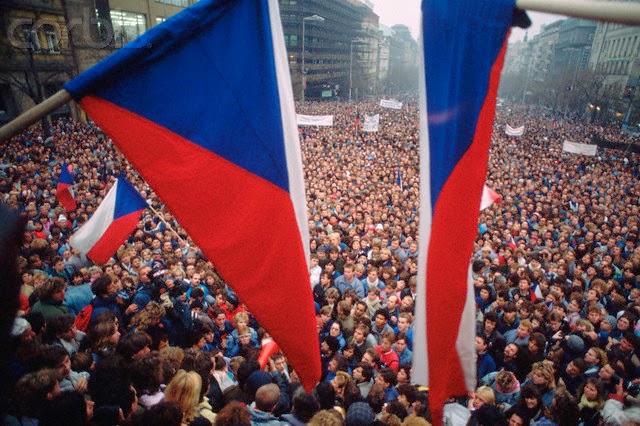
The Velvet Revolution in Prague on November 17, 1989

What was achieved 32 years ago in Czechoslovakia on November 17, 1989 that makes it a day of celebration around the world? 

It was a rejection of totalitarianism and the system of lies and hatred on which the regime thrived. It was a rebirth of freedom and of normal human relationships.  In Vaclav Havel's address to the European Parliament on November 11, 2009 he outlined the daunting challenges faced after the transition:

A democratic political culture cannot be created or renewed overnight. It takes a lot of time and in the meantime there are plenty of unanticipated problems to be solved. Communism ruled just once in modern times (and, hopefully, for the last time), so the phenomenon of post-Communism was also a novelty. We had to confront the consequences of the rule of fear that lasted for so many years, as well as all the dangers related to a redistribution of property without precedent in history. So there were and are lots of obstacles and we are only now acquiring experience of such a state of affairs.

Months earlier in the summer of 1989 Jiří Křižan and Václav Havel had drafted "A Few Sentences" Petition calling for the release of political prisoners and respect for human rights. Tens of thousands of Czechoslovakians signed the petition and it contributed to the Velvet Revolution and the fall of communism in Czechoslovakia.

What took place on November 17, 1989 was the nonviolent triumph of the power of the powerless over a brutal totalitarian regime.This is in profound contrast to the centenary of the start of World War One that was supposed to make the world safe for democracy and instead ushered in two totalitarian systems: Nazism and Communism, a Second World War, a Cold War, and the age of nuclear weapons.

The Velvet Revolution was not inevitable, but a combination of providence, free will, and principled human action. The "Velvet Revolution" achieved profound non-violent change without wholesale slaughter and violence associated historically with revolutions. A cursory look would claim that the "revolution" took 11 days in November for the Communists to relinquish power. 

Some say it began in 1976 after the beating and arrest of the rock band the Plastic People of the Universe led to a number of intellectuals, Vaclav Havel, among them drafting and signing Charter 77 challenging the Czech communists to honor the rights outlined in their own constitution and in the Helsinki accords which the communist government had signed in 1975.

However some nonviolent theoreticians place the roots of the 1989 success even further back in the nonviolent response to the Soviet invasion of Czechoslovakia in 1968. After Soviet tanks crushed the Prague Spring, an effort by Czechoslovak communist reformers to build socialism with a human face, Havel wrote the following to the Czechoslovak President Alexander Dubcek who had been one of the reformers later purged: "Even a purely moral act that has no hope of any immediate and visible political effect can gradually and indirectly, over time, gain in political significance." The response by Czechs in what later became known as a civilian based defense, nonviolently bogged down the advancing Soviet army for eight months. The nonviolent lessons learned in 1968 planted seeds that bore fruit in 1989.  

Havel passed away on December 18, 2011 but his legacy endures and his ideas remains relevant raising the call to vigilance at a conference at Charles University titled “Freedom and its Enemies”:

The era of dictatorships and totalitarian systems has not ended at all. It may have ended in a traditional form as we know it from the 20th century, but new, far more sophisticated ways of controlling society are being born. It requires alertness, carefulness, caution, study and a detached view.

I've had the privilege to have walked the streets and breathed the air of Prague in May of 1990, barely five months after Havel went to the Castle in December of 1989, and returned nineteen years later in October of 2009 to participate in Forum 2000 and see the changes that had taken place. 

Although Czechs may no longer look in awe at all that they have accomplished after walking around the center of the city visiting shops and a grocery store, and talking with Czechs over a few beers I left impressed by all that had been accomplished, and with an overwhelming sense of happiness at bearing witness to a flowering of freedom and creativity that continues to endure and thrive. 

Vaclav Havel greets crowds in Wenceslas Square during 'Velvet Revolution'.

Victims of dictatorship the world over have experienced first hand the solidarity of the Czech and Slovak peoples. Further evidence that 25 years later the ideals of the Velvet Revolution endure.

 In Cuba, a year ago the San Isidro Movement, a collective of artists founded in 2018 to resist new restrictions on artistic freedom imposed by Havana's Decree 349 has marked a before and after in Cuban history with their civic protest, and the regime's violent reaction. 

Artists from the San Isidro Movement celebrating Cuban culture

Earlier this year members of the San Isidro Movement together with compatriots in the diaspora challenged the dictatorship's culture of death embodied in the phrase "Patria o Muerte" (Homeland or Death) with a song titled "Patria y Vida" (Homeland and Life). Let us pray that soon Cuba will have its nonviolent revolution and its people freed from seven decades of first authoritarian, then totalitarian dictatorship and the old phrase of a democratic Cuba returns "Patria y Libertad" (Homeland and Freedom).

The Velvet Revolution gives us hope that it can be achieved, and Cuban artists are on the front lines of this effort.

Sunday, November 14, 2021

Why are Cubans protesting in Cuba and around the world?

Cubans are engaging in nonviolent protests both inside the island and in the diaspora on November 15th ostensibly to protest limitations on civil liberties in Cuba, and call for the release of hundreds of political prisoners. The Cuban dictatorship has prohibited peaceful protests on the island, and is ramping up repression, and strategies to stop the demonstrations. 

Protest on 11/14/21 at Cuban Embassy in Washington DC.

Although the main objective is the release of political prisoners, and defending civil liberties, the grievances run far deeper, and are too numerous to list in a single blog entry, but some highlights can be listed here for context and greater understanding.

1. Dictatorship's decision not to get foreign vaccines for Cubans in order to claim that Cuba was the first country in the world to vaccinate their entire population with homegrown vaccines caused many deaths.

Posted on Facebook by Tîcö Äwö Ôrümîlä, had to bury his grandmother in a mass grave in the Juan González cemetery, in Santiago de Cuba. (Screen capture)

Officials decided not to acquire vaccines from their allies, China and Russia, or sign up with the United Nation's COVAX program. Russian and Chinese vaccines became available in Latin America as early as February 2021. Reports of Russian and Chinese COVID-19 vaccines reaching Latin America made news in early March 2021, but Havana declined them preferring to promote their still unavailable domestic vaccines while most other countries in Latin America did.

Official regime journalist Leticia Martinez Hernandez over Twitter on May 18, 2021 bragged that "Cuba will be the first country in the world to vaccinate their whole population with their own vaccines. Live to see!" She even replied to her own Tweet that she would keep the above "tweet fixed until then. I want to remember the feat on which we have bet." Havana's foreign ministry on June 9, 2021 repeated the same campaign theme as the official journalist: "Cuba could be the first country to immunize its entire population with its own vaccines. The population wants and trusts the vaccine candidates, our science, and the country's experience in vaccine development."  Officials rejected using alternative vaccines over the six months that they were available, because their  first "homegrown vaccines" had not been ready for clinical trials until May 2021 in Havana, and in the rest of the island until June. As of November 9, 2021 none of the Cuban vaccines have been peer reviewed. 

Cuban official statistics on COVID-19 infections and deaths are not reliable. Professor Duane Gubler of the Duke-NUS Medical School in Singapore in the January 8, 2019 New Scientist report, "Cuba failed to report thousands of Zika virus cases in 2017", stated matter of factly that "Cuba has a history of not reporting epidemics until they become obvious." Doctors and journalists have been jailed in Cuba for speaking truthfully on past disease outbreaks.  Sarah Marsh, of Reuters, was reporting on June 17, 2021 that "coronavirus infections have halved in Havana since authorities started administering Cuba’s experimental vaccines en masse in the capital a month ago." Less than a month later Reuters was reporting that Cuba "has the highest rate of contagion per capita in Latin America." There are official denials, but independent reports of mass graves in Cuba for COVID-19 victims continue to circulate.

Following July protests in Cuba, officials in later August 2021 accepted China's sinopharm vaccine and began providing it to Cubans. This was at least seven months after it had already been distributed in the rest of Latin America. Why didn't Havana do this beginning in January or February when the rest of Latin America did and Cuba did not have "home grown" vaccines? Why are they doing it now when they have the "home grown" vaccines that they claim are up to 92.8% effective (but have not been peer reviewed), compared to China's sinopharm vaccine that is only 72% effective?

2. Havana wishes to maintain monopoly control over distribution of assistance and zero transparency. 

Volunteers collect humanitarian aid collected in Miami to be sent to Cuba.

In 2020 the Castro regime seized a humanitarian shipment that would have helped tens of thousands of Cubans.They continue to block grassroots efforts today. The Biden Administration in early July 2021 granted a temporary authorization from the US Department of Transportation for two cargo airlines to travel to the island with humanitarian cargo. According to 14ymedio the "permit, which will be in force until November 30 and was made public on August 13, includes charter flights 'for emergency medical purposes, search and rescue, and other trips considered of interest to the United States.'” Two months had passed and there was still no response from Havana, despite the urgent need on the ground.

3. Cubans are resentful of the internal blockade placed on them by the Castro dictatorship.

Havana continues to call the United States economic embargo on Cuba a "blockade." This is not true as the State Department (and U.S. - Cuba trade statistics over the past 20 years) demonstrate. A meme appeared on social media in Spanish that outlines this reality, and Cuban scholar and journalist Carlos Alberto Montaner on July 15, 2021 gave a commentary on the blockade not prohibiting a series of economic measures that are proscribed by the Cuban government. Another meme correctly replaced the term "blockade" with "economic sanctions."

This first to be examined was the claim that "U.S. sanctions do not prohibit fishermen in Cuba from fishing, the dictatorship does." This was explored in a July 29th CubaBrief that was mentioned in a column by Mary Anastasia O'Grady in the September 7, 2021 print edition of The Wall Street Journal titled "A Sanction Worth Lifting in Cuba."

The second to be examined was the claim that "U.S. sanctions do not confiscate what farmers harvest, the dictatorship does." Castro regime seized and collectivized properties, and prohibited farmers selling their crops to non-state entities, in the early years of the revolution. The Cuban government established production quotas and farmers were (and are) obligated to sell to the state collection agency, called Acopio. Most recent law on agriculture in Cuba ( Decreto Ley 358 de 2018) continues to prohibit private sales of agricultural products to non-state entities. 

Today, between 70% and 80% of Cuba's food is imported. This included the years when Cuba was heavily subsidized by the Soviet Union, and was part of the East Bloc. Since 2000, much of the food purchased by Havana has been imported from the United States.

Rotting crops cannot be blamed on economic sanctions, but inefficient centralized communist agricultural practices that prohibit market mechanisms to increase efficiency and deliver more food to Cubans. Diario de Cuba (DDC) ( March 18, 2021) and 14ymedio (June 15, 2021) have reported on rotting food crops due to the failures of the state enterprise, Acopio in picking them up on time. Worse yet, farmers have no other option bu to allow them to rot or risk fines and prison.

4. Cubans are beaten and imprisoned for thinking differently. There are hundreds of Cuban political prisoners who have not committed any crime, except exercise their fundamental rights. Nonviolent opposition leaders have died under suspicious circumstances with official involvement. 

Oswaldo Payá and Laura Pollán died under suspicious circumstances linked to regime.

Cubalex, a human rights NGO, identified 1,227 detained Cubans (this is a partial number), related to the protests that began on July 11th, in their database. Summary trials have been carried out, with Cubans condemned in excess of 20 years in prison for taking part in the protests.

Following the 11J uprising on August 18, 2021 Havana brought Decree-Law 35 into force. Human Rights Watch reported that "the decree, which has the stated purpose of 'defending' the Cuban revolution, requires telecommunications providers to interrupt, suspend, or terminate their services when a user publishes information that is 'fake' or affects 'public morality' and the 'respect of public order.'

Extrajudicial killings of dissidents also happen in Cuba.

On July 22, 2015 Javier El-Hage, and Roberto González of the Human Rights Foundation released a 147 page report titled The Case of Oswaldo Payá found that "witness statements, physical evidence and expert reports – suggest direct government responsibility in the deaths of Payá and Cepero. Specifically, the evidence deliberately ignored by the Cuban State strongly suggests that the events of July 22, 2012 were not an accident – as was quickly claimed by authorities in the state-owned media monopoly and later rubber – stamped by Cuba’s totalitarian court system – but instead the result of a car crash directly caused by agents of the State, acting (1) with the intent to kill Oswaldo Payá and the passengers in the vehicle he was riding." Oswaldo Payá was the founding leader of the Christian Liberation Movement.

Cuban opposition leader and human rights defender Laura Pollán died on October 14, 2011 under circumstances that Cuban dissident and medical doctor Oscar Elias Biscet described as "death by purposeful medical neglect." Laura Inés Pollán Toledo, a courageous woman spoke truth to power and protested in the streets of Cuba demanding an amnesty for Cuban political prisoners. She had been a school teacher, before her husband was jailed for his independent journalism in 2003 along with more than 75 other civil society members. She was the founding leader of the Ladies in White.

5. The Castro regime ended black advancement in Cuba, and silenced criticism of racism for decades through repression of black voices.

From Verde Olivo 1, no. 29 (October 1, 1960). A cartoon depicting Fidel Castro meeting with African Americans in Harlem in a pro-regime publication. On the left capitalists, and on the right Fidel Castro with black Americans featured with racist stereotype


“Of the 256 Negro societies in Cuba, many  have had to close their doors and others are in death agony. One can truthfully say, and this is without the slightest exaggeration, that the Negro movement in Cuba died at the hands of Sr. Fidel Castro.” … “Yet this is the man who had the cynical impudence to visit the United States in 1960 for the purpose of censuring American racial discrimination. Although this evil obviously exists in the United States, Castro is not precisely the man to offer America solutions, nor even to pass judgement,” reported Cuban nationalist Juan René Betancourt in his essay in the NAACP's publication The Crisis in 1961. 

Racist attitudes persist in Cuba under the Castros and this is reflected in rates of interracial marriage being lower in Cuba than in Brazil that has a much higher level of inequality than the Caribbean island, and has not undergone a communist revolution.

On the economic front the glaring differences between black and white Cubans are shocking with 95% of Afro-Cubans having the lowest incomes compared to 58% of white Cubans.


Tuesday, November 9, 2021

November 9th marks two historic dates: the destruction of the Berlin Wall in 1989 and Kristallnacht in 1938, the night Nazis systematized their anti-Jewish violence

For here on either side of the wall are God’s children, and no man-made barrier can obliterate that fact. - Reverend Martin Luther King Jr., St. Mary’s Church, East Berlin, September 13, 1964.

Tearing down the Berlin Wall on November 9, 1989

November 9th has a double significance in German history.

Thirty two years ago today was a day of freedom when the Berlin Wall was torn down and a symbol of totalitarianism crumbled. The Communist empire that emerged after WW2 began to implode in a process that would end on Christmas 1991 with the nonviolent dissolution of the Soviet Union. 

From 1961 to 1989 the Berlin Wall divided what is today Germany's capital and the world. February 5, 2018 marked the date on which the Wall had been down for as long as it once stood: 28 years, 2 months and 27 days.  

Sixty years ago, in the early morning hours of August 13, 1961, the Berlin Wall went up and divided the old German capital city in two.  Western manufacturers provided the 150 tons of coiled barb wire to imprison East Germans behind the Berlin Wall for an entire generation.

In East Germany there are 136 documented cases of German civilians killed by East German border guards between 1961 and 1989 with their names provided. An estimated 1,000 were killed trying to cross.  The East German government had given a clear Order to Border Guards on October 1, 1973 that left no doubt to their criminal nature:

"It is your duty to use your combat … skills in such a way as to overcome the cunning of the border breacher, to challenge or liquidate him in order to thwart the planned border breach... Don’t hesitate to use your weapon even when border breaches happen with women and children, which traitors have often exploited in the past.”

Killings at the Berlin Wall continued until it was torn down in 1989. One of the last victims, Chris Gueffroy was born on June 21, 1968 and shot dead on February 5, 1989 trying to cross the Berlin Wall. Murdered at 20 years of age for the crime of wanting to live in freedom. 

Today also marks the date when the Nazis began their genocide of European Jewry.

Germans pass by the broken shop window of a Jewish-owned business that was destroyed during Kristallnacht.

83 years ago tonight was Kristallnacht, the night of broken glass, when Nazism, another totalitarian ideology, sought to systematically destroy the Jewish people through institutionalized and coordinated anti-Semitic violence

The Nazis committed these atrocities by "othering" Jewish people, but they had help.

Beginning with the National Socialists arrival to power in the 1930s the International Business Machines Corporation (IBM) provided equipment with ground breaking technologies, precursors to computers, to identify and categorize holocaust victims. 

Thomas J. Watson, head of IBM, Int'l Chamber of Commerce president with ICC board members meet Hitler (1937).

According to a October 8, 2002 article in The Village Voice "the infamous Auschwitz tattoo began as an IBM number. IBM engineered a strategic business alliance with Nazi Germany and provided the punch card technology that would be used in managing the vast apparatus of the Nazi death camps. 

Equally troubling is that the Nazis were able to arrive in a town with lists of names of people identified as being Jewish. Where did they get the data? From IBM Germany's census operations and similar advanced people counting and registration technologies. IBM enabled the Holocaust.

Eighty years later, and the conduct of Western corporations in Communist China and others that profit from genocide today are little better than IBM in the 1930s.

Rev. Martin Luther King Jr. at St. Mary's Church in East Berlin.

Reverend Martin Luther King Jr. in his September 13, 1964 address to St. Mary's Church in what was then East Germany contained an antidote to both Communist and Nazi ideologies when he rejected violent conflict based on race  or class in favor of a nonviolent struggle for justice, and stated to Germans that "regardless of the barriers of race, creed, ideology, or nationality, there is an inescapable destiny which binds us together. There is a common humanity which makes us sensitive to the sufferings of one another." 

This was true in 1938, 1964, 1989, and remains true today.  We must learn from both these chapters of history.

Sunday, November 7, 2021

National Day for the Victims of Communism: Remembering those killed and the courageous Poles that twice saved the world

Today is the day that Americans set aside to remember the victims of communism around the world.

Communists manufactured famines to liquidate class enemies started in the USSR

We owe it to both the victims of communism from the past and of today to remember them and denounce what has happened and is still happening now in order to finally bring an end to the communist death toll. Below is a partial list of the dead reaches 102.566 million dead.

Communist death toll (estimate)*
Soviet Union 61 million dead
Peoples Republic of China 35 million dead
Khmer Rouge (Cambodia) 2 million dead
Communist Vietnam 1.670 million dead
North Korea 1.663 million dead
Communist Ethiopia 725,000 dead
Communist Rumania 435,000 dead
Communist Cuba 73,000 dead

In addition to remembering the over 100 million victims in the 20th century alone, also recall the 101st anniversary of "the Polish victory against Vladimir Lenin’s Bolsheviks in the Battle of Warsaw. Known as the Miracle on the Vistula, the Polish heroes of this battle halted the spread of communism in Europe for decades."  

Today, Cubans remember the tens of thousands of victims of Cuban communism under the dictatorship of the Castros. The Victims of Communism Memorial Foundation has highlighted three cases: Oswaldo Payá Sardiñas, Harold Cepero Escalante, and Sirley Ávila León.

Below is the video that highlights the killings of Oswaldo and Harold in 2012:

Below is the video that highlights the brutal assault against Sirley Avila Leon in 2015:

One week from today Cubans around the world will be engaging in solidarity protests with their brothers and sisters on the island that have announced civic marches across  the island on November 15th. 

In Washington, DC Cubans and friends of a free Cuba will gather on Sunday, November 14th at Meridian Hill Park at 2:00pm and at 3:00pm will set out in a short prayer walk to the Cuban Embassy down the street followed by an hour of prayer, poetry readings, and music that will conclude at 4:00pm.


Participants will return on Monday, November 15th at Meridian Hill Park at 2:00pm and at 3:00pm, the same time the Civic March will be underway in Cuba, will set out on a Civic walk to the Cuban Embassy, and picket their from 3pm and 6pm while following events unfolding in the island.

Today, we also join with the peoples of the many other nations that have, and continue to, suffer under the scourge of communism in prayers for the dead, and to carry on the liberation struggle for those still living under the yoke of communist oppression.

Finally, we give thanks to our Polish brethren who stopped the spread of communism in 1920 and sixty nine years later led the offensive that ended communism in Europe in 1989.
