With apologies to Chevy Chase and Saturday Night Live
One year ago the dictatorship in Cuba announced that Cuban communist dictator Fidel Castro had died. Today one can say with full confidence that Fidel Castro is still dead. This blog entry will list ten reasons why that is a good thing.
1. Fidel Castro, secretly a communist since at least 1950, lied to Cubans and the world that he would restore the 1940 Constitution and democracy in Cuba. Castro arrived in Havana in January of 1959 and immediately set upon consolidating power and erecting a totalitarian, communist dictatorship. On December 2, 1961 Castro explained the reason for the lie: "If we had paused to tell the people that we were Marxist-Leninists while we were on Pico Turquino and not yet strong, it is possible that we would never have been able to descend to the plains." Communism and the communist party were deeply unpopular in Cuba because of its links to the Batista regime.
2. While Fidel Castro talked democracy in 1959 the firing squads were filmed and broadcast and the terror began to consolidate control. Those who had fought by his side in good faith believing the Revolution was a struggle to restore democracy became uneasy with the course of the new regime. Some, like Huber Matos, Julio Ruiz Pitaluga, and Mario Chanes de Armas who spoke out spent decades in prison. Many returned to the hills of the Escambray to carry on the struggle for the democratic restoration. This resistance was crushed in 1966 after five years of assistance from 400 Soviet counterinsurgency advisors.
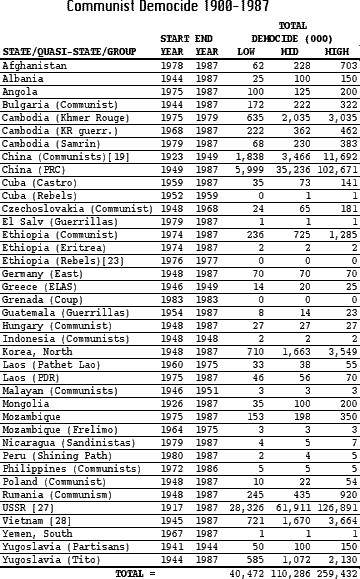
3. The Black Book of Communism states that in Cuba between 1959 thru the late 1990s between 15,000 and 17,000 Cubans were shot. Rudolph Joseph Rummel, a political science professor at the University of Hawaii and an expert in Democide (murder by government) also takes into account the Cuban boat people who have died fleeing the dictatorship and estimates 73,000 dead Cubans between 1959 and 1987. Without opening up archives on the island and an exhaustive search the full number of victims may never be known.
4. Fidel Castro twice called on the Soviet Union to launch a nuclear first strike on the
United States and plunge the world into a nuclear holocaust. The first
time was during the October 1962 Missile Crisis in a letter to Nikita Khrushchev and the second time in the early 1980s were Castro pressed the Soviets hard for a nuclear strike against the United States. This revelation became public knowledge on September 21, 2009 and The New York Times quotes the source:
5. Fidel Castro visited Berlin in 1972 and addressed the border guards that policed the
Berlin Wall to prevent East Germans from escaping to the West. At Brandenburg gate on June 14, 1972 in the afternoon (pictured above) he addressed the men charged with shooting East Germans fleeing to West Germany as "the courageous and self-denying border guards of the GDR People's Army who stand guard in the front line of the entire-socialist community." Later in the evening Premier Castro addressed the Nikolay Bezarin Barracks in East Berlin:
6. Fidel Castro on April 3, 1977 met in East Berlin with Erich Honecker about the need to help the revolution in Ethiopia and talked up Mengistu Haile Mariam, a then emerging new Marxist-Leninist leader. Fidel Castro celebrated the initiation of the Red Terror on February 3, 1977
in Ethiopia:
Both Fidel and Raul Castro were deeply involved in sending 17,000 Cuban
troops to East Africa in assisting Mengistu in consolidating his rule
and eliminating actual and potential opposition. The last Cuban troops
did not leave Ethiopia until 1989 and were present and complicit in the
engineered famine that took place there in the 1980s. Donald R. Katz in the September 21, 1978 Rolling Stone article "Ethiopia After the Revolution: Vultures Return to the Land of Sheba" gave the following description of the wave of terror and repression unleashed by Mengistu.
8. Fidel Castro linked to international drug trafficking. The U.S. State Department on March 1, 1982 declared Cuba a state sponsor of terrorism whose government was was using a narcotics ring to funnel both arms and cash to the Colombian M19 terrorist group then battling to overthrow Colombia’s democratic government. During General Manuel Noriega's 1992 trial information emerged publicly implicating the Castro brothers as the Sun Sentinel reported at the time:
9. Fidel Castro spent decades trying to overthrow democracy in Venezuela before succeeding with Hugo Chavez and then sought to consolidate a totalitarian regime in the South American country. The Castro regime's interest in Venezuela began from the earliest days
of the dictatorship. Venezuelans understood the threat poised by the
Cubans by 1960 when Ernesto "Che" Guevara was giving unsolicited advice
to Rómulo Betancourt, the democratically elected president of
Venezuela. Guevara called for Betancourt to use the firing squad against
his "rightist opponents." In 1963 Congressional Quarterly reported on how:
The Castro dictatorship a few years later had Cuban agents assisting the Macheteros (FALN) who committed terrorist attacks and bank robberies in the United States including bombings; among them the 1975 bombing of Fraunces Tavern in New York which killed four instantly and injured 63. On December 31, 1982, New York City was the scene of a wave of bombings by the Macheteros (FALN): Federal Courthouse at 26 Federal Plaza; a Police Officer at One Police Plaza lost part of his leg when another bomb went off there; a bomb tore into the Federal Courthouse at Cadman Plaza in Brooklyn; two other devices were discovered in St. Andrew's Plaza beside the Federal Courthouse at Foley Square, the NYPD Bomb Squad sealed off the area and was preparing to disarm the device when it exploded severely injuring two officers were. In 1983 the Cuban government provided financial and logistical support for the Wells Fargo armored car robbery which netted the Macheteros $7.1 million dollars of which $2 million made its way back to Cuba via a diplomatic pouch. The whole story is detailed in a Hartford Courant investigative piece published in 1999. Oscar López Rivera, one of the leaders of the Macheteros, granted clemency by President Obama on January 17, 2017 was honored in Cuba with the Order of Solidarity in November of 2017 and he called on the world to emulate Fidel Castro.
 |
| Fidel Castro's gone but when will the dictatorship he created follow him? |
1. Fidel Castro, secretly a communist since at least 1950, lied to Cubans and the world that he would restore the 1940 Constitution and democracy in Cuba. Castro arrived in Havana in January of 1959 and immediately set upon consolidating power and erecting a totalitarian, communist dictatorship. On December 2, 1961 Castro explained the reason for the lie: "If we had paused to tell the people that we were Marxist-Leninists while we were on Pico Turquino and not yet strong, it is possible that we would never have been able to descend to the plains." Communism and the communist party were deeply unpopular in Cuba because of its links to the Batista regime.
 |
| Matos and Chanes fought with Castro but jailed for questioning communist infiltration |
2. While Fidel Castro talked democracy in 1959 the firing squads were filmed and broadcast and the terror began to consolidate control. Those who had fought by his side in good faith believing the Revolution was a struggle to restore democracy became uneasy with the course of the new regime. Some, like Huber Matos, Julio Ruiz Pitaluga, and Mario Chanes de Armas who spoke out spent decades in prison. Many returned to the hills of the Escambray to carry on the struggle for the democratic restoration. This resistance was crushed in 1966 after five years of assistance from 400 Soviet counterinsurgency advisors.
 |
| Executed by firing squad in Santiago de Cuba by the Castro regime in 1959 |
 |
| Raul Castro preparing one of his victims for execution |
Andrian A. Danilevich, a Soviet general staff officer from 1964 to ’90 and director of the staff officers who wrote the Soviet Union’s final reference guide on strategic and nuclear planning is quoted in the early 1980s, saying that Mr. Castro “pressed hard for a tougher Soviet line against the U.S. up to and including possible nuclear strikes.” The general staff, General Danilevich continued, “had to actively disabuse him of this view by spelling out the ecological consequences for Cuba of a Soviet strike against the U.S.”
 |
| Castro encouraged East German border guards in their deadly work |
It is very important to know that the people of the GDR have great confidence in you, that they are truly proud of you. The comrades of the party and the citizens of socialist Berlin have told us with great satisfaction about the activity of the border troops, speaking with great admiration for you and for your services.
 |
| Fidel Castro with ally and war criminal Mengistu Haile Mariam in Ethiopia 1977 |
"Mengistu strikes me as a quiet, serious, and sincere leader who is aware of the power of the masses. He is an intellectual personality who showed his wisdom on February 3. […] The prelude to this was an exuberant speech by the Ethiopian president in favor of nationalism. Mengistu preempted this coup. He called the meeting of the Revolutionary Council one hour early and had the rightist leaders arrested and shot. A very consequential decision was taken on February 3 in Ethiopia. […]Before it was only possible to support the leftist forces indirectly, now we can do so without any constraints."
7. Fidel Castro took part in mass murder in Eastern Africa in the 1970s and 1980s. Between 1977-78, a conservative estimate of over 30,000 Africans perished as a result of a Red Terror unleashed in Ethiopia by the Mengistu and his Cuban allies. Amnesty International concluded that
"this campaign resulted in several thousand to perhaps tens of
thousands of men, women, and children killed, tortured, and imprisoned."
Sweden's Save the Children Fund lodged a formal protest in early 1978 denouncing the execution of 1,000 children, many below the age of thirteen, whom the communist government had labeled "liaison agents of the counter revolutionaries."
 |
| Raul Castro and Fidel Castro with ally Mengistu Haile Mariam |
"Toward the middle of last year [1977], Mengistu pulled out all the stops. "It is an historical obligation," he said then, "to clean up vigilantly using the revolutionary sword." He announced that the shooting was about to start and that anyone in the middle would be caught in the cross fire. In what came to be known as the "Red Terror," he proceeded to round up all those who opposed the military regime. According to Amnesty International, the Dergue killed over 10,000 people by the end of the year. One anti-government party, mostly made up of students and teachers, was singled out as 'the opposition.'"Human Rights Watch in their 2008 report on Ethiopia titled outlined "Collective Punishment War Crimes and Crimes against Humanity in the Ogaden area of Ethiopia’s Somali Region" some of the practices carried out by Cuban troops sent there by Fidel and Raul Castro excerpted below:
Africa Watch (the precursor to Human Rights Watch’s Africa Division) analyzed Ethiopian counter-insurgency operations in this period and found that they followed a four-pronged approach: i) the forced displacement of much of the civilian population into shelters and protected villages; ii) military offensives against people and economic assets outside the shelters; iii) the sponsoring of insurgent groups against the WSLF and Somali government; and iv) attempts to promote the repatriation of refugees. In December 1979, a new Ethiopian military offensive, this time including Soviet advisors and Cuban troops, “was more specifically directed against the population’s means of survival, including poisoning and bombing waterholes and machine gunning herds of cattle.”
 |
| Manuel Noriega and Fidel Castro: Partners in drug trafficking |
"Federal prosecutors say Noriega traveled to Havana to ask [Fidel] Castro to mediate a potentially deadly dispute with top members of Colombia`s Medellin cocaine cartel. They say the cartel chiefs were upset because a major drug lab had been seized in Panama despite payment of millions of dollars in protection money to Noriega.At the same time convicted cartel leader Carlos Lehder directly implicated Raul Castro and U.S. fugitive Robert Vesco "to route cocaine flights through Cuba." Capitol Hill Cubans blogged how two years later, a federal indictment listed General Raul Castro as part of a conspiracy that smuggled seven and a half tons of cocaine into the United States over a 10-year period but the Clinton administration overruled prosecutors. Regime continues to engage in such practices in the present.
According to the Noriega indictment, Castro negotiated a peace accord between the cartel and Noriega at the 1984 meeting. The allegation forms a cornerstone of the racketeering and drug trafficking charges against Noriega."
 |
| Fidel Castro, Hugo Chavez of Venezuela and Raul Castro |
"Riots led by Communists and other pro-Castro elements in Caracas [in the autumn of 1960] took the lives of 13 persons and injured 100. Venezuela recalled its ambassador to Cuba, and Betancourt ordered out the army to end the rioting, which he termed an attempt to “install a regime similar to that in Cuba.”
Cuban Communist leader Blas Roca, told a Havana rally on January 23, 1963 that when the communists gained full control and “make themselves owners of the great
riches in oil, aluminum and everything their earth imprisons, then all
of America shall burn.” A cache of three tons of weapons was found on a Venezuelan beach in November
1963 that was to be used to disrupt the democratic elections there.
Fidel Castro would continue to agitate for revolution in Venezuela. A
well documented incident occurred on May 8, 1967 and was reported by
Francisco Toro in The Washington Post who described how:
"two small boats carrying a dozen heavily armed fighters made landfall
near Machurucuto, a tiny fishing village 100 miles east of the
Venezuelan capital, Caracas. Their plan was to march inland and recruit
Venezuelan peasants to the cause of socialist revolution." An all night
gun battle with the Venezuelan military led to nine guerrillas dead, two
captured, and one who had escaped.
The Castro regime's efforts would not begin to bear fruit until December 1994 with the arrival of Hugo Chavez in Havana to a hero's welcome following two years in prison for a coup attempt in Venezuela. Four years later Chavez had won the presidency of Venezuela and the Castro regime finally had its entry to Venezuela. By 2007, Chávez had declared that Cuba and Venezuela were a single nation. “Deep down,” he said, “we are one single government.” When Hugo Chavez died in 2013 the succession to Nicolas Maduro was planned in Havana.
The Castro regime's efforts would not begin to bear fruit until December 1994 with the arrival of Hugo Chavez in Havana to a hero's welcome following two years in prison for a coup attempt in Venezuela. Four years later Chavez had won the presidency of Venezuela and the Castro regime finally had its entry to Venezuela. By 2007, Chávez had declared that Cuba and Venezuela were a single nation. “Deep down,” he said, “we are one single government.” When Hugo Chavez died in 2013 the succession to Nicolas Maduro was planned in Havana.
The name of this "single nation" is Cubazuela and is a term that has been used by mainstream press publications such as The Wall Street Journal. The consequences to the people of Venezuela are well known. Violence has escalated during the Chavez-Maduro era to levels never seen before. There is widespread hunger now in Venezuela. Civil liberties and the rule of law are rapidly disappearing.
 |
| NY Daily News Photo By Harry Hamburg 1975 Fraunces Tavern bombing committed by Cuban backed FALN |
10. Fidel Castro has a long and shameful history of sponsoring and taking part in terrorism including utilizing the tactic in the struggle against dictator Fulgencio Batista. On New Year’s Eve in 1956 members of Castro's 26th of July movement set off bombs in the Tropicana nightclub, blowing off the arm of a seventeen-year-old girl. From bombings, killings, and arson in 1957 to a botched hijacking to smuggle weapons to the Cuban guerrillas that led to 14 dead and the night of the 100 bombs in 1958 . The organizer of the bombing campaign Sergio González López nicknamed “El Curita” and the terrorist action itself are remembered fondly by the dictatorship that named a park in his honor along with a plaque
pictured below. Regime apologists now deny that anyone was wounded or
killed but the memories of those who lived through this say otherwise. González López was captured, tortured, and killed by agents of the Batista dictatorship on March 18, 1958. A pro-Cuban dictatorship website recalls some of El Curita's actions:
“He actively participated in the actions of the burning of Standard Oil; the bombing of Bejucal Railway Station cable, the cable from the Bus Station, the explosion of Vento, in the action of the Tunnel and the explosion of 120 coordinated bombings in Havana, which in a telephone phone call on this occasion to the chief of police, he told him “Coward, prepare your ear tonight ... we are going to explode 100 bombs under your own noses.”The Castro regime has practiced, trained, and even published manuals with chapters on how to engage in terrorism and to never renounce it, and on more than one occasion targeted the United States.
 |
| Plaque erected by Castro regime to honor bomber Sergio González López “El Curita” |
The Castro regime organized a 1966 gathering called the Tricontinental Conference
where Fidel Castro insisted that "conditions exist for an armed
revolutionary struggle." The aim of the Tricontinental, according to Georges Fauriol in the book Cuba:the international dimension, was to promote violent revolution in Africa and Asia as well as Latin America: “At this conference, Cuba
and Latin American Marxist Leninist terrorist groups began their
collaboration with black militant groups in the United States, the Palestine Liberation Organization (PLO), and
other radical Arab groups in the training and arming of terrorists."
Gerardo Jorge Schamís in his book War and terrorism in international affairs describes how in the summer of 1975 the disappearance of “Carlos” who killed his assistant and two members of the French secret service led to the expulsion of three Cuban diplomats from Paris and greater surveillance of the activities of Cuban agents in Europe. According to Jorge Schamís the terrorists had concealed their “modus operandi” since 1976 in Paris in offices of the Revolutionary Coordination Board (JCR) which on the surface sought to obtain solidarity from European democracies to condemn authoritarian regimes in Latin America but in reality it was a documentation center producing forged passports; raise money for clandestine operations and were connected to terrorist training camps in Cuba:
Gerardo Jorge Schamís in his book War and terrorism in international affairs describes how in the summer of 1975 the disappearance of “Carlos” who killed his assistant and two members of the French secret service led to the expulsion of three Cuban diplomats from Paris and greater surveillance of the activities of Cuban agents in Europe. According to Jorge Schamís the terrorists had concealed their “modus operandi” since 1976 in Paris in offices of the Revolutionary Coordination Board (JCR) which on the surface sought to obtain solidarity from European democracies to condemn authoritarian regimes in Latin America but in reality it was a documentation center producing forged passports; raise money for clandestine operations and were connected to terrorist training camps in Cuba:
“opened in 1966 by the Dirección General de Inteligencia (DGI) , the Cuban regime's main intelligence agency, under the supervision of the Soviet KGB after the Tricontinental Conference in Havana, to "organize anti-imperialist forces.”There are links between the Cuban dictatorship and international terrorists such as Uruguayan Tupamaros, the Argentinian Montoneros and ERP , the Chilean MIR, the M19, a Colombian guerilla group that captured the Dominican embassy and Justice building in Bogota assasinating several prominent judges, FARC (Fuerzas Armadas Revolucionarias de Colombia) in 2003, the FARC conducted a February car-bombing of a Bogota nightclub that killed more than 30 persons and wounded more than 160, the Basque terrorist/separatist organization ETA, and the Irish Republican Army (IRA) which has its Latin American headquarters in Havana and has been linked with the FARC.
The Castro dictatorship a few years later had Cuban agents assisting the Macheteros (FALN) who committed terrorist attacks and bank robberies in the United States including bombings; among them the 1975 bombing of Fraunces Tavern in New York which killed four instantly and injured 63. On December 31, 1982, New York City was the scene of a wave of bombings by the Macheteros (FALN): Federal Courthouse at 26 Federal Plaza; a Police Officer at One Police Plaza lost part of his leg when another bomb went off there; a bomb tore into the Federal Courthouse at Cadman Plaza in Brooklyn; two other devices were discovered in St. Andrew's Plaza beside the Federal Courthouse at Foley Square, the NYPD Bomb Squad sealed off the area and was preparing to disarm the device when it exploded severely injuring two officers were. In 1983 the Cuban government provided financial and logistical support for the Wells Fargo armored car robbery which netted the Macheteros $7.1 million dollars of which $2 million made its way back to Cuba via a diplomatic pouch. The whole story is detailed in a Hartford Courant investigative piece published in 1999. Oscar López Rivera, one of the leaders of the Macheteros, granted clemency by President Obama on January 17, 2017 was honored in Cuba with the Order of Solidarity in November of 2017 and he called on the world to emulate Fidel Castro.
These are ten reasons and there are many more that have been documented in this blog among them: massacres of fleeing refugees (1993, 1994); the extrajudicial killings of four members of Brothers to the Rescue in the shoot down (1996); and the extrajudicial killings of Oswaldo Payá Sardiñas and Harold Cepero(2012). Fidel Castro is dead, but the regime he built continues to cause harm, and Mr. López Rivera is wrong the world should reject the harmful example of Fidel Castro and his terrible legacy of lies, terror, murder and complicity in genocide.




 Posts
Posts