Showing posts with label Velvet Revolution. Show all posts

Friday, November 17, 2023

The Velvet Revolution at 34: Václav Havel, The Power of the Powerless, and the hope that it inspires today

 "The salvation of this human world lies nowhere else than in the human heart, in the human power to reflect, in human meekness and human responsibility."- Václav Havel IHT (21 February 1990) 

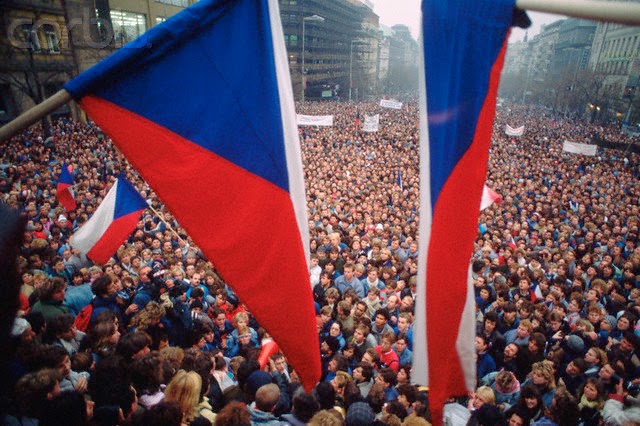
The Velvet Revolution in Prague on November 17, 1989

What was achieved 34 years ago in Czechoslovakia on November 17, 1989 that makes it a day of celebration around the world? 

It was a rejection of totalitarianism and the system of lies and hatred on which the regime thrived. It was a rebirth of freedom and of normal human relationships. In Vaclav Havel's address to the European Parliament on November 11, 2009 he outlined the daunting challenges faced after the transition:

A democratic political culture cannot be created or renewed overnight. It takes a lot of time and in the meantime there are plenty of unanticipated problems to be solved. Communism ruled just once in modern times (and, hopefully, for the last time), so the phenomenon of post-Communism was also a novelty. We had to confront the consequences of the rule of fear that lasted for so many years, as well as all the dangers related to a redistribution of property without precedent in history. So there were and are lots of obstacles and we are only now acquiring experience of such a state of affairs.
Months earlier in the summer of 1989 Jiří Křižan and Václav Havel had drafted "A Few Sentences" Petition calling for the release of political prisoners and respect for human rights. Tens of thousands of Czechoslovakians signed the petition and it contributed to the Velvet Revolution and the fall of communism in Czechoslovakia.

What took place on November 17, 1989 was the nonviolent triumph of the power of the powerless over a brutal totalitarian regime.This is in profound contrast to the centenary of the start of World War One that was supposed to make the world safe for democracy and instead ushered in two totalitarian systems: Nazism and Communism, a Second World War, a Cold War, and the age of nuclear weapons.

The Velvet Revolution was not inevitable, but a combination of providence, free will, and principled human action. The "Velvet Revolution" achieved profound non-violent change without wholesale slaughter and violence associated historically with revolutions. A cursory look would claim that the "revolution" took 11 days in November for the Communists to relinquish power. 

Some say it began in 1976 after the beating and arrest of the rock band, the Plastic People of the Universe, led to a number of intellectuals, Vaclav Havel, among them drafting and signing Charter 77 challenging the Czech communists to honor the rights outlined in their own constitution, and in the Helsinki accords which the communist government had signed in 1975.

Plastic People of the Universe

However some nonviolent theoreticians place the roots of the 1989 success even further back in the nonviolent response to the Soviet invasion of Czechoslovakia in 1968. After Soviet tanks crushed the Prague Spring, an effort by Czechoslovak communist reformers to build socialism with a human face, Havel wrote the following to the Czechoslovak President Alexander Dubcek who had been one of the reformers later purged: "Even a purely moral act that has no hope of any immediate and visible political effect can gradually and indirectly, over time, gain in political significance." The response by Czechs in what later became known as a civilian based defense, nonviolently bogged down the advancing Soviet army for eight months. The nonviolent lessons learned in 1968 planted seeds that bore fruit in 1989.  

Havel passed away on December 18, 2011 but his legacy endures and his ideas remains relevant raising the call to vigilance at a conference at Charles University titled “Freedom and its Enemies”:

The era of dictatorships and totalitarian systems has not ended at all. It may have ended in a traditional form as we know it from the 20th century, but new, far more sophisticated ways of controlling society are being born. It requires alertness, carefulness, caution, study and a detached view.

I've had the privilege to have walked the streets and breathed the air of Prague in May of 1990, barely five months after Havel went to the Castle in December of 1989, and returned nineteen years later in October of 2009 to participate in Forum 2000 and see the changes that had taken place. 

Although Czechs may no longer look in awe at all that they have accomplished after walking around the center of the city visiting shops and a grocery store, and talking with Czechs over a few beers I left impressed by all that had been accomplished, and with an overwhelming sense of happiness at bearing witness to a flowering of freedom and creativity that continues to endure and thrive. 

Vaclav Havel greets crowds in Wenceslas Square during 'Velvet Revolution'.

Victims of dictatorship the world over have experienced first hand the solidarity of the Czech and Slovak peoples. Further evidence that 34 years later the ideals of the Velvet Revolution endure.

 In Cuba, three years ago the San Isidro Movement, a collective of artists founded in 2018 to resist new restrictions on artistic freedom imposed by Havana's Decree 349 has marked a before and after in Cuban history with their civic protest, and the regime's violent reaction. 

Artists from the San Isidro Movement celebrating Cuban culture

Two years ago members of the San Isidro Movement together with compatriots in the diaspora challenged the dictatorship's culture of death embodied in the phrase "Patria o Muerte" (Homeland or Death) with a song titled "Patria y Vida" (Homeland and Life). Let us pray that soon Cuba will have its nonviolent revolution and its people freed from seven decades of first authoritarian, then totalitarian dictatorship and the old phrase of a democratic Cuba returns "Patria y Libertad" (Homeland and Freedom).

The Velvet Revolution gives us hope that freedom can be achieved in Cuba, and Cuban artists are on the front lines of this effort. Some of them, including Luis Manuel Otero Alcántara and Maykel Castillo Pérez, "El Osorbo" are enduring prison today in Cuba.

Wednesday, November 17, 2021

The Velvet Revolution at 32: Václav Havel, The Power of the Powerless, and the hope that it inspires today

 "The salvation of this human world lies nowhere else than in the human heart, in the human power to reflect, in human meekness and human responsibility."- Václav Havel IHT (21 February 1990) 

The Velvet Revolution in Prague on November 17, 1989

What was achieved 32 years ago in Czechoslovakia on November 17, 1989 that makes it a day of celebration around the world? 

It was a rejection of totalitarianism and the system of lies and hatred on which the regime thrived. It was a rebirth of freedom and of normal human relationships.  In Vaclav Havel's address to the European Parliament on November 11, 2009 he outlined the daunting challenges faced after the transition:

A democratic political culture cannot be created or renewed overnight. It takes a lot of time and in the meantime there are plenty of unanticipated problems to be solved. Communism ruled just once in modern times (and, hopefully, for the last time), so the phenomenon of post-Communism was also a novelty. We had to confront the consequences of the rule of fear that lasted for so many years, as well as all the dangers related to a redistribution of property without precedent in history. So there were and are lots of obstacles and we are only now acquiring experience of such a state of affairs.

Months earlier in the summer of 1989 Jiří Křižan and Václav Havel had drafted "A Few Sentences" Petition calling for the release of political prisoners and respect for human rights. Tens of thousands of Czechoslovakians signed the petition and it contributed to the Velvet Revolution and the fall of communism in Czechoslovakia.

What took place on November 17, 1989 was the nonviolent triumph of the power of the powerless over a brutal totalitarian regime.This is in profound contrast to the centenary of the start of World War One that was supposed to make the world safe for democracy and instead ushered in two totalitarian systems: Nazism and Communism, a Second World War, a Cold War, and the age of nuclear weapons.

The Velvet Revolution was not inevitable, but a combination of providence, free will, and principled human action. The "Velvet Revolution" achieved profound non-violent change without wholesale slaughter and violence associated historically with revolutions. A cursory look would claim that the "revolution" took 11 days in November for the Communists to relinquish power. 

Some say it began in 1976 after the beating and arrest of the rock band the Plastic People of the Universe led to a number of intellectuals, Vaclav Havel, among them drafting and signing Charter 77 challenging the Czech communists to honor the rights outlined in their own constitution and in the Helsinki accords which the communist government had signed in 1975.

However some nonviolent theoreticians place the roots of the 1989 success even further back in the nonviolent response to the Soviet invasion of Czechoslovakia in 1968. After Soviet tanks crushed the Prague Spring, an effort by Czechoslovak communist reformers to build socialism with a human face, Havel wrote the following to the Czechoslovak President Alexander Dubcek who had been one of the reformers later purged: "Even a purely moral act that has no hope of any immediate and visible political effect can gradually and indirectly, over time, gain in political significance." The response by Czechs in what later became known as a civilian based defense, nonviolently bogged down the advancing Soviet army for eight months. The nonviolent lessons learned in 1968 planted seeds that bore fruit in 1989.  

Havel passed away on December 18, 2011 but his legacy endures and his ideas remains relevant raising the call to vigilance at a conference at Charles University titled “Freedom and its Enemies”:

The era of dictatorships and totalitarian systems has not ended at all. It may have ended in a traditional form as we know it from the 20th century, but new, far more sophisticated ways of controlling society are being born. It requires alertness, carefulness, caution, study and a detached view.

I've had the privilege to have walked the streets and breathed the air of Prague in May of 1990, barely five months after Havel went to the Castle in December of 1989, and returned nineteen years later in October of 2009 to participate in Forum 2000 and see the changes that had taken place. 

Although Czechs may no longer look in awe at all that they have accomplished after walking around the center of the city visiting shops and a grocery store, and talking with Czechs over a few beers I left impressed by all that had been accomplished, and with an overwhelming sense of happiness at bearing witness to a flowering of freedom and creativity that continues to endure and thrive. 

Vaclav Havel greets crowds in Wenceslas Square during 'Velvet Revolution'.

Victims of dictatorship the world over have experienced first hand the solidarity of the Czech and Slovak peoples. Further evidence that 25 years later the ideals of the Velvet Revolution endure.

 In Cuba, a year ago the San Isidro Movement, a collective of artists founded in 2018 to resist new restrictions on artistic freedom imposed by Havana's Decree 349 has marked a before and after in Cuban history with their civic protest, and the regime's violent reaction. 

Artists from the San Isidro Movement celebrating Cuban culture

Earlier this year members of the San Isidro Movement together with compatriots in the diaspora challenged the dictatorship's culture of death embodied in the phrase "Patria o Muerte" (Homeland or Death) with a song titled "Patria y Vida" (Homeland and Life). Let us pray that soon Cuba will have its nonviolent revolution and its people freed from seven decades of first authoritarian, then totalitarian dictatorship and the old phrase of a democratic Cuba returns "Patria y Libertad" (Homeland and Freedom).

The Velvet Revolution gives us hope that it can be achieved, and Cuban artists are on the front lines of this effort.

Sunday, November 3, 2019

Remembering the lessons of 1939 and 1989: Resistance not appeasement to totalitarian thugs

Today we too find ourselves in the midst of a dramatic conflict between the "culture of death" and the "culture of life".  - Saint John Paul II, Evangelium Vitae, March 25, 1995

Statue of Felix Dzerzhinsky taken down in Warsaw
Europe offers a cautionary example to the world of what happens when the good appease tyrants rather than oppose them.  In the 1930s Western Democrats sought to appease Hitler's Third Reich to avoid war and ended up with the destruction of Europe in World War II. Fifty years later, Western Democrats following decades vigilance and resistance, the communist regimes of the Soviet empire peacefully imploded.
  
Despite this moment of celebration, Pope John Paul II raised the warning in 1995 that there was a dramatic conflict between the cultures of life and death. This warning had also applied in 1939, and caught many by surprise when two ideologies that at first glance appeared to be opponents became allies.

On August 23, 1939 the Hitler-Stalin Pact (formal name the Molotov-Ribbentrop pact) was signed that publicly proclaimed a non-aggression treaty, but had secret protocols that divided up Central Europe and partitioned Poland. This so-called "non-aggression pact" had sparked Word War 2 on September 1, 1939. On September 22, 1939 a joint Nazi–Soviet military parade in Brest-Litovsk was held to celebrate the successful invasion and conquest of Poland. This war ended six years and one day later on September 2, 1945.  An estimated 15 million soldiers died on the battlefield, and 45 million civilians were killed in the conflict. In a speech delivered on August 1, 1940 Soviet Foreign Minister Vyacheslav Molotov,  celebrated this alliance.
"A radical change for the better in the relations between the Soviet Union and Germany found its expression in the non-aggression pact signed last August. These new, good relations between the USSR and Germany have been tested in practice in connection with events in former Poland, and their strength has been sufficiently proved."
The Soviet Union and Nazi Germany continued to collaborate and assist each other in a bilateral pact through the summer of 1941.  In October - November 1940 they held talks and negotiated terms and spheres of influence to have the Soviet Union join the Axis powers in a four power pact. This would have meant that Germany, Italy, Japan and the Soviet Union would all work together to overthrow Western Democracies and divide up the world.  However, their inability to reach on accommodation on the division of Europe led to a deterioration of relations in 1941, and Hitler's invasion of Russia in Operation Barbarossa on June 22, 1941 ended their alliance. 

Talks on dividing up the world between Nazi and Soviet spheres held in 1940
This was not the first time Nazis and Communists would collaborate nor would it be the last.  This history calls for a deeper reflection on the two ideologies and their commonalities, which are found in the "culture of death" they both embraced.

World War II escalated the culture of death to levels not seen before in human history and culminated in the creation of atomic bombs that threaten continued human existence, and the depravity of the Holocaust. It also ended with the Soviet Union occupying half of Europe and imposing communist regimes on captive nations.

Thankfully the liberation of Central and Eastern Europe from communist control was finally achieved relatively non-violently between 1989 and 1991. Democrats were nonviolent while communists killed opposition members and created martyrs.

Over the next few weeks many in the world will be celebrating this triumph of the culture of life over the culture of death that took place between 1989 and culminated on Christmas day in 1991 with the dissolution of the Soviet Union.

The Velvet Revolution in Prague on November 17, 1989
 What was achieved 30 years ago in Czechoslovakia on November 17, 1989 that makes it a day of celebration around the world? It was a rejection of totalitarianism and the system of lies and hatred on which the regime thrived. It was a rebirth of freedom and of normal human relationships.  In Vaclav Havel's address to the European Parliament on November 11, 2009 he outlined the daunting challenges faced after the collapse of the communist regime:
A democratic political culture cannot be created or renewed overnight. It takes a lot of time and in the meantime there are plenty of unanticipated problems to be solved. Communism ruled just once in modern times (and, hopefully, for the last time), so the phenomenon of post-Communism was also a novelty. We had to confront the consequences of the rule of fear that lasted for so many years, as well as all the dangers related to a redistribution of property without precedent in history. So there were and are lots of obstacles and we are only now acquiring experience of such a state of affairs.
In Poland on the same day, people applauded in Warsaw as a 49 foot statue of Felix Dzerzhinsky, the founder of Cheka, the first Soviet's secret police that would eventually be replaced by the KGB, was taken down. It had been in downtown Warsaw since 1945. Poland had elected its first non-communist government since WW2 in September of 1989.


Despite the claims of Francis Fukuyama that history had ended and democracy had won the reality is that resistance to these evil ideologies and other variants that arise must continue. The German city of Dresden declared a "Nazi emergency" on November 1, 2019 citing a resurgence of the toxic ideology. 

Communism did not disappear with the Soviet Union. In 1990 following a request made by Fidel Castro to Brazilian leader Lula Da Silva the Sao Paulo Forum (FSP) was established with the goal “to reconquer in Latin America all that we lost in East Europe.” The FSP is a communist network comprised of over 100 left wing political parties, various social movements, and guerrilla terrorist organizations such as the Fuerzas Armadas Revolucionarias de Colombia (FARC) and the Chilean Movimiento de la Izquierda Revolucionaria (MIR).

Both Communist and Nazi networks continue to operate worldwide, but the communists can still rely on state actors such as Cuba, Vietnam, North Korea and Mainland China for additional support to the existing networks.  During the Cold War, the Soviets provided support to the Neo-Nazis in West Germany in an effort to disrupt the democracy there.

What began as a strike on rising prices at the metro turned violent
Communists in Chile channeled discontent over a fare increase in the Metro there into a coordinated series of violent protests that destroyed in short order 80 of the 136 metro stations had been damaged with eleven completely destroyed. This began with a protest of the fare increase that led to jumping the turnstiles and escalated to coordinated acts of destruction and violence that has caused over 300 million dollars in damage and over twenty dead in riots and looting.

80 of 136 metro stations have been damaged in Chile with a cost of $300 million
We are now witnessing an attempt in New York City to repeat this "revolutionary" moment. Teen Vogue has published an article favoring the violence in Chile as a challenge to inequality while ignoring that poverty has been steadily declining in the South American nation over the past thirty years, and inequality has also been declining over the past ten. The objective is to destroy a successful economic model that has lifted many out of poverty and with proper reforms could achieve even more.

The General Secretariat of the Organization of American States on October 15, 2019 sounded the warning:
The strategy of destabilization of democracy through the financing of political and social movements has distorted political dynamics in the Americas. For years, the Venezuelan dictatorship, with the support of the Cuban dictatorship, institutionalized sophisticated co-optation, repression, destabilization and media propaganda structures in the region. For example, the financing of the Venezuelan dictatorship to political campaigns has been one of the effective ways to increase capacities to generate conflict. The crisis in Ecuador is an expression of the distortions that the Venezuelan and Cuban dictatorships have installed in the political systems of the hemisphere. However, what recent events have also shown is that the intentional and systematic strategy of the two dictatorships to destabilize democracies is no longer as effective as in the past.
This warning should not just be heeded by Latin American policy makers but also by their counterparts in the United States.  The refrain, "that it cannot happen here," is one that I have heard over the years from Venezuelans, Nicaraguans, Bolivians, and Mexicans. It is a foolish sentiment. It can happen anywhere. Complacency and lack of vigilance are the greatest threats to liberty. British statesman Edmund Burke understood that "when bad men combine, the good must associate; else they will fall, one by one, an unpitied sacrifice in a contemptible struggle."

Metro cars destroyed in Chile
We witnessed in 1989 what can be achieved when the good associate to resist evil, and what happened in 1939 when the good sought to appease evil and the terrible price paid afterwards to contain and defeat it.

Now is the time to defend the culture of life that is found in the defense of human dignity and rights. While opposing those who seek to subjugate and destroy free nations and peoples.


Monday, November 17, 2014

25 years after the Velvet Revolution Czechs take to the streets of Prague to protest against their government

“If we take the widest and wisest view of a Cause, there is no such thing as a Lost Cause because there is no such thing as a Gained Cause." -T.S. Eliot
Demonstration today in Prague honoring Havel and criticizing present government
Twenty five years ago the Velvet Revolution erupted in reaction to the brutal repression of a student march on the 50th anniversary of the execution of nine Czech students by the Nazis for demonstrating against the Nazi occupation. During those protests the demonstrators jingled keys to signify support for change and the unlocking of closed doors.


Today when Czechs gathered in Prague to give thanks to the late Vaclav Havel and celebrate 25 years of freedom they also carried red cards to protest the policies of the current Czech president Milos Zeman that are a repudiation of Havel's human rights centered foreign policy.

Until now the Czech Republic has had a morally principled foreign policy based in a steadfast and principled defense of human rights and democracy without exceptions that had been vigorously defended and advocated by Vaclav Havel.


On May 30, 2014 the Czech First Deputy Foreign Minister Petr Drulák stated that Czech President Václav Havel's foreign policy with its emphasis on human rights was damaging to national interests stating: "I consider this a false universalism, a false idea that we should enforce on others our idea of an ideal society we have created." The idea that human rights are universal is not a uniquely Czech idea but enshrined and signed off on by the vast majority of nations in the world in the Universal Human Rights Declaration that came into existence on December 10, 1948.

President Zeman has repeatedly "made it clear that he considers economic diplomacy rather than promotion of human rights to be one of the pillars of Czech foreign policy." Unfortunately, this approach has also been seen in U.S. policy to China with disastrous results.
When President Barack Obama backed out of meeting with the Dalai Lama due to an upcoming trip to China, Vaclav Havel explained the importance of such "small compromises" on October 12, 2009 at Forum 2000:
I believe that when the new Laureate of the Nobel Peace Prize postpones receiving the Dalai Lama until after he has accomplished his visit to China, he makes a small compromise, a compromise which actually has some logic to it. However, there arises a question as to whether those large, serious compromises do not have their origin and roots in precisely these tiny and very often more or less logical compromises.
Unfortunately, the decisions being made by the Czech government today may appear to be a small compromise in favor of commercial interests but the rejection of the applicability of universal human rights standards in favor of advancing economic interests will have grave consequences to the standing of the Czech Republic around the world as it has for the United States.


Today, President Zeman's policies led to the Czech president being pelted with eggs during his speech on the 25th anniversary of the Velvet Revolution. Unfortunately, the long term implications and consequences of abandoning a principled foreign policy based in human rights will be far more dire for the Czech Republic and the world.

The Velvet Revolution got its name from the American rock band the Velvet Underground whose music was covered by the Czech rock band the Plastic People of the Universe. The music outlawed by the Czech Communists led to the band members being arrested and placed on trial. This act of repression led to Charter 77 and restarting dissent after the years of repression following the 1968 Prague Spring.  This is one more example of how one action can have unexpected consequences.

Vaclav Havel's place in history is secure but the legacy of the current government of the Czech Republic is an entirely different matter. Freedom was regained 25 years ago and has lasted a generation which is a great triumph but to maintain and expand freedom depends on the current leadership pursuing the right policies and the people of the Czech Republic holding them accountable.

The Velvet Revolution at 25: Václav Havel and The Power of the Powerless

"The salvation of this human world lies nowhere else than in the human heart, in the human power to reflect, in human meekness and human responsibility."- Václav Havel IHT (21 February 1990)
The Velvet Revolution in Prague on November 17, 1989
What was achieved 25 years ago in Czechoslovakia on November 17, 1989 that makes it a day of celebration around the world? It was a rejection of totalitarianism and the system of lies and hatred on which the regime thrived. It was a rebirth of freedom and of normal human relationships.  In Vaclav Havel's address to the European Parliament on November 11, 2009 he outlined the daunting challenges faced after the transition:
A democratic political culture cannot be created or renewed overnight. It takes a lot of time and in the meantime there are plenty of unanticipated problems to be solved. Communism ruled just once in modern times (and, hopefully, for the last time), so the phenomenon of post-Communism was also a novelty. We had to confront the consequences of the rule of fear that lasted for so many years, as well as all the dangers related to a redistribution of property without precedent in history. So there were and are lots of obstacles and we are only now acquiring experience of such a state of affairs.
Months earlier in the summer of 1989 Jiří Křižan and Václav Havel had drafted "A Few Sentences" Petition calling for the release of political prisoners and respect for human rights. Tens of thousands of Czechoslovakians signed the petition and it contributed to the Velvet Revolution and the fall of communism in Czechoslovakia.


What took place on November 17, 1989 was the nonviolent triumph of the power of the powerless over a brutal totalitarian regime.This is in profound contrast to the centenary of the start of World War One that was supposed to make the world safe for democracy and instead ushered in two totalitarian systems: Nazism and Communism, a Second World War and a Cold War.

The Velvet Revolution was not inevitable, but a combination of providence, free will, and principled human action. The "Velvet Revolution" achieved profound non-violent change without wholesale slaughter and violence associated historically with revolutions. A cursory look would claim that the "revolution" took 11 days in November for the Communists to relinquish power. Some say it began in 1976 after the beating and arrest of the rock band the Plastic People of the Universe led to a number of intellectuals, Vaclav Havel, among them drafting and signing Charter 77 challenging the Czech communists to honor the rights outlined in their own constitution and in the Helsinki accords which the communist government had signed in 1975.

However some nonviolent theoreticians place the roots of the 1989 success even further back in the nonviolent response to the Soviet invasion of Czechoslovakia in 1968. After Soviet tanks crushed the Prague Spring, an effort by Czechoslovak communist reformers to build socialism with a human face, Havel wrote the following to the Czechoslovak President Alexander Dubcek who had been one of the reformers later purged: "Even a purely moral act that has no hope of any immediate and visible political effect can gradually and indirectly, over time, gain in political significance." The response by Czechs in what later became known as a civilian based defense, nonviolently bogged down the advancing Soviet army for eight months. The nonviolent lessons learned in 1968 planted seeds that bore fruit in 1989.  Havel passed away on December 18, 2011 but his legacy endures and his ideas remains relevant raising the call to vigilance at a conference at Charles University titled “Freedom and its Enemies”:

The era of dictatorships and totalitarian systems has not ended at all. It may have ended in a traditional form as we know it from the 20th century, but new, far more sophisticated ways of controlling society are being born. It requires alertness, carefulness, caution, study and a detached view.
I've had the privilege to have walked the streets and breathed the air of Prague in May of 1990, barely five months after Havel went to the Castle in December of 1989, and returned nineteen years later in October of 2009 to participate in Forum 2000 and see the changes that had taken place. Although Czechs may no longer look in awe at all that they have accomplished after walking around the center of the city visiting shops and a grocery store, and talking with Czechs over a few beers I left impressed by all that had been accomplished, and with an overwhelming sense of happiness at bearing witness to a flowering of freedom and creativity that continues to endure and thrive. Victims of dictatorship the world over have experienced first hand the solidarity of the Czech and Slovak peoples. Further evidence that 25 years later the ideals of the Velvet Revolution endure.

Vaclav Havel greets crowds in Wenceslas Square during 'Velvet Revolution'.

Tuesday, November 17, 2009

The Velvet Revolution at Twenty: Time for Reflection & Celebration


"Truth and love must triumph over lies and hatred" -Vaclav Havel 1989

“One of the goals of this concert is to remind us of the importance of the music that was played not only here but also in all the countries that were liberating themselves. This music was with us at all the big rallies; it somehow expressed the general will and was one of the factors that created the atmosphere of the time.” - Vaclav Havel 2009

[All the videos embedded here are from Saturday's Concert celebrating the Velvet Revolution titled It's Here held at the Prague Crossroads]


...Just a perfect day, you make me forget myself
I thought I was someone else, someone good
You're going to reap just what you sow
You're going to reap just what you sow ...
Lou Reed, Perfect Day

Celebrations across the world centered in Prague but as far away as Mongolia and in the United States just to name two of the many places: Houston and Kansas City will honor and remember the brave men and women who twenty years ago today began a series of actions that resulted in the triumph of love and truth. It was not inevitable, but a combination of providence, free will, and principled human action. The "Velvet Revolution" achieved profound non-violent change without wholesale slaughter and violence associated historically with revolutions. A cursory look would claim that the "revolution" took 11 days in November for the Communists to relinquish power. In reality it began at least in 1976 after beatings and arrest of the rock band the Plastic People of the Universe led to a number of intellectuals, Vaclav Havel, among them drafting and signing Charter 77 challenging the Czech communists to honor the rights outlined in their own constitution and in the Helsinki accords which the communist government had signed in 1975.

The great Indian reformer, Mohandas Gandhi, was critical of the revolutionary stating "
I have criticized the revolutionary because I have felt for him. He has the same right to hold me to be in error as I believe him to be in error." He offered an additional insight that "Impatience will blur the revolutionary’s vision and lead him astray." This describes many of the revolutionaries of France in 1789 or the Bolsheviks in 1917 but it does not describe the men and women of 1989. On the other hand Gandhi spoke positively of reformers which sound much like dissidents: "A reformer has to sail not with the current, often he has to go against it, even though it may cost him his life." The Velvet Revolution has also been called a Spiritual Revolution and that again fits with Gandhi's description of a profound process reform born of an awakening when he says that: "Every Reform means awakening. Once truly awakened, the nation will not be satisfied with reform only in one department of life." What is described as the Velvet Revolution was a spiritual awakening that led to profound reforms of an entire society.


What was achieved in 1989? It was a rejection of totalitarianism of both the lie and hatred on which it thrived. It was a rebirth of freedom and of normal human relationships. I've had the privilege to have walked the streets and breathed the air of Prague in May of 1990, barely five months after Havel went to the Castle in December of 1989, and to return nearly twenty years later in October of 2009 to see the changes that had taken place. Although Czechs may no longer look in awe at all that they have accomplished after walking around the center of the city visiting shops and a grocery store, and talking with Czechs over a few beers I left impressed by all that had been accomplished, and with an overwhelming sense of happiness at bearing witness to a flowering of freedom and creativity. In his address to the European Parliament on November 11 Havel outlined the daunting challenges faced after the power transition:

A democratic political culture cannot be created or renewed overnight. It takes a lot of time and in the meantime there are plenty of unanticipated problems to be solved. Communism ruled just once in modern times (and, hopefully, for the last time), so the phenomenon of post-Communism was also a novelty. We had to confront the consequences of the rule of fear that lasted for so many years, as well as all the dangers related to a redistribution of property without precedent in history. So there were and are lots of obstacles and we are only now acquiring experience of such a state of affairs.


The preceding observation is not that of a wild eyed revolutionary but a prudent and principled reformer. Over the past few days the concerts, celebrations, and lectures in Prague and the reflections that the main participants in the events of 1989 have made and the conclusions they have reached should generate much dialogue and debate in the future. For example Vaclav Havel raised the call to vigilance
at a conference at Charles University titled “Freedom and its Enemies”:

The era of dictatorships and totalitarian systems has not ended at all. It may have ended in a traditional form as we know it from the 20th century, but new, far more sophisticated ways of controlling society are being born. It requires alertness, carefulness, caution, study and a detached view.


Towards the end of the concert celebrating the Velvet Revolution at the Prague Crossroads titled “It’s Here at Last”, featuring Joan Baez, Suzanne Vega, Lou Reed and soprano Reneé Fleming, Václav Havel dedicated the last song of the concert, Oh Freedom, "to the people of North Korea, Burma, Tibet, Belarus, Iran, Darfur, Zimbabwe, Cuba, Venezuela and other countries whose citizens live under oppression."

Thank you President Havel for remembering the victims of repression at a moment of joyful celebration and for having consistently defended captive peoples around the world putting into action Aung San Suu Kyi’s request to "Please use your freedom to promote ours."


La Contre-Révolution ne sera pas une révolution contraire, mais le contraire de la Révolution.
- Joseph de Maistre


Thursday, November 12, 2009

Heroes and Exemplars of 1989: Vaclav Havel and the Power of the Powerless

Hero:
1. a person of distinguished courage or ability, admired for his brave deeds and noble qualities.
2. a person who, in the opinion of others, has heroic qualities or has performed a heroic act and is regarded as a model or ideal: He was a local hero when he saved the drowning child.


Vaclav Havel, Czech Republic
A brief biography of Mr. Havel would be summed up as playwrite, essayist, former dissident, and politician, but there is much more to this individual that bears a closer look. His essays on The Power of the Powerless and Politics and Conscience should be required reading in any civics course and should be read and reread by politicians who aspire to become statesmen. Visit his official website where some of his essays from both his time as a dissident and later as president are available online.

The purpose of this brief profile is to encourage the reader to search further and read Havel's collection of essays and watch the documentaries on the struggle of the Czech people to obtain and maintain their freedom, and in the process learn how to make the world a better place.

Vaclav Havel is hosting a concert "It is coming" on Saturday, November 14, 2009 at the Prague Crossroads to celebrate the nonviolent end of communism in Czechoslovakia on November 17, 1989 that became known as the Velvet Revolution.

Below a selection of images, quotes, phrases, and trailers of documentaries with the aim of better capturing this great person:


The only lost cause

The only lost cause is one we give up on before we enter the struggle. Quoted in Amnesty International's essay "From Prisoner to President – A Tribute"

The significance of a purely moral act


Even a purely moral act that has no hope of any immediate and visible political effect can gradually and indirectly, over time, gain in political significance -Letter to the overthrown Czechoslovak Communist Party chairman Alexander Dubček (August 1969)

How you become a dissident

You do not become a "dissident" just because you decide one day to take up this most unusual career. You are thrown into it by your personal sense of responsibility, combined with a complex set of external circumstances. The Power of the Powerless (1978)

The Pen and the Sword


I really do inhabit a system in which words are capable of shaking the entire structure of government, where words can prove mightier than ten military divisions. Speech of October 1989, accepting a peace prize

On Truth and Love


“The truth and love will always beat the lie and hatred.”

Vaclav Havel Fall 1989 Prague


On Politicians

I have noticed that a politician – and this is a general phenomenon – always has a special halo around him, due to the simple fact that he holds a particular office. It has nothing to do with whether he is a good politician or a complete fool: the position itself lends that person a special aura. Interview, Atlantic Monthly November 11, 2009


Documentary: Citizen Havel


"Citizen Vaclav Havel Goes on Vacation" recreates a trip around Czechsolovakia that its future president Vaclav Havel took in 1985 when he was still the country's most prominent dissident. In the course of one week, he was twice thrown into jail for 48 hours of preventive detention and followed by over 300 plainclothed policemen, who would helpfully point out the right way whenever he got lost.

Two positive aspects of being a Dissident

..When someone makes the effort to become a dissident and joins the opposition and runs the risk of being persecuted, that fateful step has two positive aspects to it. The first is that they feel good about being in harmony with their conscience and their beliefs. When you lie a little, or make compromises you shouldn’t, you can have the ugly feeling of being soiled. If you decide to do something good, regardless of whether that advances your cause or not, you at least have the positive feeling of being on the side of truth. And the second aspect – and the experience of my country and of the other post-communist countries bears this out—is that these seemingly pointless, quixotic efforts may rather quickly turn into something important, and may eventually bear fruit. The just may be successful. Interview, Atlantic Monthly November 11, 2009

The Power of the Powerless Documentary (2009)

Narrated by Jeremy Irons, The Power of the Powerless examines the struggle for freedom during the communist era in Czechoslovakia. Featuring Vaclav Havel, who ascended to power during the bloodless revolution of 1989, The Power of the Powerless investigates haunting questions about the communist past, which still linger today.