Sunday, October 8, 2023

Note to His Admirers: Comandante Ernesto "Che" Guevara is still dead and his ideas remain toxic

 "I'd like to confess, at that moment I discovered that I really like killing." Ernesto "Che" Guevara, in a letter to his father after executing an unarmed man.  

Che Guevara executed for trying to overthrow Bolivian govt on October 9, 1967

Ideas have consequences and those ideas are sometimes represented in iconic images. This is the case of the image of Ernesto "Che" Guevara and his toxic philosophy of political action that others seek to emulate.  He embraced hatred and dehumanization of the other as the means to carry out what he thought necessary actions.

“Blind hate against the enemy creates a forceful impulse that cracks the boundaries of natural human limitations, transforming the soldier in an effective, selective and cold killing machine. A people without hate cannot triumph against the adversary.”

Hamas terrorists launched indiscriminate rocket attacks on October 7, 2023 across Israel then invaded the Jewish nation beating, killing innocent people, raping women, kidnapping civilians, and parading the naked, battered body of a young woman they had murdered through the streets and spitting on her. These are war crimes. Over 700 Israelis killed, over 2,000 wounded, and 100 civilian hostages taken in this act of terrorism.

Leticia Martinez, head of communications for Miguel Diaz-Canel posted a message celebrating a “Free Palestine” in the aftermath of the terrorist attacks over her social media.

She was not alone. 


In the midst of this barbarism and evil, Castro Regime spokesman "El Necio" cites Che Guevara visit to Gaza as inflection point that turned Palestine into a world cause, and posts photos of the Argentine guerilla with Middle East leaders during a visit there at the start of the Cuban dictatorship. He lies about Israel calling it a "Zionist colonization" without recognizing Jewish people as indigenous to this their ancestral lands. He claims that Guevara is the inspiration for the "resistance" i.e. terrorist barbarism taking place today, and concludes his rant with "Che Lives."

The only truth to what El Necio argues in his social media post is the role that Che Guevara plays in inspiring barbarism and cruelty against the innocent. 

Guevara's claim to fame was the role he played alongside Fidel and Raul Castro in installing a totalitarian communist dictatorship using violent means, including terrorism, in Cuba then attempting to spread this model using violent means to Africa and Latin America. His efforts failed.

Castro executed thousands of Cubans, locked up hundreds of thousands of Cubans, built a police state, with the assistance of the KGB and the East German Stasi, and imposed revolutionary terror to consolidate power. Credible and conservative estimates of the Castro regime’s death toll against Cuban nationals ran from 35,000 to 141,000, with a median of 73,000. In the beginning executions were televised in Cuba to terrorize the populace.  

Che Guevara addressing the United Nations on December 11, 1964

Che Guevara addressing the United Nations on December 11, 1964 did not mince words: "We must say here something that is a well-known truth and that we have always asserted before the whole world: executions? Yes, we have executed people; we are executing people and shall continue to execute people as long as it is necessary. We know what the result of a losing battle would be and the worms also have to know what the result of the lost battle is today in Cuba." 

Ernesto "Che" Guevara with a Cuban delegation visited Mainland China and met with Mao Zedong, Zhou Enlai, and other high ranking Chinese officials in November 1960 to discuss conditions in Cuba and in Latin America, and the prospects for communist revolution in the Western Hemisphere.

Guevara meets Mao Ze Dong in November 1960.

Mao Ze Dong caused the deaths of an estimated 45 million Chinese people in his communist project through famine and mass executions.  He is the greatest mass murderer of the 20th century, and someone Guevara stayed allied to, even after the Castro regime cooled relations with Beijing siding with Moscow.


Months after the world came perilously close to a nuclear holocaust in October 1962, Che Guevara was disappointed. The Argentine declared in November 1962: "What we affirm is that we must proceed along the path of liberation even if this costs millions of atomic victims.”

Ernesto Guevara was executed  summarily on October 9, 1967 in La Higuera, Bolivia after he and his band of guerrillas were captured trying to overthrow the legitimate government there and install a Castro style dictatorship. His legacy at the time was already one of blood and terror that should be lamented not celebrated.

Comandante Ernesto "Che" Guevara is still dead, his ideas are still toxic, and need to be buried along with him. The barbarism visited upon the Israeli people by Hamas and Hezbollah, both receiving support from the Cuban dictatorship, demonstrates how the cult of violence and hate Guevara promoted are an obstacle to a just peace.

Friday, October 6, 2023

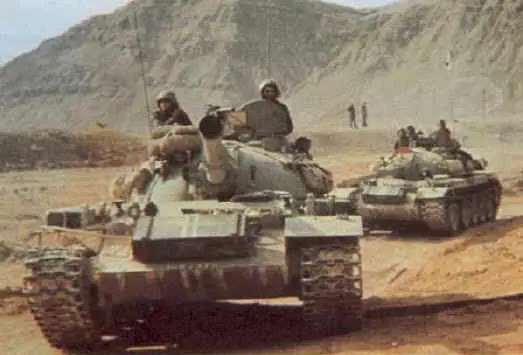
Yom Kippur War at 50: Castro deployed Cuban troops to invade and destroy Israel in October 1973.

Hundreds of Cuban tank crews took part in the 1973 Yom Kippur War.

On October 6, 1973, the beginning of Yom Kippur, the Day of Atonement, the holiest day in the Jewish calendar, Egyptian battalions and Syrian tank columns launched a surprise offensive on two fronts against Israel.

During the course of the Yom Kippur War that lasted twenty days, 2,656 Israelis were killed and 7,200 wounded.

 Fidel Castro sent thousands of Cuban troops to fight on the Syrian side in the surprise attack to destroy Israel.

Syria's dictator Hafez al-Assad and Fidel Castro

Havana maintained diplomatic relations with Israel from 1959 through 1973, even as it fully embraced terrorism against the Jewish nation. 

Fidel Castro broke relations with Israel on the eve of the Yom Kippur War. This was required for all Soviet-aligned regimes, as the international communist line defined Israel as a colonial state and an arm of U.S. imperialism.  Noticias de Israel (News of Israel) provided a more in-depth description of what took place.

From the highest levels of power in Havana, a secret operation was orchestrated to send military support to Syria. A tank brigade, helicopter pilots, communications agents, and intelligence and counterintelligence officers were meticulously selected for this mission. It was imperative that these men did not arouse suspicion and that they were perfectly prepared for the task entrusted to them.

The Military Brigade of Senén Casas Regueiro was mobilized, and under the command of General Leopoldo Cintra Frías, a recognized name in military circles, this surreptitious plan was put into action. In a carefully planned diversionary maneuver, the soldiers left Cuba dressed in civilian clothes, with forged passports that identified them as university students. They traveled on separate flights to East Germany, where they made a technical stopover, before reaching their final destination: Syria.  

Once on Syrian territory, Soviet military equipment, including modern T-62 tanks and SAM rocket artillery, was ready for operation. Figures vary, but it is estimated that between 1,800 and 4,000 Cubans were present in Syria during the 1973 confrontation.

The surprise of this operation resulted in a series of significant losses for Israel, both in human lives and military equipment. Some civilian areas were also hit during the clash. 

On March 31, 1974, Israeli Defense Minister Moshe Dayan announced on US television that 3,000 Cuban troops had been dispatched to support Syria during the Yom Kippur War. The Economist published two articles in its Foreign Report in 1978 that highlighted Cuba's role in Syria beginning shortly after the 1973 Arab-Israeli war. Cuban tank crews fought with Syrian troops. According to Foreign Report, 180 Cubans were killed and 250 were injured.  

Cuban combat troops remained in Syria until 1975

Below is the documentary in Spanish by Abraham Rivera from 2020 on the Yom Kippur War.


The lies and secrecy surrounding the role of Cubans in this war of aggression against Israel in 1973 should inform those inquiring about the presence of Cuban soldiers in the Russian army today fighting in another war of aggression, but this time in Ukraine. Below is the 2023 documentary, War of Deception, by Casto Ocando on this topic.

Monday, October 2, 2023

International Day of Nonviolence: Mohandas Gandhi born 154 years ago today on October 2, 1869

 "Civil disobedience is the assertion of a right which law should give but which it denies." - Mohandas Gandhi


Mohandas Karamchand Gandhi was born on October 2, 1869, 154 years ago today, and his legacy continues to be passionately debated in India. The Economic Times, based in India, in 2021 published an editorial titled "Continuing relevance of Mohandas Gandhi" that highlights the challenges to Gandhian nonviolence today in his home country. 

“Gandhi is remembered for Ahimsa, non-violence. However, Gandhi’s Ahimsa was not passive acceptance of violence, but its active resistance by the force of moral purpose and mobilization of public opinion. Today, we have elected representatives who venerate Gandhi’s assassin, but few supporters who follow his example of opposing violence.”

This debate is not limited to India. The September 29, 2019 story in NPR "Gandhi Is 'An Object Of Intense Debate': A Biographer Reflects On The Indian Leader" contrasts the debate around Gandhi with how the Chinese don't debate Mao Zedong, or the Vietnamese don't debate Ho Chi Minh or the Pakistanis don't debate Muhammad Ali Jinnah.

Perhaps part of the reason for the lack of debate is that China and Vietnam are totalitarian dictatorships where such debate is forbidden, and Pakistan has been divided between periods of democratic and military rule in questioning the founder could prove unhealthy. India on the other hand has been a democracy through out its period of independence.

Gandhi liberated an entire subcontinent from imperial rule without firing a shot. The United Nations has designated his birthday, October 2nd, as the International Day of Nonviolence. Nevertheless,  he did not win the Nobel Peace Prize and is recognized by the Nobel Committee as the "Missing Laureate."


In 2009 the United Nations released a one-dollar postal stamp of Mohandas Gandhi to commemorate his 140th birth anniversary. The stamp was designed by Miami-based artist Ferdie Pacheco.
 
He wasn't a rich man. He never held formal political office. He wasn't a saint or divine figure. He was just a man. An attorney who had taken a vow of poverty and celibacy. His full name was Mohandas Karamchand Gandhi.   
 
Gandhi transformed himself into a principled strategic non-violent activist in South Africa at the end of the 19th century struggling against racist laws and policies of the colonial authorities. An important theoretical result of his South African campaign was the development of Satyagraha
 
Gandhi announced on September 11, 1906 in his newspaper Indian Opinion a contest to submit names to describe this movement. The final name was the fusion of two words as explained by Gandhi: “Truth (Satya) implies love, and firmness (agraha) engenders and therefore serves as a synonym for force…the Force which is born of Truth and love or nonviolence.”

He was the antithesis of Mao Zedong who took power and killed tens of millions to impose his political ideology on the Chinese. Marxist-Leninists view "truth" as something malleable and in the service of achieving power. 

Gandhi's explicit rejection of Marxist class struggle as hateful, his embrace of truth and love,
 and his critique that socialists and communists did nothing to solve problems are powerful:

The socialists and communists say, they can do nothing to bring about economic equality today. They will just carry on propaganda in its favor and to that end they believe in generating and accentuating hatred. They say, when they get control over the State, they will enforce equality. Under my plan the State will be there to carry out the will of the people, not to dictate to them or force them to do its will. I shall bring about economic equality through non-violence, by converting people to my point of view by harnessing the forces of love as against hatred. I will not wait till I have converted the whole society to my view but will straight away make a beginning with myself. It goes without saying that I cannot hope to bring about economic equality of my conception, if I am the owner of fifty motor-cars or even of ten bighas of land. For that I have to reduce myself to the level of the poorest of the poor.
Gandhi's description of the nature of a regime that sought to use violence to crush capitalism offers an excellent description of what has taken place in Marxist Leninist states that promised paradise but delivered the opposite:
It is my firm conviction that if the State suppressed capitalism by violence, it will be caught in the coils of violence itself, and will fail to develop non-violence at any time. The State represents violence in a concentrated and organized form. The individual has a soul, but as the State is a soulless machine, it can never be weaned from violence to which it owes its very existence. [...] It can be easily demonstrated that destruction of the capitalist must mean destruction in the end of the worker and as no human being is so bad as to be beyond redemption, no human being is so perfect as to warrant his destroying him whom he wrongly considers to be wholly evil.

This explains in large part the hostility from communists to Mohandas Gandhi's social political agenda, and many on the Left who share the Marxist belief in class struggle. However the legacies between those who advocate class struggle and those who advocate nonviolent resistance could not be more stark.

The heirs of Mao Zedong, who were inspired by his violent revolutionary tradition generated great suffering: Ernesto "Che"Guevara in Cuba,  the Khmer Rouge in Cambodia, the Black Panther Party in the United States and Shining Path guerillas in Peru are but just four of many bloody examples.

Contrast these with the heirs of Mohandas Gandhi, who were inspired by his non-violent resistance to injustice and the good they achieved:  Martin Luther King Jr. in the United StatesSteve Biko in South Africa, Abdul Ghaffar Khan in Pakistan, Oswaldo Payá Sardiñas in Cuba, Vaclav Havel in Czechoslovakia, Lech Walesa in Poland, and Corazon Aquino in the Philippines are but just seven of many inspirational examples.

Mohandas Gandhi changed political protests and empowered millions with Satyagraha and the use of strategic nonviolence to battle powerful and violent regimes and great injustices in an effective manner that frustrates those who want to preserve or change the status quo using violence.

Today, as we witness the brave women of Iran risking all by taking off their hijabs in nonviolent defiance of Islamic law, and Cubans nonviolently defying the communist dictatorship in Cuba, the legacy of Gandhi continues to shake the foundations of tyrannies around the world.  

Nonviolence is a force more powerful, and it offers an alternative to nuclear, biological or artificial intelligence holocausts that threatens all humanity's existence with their respective cultures of death.

Sunday, October 1, 2023

International Day of Non-Violence 2023: Join Cubans' non-violent movement for restoring democracy and human rights to Cuba

 "Use truth as your anvil, nonviolence as your hammer, and anything that does not stand the test when it is brought to the anvil of truth and hammered with nonviolence, reject it." - Mohandas Gandhi
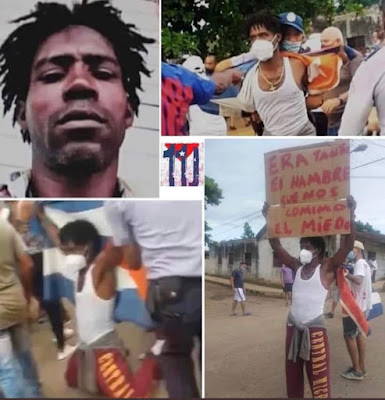
"Era tanto el hambre que nos comimos el miedo." - "The hunger was so much that we ate the fear."

Juan Enrique Pérez Sánchez, father of four and former phone technician, was arrested and badly beaten on July 12, 2021 after participating in the 11J protests in Nueva Paz, Mayabeque. He carried a poster that read "Down with the dictatorship" on one side, and "The hunger was so much that we ate the fear."  Juan Enrique was sentenced to eight years in prison on December 15, 2021. He suffers from asthma and a herniated disc. Reports emerged over social media that Juan Enrique sowed his mouth shut with a wire, as a sign of protest.

Today in Cuba there are thousands of Cubans, like Juan Enrique, jailed for their nonviolent demand for an end to the Castro dictatorship expressed most widely during the July 2021 protests. Over a thousand have been identified that were jailed or disappeared. It is known that some have resorted to going on hunger strike to protest their unjust imprisonment. This is part of the movement's repertoire of nonviolent tactics to resist the dictatorship in Cuba.

The men and women in Cuba who have led protests across the island have maintained their non-violent posture, continue to call for civic resistance as the method to challenge the dictatorship, and are asking for active nonviolent solidarity from people of goodwill living abroad. 

On July 27, 2021 the Christian Liberation Movement tweeted: "For solidarity with the freedom of Cubans. Eleven specific actions to isolate the regime."  This Cuban based movement, with its national coordinator, a former Amnesty prisoner of conscience living in Cuba, said that although statements criticizing the dictatorship are welcome that now is also the time for actions to isolate the Castro regime internationally, and sanction both on the dictatorship collectively, and individual bad actors in the regime are needed. These efforts to raise the cost of repression too are part of strategic nonviolence, and requires international solidarity. Please share and support this campaign with others.

This is a moment in which many that have not been following the resistance movement on the island are advocating to do business with the dictatorship, and the children of the nomenklatura. This will only prolong the life of the dictatorship, and increase the likelihood of violence, and Cuba bottoming out as a failed state.

It is important to revisit recent Cuban history.

The opposition in Cuba violently resisted the Castro dictatorship from 1959 to 1966.  In April of 1961 an expedition covertly supported by the United States was not provided sufficient air cover and support leading to their defeat, and the consolidation of communist rule in the island. Many of the Cubans who had fought alongside Castro, but felt betrayed when he installed a new dictatorship instead of restoring the democratic order, took up arms and went back into the hills. The new regime received counter insurgency forces from its Soviet allies that sent  to battle the Cuban resistance in the Escambray after years of struggle in 1967.

Eusebio Peñalver with machine gun and Joaquin Membibre, with M-1 carbin

Eusebio Peñalver (pictured above) opposed the Batista regime and fought with the rebel army to restore Cuba's constitutional democracy. Mary O'Grady wrote about him in 2013 and quoted the Cuban warrior. 

"But when Castro hijacked the revolution for himself, Peñalver broke ranks rather than 'sell my soul to the same devil that here on earth is Castro and communism.'" He took up arms against Castro's military in the Escambray Mountains, he was captured in October 1960. He spent 28 years in Cuban prisons and was banished from the island upon his release in 1988. "From exile in Los Angeles he wrote about the 'naked brutality' and round-the-clock beating and harassment that he had endured: 'They made the men eat grass, they submerged them in sewage, they beat them hard with bayonets and they hit them with fence posts until their bones rattled.'

Total number of dead in this phase of the resistance remains unknown, but tens of thousands were jailed for decades. On January 28, 1976, within the Cuban prisons, dissidents and former members of the resistance came together to found the Cuban Committee for Human Rights.  This initiative to document human rights abuses in Cuba, and report them to the international community marked  the start of a non-violent resistance to the Castro dictatorship.


Many movements would emerge over the next 47 years. It would be impossible to list them all. However, it would be worthwhile to highlight some that still exist today on the island. The Christian  Liberation Movement was founded in 1988, and in May 2002 with the Varela Project, a citizen initiative that thousands of Cubans signed, and led the Castro regime to change the constitution in an effort to block it, and brought international attention to Cuba's pro-democracy movement, and the democratic aspirations of the Cuban people.

Oswaldo Payá Antonio Diaz, and Regis Iglesias turn in petition

In 1991 the Cuban Youth for Democracy Movement came into existence calling for free thought in Cuban education, and a return to university autonomy.

Cuban Youth for Democracy Movement

 In 1997 the Lawton Foundation was founded by Dr. Oscar Elias Biscet and sought to educate Cubans on human rights and strategic non-violence, explicitly embracing the legacies of Mohandas Gandhi, and Martin Luther King Jr. 

Dr. Oscar Elias Biscet

In 2003 following a major crackdown on the opposition due to the Varela Project initiative and overall growth in the democratic resistance the Ladies in White came into existence and through non-violent actions challenged the Castro regime to free their loved ones and to change the totalitarian penal code that creates prisoners of conscience. In 2011 following his release from eight years in prison, Jose Daniel Ferrer Garcia founded the Patriotic Union of Cuba (UNPACU).  

In 2018, following the announcement that the Cuban dictatorship would further restrict artistic freedoms with Decree 349, a collective of artists formed the San Isidro Movement to campaign against the repressive law

Logo of the San Isidro Movement

What they all have in common is the decision to use nonviolent means and strategies to challenge the Castro dictatorship. However, they are not advocating collaboration or going into business with the oppressors.

Human action is a powerful force that must not to be underestimated, but to maximized it requires knowledge, strategic planning and courage. It also requires an understanding of the real nature of political power.

Professor Gene Sharp, a nonviolent theoretician who passed away on January 28, 2018, in his book, Waging Nonviolent Struggle: 20th Century Practice and 21st Century Potential, recognized that political power is "the totality of influences and pressures available for use to implement, change, or oppose official policies for a society." This means that political power "may be wielded by the institutions of government, or in opposition to the government by dissident groups and organizations."

According to Gene Sharp the sources of political power include "authority, human resources, skills and knowledge, intangible factors, material resources, and sanctions."

If we look at Cuba, the communist dictatorship there uses propaganda claims, both internally and internationally, to assert that the regime has achieved successes in education and health care. These are pillars of legitimacy and authority for the Castro regime. The dictatorship has also trained and staffed a massive intelligence apparatus to monitor and surveil the populace in Cuba trained by the East German Stasi and the Soviet KGB with 64 years of experience.

There is a large military that is heavily embedded in the Cuban economy, including tourism. In the area of skill and knowledge there is a dictatorship with 64 years of experience of imposing itself through violent means on the populace in Cuba, and overseas in places such as Ethiopia, Nicaragua and Venezuela. They have had experience in carrying out mass killings that rise to the level of genocide to assist client regimes. These first generation leaders are dying out, but many remain, including Raul Castro that have this knowledge and expertise in repression and terror.

One must consider the best course of action with the greatest likelihood of success while taking into account conditions on the ground.

Conservative activist Morton Blackwell explained a truth often ignored by activists of all ideological stripes in a talk titled "The Real Nature of Politics," which is required reading and offers three conclusions.

"1. Being right in the sense of being correct is not sufficient to win.  You don't win just because your heart is pure, even if you can prove logically that you are right.
2. The winner in a political contest over time is determined by the number and the effectiveness of the activists and leaders on the respective sides.
3. The number and effectiveness of the activists and leaders on a given side in a political contest is determined by the political technology used by that side."

These conclusions work both in a political struggle within a democratic order, and in confronting a dictatorship that does not play by democratic rules.  

These three ideas need to be present when planning resistance to the dictatorship in Cuba.

Providing more resources and legitimacy to the dictatorship and their networks of supporters, while marginalizing democratic forces is a recipe, already witnessed in Communist China for strengthening and modernizing the dictatorship in Beijing that turned into a greater threat to the rest of the world, and did nothing to advance democracy.

Considering that the Cuban opposition in the island over the past 47 years decided to resist the Castro dictatorship using nonviolent means, that the democratic resistance today as evidenced by the start of the July 11, 2021 uprising did so non-violently, and that concrete calls for help from the island are asking for nonviolent solidarity both inside and outside of Cuba now is the time to step up with the support requested, and not resort to the siren call of embracing the dictatorship providing it with more resources and legitimacy that has failed in the past against this regime.

Today, October 2nd is the international day of nonviolence and the 154th birth anniversary of Mohandas Gandhi. On this day let us remember our nonviolent icons in Cuba and share their message with the world, and continue to carry out concrete actions to restore democracy, the rule of law, and isolation and accountability for those engaged in human rights violations.


"The first victory we can claim is that our hearts are free of hatred. Hence we say to those who persecute us and who try to dominate us: ‘You are my brother. I do not hate you, but you are not going to dominate me by fear. I do not wish to impose my truth, nor do I wish you to impose yours on me. We are going to seek the truth together’." - Oswaldo Payá Sardiñas


“If we must give our own lives in pursuit of the freedom of our Cuba, so be it.” - Laura Pollán

Saturday, September 30, 2023

International Day of Non-Violence 2023: Raising hope with Satyagraha

 We may never be strong enough to be entirely nonviolent in thought, word and deed. But we must keep nonviolence as our goal and make strong progress towards it. - Mohandas Gandhi

Mohandas Gandhi

The United Nations has designated October 2nd as International Day of Non-Violence. This date was chosen to reflect on this profound idea since Mohandas Gandhi was born in India on October 2, 1869.  According to the United Nations, Gandhi was the "leader of the Indian independence movement and a pioneer of the philosophy and strategy of non-violence." 

On September 11, 1906 in South Africa, dissatisfied with the term passive resistance to describe nonviolence he convened a contest that resulted in a new word "Satyagraha" derived from Sanskrit that Gandhi described as follows: "Truth (Satya) implies love, and firmness (agraha) engenders and therefore serves as a synonym for force."

Monday, October 2nd is the day to share the message of nonviolence through education and awareness. It is a powerful idea that recognizes the dignity and power inherent in each individual, while at the same time recognizing that harnessing force through disciplined, strategic and non-violent action magnifies the power of the individual and when working in concert with others can become an unstoppable force for positive change. The life and example of Congressman John Lewis, who passed away in 2020, is an example of this.

Critics often cite that both Mohandas Gandhi and Martin Luther King Jr. were assassinated, and that this demonstrates the failure of their nonviolent philosophy, but they fail to look at what they accomplished in the wider societies they inhabited, and their respective legacies decades later. Both changed their respective countries. Gandhi achieved Indian independence, and King ended official segregation, empowered African Americans with their full voting rights, and achieved much more.

Gene Sharp who also taught generations of activists that there was an alternative to bloody conflict and that it was non-violent armed conflict. He demonstrated, as both Gandhi and King understood and practiced, that there was nothing passive about nonviolent resistance and that it also required strategy to increase the odds of success in a struggle. In 1990 at the National Conference on Nonviolent Sanctions and Defense in Boston, Gene Sharp succinctly outlined his argument.

"I say nonviolent struggle is armed struggle. And we have to take back that term from those advocates of violence who seek to justify with pretty words that kind of combat. Only with this type of struggle one fights with psychological weapons, social weapons, economic weapons and political weapons. And that this is ultimately more powerful against oppression, injustice and tyranny then violence."

This idea has extended to many places, and cultures around the world, but it is co-existing in conflict with ideologies like Marxism-Leninism that are based in class struggle, revenge redefined as justice, and violence exalted as a superior tool of struggle. Both Gandhi and King saw the latter approach as extremely counterproductive. 

Michael Nagler, a long time non-violence scholar, presents this idea as follows: Nonviolence sometimes “works” and always works, while by contrast, Violence sometimes “works” and never works.  Nagler offers a more detailed explanation.

The exercise of violence always has a destructive effect on human relationships even when, as sometimes happens, it accomplishes some short-term goal. The exercise of nonviolence, or Satyagraha, always brings people closer. This explains why Gandhi, after fifty years of experimentation in every walk of life, could declare that he “knew of no single case in which it had failed.” Where it seemed to fail he concluded that he or the other satyagrahis had in some way failed to live up to its steep challenge.  Taking the long view, he was able to declare that “There is no such thing as defeat in non-violence. The end of violence is surest defeat.”

 Below are several videos that introduce nonviolence and how it works. Please share them with others.

The secret to effective nonviolent resistance | Jamila Raqib


The 20th Annual Mahatma Gandhi Lecture on Nonviolence


Groundbreaking New Study: The Role of External Support in Nonviolent Campaigns (ICNC Webinar)

Czech dissident, play write, author, and former president Václav Havel who carried out a nonviolent revolution in his homeland offered a reflection on hope in his book , Disturbing the Peace, that complements Satyagraha.
 
“Hope, in this deep and powerful sense, is not the same as joy that things are going well, or willingness to invest in enterprises that are obviously headed for early success, but rather an ability to work for something because it is good, not just because it stands a chance to succeed. The more unpromising the situation in which we demonstrate hope, the deeper that hope is. Hope is not the same thing as optimism. It is not the conviction that something will turn out well, but the certainty that something makes sense, regardless of how it turns out.