Showing posts with label trade. Show all posts

Friday, February 14, 2020

Castro again defaults on payments to Paris Club, but purchases more US products for cash than under Obama thaw

What the Chamber of Commerce won't tell you about trade with the Castro regime.
Under the Trump Administration trade has increased with Cuba.
Taken from CubaBrief

The United States since 2000 has not provided credits to the Castro regime and maintained a cash in advance trade arrangement for the purchase of agricultural and pharmaceutical products. This protects U.S. taxpayers from having to subsidize the Cuban dictatorship when it defaults on its financial obligations. Their European, Latin American and Asian counterparts cannot say the same to their respective taxpayers.

Under this cash in advance agreement American companies sold over $6.3 billion to the Castro regime and have gotten paid. Despite billions in debt forgiveness  on its restructured debt less than five years ago by the Paris Club, the Cuban dictatorship in 2019 again defaulted on its payments, reported Reuters on February 11, 2020.


How did the Castro regime raise the money to purchase U.S. goods?

James Prevor, President and Editor in Chief of the publication Produce Business in the October 2002 article, Cuba Caution, reported that Cuba "had exhausted all its credit lines and, at best, was simply rotating the accounts. When the opportunity came to buy from the United States, Cuba simply abandoned all those suppliers who supported the country for 40 years and began buying from us."

The suppliers were not the ones impacted by Cuba's failure to pay its debts, the taxpayers of the suppliers' home countries were the one's left holding the bag. The dirty little secret is that profit is private but risk has been socialized in what amounts to a perversion of capitalism.

On November 1, 2013 the government of Mexico announced that it was ready to waive 70 percent of a debt worth nearly $500 million that Cuba owes it. The former president of Mexico Vicente Fox protested the move stating: “Let the Cubans get to work and generate their own money…They’re normally like chupacabras.  The only thing they’re looking for is someone to give them money for free.”

“Let the Cubans get to work and generate their own money…They’re normally like chupacabras." - President Vicente Fox
In December 2015 it was announced that Spain would forgive $1.7 billion that the Castro regime owes it. In December of 2013, Russia and Cuba quietly signed an agreement to write off $29 billion of Cuba's debt to the former superpower. Western governments pursued Cuban maritime debts seizing Cuban vessels and negotiating payment through Canadian courts.

The 2015 debt restructuring accord between Cuba and the Paris Club, according to Reuters, "forgave $8.5 billion of $11.1 billion, representing debt Cuba defaulted on in 1986, plus charges."

The 19-member Paris Club owed money by Cuba is comprised of Australia, Austria, Belgium, Canada, Denmark, Finland, France, Britain, Italy, Japan, the Netherlands, Spain, Sweden and Switzerland. Companies, with the exception of American companies, doing business with Cuba when they are not paid pass the costs off to their respective governments, who in turn pass the costs off to taxpayers.

This is something to consider when the Chamber of Commerce argues that U.S. laws should be changed and the United States should join the long line of governments seeking to collect from the Castro regime, a deadbeat dictatorship.

Lastly, it is important to note that the U.S. Census Bureau documented the collapse of trade in goods with Cuba under the Obama thaw and have actually improved during the Trump Administration, despite tightened sanctions.


Friday, August 9, 2019

Paradox of Cuban Trade: U.S. exports to Cuba collapsed in 2015 but now are increasing

The devil is in the details. Stop eating what the chickens are picking at.


Yesterday morning Cuban blogger and journalist Yoani Sanchez tweeted: "Chicken arrived at the neighborhood stores ... don’t ask what country it comes from this time ... you know 'that is not talked about' in the official media." Performed a quick search of the packaging and found that it is indeed an American export. Hudson Midwest Foods, Inc. is a subsidiary of the American company Tysons foods.


How can this be? If you read the propaganda spread by the Castro regime then you'd believe there is an "economic blockade" that prevents U.S. products entering Cuba.

It is true that economic sanctions have been tightened by the current Administration, and Title III of the Cuban Democracy Act will make life more difficult for those who traffic in stolen properties.

Nevertheless, trade continues between U.S. companies and the Castro dictatorship, and in 2017 and 2018 U.S. exports to the island increased compared to the last two years of the previous Administration.

It is counter-intuitive, but the December 17, 2014 announcement that the United States and Cuba would seek normalized relations was followed by a collapse in U.S. exports to the island.


The Cuban government was no longer interested in buying U.S. products. The first question one should ask was why had the Castro regime been interested in buying them in the first place?

James Prevor, President and Editor in Chief of the publication Produce Business in October of 2002 in the article, Cuba Caution, reported on how Cuba "had exhausted all its credit lines and, at best, was simply rotating the accounts. When the opportunity came to buy from the United States, Cuba simply abandoned all those suppliers who supported the country for 40 years and began buying from us."  The suppliers were not the ones impacted by Cuba's failure to pay its debts, the taxpayers of the suppliers' home countries were left picking up the tab.


U.S. products being sold in larger quantities today in Cuba than four years ago.
Why would the Castro regime double cross the suppliers that had been supporting them for decades?

There are two fundamental reasons.

First, it was an investment to open up the credit spigot of the United States that would provide it with billions more in hard currency.

Seventeen years ago Prevor predicted where things have now arrived in the Cuba policy debate as far as agribusiness is concerned: 
"But what the really big grain traders want is to sell to Cuba on credit - and get those credits provided or guaranteed by various federal loan programs. In effect, these agribusiness behemoths want to sell to Cuba and have the U.S. tax- payer pick up the tab. And their bet is that once produce shippers have gotten a taste of the business, they will become a kind of Amen corner for the Cuban lobby, pushing Congress to approve whatever laws will be to the liking of the Cuban government. This really brings to the forefront why trade with a communist country poses unique dangers to a democratic society."
The Castro regime views the billions in goods purchased from the United States as the ultimate variation of the bait and switch con. A policy of normalization with the current government in Cuba may be good for agribusiness, the US Chamber of Commerce, and the Cuban dictatorship but it will not be good for U.S. taxpayers who will be left holding the bag like so many other tax payers around the world. 

Second, it was a way for the Castro dictatorship to purchase influence in the corridors of power both at the state and national level.

Castro used openings in trade from the Clinton era (medical products in 1992 and agricultural products in 2000)  to build up a pro-Castro lobby and to target congressional districts in agricultural states to advance the dictatorship's interests. 

The Cuban autocracy accomplished this by purchasing American exports and requiring U.S. corporations and members of Congress to sign "advocacy contracts" that turned Americans into lobbyists for the dictatorship as a condition of the Castro regime buying their goods. 

News of this practice broke 15 years ago in USA Today and in The Miami Herald but goes unmentioned today. The Miami Herald in a October 5, 2004 editorial described this practice as "peddling influence for a communist state" and said that those engaged in the practice "should be required to register as agents of a foreign government."

John Kavulich, who was the head of the U.S.-Cuba Trade and Economic Council until 2005 explained in 2003 the significance of these "advocacy agreements" stating

''These agreements are a corruption of the commercial process,'' ... ``Once you include an advocacy clause, they're no longer commercial agreements; they're political documents.'' 
Castro's suppliers didn't eat the cost that was passed on to taxpayers in their respective countries. Meanwhile Havana maximized its influence in the corridors of power in Washington, DC and created an army of pro-regime lobbyists.

Why did U.S. exports to Cuba collapse during the last two years of the prior Administration?


US Cuba exports collapsed from a 2008 high of $711 million to $185.7 million in 2015

The prior Administration gave the Castro regime everything it wanted, caving on numerous foreign policy priorities that Havana had long been pursuing and steadily loosened sanctions. The Cuban tyrant, following several years of this, correctly calculated that further influence peddling was not needed.

Now that a new team entered the White House with different foreign policy priorities the Castro regime has been ramping up U.S. purchases to levels higher than in 2015 and 2016 while in the midst of an economic crisis.

If these patterns hold then it means that Havana is pursuing a campaign of increasing political influence in the United States to advance its foreign policy agenda, which includes, but is not limited to, lifting economic sanctions and pursuing U.S. credits.


US Cuba exports rose from a 2015 bottom of $185.7 million to $274.6 million in 2018
Political considerations drive the Castro regime's economic policies. This is why U.S. export trade with Cuba increased during the Bush Administration, and is rebounding now at a time of increased political tensions over Venezuela, and Nicaragua.

If you are pursuing free trade and normal relations with communist Cuba then you are "comiendo de lo que pica el pollo."  That literally translates to "eating what the chickens are picking at" and in Cuban slang means to "waste your time on foolish things." Cuba does not have a normal regime, but a criminal mafia driven by a murderous ideology to build alliances with bad actors and undermine existing democracies to be more like them. Venezuela is a case in point.

Version of this was originally published in CubaBrief.

Tuesday, February 13, 2018

Year one of the Trump Administration and a new Cuba policy: Trade is up and detentions are down

A look at some numbers for 2017 and U.S. - Cuba relations.
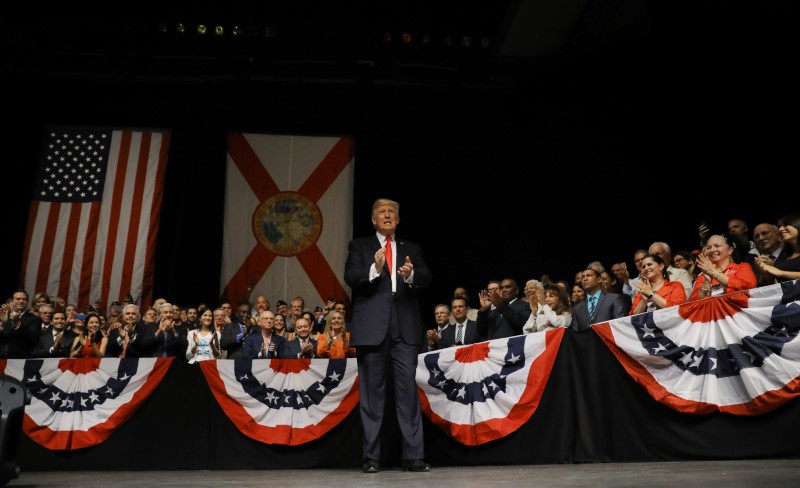
President Trump at the Manuel Artime Theater with Cuban Americans in 2017
Cuba in 2017 remained a repressive totalitarian regime with prisoners of conscience, and a one-party communist dictatorship that has used its military and intelligence apparatus to control Venezuela, turning that nation into a colony that it is plundering.Things had gotten worse for Cubans, especially following the Obama Administration's engagement with the Castro dictatorship, including a state visit in March of 2016. The current Administration has rolled back a number of Obama era Cuba policies, spoken out on the human rights situation in Cuba, and Ambassador Nikki Haley defended the morality of U.S. sanctions on the Castro regime.

Despite the claim by the architect of the previous Administration's Cuba policy, that President Trump's turn around on the Obama Administration's Cuba policy would fail, trade between the United States and Cuba was at its highest level in 2017 following its collapse between 2014 and 2016 when the previous Administration was pushing its new Cuba policy.

President Barack Obama announced his new Cuba policy on December 17, 2014 and the following year U.S. trade in goods with Cuba dropped $118.9 million from $299.1 million in 2014 to $180.2 million in 2015. This economic relationship has improved under the Trump Administration despite news that the Cuban economy is worsening and the regime's creditors are nervous.

Trade peaked under Bush in 2008 and began a steady decline under Obama
Obama Cuba policy flawed
President Obama downplayed commuting the sentences of three Cuban spies, including Gerardo Hernandez who was serving a life sentence for his role in a murder conspiracy that claimed four innocent lives in 1996 and freed them the same day.  This was part of the price paid to free an American hostage, Alan Gross, that had been an impediment to normalized relations.

President Obama does the wave with Raul Castro at a baseball game in Cuba
The Obama Administration apparently ignored the mysterious attacks that began in November of 2016 at the U.S. Embassy in Havana when 24 American diplomats and their dependents suffered severe injuries, including brain trauma.

On the human rights front the Obama Administration's new Cuba policy was also a disaster. The suspicious deaths of human rights defenders such as Orlando Zapata Tamayo (2010), Juan Wilfredo Soto Garcia (2011), Laura Inés Pollán Toledo (2011), Wilman Villar Mendoza (2012), Oswaldo Payá Sardiñas (2012), and Harold Cepero Escalante (2012) is a terrifying alternative to the long prison sentences that the Castro regime would use to take opposition leaders out of circulation, as was the case in 2003, during the Bush administration.

Some of the Cubans killed by the Castro regime during the Obama years
Over the eight years of the previous Administration (January 2009 through January 2017) high profile activists met untimely deaths that appear to have been carried by Castro's state security service. The same spy agency that President Obama's October 2016 Presidential Directive on Cuba orders the CIA to share intelligence with.

The number of politically motivated arbitrary detentions documented by the Havana based, Cuban Commission for Human Rights and National Reconciliation since 2008 demonstrates a dramatic rise in repression between 2008 and 2016, that spiked dramatically in the year of the Obama Administration's new Cuba policy announcement in 2014 from 6,424 arbitrary detentions in 2013 to 8,899 in 2014. This also occurred with troubling incidents of violence by regime agents.


 During President Obama's last year in office the number of arbitrary detentions reached their highest number since 2010 with 9,940 arbitrary detentions. Despite this, on his way out of office in January 2017, President Obama closed the door on Cuban refugees.


Under Trump's first year a dramatic reduction in arbitrary detentions in Cuba
During 2017 there were 5,155 Cubans arbitrarily detained, and although still far too high, it is a dramatic improvement over 2016. There are still prisoners of conscience enduring horrid and dangerous conditions in Cuban prisons and dissenters sent to psychiatric institutions for punishment.

However in the area of religious freedom. Things have gotten worse in Cuba. "From January to December 2017 Christian Solidarity Worldwide (CSW) recorded 325 separate violations of freedom of religion or belief (FoRB) in Cuba. Christians across a wide range of denominations were affected. Many of these cases involved large numbers of victims. By comparison, CSW reported 220 FoRB violations in Cuba in 2014, 180 in 2013, 120 in 2012 and 40 in 2011."

Overall the changes in tone and substance by the current Administration, so far, have been an improvement over the previous failed policy of the prior Administration that scrapped an old policy that was containing the regime, replacing it with one that legitimized the dictatorship, marginalized democrats, and negatively impacted U.S. interests.

The Trump Administration has taken positive steps, with its policy changes on Cuba, but more needs to be done.

Friday, November 4, 2016

Address to the International Young Democrat Union at its Annual Council meeting in Miami, FL

Obama's Cuba policy legacy is an unmitigated disaster for Cuba


Addressing IYDU members at Miami City Hall
Background on Cuba Policy
Cuba has suffered under a 57 year old totalitarian dictatorship in Cuba that came to power in January of 1959 promising a democratic restoration. They lied. Instead the Castro brothers and their revolutionary cadre embraced the communists who had previously opposed them and broadcast footage of the firing squads they were carrying out where scores of Cubans were executed to terrorize the populace. Within Cuba anti-Castro guerrillas fought up in the hills of the Escambray until the mid 1960s when they were finally all exterminated or imprisoned. The same first generation of communist leadership, now in their 80s, remains in power today. They have groomed a second generation of hard line leadership to replace them with high profile members of the Castro family in key roles for the succession.

Executed in Santiago de Cuba by the Castro regime in 1959
The Castro regime since the beginning has had a revolutionary project to spread communism throughout the Americas. They sought within the first months that they were in power to destabilize and overthrow governments across Latin America. The United States attempted to overthrow the dictatorship Cuba in 1961 at the Bay of Pigs that failed and instead consolidated the Castro regime.

The economic embargo, first erected following the massive confiscation of U.S. properties without compensation, became an instrument of containment to raise the cost for the Soviet Union and Castro to export revolution in the Americas. Following attempts by the Castro regime to violently overthrow governments in Latin America and the Cuban Missile Crisis the Organization of American States voted to isolate Cuba, and it worked. No governments were violently overthrown.

However in 1977 President Carter arrives in The White House and began normalizing relations with Cuba, loosening sanctions, suspending the travel embargo.  This effectively ended the era of isolation of the Castro regime. It is not a coincidence that the Sandinistas came to power at the end of the Carter Administration. Nor that in Africa in places like Angola and Ethiopia, in the 1970s and 1980s thousands of Cuban troops fought to spread their revolutionary project there. In the case of Ethiopia Cuban troops assisted in the Red Terror that claimed thousands of lives and manufactured famine that claimed hundreds of thousands of lives.

Reagan's rollback of Carter concessions and greater human rights scrutiny in Cuba
Nor does easing sanctions improve the situation for Cuban dissidents. The only time the Castro regime permitted the International Committee of the Red Cross to visit Cuban prisons, and Amnesty International to visit Cuba was in the late 1980s after Ronald Reagan took a hard line on human rights violations in Cuba at the United Nations, rolled back the Carter Administration’s 1977 opening of the travel embargo in 1982, toughened economic sanctions, and began broadcasting uncensored news to Cuba over Radio Marti.  Bush continued the Reagan Administration's Cuba policy and then Bill Clinton did all he could to undo it but still win The White House pretending otherwise.

The rapprochement between the Obama Administration and the Castro regime today reminds Cubans of a similar effort in the 1990s by the Clinton Administration that began with joint military exercises in 1994 and reached its high point in 2000 with Bill Clinton shaking hands with Fidel Castro in New York City and months later opening up cash and carry trade.  This period of time also coincided with a  worsening human rights situation on the island, the use of grenades and snipers on swimmers trying to reach Guantanamo naval base, a rafter mass exodus in 1994 - 1995, and the above mentioned Brothers to the Rescue shoot down in 1996.

It is important to remember that as President Obama did in 2008 and again in 2012, President Clinton ran both times as  a pro-sanctions candidate linking lifting the U.S. embargo to improvement on human rights in the island. In fact in 1992 Clinton ran to the right of George Bush supporting legislation further tightening the Embargo and in 1996 signed the Helms-Burton bill, following the Brothers to the Rescue shoot down, further tightening sanctions on the Cuban dictatorship. This won him inroads among the Cuban American voting block, but once in office he went in a radically different direction than the one advertised during both elections shaking hands with Fidel Castro and opening up cash and carry trade. Castro at the time said he would not buy a grain of rice because he wanted credits.

This all changed when George W. Bush arrived in the White House in 2001 and trade took off with American agriculture selling hundreds of millions in goods to Cuba becoming one of its top trading partners despite the Republican President tightening sanctions.  The peak year of trade between the United States and Cuba was 2008. The last year of the Bush presidency.

Correlation between U.S. - Cuba Normalization and Democratic Reverses in the Americas
Castro had some success first in Nicaragua in 1979 then in Venezuela in 1999 and today the regime is a strong and anti-democratic force in the hemisphere and at the United Nations Human Rights Council. No surprise that these regime offensives coincided with normalization policies of the United States.

At first look, it is surprising that trade between the United States and Cuba collapsed to 2002 levels under the Obama Administration but then one must consider the nature of the regime in Cuba. The Cuban government is a totalitarian dictatorship that controls the economy and all foreign trade. Cuba has demonstrated over the past 57 years that political considerations trump economic ones even if it causes great suffering in the Cuban populace. Once Obama began to offer unilateral concessions the Castro regime did not need to purchase influence buying American agriculture.

President Obama in 2009 offered to extend a hand of friendship to America's enemies in the hope that they would uncurl their angry fists. He did this early on with Cuba, unilaterally loosening sanctions, and the Castro regime responded by taking Alan Gross, an American citizen, hostage in December 2009. The Obama administration responded with more unilateral concessions until five years later on December 17, 2014 when they freed the last of five Cuban spies serving long prison sentences in the United States. Between 2009 and the present date with this green light the Cuban men and women in the democratic opposition have been subjected to a dramatic increase in repression not seen in years. Opposition leaders, respected the world over who could have overseen a nonviolent democratic transition have been murdered in state security operations or died under suspicious circumstances.

Secret negotiations between the Obama Administration and the Castro regime began in 2013 and ended in December 2014 during which a North Korean ship in 2013 was stopped in Panama with a cargo manifest that read sugar, but was in reality a weapons shipment sent by Havana to Pyongyang with fighter jets, fighter jet parts, missile technology and other weapons. Also in 2014 a U.S. Hellfire missile that had been used in NATO exercises in Europe somehow ended up on its return trip to the United States in Cuba in the possession of Castro's intelligence service. The White House negotiators requested its return and were told no. Finally in January of 2016 The Wall Street Journal broke the story and a month later it was finally returned.

U.S. policy on Cuba
The Brigade 2506 Bay of Pigs Veterans Association formally and publicly endorsed Donald Trump for President on October 25, 2016 and received him at The Bay of Pigs Museum in Little Havana. This is the first endorsement for President ever made by the organization. A natural question arises: "Why after more than a half century of formal neutrality in Presidential elections did the Bay of Pigs Veterans Association decide to endorse a candidate?"

There are a number of reasons for this decision and why large numbers of Cuban Americans may vote for Trump in higher percentages than previously predicted by pollsters.

Freeing a murderer of four Cuban Americans and downplaying state terrorism
On December 17, 2014 President Obama announced he was normalizing relations with the Castro regime, and he commuted the prison sentences of three Cuban spies. One of them Gerardo Hernandez was serving a life sentence for the murder of four members of Brothers to the Rescue on February 24 1996.  Two days later on December 19, 2014 at a year end press conference President Obama downplayed the Brothers to the Rescue shoot down as a "tragic circumstance" and not the premeditated act of state terrorism that had been plotted weeks in advance of February 24, 1996.

The 2000 handshake between Fidel Castro and Bill Clinton was reported on but no video or photos were ever made public. However in 2015 video appeared of former President Clinton warmly greeting and meeting with Raul Castro in New York City despite General Castro's role in the murder of American citizens on Clinton's watch.

Young Cuban Americans picketed Clinton, protested Cuban embassy opening (2015)

Secretary Clinton sets out a different campaign message on Cuba

In June of 2014 the New York Post reported on Hillary Clinton’s address to the Council of Foreign Relations while promoting her book, “Hard Choices” where she declared “The embargo is Castro’s best friend,” and that the regime was using it as an excuse” to blames all of its problems on the United States.  Secretary Clinton repeated the same argument on July 31, 2015 at Florida International University in a speech where she called for the lifting of the embargo on the Castro regime stating “Lifting the embargo doesn’t set back the advance of freedom – it advances freedom where it is most desperately needed.” She also failed to make a simple gesture. A few hundred yards from where the former Secretary of State spoke there was a monument to the thousands of victims of the Castro regime, but she did not visit it.

Cuban millennials at Florida International University in Miami were outside picketing against Secretary Clinton protesting her anti-embargo speech and harassed by the police, who did not want the youthful protesters to be visible, and tried unsuccessfully to corral them in a designated protest zone. In mid-April 2016 hundreds of Cuban Americans poured into the Miami Beach City Hall to reject efforts to bring a Cuban Consulate there. Nevertheless an FIU poll appeared on September 14, 2016 claiming that a majority of Cuban Americans no longer supported the embargo and supported President Obama's new Cuba policy.

Despite Secretary Clinton's claims, the Castro dictatorship wants all sanctions eliminated in order to be completely legitimized internationally and to obtain additional financial credits. The claim that the Castro regime wants the embargo to continue is absurd when one considers that all the spies for the Cuban dictatorship uncovered by U.S. counter-intelligence have been pushing an anti-embargo agenda within the U.S. government, academy and media.

Obama's failed Cuba policy on all fronts
The Obama policy that Hillary Clinton championed in 2014 and 2015 has not had the desired results.  Human rights violations are at record levels in Cuba, there is a mass exodus of over a 100,000 Cubans fleeing the island, not seeing a future there because the White House has legitimized the regime and assisted in a generational succession with Colonel Alejandro Castro Espin, Raul Castro's son, and the U.S. is more isolated than ever in Latin America with its embrace of the Castro regime alienating it. The Colombian peace initiative, backed by the Obama administration, mediated by Raul Castro in Havana was rejected by the Colombian people in a national vote. The situation in Venezuela has descended into crisis as Nicaragua also slides into dictatorship.

What Secretary Clinton and the Obama administration call “engagement” and advancing freedom” in practice has meant American companies such as Starwood trafficking in stolen properties, and Cuban Americans discriminated against by American corporations such as Carnival and American Airlines to satisfy the whims of the Castro dictatorship that sparked protests and controversy in South Florida. Despite all of this trade with Cuba has collapsed during the Obama administration.

In August of 2015 Secretary of State John Kerry in an interview with journalist Andres Oppenheimer made it known that "the United States and Cuba are talking about ways to solve the Venezuelan crisis." Walter Russell Mead in March of 2016 in The American Interest explained the logic behind this approach:
"Socialism has failed both in Cuba and in Venezuela. The Cuban people know just what is happening in Venezuela, and they know, too, that the two excuses that the Castros have always made for socialism’s abysmal record in Cuba (no oil, and the U.S. embargo) simply fall to pieces in the light of the Venezuela catastrophe. They know that the Castros aren’t getting any younger, and they know that integration with the U.S. economy represents the only possible future for their island.
Just possibly, Fidel and Raul have genuinely drawn the appropriate conclusions from more than half a century of socialist failure in the Americas. Just possibly, they want to burnish their legacies by doing something to help Venezuela step away from the abyss, especially if they can get some U.S. help for Cuba by doing so. Investigating that possibility was the most important reason, other than grandstanding, for the President’s visit. Let’s hope the subject came up."
The Obama Administration and the Castro regime share a common interest in stabilizing the Maduro regime and avoiding chaos in Venezuela. According to Secretary Kerry if the current Maduro regime fails then Venezuela will become a refuge for terrorists and drug traffickers. This approach ignores some inconvenient facts. Franco Ordoñez of The Miami Herald reported on October 28, 2016 that
"One of the nephews of the Venezuelan first family pressed for a quick cocaine deal because his “mother” needed campaign cash, according to a newly released transcript of a conversation he had with a U.S. Drug Enforcement Administration informant from October 2015. Efrain Campo, 29, also was recorded saying “we’re at war” with the Americans and laughing about sending opposition leaders to jail, according to the transcript, which was filed in federal district court in New York.
At the time of the conversation, Campo’s aunt, Cilia Flores, who is married to Venezuelan President Nicolás Maduro, was running for a seat in the National Assembly. Campo referred to her as his mother. Two of Flores’ nephews face federal charges of conspiring to smuggle 800 kilograms of cocaine into the U.S."  
The trial is scheduled to start on November 7th. None of the above should be a surprise. First the Castro regime has been involved in drug trafficking for decades in the service of its ideological mission to undermine the United States with drugs and use the profits to fund guerrilla and terrorist movements. Raul Castro faced a federal indictment for drug trafficking in the 1990s but the Clinton administration quashed it. Despite ample evidence of continued bad acts the Obama administration took Cuba off the list of state sponsors of terrorism.

Second Venezuela under both Chavez and Maduro has become a refuge for terrorists and drug traffickers with the aid of Cuban state security agents. A high profile example is Diosdado Cabello, the past head of Venezuela's National Assembly and suspected by U.S. prosecutors of being in charge of the infamous drug-trafficking organization, "Cartel de los Soles".

The Obama Administration's Cuba policy is a failure across: human rights, national security, migration, strengthening democracy regionally, and even in the area of trade that was supposed to be a "no brainer."

The Cuban American Republican Vote
Cuban-Americans have been a reliable Republican voting block since at least 1980 with Ronald Reagan. This has been due to the GOP's consistent anti-communist stand on the Castro regime in Cuba.  Nevertheless, there has been an attempt over the decades to claim that younger Cubans are shifting and voting Democrat while at the same time softening their "hard-line" (read pro-democracy) stand on Cuba.

This has been a fatal belief for aspiring politicians whose policy positions are driven by dodgy polls. The latest victim was Charlie Crist in 2014 who lost narrowly to Florida governor Rick Scott. This was because the forces advocating for the end of economic sanctions on the Castro dictatorship produced push polls that convinced candidate Charlie Crist in his run for governor of Florida to support ending the embargo and announce that he planned to go to Cuba. As reality hit and his numbers dropped the trip was put off but in the end Crist lost despite running against the unpopular incumbent Rick Scott in a tight race in part because of the Cuban vote.

The Trump Conundrum
In the Republican primary in Florida the two candidates loudly rejecting the Obama administration's Cuba policy got 75% of the Cuban-American vote to Donald Trump's 18%. Cuban American voters have rejected the Obama administration's failed Cuba policy.

Donald Trump's candidacy posed a threat to continued Cuban-American support for the Republican Party, and despite conventional wisdom, it was not due to his anti-immigration stand. Both Senators Marco Rubio and Ted Cruz tried to out trump Trump on being tough on immigration and together got 75% of the Cuban vote to Trump's 18%. Polls in May of 2016 in Miami-Dade placed Trump ahead of Clinton among Cuban Americans by 37% to 31% which is extremely low compared to previous elections. This was also part of the reason that Clinton was ahead in South Florida by 27 points.

This was because Donald Trump had repeatedly publicly declared luke warm support for Obama's Cuba policy which is extremely unpopular with Cuban-Americans, and especially the vast majority of those who are Republicans.

All that changed on September 16, 2016.

The 2016 presidential election was going to be a wash on Cuba policy but then that was turned upside down. Mr. Trump on September 16, 2016 in Miami announced that he had changed his mind on the President's Cuba policy. CNN reported on what the GOP presidential candidate said:
Trump -- speaking in a state with a heavy Cuban voting bloc -- characterized Obama's deal as "one-sided" and benefiting "only the Castro regime."... "But all of the concessions that Barack Obama has granted the Castro regime were done with executive order, which means the next president can reverse them. And that is what I will do unless the Castro regime meets our demands," Trump said Friday. ... "Those demands will include religious and political freedom for the Cuban people and the freeing of political prisoners," Trump said.
Less than two weeks after Trump's rejection of Obama's Cuba policy, Hillary Clinton began attacking him with radio advertisements for having supposedly violated the embargo, without mentioning her own anti-embargo position. Nor did she mention that Trump enterprises in 1998 like many other businesses then hired a consulting firm to explore opportunities in Cuba because the Clinton administration was encouraging it at the time. The same thing is happening now with the Obama Administration.

The response of the Clinton campaign demonstrated that they also knew that Cuban Americans supported the U.S. embargo on Cuba, and did not accord with what pollsters had been peddling to the press.

Mr. Trump began to lose ground in Florida to Secretary Clinton when he did not provide context to the events of 1998 in a sustained manner, but the he returned to South Florida on October 25, 2016 and first met a small group of Cuban American leaders for breakfast. Among the guests were Mario and Miriam de la Peña whose son Mario was one of the four men murdered on February 24, 2016 and describe what had happened to their family as "our Benghazi."  Trump listened intently and asked questions about photos of Cuba's Ladies in White being beat up including when the pictures had been taken. One of the photos had been taken the same day President Obama and his family arrived in Cuba earlier in March 2016 for their official visit.  A visit that the President had initially said would only be done if human rights had improved in Cuba. Although the human rights situation had in fact worsened the Obama family went anyway.

Now in the final weeks of the campaign President Obama announced on October 14, 2016 a directive that says "the Office of the Director of National Intelligence (DNI) will support broader United States Government efforts to normalize relations with Cuba, with Intelligence Community elements working to find opportunities for engagement on areas of common interest through which we could exchange information on mutual threats with Cuban counterparts." This has been described as unilateral surrender by a former National Security Agency analyst.

On October 26, 2016 at the UN General Assembly Ambassador Power abstained from voting against a resolution condemning the US embargo presented by the Castro dictatorship and agreed with a Castro regime talking point:
Let me be among the first to acknowledge – as our Cuban counterparts often point out – that the United States has work to do in fulfilling these rights for our own citizens. And we know that at times in our history, U.S. leaders and citizens used the pretext of promoting democracy and human rights in the region to justify actions that have left a deep legacy of mistrust. We recognize that our history, in which there is so much that makes us proud, also gives us ample reason to be humble. 
Frank Calzon over twitter explained why this is such a terrible statement. "By saying U.S. leaders used the pretext of human rights to justify US policy, Ambassador Samantha Power, kicks dirt on Jimmy Carter's [human rights] legacy. Ambassador Power says Obama Cuba policy is new. But it is the same discredited policy of embracing dictators of long ago: $ over principles."


All of this activity by the Obama Administration is mobilizing Cuban American voters and in a tight race in Florida could swing the state for Trump. Perhaps this electoral disaster for the Democrats would finally convince President Obama that his Cuba policy has been an unmitigated disaster.

At the end of the presentation the following video was shown to the audience present:


Thursday, September 15, 2016

Testimony before House Agricultural Committee: The Reality of Trade With Cuba

There are times in the course of a public discussion when one comes across a presentation that encapsulates ones argument that the only thing you can do is point to it and say "What he said."  This is my reaction to Mauricio Claver-Carone's testimony on Capitol Hill on September 14, 2016. I have touched on these issues in the past and how they will negatively affect U.S. taxpayers, but his testimony is the best encapsulation of the most important points surrounding this policy debate. Below is Mauricio's full statement taken from his Capitol Hill Cubans blog.

Mauricio Claver-Carone testifying before the House Committee on Agriculture

Testimony House Agriculture Committee: 'American Agricultural Trade With Cuba'


The following is today's testimony by Mauricio Claver-Carone during a hearing of the House Agriculture Committee on 'American Agricultural Trade With Cuba':

Thank you, Mr. Chairman, Ranking Member and Members of the Committee.

It's truly a privilege to join you here today to discuss important and consequential issues surrounding U.S. agricultural trade with Cuba. I commend you for including a dissenting voice on this panel.

My name is Mauricio Claver-Carone and I'm the Executive Director of Cuba Democracy Advocates, a non-profit, non-partisan organization dedicated to the promotion of human rights, democracy and the rule of law in Cuba.

My testimony will be divided into two parts. First, I would like to present key facts regarding agricultural trade with Cuba and highlight the counter-productive trends we are seeing since President Obama announced a new policy of unconditional engagement with the Castro regime on December 17th, 2014. Second, I would like to focus on the issue of financing agricultural sales to Cuba, which I understand is a priority for my fellow panelists, with the good faith and disposition to find common ground.

The Reality of Trade With Cuba

As you are surely aware, pursuant to the Trade Sanctions Reform and Export Enhancement Act of 2000 (‘TSREEA’), the sale of agricultural commodities, medicine and medical devices to the Castro regime in Cuba was authorized by Congress, with one important caveat – these sales must be for “cash-in-advance.” Prior to that, the export of food, medicine and medical devices to the Cuban people had already been authorized under the Cuban Democracy Act of 1992 (‘CDA’).

This is an important distinction that needs to be made, for in order to have a productive discussion about agricultural trade with Cuba, one should understand how the island’s totalitarian regime conducts business.

In most of the world, trade means dealing with privately-owned or operated corporations. That's not the case in Cuba. In Cuba, foreign trade and investment is the exclusive domain of the state, namely the Castro regime. There are no "exceptions."

Here's a noteworthy fact: In the last five decades, every single "foreign trade" transaction with Cuba has been with a state entity, or individual acting on behalf of the state. The state's exclusivity regarding trade and investment remains enshrined in Article 18 of Castro's 1976 Constitution.

Since the passage of TSREEA in 2000, over $5 billion in U.S. agricultural products have been sold to Cuba. It is an unpleasant fact, however, that all of those sales by more than 250 privately-owned U.S. companies were made to only one Cuban buyer – the Castro regime.

As the U.S. Department of Agriculture’s (‘USDA’) own report on Cuba notes, “The key difference in exporting to Cuba, compared to other countries in the region, is that all U.S. agricultural exports must be channeled through one Cuban government agency, ALIMPORT."

ALIMPORT is an acronym for Empresa Cubana Importadora de Alimentos, S.A. It is a subsidiary of Cuba's Ministry of Foreign Trade and serves as the sole procurement agency for U.S. agricultural products. Throughout the years, the Castro regime has ensured the Ministry of Foreign Trade is run by senior officials from Cuba's intelligence services (known as Directorio General de Inteligencia, or ‘DGI’). The current Minister of Foreign Trade is a DGI official, Rodrigo Malmierca Diaz, who is the son of Isidoro Malmierca Peoli, a historic Castro family confidant and founder of Cuba's counter-intelligence and state-security services.

Hence another unpleasant fact: All business decisions in Cuba are based on the political and control-based calculations of the Castro regime -- not on market forces. If the Cuban people enjoyed property rights to establish their businesses and were allowed to freely partake in foreign trade and investment – my testimony today would be very different.

ALIMPORT primarily supplies government institutions, and the Cuban military's hard currency retail stores (known as Tiendas de Recuperacion de Divisas, ‘TRDs’), hotels and other facilities that cater to tourists and other foreigners.

So let’s immediately debunk a myth: Financing agricultural transactions with Cuba is not about assisting small and midsize farmers on the island, but about financing a monopoly of the Castro regime.

Again, as the USDA itself recognizes: “U.S. food products will be sold and delivered to Alimport, which will take control of the imports at the Cuban point of entry, manage distribution throughout Cuba and coordinate payments. Consequently, U.S. agricultural firms planning on doing business with Cuba need to learn to negotiate and transact business with the Cuban government through Alimport.”

As a result, we already know what any further lifting sanctions towards Cuba would look like. TSREEA sales from the U.S. and business ventures with other nations exhibit the model: A mercantilist system whereby commerce is simply a tool to benefit and strengthen its totalitarian regime.

President Obama’s Policy Changes Have Proven Counter-Productive

President Obama’s policy of unilaterally easing sanctions has proven to be counter-productive for agricultural sales to Cuba. But before focusing on those figures, it’s important to note how President Obama’s new policy has broadly proven to yield counter-productive results.

For example, since December 17th, 2014:

· Political arrests have intensified. Throughout 2015, there were more than 8,616 documented political arrests in Cuba. Thus far, there have already been over 7,935 political arrests during the first eight months of 2016. This represents the highest rate of political arrests in decades and nearly quadruples the tally of political arrests throughout all of 2010 (2,074), early in Obama’s presidency.

· A new Cuban migration crisis has unfolded. The United States is faced with the largest migration of Cuban nationals since the rafters of 1994. The number of Cubans fleeing to the United States in 2015 was nearly twice that of 2014. Some 51,000 Cubans last year entered the United States and this year’s figures will easily surpass that. The numbers of Cuban nationals fleeing the island have now quintupled since President Obama took office, when it was less than 7,000 annually.

· Castro’s military monopolies are displacing "self-employed" workers. There are fewer licensed "self-employed" workers in Cuba today than in 2014. In contrast, Castro's military monopolies are expanding at record pace. The Cuban military-owned tourism company, Gaviota S.A., announced 12% growth in 2015 and expects to double its hotel business this year. Even the limited spaces in which “self-employed” workers previously operated are being squeezed as the Cuban military expands its control of the island's travel, retail and financial sectors of the economy.

· Internet "connectivity ranking" has dropped. The International Telecommunication Union's (ITU) Measuring the Information Society Report for 2015, the world's most reliable source of data and analysis on global access to information and communication. ITU has dropped Cuba's ranking to 129 from 119. The island fares much worse than some of the world's most infamous suppressors of the Internet suppressors, including Zimbabwe (127), Syria (117), Iran (91), China (82) and Venezuela (72).

· Religious freedom violations have increased tenfold. According to the London-based NGO, Christian Solidarity Worldwide (‘CSW’), last year 2,000 churches were declared illegal and 100 were designated for demolition by the Castro regime. Altogether, CSW documented 2,300 separate violations of religious freedom in 2015 compared to 220 in 2014. In the first half of 2016, there have already been 1,606 separate violations of religious freedom.

· Democracy’s regional foes have been emboldened. President Obama’s unconditional recognition and engagement of the sole remaining dictatorship in the Western Hemisphere has sent a message to Castro’s allies in the region that there are no consequences for rogue and undemocratic behavior. Hence the recent militarization (with Cuba’s support) of Venezuela's regime and the parliamentary coup in Nicaragua.

Agricultural sales have not escaped this downward trend.

Over the years, in this same Committee room, I have heard testimony professing that an easing of sanctions; re-defining of “cash-in advance”; improving U.S.-Cuba relations; and an increase in travel to the island, would benefit U.S. farmers. And, as we all know, since December 17th, 2014, the Obama Administration has engaged the Castro regime and extended a litany of unilateral concessions.

As part of these concessions, the Obama Administration has redefined “cash-in-advance”; eased payment terms for agricultural sales; American travel to Cuba has increased by over 50%; Cuba’s GDP grew last year by over 4%; diplomatic relations were established; and endless U.S. business and trade delegations have visited Havana.

Yet, U.S. agricultural exports to Cuba plummeted by nearly 40% in 2015. During the first quarter of 2016, the slide continued, as ALIMPORT purchased only $63 million in U.S. agricultural products. That is an additional 21% percent drop from the same period in 2015. These are the lowest numbers since the United States authorized agricultural exports to the Castro regime in 2000.

Of course, those who understand how the Castro regime operates are not surprised -- for it has long used agricultural sales as a tool of political influence.

As a 2007 report of the U.S. International Trade Commission (‘ITC’) confirmed: "Alimport reportedly initiated a policy in 2003 that limited or ceased purchases from U.S. companies that did not actively lobby the U.S. government for changes to laws and regulations regarding trade with Cuba. Purchases are also allegedly geared to particular U.S. States or Congressional districts in an effort to heighten local interests in pressing the Administration to normalize trade with Cuba."

Today is no different. The Castro regime wants the U.S. Congress to lift tourism, financing and investment sanctions that would overwhelmingly benefit its military monopolies, so it is putting on the squeeze.

Financing Agricultural Sales to Cuba

We will surely hear testimony today about Cuba being one of the U.S.’s largest export markets pre-1959 and how we need to “recapture” it. Politics aside, I would caution that Cuba’s economy is nowhere near the same today as it was throughout its pre-1959 history, when it was free-market oriented, with a dynamic private sector, property rights, and among the largest middle class and highest per capita income in Latin America at the time. Today, Cuba is a totalitarian dictatorship, with a centralized control economy and the lowest per capita income in Latin America.

We will also surely hear testimony about Cuba purchasing rice from Brazil and Vietnam, instead of from the United States, as a result of the prohibition on U.S. financing for agricultural sales. But I would caution that Brazil and Vietnam’s rice sales to the Castro regime are heavily state-subsidized and made pursuant to political arrangements. They are not based on competitive terms and rates. I would further argue that the recent downfall of the socialist government in Brazil -- and its shady financing deals with the Castro regime that are currently under investigation by the Brazilian authorities -- may lead to a bigger increase in U.S. rice sales to Cuba than anything the U.S. Congress could do.

Finally, we will surely hear many theories and estimates about how much more money one commodity sector or another -- or one state or another -- can make from exports to the Cuba, if U.S. sanctions were further eased or lifted. However, as we’ve learned from the dramatic decline in agricultural sales figures over the last year -- despite the Obama Administration easing of sanctions and establishing diplomatic relations with the Castro regime -- that is hardly guaranteed.

Let me be absolutely clear. Those of us who support sanctions and oppose the financing of transactions with the Castro regime do not do so with the intent of harming American farmers. Conversely, I know that American farmers do not seek to sell their products with the intent of supporting or subsidizing the Castro regime.

American farmers are the best in the world and we all share their desire to establish and expand markets. As a matter of fact, I’m sure Cuban-Americans in Florida consume more rice than any amount ever sold to Cuba pre- or post-1959. However, the agricultural groups represented here today remain steadfast in their desire for the financing of agricultural sales to Cuba and there is even legislation before this Committee to that end.

But any such proposition must be weighed by serious factual considerations regarding the troubling structure of Cuba’s business entities (military-run monopolies), its beneficiaries (the Castro family and regime cronies), the rights of its victims (both Cubans and Americans), and whether such practices are in the U.S.’s security interests.

Thus, the question comes down to: How to authorize private financing for U.S. agricultural sales to Cuba without subsidizing its derelict regime and in a manner consistent with U.S. security interests and the rights of victims?

We are obviously not going to resolve this challenge today. But hopefully, this discussion can be helpful in understanding each other’s concerns and in highlighting important safeguards that could address broader policy implications.

These safeguards fall into three categories:

1. Protect American Taxpayers.

Cuba ranks among the world's worst credit-risks and debtor nations. Moody's Investors Service gives Cuba's sovereign debt a Caa2 rating, which translates into "very high credit risk."

Despite highly publicized (and politicized) debt forgiveness concessions from Russia and the Paris Club, Cuba still owes upward of $75 billion to a long international list of creditors. As recently as 2010, Reuters reported how Cuba “failed to make some debt payments on schedule beginning in 2008, and then froze up to $1 billion in the accounts of foreign suppliers by the start of 2009." That should make anyone unwise enough to leave money sitting in a Cuban bank account reconsider.

And just a few months ago, on July 8th, 2016, General Raul Castro stated, in his own words: "I should recognize that there have been some delays in current payments to creditors."

I am confident we all agree that American taxpayers must not be exposed to any direct bailout of the Castro regime. It is for this reason that TSREEA includes a prohibition (Sec. 7207(a)) on United States assistance, which reads:

No United States Government assistance, including United States foreign assistance, United States export assistance, and any United States credit or guarantees shall be available for exports to Cuba.”

But American taxpayers should also not be exposed to any indirect bailout of the Castro regime. Thus, TSREEA should further be supplemented by a prohibition in the Internal Revenue Code that would prevent any losses stemming from commercial transactions with Cuba’s regime -- pursuant to Obama’s policy changes -- from being deducted when calculating business taxes.

2. Protect American Victims of Stolen Property.

According to the Inter-American Law Review, the Castro regime’s confiscation of U.S. assets was the “largest uncompensated taking of American property by a foreign government in history.” Unfortunately, President Obama's policy of expanding business transactions with the Castro regime is already encouraging American companies to traffic and exploit properties stolen from other fellow Americans. Any expansion of such transactions by the U.S. Congress would further expose American victims.

There are nearly 6,000 unpaid, certified claims, worth nearly $7 billion arising from the Castro regime’s confiscation of American-owned business and properties. They include many of the ports and other infrastructure used for agricultural exports to Cuba.

American farmers understand the importance of property rights. Property is the very core of farming. As such, it is easy for farmers to appreciate the injustice of having your property stolen, and then coopted, exploited and marketed to someone else to the benefit of the thief. This injustice must be corrected and resolved for the victims. Part of that solution will involve restitution from those collaborators who have knowingly benefited from the theft. The injustices occurring today in Cuba regarding confiscated property must be resolved; U.S. law promises that it will, and it is not just the Castro regime that is on the hook.

It is for this reason that Section 103 of the 1996 Cuban Liberty and Democratic Solidarity Act (‘Libertad Act’) contains a prohibition on the indirect financing of Cuba, which states:

“No loan, credit, or other financing may be extended knowingly by a United States national, a permanent resident alien, or a United States agency to any person for the purpose of financing transactions involving any confiscated property the claim to which is owned by a United States national.”

The American victims of stolen property in Cuba must not only remain protected from any financing involving their property, but they should be provided recourse.

Unfortunately, President Obama is denying any recourse -- through his waiver of Title III of the Libertad Act -- to Americans who are now seeing their property rights trampled upon by other fellow Americans. That used to be unimaginable. If the Obama Administration is unwilling to protect the rights of grieved Americans, then a private right of action should allow for the victims to do so directly through the rule of law.

As such, the U.S. Congress should pass legislation to end the President’s waiver authority over Title III of the Libertad Act and grant Americans the legal standing to pursue justice.

3. Prevent Support for Cuban Military Entities.

Today, the Cuban military owns and operates one of the largest conglomerates in Latin America, known as the Grupo de Administración Empresarial, S.A., or GAESA. Its portfolio includes companies that dominate ports, trade zones, tourist attractions, restaurants, hotels, real estate, retail stores, currency exchanges, gas stations, airlines, and other transportation services. Its head, Gen. Luis Alberto Rodriguez Lopez-Callejas, is Raul's son-in-law.

Far from empowering Cuba’s small sector of "self-employed" residents, the Castro regime is taking full advantage of President Obama's new policy to accelerate the military's holdings of every entity poised to benefit from current U.S.-Cuba relations.

As an Associated Press report this weekend confirmed: “the [Cuban] military's long-standing business wing, GAESA, assumed a higher profile after Gen. Raul Castro became president in 2008, positioning the armed forces as perhaps the prime beneficiary of a post-detente boom in tourism. Gaviota, the military's tourism arm, is in the midst of a hotel building spree that outpaces projects under control of nominally civilian agencies like the Ministry of Tourism. The military-run Mariel port west of Havana has seen double-digit growth fueled largely by demand in the tourism sector. The armed forces this year took over the bank that does business with foreign companies, assuming control of most of Cuba's day-to-day international financial transactions, according to a bank official.”

Let there be no doubt, the Cuban military is already encroaching into the U.S. agricultural trade sphere, which is currently under the direction of the nominally-civilian Ministry of Foreign Trade. However, if Congress were to authorize any financing for agricultural sales to Cuba, I guarantee that GAESA would absorb ALIMPORT as swiftly -- with no legal process and lack of transparency -- as it recently did Habaguanex, S.A. and Banco Financiero Internacional. (Both were the focus of the AP story referenced in the prior paragraph).

With great foresight, just a few months after President Obama announced his new Cuba policy, the Chairman of the House Intelligence Committee, U.S. Rep. Devin Nunes (Cal.), and the Chairman of the House Armed Services Committee, U.S. Rep. Mac Thornberry (Tex.), anticipated this trend and introduced the Cuban Military Transparency Act (H.R. 2937), which seeks to ensure that any increase in resources to Cuba -- pursuant the Obama Administration's recent policy changes -- truly reach the Cuban people and are not funneled through the Castro regime's armed forces.

After all, these are the same Cuban armed forces that recently held a stolen U.S. Hellfire missile for nearly two years; that have been caught twice internationally-smuggling heavy weaponry, including the worst sanctions violations ever to North Korea; that oversee the most egregious abuses of human rights in the Western Hemisphere; that are subverting democracy in Venezuela and exporting surveillance systems and technology to other countries in the region; that welcome Russian military intelligence ships to dock in their ports; that share intelligence with the world's most dangerous anti-American regimes; and of which three senior Cuban military officers remain indicted in the United States for the murder of four Americans.

As such, I would urge that this important piece of legislation, introduced by your national security counterparts, remain the priority of any Cuba policy consideration by the U.S. Congress.

Mr. Chairman, this concludes my testimony. Again, I thank you for the opportunity to testify today. I look forward to continuing this important discussion and working in furtherance of our common interests.