Showing posts with label Trump. Show all posts

Saturday, June 22, 2019

Setting the record straight on human trafficking in Cuba and Saudi Arabia

Cuba downgraded status in this year’s #TIPReport because Cuban regime fails to provide trafficking victims the justice and protection they deserve.- Kimberly Breier, Assistant Secretary of State for Western Hemisphere Affairs


On July 27, 2015 the Obama administration continued its drive to normalize diplomatic relations with the Castro regime by whitewashing the dictatorship's record on human trafficking. The State Department upgraded Cuba's status after 12 years from Tier 3 to Tier 2 in its Trafficking in Persons Report, but there had been no improvement. Melysa Sperber, director of the Alliance to End Slavery and Trafficking (ATEST) back in 2015 expressed both her surprise and concern that these were "blatantly political decisions" by the Kerry State Department that would "have a really detrimental impact on both the integrity of the report and progress in the global fight to end modern slavery."

Four years later on June 20, 2019, the State Department's 2019 Trafficking in Persons report is finally setting the record straight. Both Cuba and Saudi Arabia have been placed on Tier 3, the blacklist for human trafficking. They should have both been on this list for some time, and Cuba had been for many years because of its dismal record. The Pompeo State Department has restored the integrity of the report, demonstrating their commitment to end modern slavery.


2019 Trafficking in Persons Report: Cuba

CUBA: Tier 3

The Government of Cuba does not fully meet the minimum standards for the elimination of trafficking and is not making significant efforts to do so; therefore Cuba was downgraded to Tier 3. Despite the lack of significant efforts, the government took some steps to address trafficking, including prosecuting sex traffickers and one labor trafficker and imprisoning sex tourists engaged in child sex trafficking. However, the government did not take action to address forced labor in the foreign medical mission program, despite persistent allegations Cuban officials threatened and coerced some participants to remain in the program. The government did not criminalize all forms of forced labor or sex trafficking of children ages 16 and 17. The government lacked procedures to proactively identify forced labor victims, lacked a comprehensive package of services to include housing and physical protection, and detained or charged potential sex trafficking victims for unlawful acts their traffickers coerced them to commit.

PRIORITIZED RECOMMENDATIONS

Implement policies to prohibit force, fraud, or coercion by foreign labor recruiters and state-owned or controlled enterprises, including foreign medical missions in recruiting and retaining employees. • Draft and enact a comprehensive anti-trafficking law that prohibits and prescribes significant prison terms for all forms of human trafficking, including forced labor, sex trafficking of children ages 16 and 17, and the full range of trafficking “acts” (recruiting, transporting, transferring, harboring, or receiving persons).
• Vigorously investigate and prosecute both sex trafficking and forced labor offenses.
• Implement formal policies and procedures on the identification of all trafficking victims and their referral to appropriate services, and train officials, including first responders, in their use.
• Proactively identify trafficking victims, including among vulnerable populations.
• Adopt policies and programs that provide trafficking-specific, specialized assistance for male and female trafficking victims.
• Ensure participants in the foreign medical missions program retain control of their passports.
• Screen individuals charged or detained for prostitution-related offenses for sex trafficking and refer victims to care providers.
• Educate all Cuban workers about trafficking indicators and where to report trafficking-related violations.
• Establish a permanent inter-ministerial anti-trafficking committee and implement the 2017-2020 national anti-trafficking action plan in partnership with international organizations. • Provide specialized training on trafficking indicators for hotline staff and interpretation for non-Spanish speakers.

Tuesday, February 13, 2018

Year one of the Trump Administration and a new Cuba policy: Trade is up and detentions are down

A look at some numbers for 2017 and U.S. - Cuba relations.
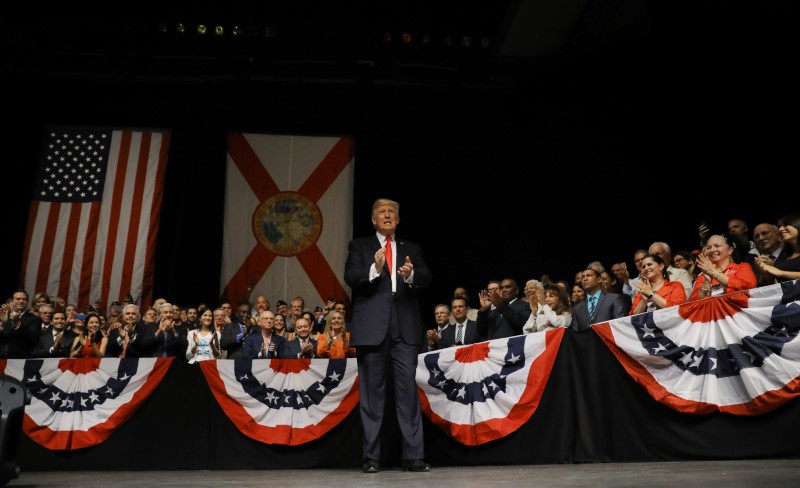
President Trump at the Manuel Artime Theater with Cuban Americans in 2017
Cuba in 2017 remained a repressive totalitarian regime with prisoners of conscience, and a one-party communist dictatorship that has used its military and intelligence apparatus to control Venezuela, turning that nation into a colony that it is plundering.Things had gotten worse for Cubans, especially following the Obama Administration's engagement with the Castro dictatorship, including a state visit in March of 2016. The current Administration has rolled back a number of Obama era Cuba policies, spoken out on the human rights situation in Cuba, and Ambassador Nikki Haley defended the morality of U.S. sanctions on the Castro regime.

Despite the claim by the architect of the previous Administration's Cuba policy, that President Trump's turn around on the Obama Administration's Cuba policy would fail, trade between the United States and Cuba was at its highest level in 2017 following its collapse between 2014 and 2016 when the previous Administration was pushing its new Cuba policy.

President Barack Obama announced his new Cuba policy on December 17, 2014 and the following year U.S. trade in goods with Cuba dropped $118.9 million from $299.1 million in 2014 to $180.2 million in 2015. This economic relationship has improved under the Trump Administration despite news that the Cuban economy is worsening and the regime's creditors are nervous.

Trade peaked under Bush in 2008 and began a steady decline under Obama
Obama Cuba policy flawed
President Obama downplayed commuting the sentences of three Cuban spies, including Gerardo Hernandez who was serving a life sentence for his role in a murder conspiracy that claimed four innocent lives in 1996 and freed them the same day.  This was part of the price paid to free an American hostage, Alan Gross, that had been an impediment to normalized relations.

President Obama does the wave with Raul Castro at a baseball game in Cuba
The Obama Administration apparently ignored the mysterious attacks that began in November of 2016 at the U.S. Embassy in Havana when 24 American diplomats and their dependents suffered severe injuries, including brain trauma.

On the human rights front the Obama Administration's new Cuba policy was also a disaster. The suspicious deaths of human rights defenders such as Orlando Zapata Tamayo (2010), Juan Wilfredo Soto Garcia (2011), Laura Inés Pollán Toledo (2011), Wilman Villar Mendoza (2012), Oswaldo Payá Sardiñas (2012), and Harold Cepero Escalante (2012) is a terrifying alternative to the long prison sentences that the Castro regime would use to take opposition leaders out of circulation, as was the case in 2003, during the Bush administration.

Some of the Cubans killed by the Castro regime during the Obama years
Over the eight years of the previous Administration (January 2009 through January 2017) high profile activists met untimely deaths that appear to have been carried by Castro's state security service. The same spy agency that President Obama's October 2016 Presidential Directive on Cuba orders the CIA to share intelligence with.

The number of politically motivated arbitrary detentions documented by the Havana based, Cuban Commission for Human Rights and National Reconciliation since 2008 demonstrates a dramatic rise in repression between 2008 and 2016, that spiked dramatically in the year of the Obama Administration's new Cuba policy announcement in 2014 from 6,424 arbitrary detentions in 2013 to 8,899 in 2014. This also occurred with troubling incidents of violence by regime agents.


 During President Obama's last year in office the number of arbitrary detentions reached their highest number since 2010 with 9,940 arbitrary detentions. Despite this, on his way out of office in January 2017, President Obama closed the door on Cuban refugees.


Under Trump's first year a dramatic reduction in arbitrary detentions in Cuba
During 2017 there were 5,155 Cubans arbitrarily detained, and although still far too high, it is a dramatic improvement over 2016. There are still prisoners of conscience enduring horrid and dangerous conditions in Cuban prisons and dissenters sent to psychiatric institutions for punishment.

However in the area of religious freedom. Things have gotten worse in Cuba. "From January to December 2017 Christian Solidarity Worldwide (CSW) recorded 325 separate violations of freedom of religion or belief (FoRB) in Cuba. Christians across a wide range of denominations were affected. Many of these cases involved large numbers of victims. By comparison, CSW reported 220 FoRB violations in Cuba in 2014, 180 in 2013, 120 in 2012 and 40 in 2011."

Overall the changes in tone and substance by the current Administration, so far, have been an improvement over the previous failed policy of the prior Administration that scrapped an old policy that was containing the regime, replacing it with one that legitimized the dictatorship, marginalized democrats, and negatively impacted U.S. interests.

The Trump Administration has taken positive steps, with its policy changes on Cuba, but more needs to be done.

Wednesday, December 20, 2017

Cuba, Iran, Hezbollah, drug trafficking and the list of state sponsors of terrorism

 Explosive report exposes extent of drug trafficking by terrorist group

 
Newsweek reported on December 18, 2017 that the "Islamist militant group Hezbollah exploded into a major cocaine trafficker for the United States over the past decade—and it happened under former President Barack Obama's watch to help score a nuclear deal with Iran, a report revealed Monday."  

There is a Cuban link that the current Administration should pay attention to. On February 13, 2016 Vice News reported that in 2011 Secretary of State Hillary Clinton had been warned that the Lebanese Islamist militant group Hezbollah was setting up an operational base in Cuba to carry out attacks in Latin America that might also involve attacks on American diplomatic posts or banks there was revealed in an e-mail from September 9, 2011 that stated the following:

The Hezbollah office in Cuba is being established under direct orders from the current General  Secretary Hasan Nasrallah, who replaced Musawi in 1992. According to the information  available to this source, in preparation for establishment of the base, Nasrallah, working from  inside of Lebanon, carried out secret negotiations with representatives of the Cuban Government,  particularly the Cuban Intelligence Service (General Intelligence Directorate — DGI), agreeing to, maintain a very low profile inside of Cuba. Nasrallah also promised to take measures to avoid any trail of evidence that could lead back to Cuba in the event of a Hezbollah attack in Latin  America.
Furthermore the Castro regime also has a long history of involvement in drug trafficking.  There should be Congressional hearings exploring the operational Hezbollah base in Cuba and its possible involvement in drug trafficking, weapons smuggling, and terrorism in the region.


The previous Administration had a poor track record of politicizing reports to pursue political objectives. In the case of Cuba this meant watering down reports on human trafficking, looking the other way on connections to drug trafficking, terrorist groups and downplaying Cuba's role in Venezuela's crisis and attempt to smuggle tons of heavy weapons to North Korea. It now appears that the practice has also been repeated with Iran. Newsweek in the already mentioned December 18, 2017 report reveals the following:
"Project Cassandra, a campaign launched by the Drug Enforcement Administration in 2008, found that the Iran-backed military and political organization collected $1 billion a year from money laundering, criminal activities, and drug and weapons trade, according to Politico. Over the following eight years, the agency found that Hezbollah was involved in cocaine shipments from Latin America to West Africa, as well as through Venezuela and Mexico to the United States.  The Obama administration halted Project Cassandra as it was approaching the upper echelons of Hezbollah’s conspiracy in order to seal a nuclear deal with Iran, even though Hezbollah was still funneling cocaine into America."
 Boneheaded political calculations are a bipartisan affair. In October of 2008, the Bush Administration took North Korea off the list of state sponsors of terrorism in the hopes that it would “salvage a fragile nuclear deal” with the totalitarian regime. The Reagan Administration designated North Korea a terror sponsor in 1988 after it was implicated in the 1987 bombing of  a South Korean airliner, in which more than 100 died. Nine years after taking Kim Jong Un’s regime off the list of terror sponsors, North Korea has tested nuclear weapons and is now threatening to attack the United States with its new nukes.

On November 20, 2017 the White House announced that North Korea would be returned to the list of state sponsors of terrorism. North Korean dictatorship should have never been taken off the list of state terror sponsors.

The lessons from the Bush Administration’s cozying up to North Korea should have given the next Administration cause to reject pursuing a similar path with Cuba. Unfortunately, that was not the case and on May 29, 2015 the Obama Administration took Cuba off the list of state sponsors of terrorism.

Iran has been on the list of state terror sponsors since 1984 and should remain there.

The U.S. Congress and Tillerson State Department should investigate what is going on in Cuba and its links to Hezbollah and other bad actors. If the regime in Cuba is continuing its pattern of sponsoring terrorism and international criminal enterprises then it should be returned to the list of state sponsors of terrorism.

Tuesday, June 6, 2017

The Case for a Reboot of U.S. Cuba Policy

"They are selling a virtual reality as if it was real change, and that is fraud. It is outrageous." - Oswaldo Payá Sardiñas, Cuban opposition leader interviewed on October 3, 2011


 The New York Times has published an Editorial titled "Undoing All the Good Work on Cuba" that rehashes Obama Administration talking points that advance a specific policy agenda, although ignoring the current situation, changing policies over the past half century, security concerns, and how sanctions on the Castro regime have protected US taxpayers.


During the eight years of the Obama Administration the situation for Cuban opposition leaders became more precarious and this was demonstrated with the deaths of high profile figures that could have over seen a democratic transition such as Oswaldo Payá Sardiñas and Laura Inés Pollán Toledo.

The current situation

Levels of violence against dissidents worsened while the old totalitarian patterns of repression still endure.  Rising violent repression against political dissidents in Cuba, including crippling and disfiguring machete attacks, became a high profile regime tactic starting in 2013. The case of Sirley Avila Leon in May of 2015 is well documented, even if it is not widely well known because The New York Times did not find it "fit to print" but thankfully others have.

Machete attack victims 2013 - 2015

 There is no right to education in Cuba if you dissent from the official line. Fếlix Yuniel Llerena López, a 20 year-old religious freedom defender, was expelled from the Enrique José Varona Pedagogical University in Havana on May 8, 2017 following a visit to the United States. 18-year-old journalism student, Karla Pérez González, was expelled from Marta Abreu University of Santa Clara for “political reasons” on April 12, 2017 and her expulsion ratified three days later on April 15th. 24 year old David Mauri Cardoso was expelled from the University of Cienfuegos in February of 2017 after he honestly answered politically loaded questions in what was supposed to be a Spanish literature exam.

If you have a relative who is a dissident, although you are not, you can still be fired from your job. Professor Dalila Rodriguez from the University of Las Villas was expelled from her job on May 9, 2017 because her father, Leonardo Rodriguez is a dissident. 

Dissidents have been jailed and mistreated in psychiatric facilities in Cuba. The practice continues today with Daniel Llorente Miranda, the dissident who on May Day ran out in front of the parade with an American flag shouting out for a free Cuba, held in Mazorra.

There is no right to travel for Cuban nationals and dissenters are regularly denied exit and entry. Ivan Hernandez Carrillo, and Sayli Navarro were denied the right to travel by the Castro regime on June 4, 2017. 

Amnesty International has recognized Eduardo Cardet as a new Cuban prisoner of conscience and has an urgent action underway for his release.


What is taking place in Cuba is fake change. The regime is working to achieve regime succession and prevent a democratic transition in Cuba.

Policy changes over the past half century

The argument made by the Obama Administration and repeated by The New York Times that "hard-line sanctions-based approach was in place for more than 50 years after the 1959 revolution and never produced what anti-Castro activists hoped would be the result" is both a straw man argument and untrue.

The Castro regime beginning in 1959 sent armed expeditions to Panama, Haiti, Nicaragua, Venezuela and the Dominican Republic to overthrow their governments. The regime's destabilization policy led two thirds of the 21 states of Latin America voting to expel Cuba from the Organization of American States on February 14, 1963.   A cache of three tons of weapons was found on a Venezuelan beach in November 1963 that was to be used to disrupt the democratic elections there.

Due to the 1961 Bay of Pigs debacle that consolidated Castro's rule and the 1962 Cuban Missile Crisis that ruled out a direct U.S. invasion, economic sanctions were put in place not to eliminate the Castro regime but limit its ability to expand into the rest of the hemisphere and to force the Soviet Union to expend large sums in keeping the Castro regime afloat which may have contributed to the USSR's demise in 1991.  The embargo was not designed to overthrow the Castro regime but to contain its mission to destabilize other governments in the region.


President Carter ended Cuba travel embargo and began normalizing relations in 1977

On April 27, 1977 representatives of the Carter Administration and the Castro regime sat down and personally negotiated an international fishery agreement. This was the first time since 1958 that any officials of the United States government sat down with representatives of the Castro regime to formally negotiate an agreement. 

President Carter in an interview with Robert Fulghum on December 19, 1996 quoted on page 310 of the book Conversations with Carter said: "When I had only been in office two months in 1977, I opened up all travel for American citizens to go to Cuba and vice versa. And we opened up an entry section, which is just one step short of a full embassy in both Havana and Washington. And those offices, by the way, are still open."

Outcomes of Carter normalization with Castro regime

Robert A. Pastor, of The Carter Center in July 1992 in the report "The Carter Administration and Latin America: A Test of Principle" summed the outcome of the Carter policy on Cuba: "In November 1977 there were 400 Cuban military advisers in Ethiopia; by April 1978 there were 17,000 Cuban troops there serving under a Soviet general.

The Castro regime also played a crucial role in the Sandinista victory in Nicaragua while the Carter Administration imposed sanctions on the Somoza regime when it refused to pursue democratic reforms. According to Robert Pastor:  "Somoza pretended the sanctions had no effect on him. He doubled the size of the National Guard and evidently believed he was secure. However, by May 1979, with Cuban President Fidel Castro's help, the three Sandinista factions had united and established a secure and ample arms flow from Cuba through Panama and Costa Rica."

During the Mariel crisis of 1980, when over 125,000 Cubans sought to flee the island, the Cuban dictator sought to save face by selectively releasing approximately 12,000 violent criminals or individuals who were mentally ill into the exodus. 

Towards the end of the Carter Administration the discovery of a Soviet ground forces brigade operating on Cuban territory and the ineptness in handling the Mariel boat lift crisis spelled not only the end of the policy but was also a contributing factor to the defeat of President Carter during his 1980 re-election bid. 

This first attempt at normalizing relations saw a worsening human rights situation in Cuba, a migration crisis and reversals in US interests in the region.

President Reagan restores Cuba embargo in 1981 and challenges Castro regime on international stage

Carter's policy of détente was rejected by the Reagan administration. Ronald Reagan entered the White House in 1981 and re-imposed the travel ban, toughened economic sanctions, in 1982 placed the Castro regime on the list of state sponsors of terrorism, and started Radio Marti to break through the communist monopoly with uncensored information for Cubans on the island. 

Ronald Reagan backed the creation of a Radio Free Cuba to break Castro regime's information monopoly over the Cuban people beginning in 1981. When it finally went on the air in 1985 Radio Marti marked a before and after inside Cuba. At the time President Reagan hoped that Radio Marti would ''help defuse the war hysteria on which much of current Cuban Government policy is predicated.'' 

Outcomes

The Castro regime's response was to end an immigration agreement and suspend the visits to Cuba by Cubans living in the United States. The Reagan Administration named former Cuban political prisoner Armando Valladares Ambassador to the United Nations Human Rights Commission and made human rights in Cuba a priority there. The end result was that for the first and last time Amnesty International, the International Committee of the Red Cross and the UN Human Rights Commission were able to visit Cuban political prisoners inside the island. There was no Cuba migration crisis during the Reagan Administration.


President Clinton seeks rapprochement with Castro regime in 1993

The Clinton Administration in 1994 initiated regular contacts between the U.S. and Cuban military that included joint military exercises at the Guantanamo Naval base. Despite this improvement of relations the 1990s saw some brutal massacres of Cubans that are rightly remembered such as the July 13, 1994 "13 de Marzo" tugboat massacre and the February 24, 1996 Brothers to the Rescue shoot down. The shoot down involved two planes blown to bits over international airspace by Cuban MiGs killing three American citizens and a Cuban resident who were engaged in the search and rescue of Cuban rafters This led to the signing of the Helms - Burton Bill later in 1996, but as soon as he was re-elected President Clinton renewed his drive for normalized relations with the Castro regime. 

Outcomes
 
The worsening human rights situation was a contributing factor in the August 1994 rafter crisis in which 35,000 Cubans fled the country. Experts have identified that this was a migration crisis engineered by the Castro regime. The Cuban dictatorship did this because it successfully reasoned that it could coerce the Clinton Administration to the negotiating table to obtain concessions which indeed it did and prolonged the life of the dictatorship  President Clinton  shook hands with Fidel Castro in 2000 and opened cash and carry trade with the dictatorship loosening economic sanctions.  This new period of engagement coincided with the rise of Hugo Chavez and reversals of the democratic gains made in the 1980s and early 1990s.


President Obama pursues normalization of relations with Castro regime in 2009
 
The Obama Administration beginning in 2009 loosened sanctions on the Castro regime. On his watch concluding on December 17, 2014 the Obama administration freed all five members of the WASP spy network, including Gerardo Hernandez -- who was serving two life sentences, one of them for conspiracy to murder four members of Brothers to the Rescue murdered during the previous attempt at normalizing relations during the Clinton Administration. They de-linked the pursuit of full diplomatic relations from the rise in human rights violations in Cuba and in the region by Cuban state security.

The Obama administration doubled down on concessions ignoring the Castro regime's continuing sponsorship of terrorism and smuggling of weapons to North Korea in order to take Cuba off the list of state sponsors of terrorism. President Obama followed through on his pledge made at the State of the Union to work for the lifting of economic sanctions on the dictatorship.

The Obama Administration marginalized dissidents and downplayed their importance early on in 2009 refusing to meet with them; the Obama State Department threatened the daughter of a martyred dissident in order to protect the sensibilities of the Castro regime's foreign minister in 2015. Not to mention claiming that there was no room for dissidents at the opening of the U.S. Embassy in Havana later that same year.

President Obama went to Cuba with his family in March of 2016, in the midst of a human rights crackdown, and legitimized Raul Castro's regime before an international audience. In October of 2016. Less than a year after a fleeing refugee was shot in the back in the spring of 2015 by a Cuban state security agent. Mr. Obama issued a Presidential Policy Directive ordering U.S. intelligence agencies to share information with the Castro regime's secret police.  In January of 2017, in one of his final acts, President Obama further gutted the Cuban Adjustment Act ushering in the wholesale deportation of Cubans fleeing to the United States.

Outcomes

President Obama on December 17, 2014 claimed to have charted a "new" course on Cuba but in reality it was a very old and discredited policy applied in Cuba of marginalizing democrats and embracing dictators for perceived gain.

Human rights have deteriorated in Cuba with rising levels of violence against nonviolent activists. including machete attacks, and the suspicious deaths of human rights defenders such as Orlando Zapata Tamayo (2010), Juan Wilfredo Soto Garcia (2011), Laura Inés Pollán Toledo (2011), Wilman Villar Mendoza (2012), Oswaldo Payá Sardiñas (2012), and Harold Cepero Escalante (2012).


There were 9,940 politically motivated arbitrary detentions over the course of  2016. In 2009, the first year of the Obama Administration, there were just 869 arbitrary detentions documented. During the eight years of the Obama White House there has been an eleven fold increase in politically motivated arbitrary detentions with 2016 being the worse. Religious repression escalated in Cuba in 2016 including the beating of pastors, the confiscation of Churches and some demolished by the dictatorship.

This worsening situation in Cuba is also reflected in an increase in Cubans fleeing the island. In 2008 there were slightly more than 10,000 visaless Cubans entering the United States compared to 46,635 visaless Cubans entering the United States in the first ten months of 2016.

On the economic front the Obama White House repeatedly claimed to have achieved $6 billion in trade with Cuba under the new policy but the actual number according to the U.S. census bureau is $380.5 million dollars in trade in goods with Cuba.


Trade between Cuba and the United States imploded under the Obama Administration. Peak year of U.S. trade in goods with Cuba was 2008, the last year of the Bush Administration. The two worst years in trade are the ones following the new Cuba policy launch in December of 2014. All of the details are available at the U.S. Census Bureau. The Cuban economy contracted in 2016 and at the same time military control over it has expanded.

The consequences in the region have also been negative. The Castro regime's military and intelligence services have been heavily involved in the attempt to build and impose a totalitarian regime in Venezuela for the past 18 years. Furthermore in Bolivia, Nicaragua, El Salvador, and Ecuador regimes with links to Havana pursue an anti-democratic agenda. Yoani Sanchez, the Cuban dissident blogger journalist, wrote a May 28, 2017 entry titled "The Kremlin is Back."  The Russians returned to Cuba, and made new inroads into Latin America during the Obama years.  


Conclusion

The New York Times has a terrible track record in Cuba and its latest editorial continues that lamentable tradition trying to make the case for the Trump Administration to continue the failed policies of the Obama Administration on Cuba. However, even a broken clock is right twice a day and The New York Times on December 8, 2016 reported how increased U.S. tourism to Cuba has meant more food shortages for Cubans because food production is geared to tourists. The record indicates that the case for tightening sanctions, and pushing a human rights centered policy will best serve both U.S. national interests and the prospects for a non-violent democratic transition.

The good work on Cuba was undone by the Obama Administration when it prioritized engaging with the Castro dictatorship, marginalized Cuban democrats, ignored the regime's support for outlaw regimes, and terrorist groups all in the service of a flawed policy.


Friday, February 10, 2017

Christophobia, ISIS and Christian Genocide in the Middle East

"Blessed are you when people insult you, persecute you and falsely say all kinds of evil against you because of me." - Matthew 5:11

Ethiopian Christians purportedly executed by ISIS in Ethiopia
On March 17, 2016 John Kerry recognized that ISIS was committing genocide against Christians in Iraq and Syria.  ISIS marked Christian houses with the Arabic equivalent of the letter "N" for Nazarene and targeted Christians. There has been a reduction in the number of Christians in Iraq and Syria. For example, in 2006 35,000 Christians lived in Mosul and now only 20 to 30 remain.

Nine years earlier then Senator Barack Obama wrote Secretary of State  Condoleezza  Rice on September 11, 2007 concerned "for Iraq's Christian and other non-Muslim religious minorities who appear to be targeted by Sunni, Shiite, and Kurdish militants." The then Senator from Illinois and future President continued writing: "The severe violations of religious freedom faced by members of these indigenous communities, and their potential  extinction from their ancient homeland, is deeply alarming in light of our mission to bring freedom to the Iraqi people."

Things did not improve for Iraqi or Syrian Christians during the Obama Presidency and with the rise of ISIS worsened.

According to Pew Research in 2016 globally 38,901 Muslim refugees entered the United States as opposed to 37,521 Christian refugees but this is a misleading number because it does not reflect the disparity in the Middle East and that Christians there have been targeted for genocide. In fiscal year 2016 when the Secretary of State recognized that Christians in Iraq and Syria were targeted for genocide the United States admitted 12,587 Syrian Refugees out of which 12,486 were Muslims, 68 Christians, and 24 Yazidis. This is troubling since Syria had a population of 22.85 million according 2013 statistics with 10% Syrian Christians which translates to 2.2 million.  Only 0.5% of Syrian refugees admitted to the United States are Christian or 68 if the refugee flow were proportional the number of Christian Syrian refugees would be approximately 1,000.

Elliott Abrams of the Council on Foreign Relations and now being considered for a top post at the State Department concluded in September 2016 that in a de facto manner the United States was barring Christians, not Muslims from the United States and went on to explain how to solve this problem with some common sense reforms that the Obama Administration failed to implement.

James Zogby of the Arab American Institute disputed Abrams line of argument and argued that Christians were being "used" citing the silence of the Bush Administration during the first three years of the Iraq war when they were being devastated in Iraq and made the argument that not as many Christians have fled as claimed by Mr. Abrams. Mr. Zogby is a critic of the Iraq war and in 2014 in an essay "A Precarious Christmas" wrote the following that seems to contradict his argument:
Caught in the middle, as one Syrian has termed it “between the anvil of the regime and the hammer of violent extremists,” the country’s Christians have paid a dear price. Scores of churches have been destroyed and two bishops have been kidnapped by shadowy extremist groups. The famed ancient Aramaic-speaking town of Maaloula has been over-run by an al Qaida affiliated group that is holding captive the nuns from that community’s monastery. In the face of this violence and destruction, almost half of Syria’s Christians have joined their Muslim compatriots as refugees. Those who remain in the country live in fear for their future.
As a human rights activist I don't agree with a religious test for refugees but am concerned Christians targeted for genocide are being underreported for political reasons. I'm also uncomfortable that when raising the issue of Christian persecution there is a hostile reaction not seen when discussing other religious minorities such as Yazidis or Shia Muslims. Has Christophobia the hatred, prejudice, and bigotry against Christians, become so entrenched in elite circles that with a Christian genocide underway in Iraq and Syria only 68 Christian Syrian refugees arrived in fiscal year 2016 and questioning how to save more is considered a controversial proposition. 

Republican Congressman Chris Smith is calling on the Trump Administration to provide relief for Christian genocide survivors fleeing the Islamic State in Iraq and Syria (ISIS). In December 2016 Congressman Smith visited the Chaldean Catholic Archdiocese of Erbil in Iraq. This is an excerpt of the report on what the Congressman found.
  The Syriac Orthodox Archbishop of Mosul, Nicodemus Daoud Sharaf, who had to flee ISIS and seek refuge in Erbil, told Smith, “So often concern for Christians is minimized. I am so happy, because you are the first American who has come to just ask about the Christians. We pray that President Trump will help us. We are the last people to speak the Aramaic language. Without help, we are finished.”       
I also saw how the Obama Administration has shortchanged organizations conducting criminal investigations and collecting, preserving and preparing evidence usable in criminal trials. Perpetrators will dodge punishment unless there is specific evidence linking them to specific atrocity crimes. My Iraq and Syria Genocide Relief and Accountability Act legislation is a blueprint for how to assist Christians and other genocide survivors and hold perpetrators accountable. I will be working tirelessly to get this bill on the new President’s desk when we reconvene in January,” added Smith.

Monday, October 24, 2016

Christian Liberation Movement statement on Podesta wikileak referencing Oswaldo Payá

"The truth will make them stand in solidarity with our freedom." MCL Declaration on email of John Podesta, campaign manager for Hillary Clinton.


By the Christian Liberation Movement

"The truth will set them in solidarity with our freedom."

In a July 2015 email disseminated by wikileaks, John Podesta, campaign manager for Hillary Clinton says the phrase "Yes. Oswaldo Payá. Cuban government ran him off the road and killed him almost certainly."

That a very important person, also linked to the administration of President Obama and now the Democratic candidate, to make such a statement indicates that in the upper echelons of power in the United States they have evidence or details that allow them to make that statement.

The Christian Liberation Movement from the outset spread this message "Angel says that a vehicle forced us off the road" sent by Aron Modig, who traveled with Angel Carromero as a passenger in the vehicle that suffered the attack.

Since then we have been divulging all the details that we have known about this tragedy and called for an independent investigation to clarify what happened. Not only the United States, governments such as the Spanish, the Swedish and many foreign ministries have information about what occurred on July 22, 2012 on the road from Bayamo.

We hope that whoever wins the election demand and directly support this independent investigation into the death of Oswaldo Payá and Harold Cepero and to support our demand, "One Cuban, one vote" for the freedom that Oswaldo and Harold Cuba lived and died for reach the hand of the sovereign decision of the people. This is the way for the democracies to have a relationship of total solidarity with Cuba that is also all of us Cubans who do not have rights.

Oswaldo Payá and Harold Cepero killed on July 22, 2012

Tuesday, October 11, 2016

Clinton, Trump, Cuba and the 2016 Election

Trumps words and actions versus Clinton's words and actions on Cuba, the rule of law and the 2016 election

The Cuba embargo has become an issue in the 2016 election
In June of 2014 the New York Post reported on Hillary Clinton’s address to the Council of Foreign Relations while promoting her book, “Hard Choices” where she declared “The embargo is Castro’s best friend,” and that the regime was using it as an excuse” to blames all of its problems on the United States.  

In a previous book, Living History, she describes an exchange with Raul Castro’s wife in 1995 on pages 314-315 offered a different perspective: “I climbed aboard the bus and spotted an empty seat next to an amiable-looking lady with white hair. She looked familiar but I couldn’t remember who she was. Probing for clues, I asked her how long it had taken her to reach Paraguay (which would give me an idea of her country’s geographical location) and how things were going in her homeland:  “Fine,” she said stone-faced. “Except for the embargo.” I had managed to seat myself next to Vilma Espin, Fidel Castro’s sister-in-law who was representing him at the Conference.”

The dictatorship viscerally wants all sanctions eliminated in order to be completely legitimized internationally and to obtain additional financial credits. The claim that the Castro regime wants the embargo to continue is an absurdity when one considers that all the spies for the Cuban dictatorship uncovered by U.S. counter-intelligence were pushing an anti-embargo agenda within the U.S. government, academy and media.

Secretary Clinton might want to ask herself why her brother in law Roger Clinton was paid $30,000 by Cuba Travel Services in 2000 to lobby his brother, President Clinton to loosen government restrictions on travel to Cuba. Roger Clinton may have violated the law when he failed to register as a lobbyist in this matter.

A close Clinton ally, Terry McAuliffe, in 2010 traveled to Cuba to do business with the dictatorship, but could not produce the paperwork with the U.S. Office of Foreign Assets Control (OFAC) to obtain a license to travel to Cuba, saying they no longer had copies. At the time when journalists requested copies of the paperwork from OFAC they were told by an OFAC spokesman that "the office does not comment on specific licenses."  Apparently an exception was made with Donald Trump.

When Secretary Clinton on July 31, 2015 went to Florida International University to make a speech in which she called for the lifting of the embargo on the Castro regime stating “Engagement is not a gift to the Castros – it’s a threat to the Castros. An American embassy in Havana isn’t a concession – it’s a beacon. Lifting the embargo doesn’t set back the advance of freedom – it advances freedom where it is most desperately needed,” she failed to make a simple gesture. A few hundred yards from where the former Secretary of State spoke there was a monument to the thousands of victims of the Castro regime, but she did not visit it.

History contradicts her analysis. The only time the Castro regime permitted the International Committee of the Red Cross to visit Cuban prisons, and Amnesty International to visit Cuba was in the late 1980s after Ronald Reagan took a hard line on human rights violations in Cuba at the United Nations, rolled back the Carter Administration’s 1977 opening of the travel embargo in 1982, toughened economic sanctions, and began broadcasting uncensored news to Cuba over Radio Marti.  

The Clinton Administration engaged in unilateral concessions to the Castro regime and ended up with a mass exodus in 1994, a worsening human rights situation in Cuba, four young humanitarians murdered in an act of state terrorism over international airspace ordered by Fidel and Raul Castro on February 24, 1996. Despite all of this Bill Clinton refused to enforce the law tightening sanctions in 1996 in response to the shoot down, shook hands with Fidel Castro in 2000 and opened up trade with the Castro regime. In 2015 former President Clinton warmly greeted and met with Raul Castro despite his role in the murder of American citizens.

Some of what Newsweek missed in their Cuba reporting and the 2016 election
Meanwhile the Obama policy that Hillary Clinton championed in 2014 and 2015 has not had the desired results.  Human rights violations are at record levels in Cuba, there is a mass exodus of Cubans fleeing the island not seeing a future there  with the U.S. legitimizing the regime and assisting in a generational succession, and the U.S. is more isolated than ever in Latin America with its embrace of the Castro regime alienating it from democrats. The Colombian peace initiative, backed by the Obama administration, mediated by Raul Castro in Havana was rejected by the Colombian people in a national vote. The situation in Venezuela has descended into crisis as Nicaragua slides into dictatorship.

Not to mention that what Secretary Clinton and the Obama administration call “engagement” and advancing freedom” in practice has meant American companies such as Starwood trafficking in stolen properties, and Cuban Americans discriminated against by American corporations such as Carnival and American Airlines to satisfy the whims of the Castro dictatorship. Unfortunately opening up business with the Castro dictatorship has been a long term objective of Hillary Clinton most likely pushed on her by her donors. 

These positions have had consequences in the 2016 election in Florida after Mr. Trump switched positions on Cuba policy, abandoning his previous support of the Obama administration in this area.

Young millennials at Florida International University in Miami were outside picketing against Secretary Clinton protesting her anti-embargo speech on July 31, 2015 and harassed by the police, who did not want the youthful protesters to be visible, and tried unsuccessfully to corral them in a designated protest zone. Nevertheless an FIU poll appeared on September 14, 2016 claiming that a majority of Cuban Americans no longer supported the embargo.

Two days later on September 16, 2016 Donald Trump announced that he would roll back the unilateral concessions made by the Obama administration and tighten the economic embargo if the human rights situation didn’t dramatically improve and all political prisoners freed. Havana rejected the offer. Polls began to tighten in Florida and crowds of Cuban Americans met with candidate Trump in Little Havana chanting his name. It was a good start after spending more than a year on the same page as Hillary Clinton and Barack Obama on Cuba policy.

One sided hit piece on Trump ignored Clinton's Castro connections
This appears to have led the Clinton campaign to mount an offensive to block what inroads Mr. Trump could make in the Cuban community that could make the difference in a tight race in Florida.

Less than two weeks later on September 29th Newsweek broke a story that Trump may have violated the embargo in 1998 and Hillary Clinton began attacking him with radio advertisements, without mentioning her own anti-embargo position. Nor did she mention that Trump enterprises in 1998 like many businesses today hired a consulting firm to explore opportunities in Cuba because the Clinton administration was encouraging it at the time. Mr. Trump began to lose ground in Florida to Secretary Clinton when he did not provide context to the events of 1998 in a sustained manner. Meanwhile staunch Cuba embargo supporter Senator Marco Rubio is doing much better in the polls.

All of this may explain why many Cuban exile leaders have not taken the red meat dished out by the Clinton Campaign. At the same time Cuban Americans maintain a healthy dose of skepticism with both campaigns, but unlike Donald Trump, Hillary Clinton has a track record not just of words but also actions that could impact her support among Cuban Americans, but this would require a Trump campaign in Florida that could seize the initiative and so far that has not happened. Meanwhile the members of the Latin American Builders Association have endorsed Secretary Clinton despite the above facts.

However, this obvious manipulation by the Clinton campaign can be quickly neutralized by the Trump campaign by a sustained advertising campaign highlighting on Spanish radio and TV in the South Florida market the contrast between him and Secretary Clinton on this issue. This would place Secretary Clinton in the unenviable position of either continuing to support the Obama administration Cuba policy's many failures or distancing herself from it with a pledge to empower Cubans and not the Castro dictatorship as the current policy does. 

In the post-mortem of this election the Cuban American vote in South Florida will be worthy of study and analysis.