Showing posts with label Martin Luther King Jr. Show all posts

Friday, October 2, 2020

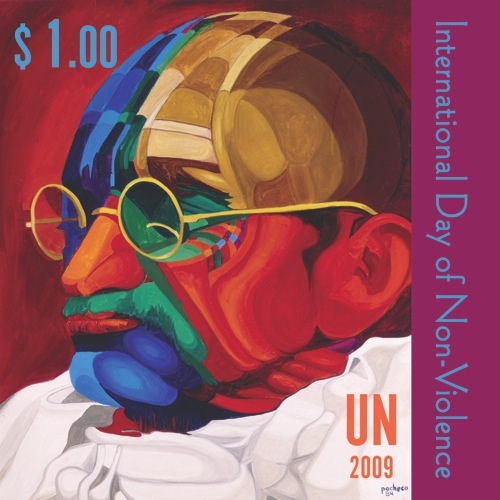
International Day of Non-Violence 2020: Raising awareness with Satyagraha

We may never be strong enough to be entirely nonviolent in thought, word and deed. But we must keep nonviolence as our goal and make strong progress towards it. - Mohandas Gandhi

Mohandas Gandhi
 

October 2nd has been recognized by the United Nations as the International Day of Non-Violence. This date was selected to reflect on this powerful idea, because on October 2, 1869 Mohandas Gandhi was born in India.  The United Nations describes Gandhi as the "leader of the Indian independence movement and pioneer of the philosophy and strategy of non-violence." 

On September 11, 1906 in South Africa, unhappy with the term passive resistance to describe nonviolence he convened a contest that led to a new word "Satyagraha" taken from Sanskrit words that Gandhi described as follows: "Truth (Satya) [that] implies love, and firmness (agraha) engenders and therefore serves as a synonym for force."

Today is a day to share the message of nonviolence through education and awareness. It is a powerful idea that recognizes the dignity and power inherent in each individual, while at the same time recognizing that harnessing force through disciplined, strategic and non-violent action magnifies the power of the individual and when working in concert with others can become an unstoppable force for positive change. The life and example of Congressman John Lewis, who recently passed away, is an example of this.

Critics often cite that both Mohandas Gandhi and Martin Luther King Jr. were assassinated, and that this demonstrates the failure of their nonviolent philosophy, but they fail to look at what they accomplished in the wider societies they inhabited, and their respective legacies decades later. Both changed their respective countries. Gandhi achieved Indian independence, and King ended official segregation, empowered African Americans with their full voting rights, and achieved much more.

Gene Sharp who also taught generations of activists that there was an alternative to bloody conflict and that it was non-violent armed conflict. He demonstrated, as both Gandhi and King understood and practiced, that there was nothing passive about nonviolent resistance and that it also required strategy to increase the odds of success in a struggle. In 1990 at the National Conference on Nonviolent Sanctions and Defense in Boston, Gene Sharp succinctly outlined his argument.

"I say nonviolent struggle is armed struggle. And we have to take back that term from those advocates of violence who seek to justify with pretty words that kind of combat. Only with this type of struggle one fights with psychological weapons, social weapons, economic weapons and political weapons. And that this is ultimately more powerful against oppression, injustice and tyranny then violence."

This idea has extended to many places, and cultures around the world, but it is co-existing in conflict with ideologies like Marxism-Leninism that are based in class struggle, revenge redefined as justice, and violence elevated as a superior tool of struggle. Both Gandhi and King understood this latter approach to be profoundly counterproductive. 

Michael Nagler, a long time peace scholar, presents this idea as follows: Nonviolence sometimes “works” and always works, while by contrast, Violence sometimes “works” and never works.  Nagler offers a more detailed explanation.

The exercise of violence always has a destructive effect on human relationships even when, as sometimes happens, it accomplishes some short-term goal. The exercise of nonviolence, or Satyagraha, always brings people closer. This explains why Gandhi, after fifty years of experimentation in every walk of life, could declare that he “knew of no single case in which it had failed.” Where it seemed to fail he concluded that he or the other satyagrahis had in some way failed to live up to its steep challenge.  Taking the long view, he was able to declare that “There is no such thing as defeat in non-violence. The end of violence is surest defeat.”

 Below are several videos that introduce nonviolence and how it works.

Nonviolence: understanding the basics by Michael Nagler 

The secret to effective nonviolent resistance | Jamila Raqib 

Nonviolence or Nonexistence: Choice of the 21st Century | Arun Gandhi | TEDxAthens

MLK: Nonviolence is the Most Powerful Weapon

Thursday, November 29, 2018

Cuban prisoner of conscience Eduardo Cardet will mark two years of unearned suffering in prison tomorrow

"I have lived these last few years with the conviction that unearned suffering is redemptive." - Martin Luther King Jr.,  Suffering and Faith,"April 27, 1960

Jailed Cuban pro-democracy leader Eduardo Cardet
Eduardo Cardet is a Cuban prisoner of conscience and the Christian Liberation Movement's imprisoned leader. November 30, 2018 will mark two years in prison. He doesn't belong there. He is an innocent man. Amnesty International has recognized him as a prisoner of conscience. He is jailed for speaking his mind and advocating for an end to dictatorship and the restoration of democracy in Cuba. He has been beaten and arrested by the secret police in front of his wife and two young children. He has been subjected to a political show trial. He has been denied family visits in order to attempt to silence his families protestations demanding his freedom. He has been attacked and stabbed in prison, and nearly died.

Wife and husband: Yaimaris Vecino and Eduardo Cardet
 Imagine for a moment two years in prison. 730 days passing by in a cell, surrounded by those who wish to do you harm.  17,520 hours to ponder the nature of the government that has imprisoned you. 1,051,200 minutes to feel the absence of family and friends. 63,072.000 seconds that have passed and will never be regained separated from your wife and children.

Reverend Martin Luther King Jr. observed in 1960 that "unearned suffering is redemptive." This observation is not a cliche but a profound insight that should be placed into fuller context.
My personal trials have also taught me the value of unmerited suffering. As my sufferings mounted I soon realized that there were two ways that I could respond to my situation: either to react with bitterness or seek to transform the suffering into a creative force. I decided to follow the latter course. Recognizing the necessity for suffering I have tried to make of it a virtue. If only to save myself from bitterness, I have attempted to see my personal ordeals as an opportunity to transform myself and heal the people involved in the tragic situation which now obtains. I have lived these last few years with the conviction that unearned suffering is redemptive.
There are some who still find the cross a stumbling block, and others consider it foolishness, but I am more convinced than ever before that it is the power of God unto social and individual salvation. So like the Apostle Paul I can now humbly yet proudly say, “I bear in my body the marks of the Lord Jesus.”
Eduardo Cardet is also a Christian man of faith, and he too understands the "scandal of the cross" cited by St. Paul. It is the ultimate example of unearned suffering which is Jesus being without sin crucified to redeem the world.

Eduardo Cardet's children received Patmos award for their dad.
The struggle for human freedom and dignity is not just a physical but a moral and spiritual struggle as well. It would be well for activists to remember this as we observe this unjust anniversary visited on the Cardet family.


Wednesday, April 4, 2018

#MLK50: From the Mountaintop to the Lorraine Motel

Martin Luther King Jr.'s prophetic and nonviolent message
 
Lorraine Motel on 4/3/68:  Hosea Williams, Jesse Jackson, MLK Jr.,  Ralph Abernathy
50 years ago on the evening of April 3, 1968 Reverend Martin Luther King Jr. scaled the heights of American rhetoric dismantling the case for violence and reaffirming nonviolent resistance.

U.S. Marshal serves MLK with restraining order to forbid Memphis march on April 8th.
 The King Center provides the following abstract summary of Martin Luther King Jr.'s I've Been to the Mountaintop speech on April 3, 1968 in their website:
Dr. King gave this address at the Mason Temple in Memphis, Tennessee the night before he was assassinated. He called for nonviolent protest and a boycott of Memphis area businesses in support of the Memphis Sanitation Workers strike. Conveying a sense of foreboding, he not only recounted a near-death experience when he was stabbed near the heart, but also spoke of the possibility of his own demise at the hands of those who opposed him.
In this speech Reverend King outlined the purpose of the overall nonviolent struggle in broad terms:
 "And that's all this whole thing is about. We aren't engaged in any negative protest and in any negative arguments with anybody. We are saying that we are determined to be men. We are determined to be people. We are saying -- We are saying that we are God's children. And that we are God's children, we don't have to live like we are forced to live."


He spoke of the importance of maintaining unity, noting how in Ancient Egypt pharaoh had sought to maintain control over his slaves by having them fight among themselves. King then explained the failings of violence, even a little violence and the specific issues of the campaign for the sanitation workers.
"Secondly, let us keep the issues where they are. The issue is injustice. The issue is the refusal of Memphis to be fair and honest in its dealings with its public servants, who happen to be sanitation workers. Now, we've got to keep attention on that. That's always the problem with a little violence. You know what happened the other day, and the press dealt only with the window-breaking. I read the articles. They very seldom got around to mentioning the fact that one thousand, three hundred sanitation workers are on strike, and that Memphis is not being fair to them, and that Mayor Loeb is in dire need of a doctor. They didn't get around to that."
King addressed the resilience and persistence of the Civil Rights movement to resist water cannons and police dogs, and the restraining order to block the march, challenging the authorities to live up to the American traditions of liberty and the rule of law.
"Now about injunctions: We have an injunction and we're going into court tomorrow morning to fight this illegal, unconstitutional injunction. All we say to America is, "Be true to what you said on paper." If I lived in China or even Russia, or any totalitarian country, maybe I could understand some of these illegal injunctions. Maybe I could understand the denial of certain basic First Amendment privileges, because they hadn't committed themselves to that over there. But somewhere I read of the freedom of assembly. Somewhere I read of the freedom of speech. Somewhere I read of the freedom of press. Somewhere I read that the greatness of America is the right to protest for right. And so just as I say, we aren't going to let dogs or water hoses turn us around, we aren't going to let any injunction turn us around. We are going on."

By 1968 the Black power movement led by Stokely Carmichael and the Black Panthers were calling for armed insurrection in the streets.  Martin Luther King Jr explained the superior power of nonviolent resistance in concrete terms.
"Now the other thing we'll have to do is this: Always anchor our external direct action with the power of economic withdrawal. Now, we are poor people. Individually, we are poor when you compare us with white society in America. We are poor. Never stop and forget that collectively -- that means all of us together -- collectively we are richer than all the nations in the world, with the exception of nine. Did you ever think about that? After you leave the United States, Soviet Russia, Great Britain, West Germany, France, and I could name the others, the American Negro collectively is richer than most nations of the world. We have an annual income of more than thirty billion dollars a year, which is more than all of the exports of the United States, and more than the national budget of Canada. Did you know that? That's power right there, if we know how to pool it.

We don't have to argue with anybody. We don't have to curse and go around acting bad with our words. We don't need any bricks and bottles. We don't need any Molotov cocktails. We just need to go around to these stores, and to these massive industries in our country, and say,    
"God sent us by here, to say to you that you're not treating his children right. And we've come by here to ask you to make the first item on your agenda fair treatment, where God's children are concerned. Now, if you are not prepared to do that, we do have an agenda that we must follow. And our agenda calls for withdrawing economic support from you."  
 And so, as a result of this, we are asking you tonight, to go out and tell your neighbors not to buy Coca-Cola in Memphis. Go by and tell them not to buy Sealtest milk. Tell them not to buy -- what is the other bread? -- Wonder Bread. And what is the other bread company, Jesse? Tell them not to buy Hart's bread. As Jesse Jackson has said, up to now, only the garbage men have been feeling pain; now we must kind of redistribute the pain. We are choosing these companies because they haven't been fair in their hiring policies; and we are choosing them because they can begin the process of saying they are going to support the needs and the rights of these men who are on strike. And then they can move on town -- downtown and tell Mayor Loeb to do what is right.  

But not only that, we've got to strengthen black institutions. I call upon you to take your money out of the banks downtown and deposit your money in Tri-State Bank. We want a "bank-in" movement in Memphis. Go by the savings and loan association. I'm not asking you something that we don't do ourselves at SCLC. Judge Hooks and others will tell you that we have an account here in the savings and loan association from the Southern Christian Leadership Conference. We are telling you to follow what we are doing. Put your money there. You have six or seven black insurance companies here in the city of Memphis. Take out your insurance there. We want to have an "insurance-in."

Now these are some practical things that we can do. We begin the process of building a greater economic base. And at the same time, we are putting pressure where it really hurts. I ask you to follow through here."
The following day they had won in court and the march was on. The civil rights leaders were in good spirits. Reverend King had been suffering from a fever and had been resting throughout the day, but feeling better he got dressed to go out to dinner at 5:30pm.

Less than 24 hours after his historic speech, the 39 year old Baptist Minister and Nobel Laureate was struck down by a sniper's bullet at the Lorraine Motel and by 6:03pm he lay there dying. Andrew Young checked and found a slight pulse. King was pronounced dead at 7:05 p.m. at St. Joseph Hospital.

Lorraine Motel 4/4/68: Andrew Young, Jesse Jackson, MLK Jr., Ralph Abernathy, Hosea Williams,
On April 5, 1968 in Washington, DC Black power militant Stokely Carmichael held a press conference and appealed for violence and called for retaliation for the killing of Reverend King.
"When White America killed Dr. King last night, it declared war on us. There will be no crying there will be no funerals. The rebellions that have been occurring around the cities of this country is just light stuff to what is about to happen. We have to retaliate for the deaths of our leaders. The executions of those deaths won't be in the courtroom but in the streets of the United States of America. Last night we led all of those youngsters up and down the street to close every store in this area. Because Dr. King was shot and they should have closed those doors. Now some of them kicked glass door windows in. We are not stopping them from kicking in the store windows. We are stopping them from coming out on the streets without guns. When they come out on the streets we want them with guns. If they don't have guns we won't let them throw bricks and bottles, but when they get guns we will be out on the street."
Carmichael had already been advocating for armed insurrection on American streets prior to Dr. King's assassination and on February 17, 1968 explicitly made the case for "offing" blacks who did not agree with hm. Following the death of Martin Luther King Jr. Carmichael's threat was made reality. Newsweek reported that "riots broke out in dozens of cities across the United States. The rampage left 39 dead, 21,000 arrested, more than 2,600 injured and was responsible for damages estimated at $65 million."


Meanwhile in Memphis the local government met the demands that had been made by Reverend King and the striking sanitation workers.  The King family held solemn services for Dr. Martin Luther King Jr. in Atlanta, Georgia, attended by thousands including the Vice President of the United States, Hubert Humphrey.

Coretta Scott King requested that King eulogize himself: His last sermon at Ebenezer Baptist Church, a recording of his famous 'Drum Major' sermon, given on February 4, 1968, was played at the funeral. The King family went on to found the King Center and continued his nonviolent legacy to the present day. Other activists from King's inner circle continued their civil rights work, while some, like John Lewis, entered political life and continued working to realize Reverend King's beloved community.


Thursday, February 23, 2017

7 years ago on February 23 after years tortured, Orlando Zapata Tamayo died on hunger strike

"He who passively accepts evil is as much involved in it as he who helps to perpetrate it." - Martin Luther King Jr.
Orlando Zapata Tamayo
Human Rights Defender

May 15, 1967 - February 23, 2010
Cuban prisoner of conscience Orlando Zapata Tamayo died on February 23, 2010 after years of torture and a prolonged water only hunger strike in which prison authorities over the course of more than two weeks on and off refused him water. 
    Following his death the Castro regime and its agents of influence sought to slander Orlando's memory. However, activists who knew Orlando had already spoken on the record as had Amnesty International.
     For example, on the same day Orlando Zapata died, Cuban opposition leader Oswaldo Payá Sardiñas in a heartfelt message explained the circumstances surrounding his untimely death: 

Orlando Zapata Tamayo, died on this afternoon, February 23, 2010, after suffering many indignities, racist slights, beatings and abuse by prison guards and State Security. Zapata was killed slowly over many days and many months in every prison in which he was confined. Zapata was imprisoned for denouncing human rights violations and for daring to speak openly of the Varela Project in Havana's Central Park. He was not a terrorist, or conspirator, or used violence. Initially he was sentenced to three years in prison, but after successive provocations and maneuvers staged by his executioners, he was sentenced to more than thirty years in prison.
     The slander campaign has failed because people of good will paid attention and refused to remain silent. In Canada, a punk rock band composed and played a song titled Orlando Zapata that placed his death in context. A video accompanying the song was edited by the Free Cuba Foundation. Orlando's death focused attention on Cuban prisoners of conscience and was a factor in their release between 2010 and early 2011.


Background

Orlando Zapata Tamayo was born in Santiago, Cuba on May 15, 1967. He was by vocation a brick layer and also a human rights activist, a member of the Movimiento Alternativa Republicana, Alternative Republican Movement, and of the Consejo Nacional de Resistencia Cívica, National Civic Resistance Committee. Orlando gathered signatures for the Varela Project, a citizen initiative to amend the Cuban constitution using legal means with the aim of bringing Cuba in line with international human rights standards.

     Amnesty International had documented how Orlando had been arrested several times in the past. For example he was temporarily detained on 3 July 2002 and 28 October 2002. In November of 2002 after taking part in a workshop on human rights in the central Havana park, José Martí, he and eight other government opponents were arrested and later released. He was also arrested on December 6, 2002 along with fellow prisoners of conscience Oscar Elías Biscet and Raúl Arencibia Fajardo.  
     Dr. Biscet just released from prison a month earlier had sought to form a grassroots project for the promotion of human rights called "Friends of Human Rights." State security prevented them from entering the home of Raúl Arencibia Fajardo, Oscar Biscet, Orlando Zapata Tamayo, Virgilio Marante Güelmes and 12 others held a sit-in in the street in protest and chanted "long live human rights" and "freedom for political prisoners." They were then arrested and taken to the Tenth Unit of the National Revolutionary Police, Décima Unidad de La Policía Nacional Revolucionaria (PNR), in Havana.
    Orlando Zapata Tamayo was released three months later on March 8, 2003, but Oscar Elias Biscet, Virgilio Marante Güelmes, and Raúl Arencibia Fajardo remained imprisoned. On the morning of March 20, 2003 whilst taking part in a fast at the Fundación Jesús Yánez Pelletier, Jesús Yánez Pelletier Foundation, in Havana, to demand the release of Oscar Biscet and the other political prisoners. Orlando was taken to the Villa Marista State Security Headquarters. 
     He was moved around several prisons, including Quivicán Prison, Guanajay Prison, and Combinado del Este Prison in Havana. Where according to Amnesty International on October 20, 2003 Orlando was dragged along the floor of Combinado del Este Prison by prison officials after requesting medical attention, leaving his back full of lacerations. Orlando managed to smuggle a letter out following a brutal beating it was published in April of 2004:
My dear brothers in the internal opposition in Cuba. I have many things to say to you, but I did not want to do it with paper and ink, because I hope to go to you one day when our country is free without the Castro dictatorship. Long live human rights, with my blood I wrote to you so that this be saved as evidence of the savagery we are subjected to...

    On May 18, 2004 Orlando Zapata Tamayo, Virgilio Marante Güelmes, and Raúl Arencibia Fajardo were each sentenced to three years in prison for contempt for authority, disorderly conduct and resisting arrest in a one-day trial. Orlando Zapata Tamayo would continue his rebelliousness and his non-violent resistance posture while in prison and suffer numerous beatings and new charges of disobedience and disrespect leading to decades added to his prison sentence in eight additional trials.

The importance of remembrance
     Friends of freedom all too often are on the defensive explaining who and what they are against. The lives of courageous nonviolent activists such as Orlando Zapata Tamayo, Oswaldo Payá Sardiñas, Harold Cepero Escalante, Laura Inés Pollán Toledo and the four men murdered in the Brothers to the Rescue shoot down who were martyred by the Castro dictatorship should be remembered and told to others. The enemies of freedom do not like to have such heroes remembered and honored.  For example on May 24, 2010 in Oslo, Norway a Cuban diplomat attacked and bit a 19 year old Cuban-Norwegian girl who was filming her mother's protest on behalf of Orlando Zapata Tamayo outside of the Cuban embassy. The whole episode was a public relations disaster for the Castro dictatorship in Norway.


Take action
     People of good will around the world who wish to remember can join in a 24-hour water-only fast starting at 3 p.m. on Feb. 23, the day and time that Orlando Zapata Tamayo died on hunger strike followed by a silent vigil the following day from 3:21 p.m. to 3:27 p.m. to correspond with the times Carlos Costa, Pablo Morales, Mario De La Peña and Armando Alejandre Jr. were shot down on February 24th.

    Fasting for 24 hours is a limited way to step, albeit briefly and incompletely, into Orlando Zapata Tamayo's shoes. Beginning the fast at 3:00pm on February 23 and completing it on February 24 at 3:00pm just in time to honor and remember the four members of Brothers to the Rescue seems an appropriate way to pay homage. 
     They all demonstrated with the lives they led and by how they died that the Bible passage, John 15:13 is as relevant as ever: "No one has greater love than this, to lay down one’s life for one’s friends." Please use all the means at your disposal through social media and word of mouth to let others know about them.
 
The price of indifference
     The failure of solidarity with Cubans in the island has led to the Castro regime not only increasing repression at home but also projecting itself elsewhere in the Americas and sadly now Venezuelans are also dying or being killed for defending freedom in their country.

Saturday, July 9, 2016

Some Core Ideas of Non-violence

"Nonviolence is a powerful and just weapon which cuts without wounding and ennobles the man who wields it. It is a sword that heals." - Martin Luther King Jr., Nobel Lecture, December 11, 1964 

Gandhi, King and Payá: Brothers in Nonviolence and Martyrdom

There is an alternative to the cycle of violence that is engulfing the world today and it is to be found with the shield of human rights that recognizes human dignity as its basis and the weapon of nonviolence. Nonviolence is not passive and often times requires an aggressive attitude but always needs a strategic vision in order to succeed. However at a time when our country is gripped by the culture of death it is important to recall some of the core ideas of nonviolence.

38 “You have heard that it was said, ‘Eye for eye, and tooth for tooth.’ 39 But I tell you, do not resist an evil person. If anyone slaps you on the right cheek, turn to them the other cheek also." - Jesus Christ, Sermon on the Mount, Matthew 5:38- 5:39

"Terrorism and deception are weapons not of the strong but of the weak." - Mohandas Gandhi

“I became convinced that noncooperation with evil is as much a moral obligation as is cooperation with good.”- Martin Luther King Jr., The Autobiography of Martin Luther King Jr.

"If you fight with violence, you are fighting with your enemy’s best weapon and you may be a brave but dead hero."- Gene Sharp 

"When you are a child of God... you try thereby to imitate Jesus, in the midst of evil. Which means, if someone slaps you on the one cheek, you turn the other cheek, which is an act of resistance. It means that you do not only love your neighbor, but you recognize that even the enemy has a spark of God in them, has been made in the image of God and therefore needs to be treated as you, yourself, want to be treated Jesus is very clear about this: "do unto others as you want others to do unto you." - which is a rather powerful ethic for personal relationships, regardless of whether family or school or community or nation." - Reverend James Lawson, preparing students for nonviolent action at an FOR workshop

"I say nonviolent struggle is armed struggle. And we have to take back that term from those advocates of violence who seek to justify with pretty words that kind of combat. Only with this type of struggle one fights with psychological weapons, social weapons, economic weapons and political weapons. And that this is ultimately more powerful against oppression, injustice and tyranny then violence." - Gene Sharp, 1990 at the National Conference on Nonviolent Sanctions and Defense in Boston

The cause of human rights is a single cause, just as the people of the world are a single people. The talk today is of globalization, but we must state that unless there is global solidarity, not only human rights but also the right to remain human will be jeopardized. - Oswaldo Paya, December 17, 2002 

"The sharp edge of a razor is difficult to pass over; thus the wise say the path to Salvation is hard." - W. Somerset Maugham, The Razor's Edge (1944) 

Friday, January 15, 2016

Martin Luther King Jr. and his constant commitment to nonviolence as a method of struggle

"Before the victory's won, even some will have to face physical death. But if physical death is the price that some must pay to free their children from a permanent psychological death, then nothing shall be more redemptive." - Reverend Martin Luther King Jr., We Shall Overcome, June 17, 1966

Martin Luther King Jr. Photograph (c) Bernard J. Kleina (1966)
Reverend Martin Luther King Jr. was born 87 years ago today on January 15, 1929. Although a day has been set aside in recognition of his impact on American history his nonviolent legacy is not fully understood but remains relevant and important for the future of human civilization. This was a man who came to national prominence leading a bus boycott in the nonviolent defense of Rosa Parks who had been arrested for not giving up her seat on a bus to a white man on December 1, 1955. Before the boycott was successfully ended, Martin Luther King Jr.'s home was bombed on January 30, 1956.

This southern baptist minister was considered so dangerous that both the FBI and the KGB targeted him in campaigns to discredit him because they could not control him and the civil rights movement under his leadership achieved concrete successes that challenged established structures of power. Reverend King advocated standing up and being aggressive but with "understanding, good will and with a sense of discipline," that was also "a demanding love" that rejected hatred. His ideas and example deserve a closer examination.

50 years ago in Hollywood, Florida on May 18, 1966 Martin Luther King Jr. discussed in great detail, at a time when other voices were counseling revolutionary violence, the nonviolent alternative in which he first described how a nonviolent movement must mobilize oppressed people for nonviolent resistance to injustice:
People are huddled in ghettos, living in the most crowded and depressing conditions. They need some outlet; some way to express their legitimate discontent. What is a better way than to provide non-violent channels through which they can do it? If this isn't provided they are going to find it through more irrational, misguided means. So the non-violent movement has a job to do, in providing the non-violent channels through which those who are caught in these conditions can express their discontent and frustration. 
Martin Luther King Jr. reaffirmed his commitment to non-violence while recognizing the consequences of such a position: 
Now let me say that I'm still convinced that non-violence is the most potent weapon available to oppressed people in their struggle for freedom and human dignity. And I'd like to say just a word about this philosophy since it has been the underlying philosophy of our movement. It has power because it has a way of disarming the opponent. It exposes his moral defenses, it weakens his morale. And at the same time it works on his heart and on his conscience, and he just doesn't know what to do. If he doesn't hit you, wonderful. If he hits you you develop the quiet courage of accepting blows without retaliating. If he doesn't put you in jail, that's very nice, nobody with any sense loves to go to jail. But if he puts you in jail you go in that jail and transform it from a dungeon of shame into a haven of freedom and human dignity. Even if he tries to kill you, you develop the inner conviction that there are some things so precious, some things so eternally true that they are worth dying for. If a man has not discovered some thing that he will die for, he isn't fit to live. 
Reverend King understood, as did Mohandas Gandhi, that Machiavelli was wrong, the ends do not justify the means:
 There's another good thing about non-violence: through it a person can use moral means to procure moral ends. There are still those who sincerely believe that the end justifies the means, no matter what the means happen to be. No matter how violent or how deceptive or anything else they are. Non-violence at its best would break with the system that argues that. Non-violence would say that the morality of the ends is implicit in the means, and that in the long-run of history destructive means cannot bring about constructive ends. So since we are working toward a just society in this movement, we should use just methods to get there. Since we are working for the end of a non-violent society in this movement, we must use non-violent means and methods to get there.
Martin Luther King, Jr. would've been 87 years old today but never saw 40 because an assassin shot the 39 year old Baptist minister in the head on April 4, 1968 at 6:01pm in the midst of the final campaign before his death: the support of a strike by sanitation workers in Memphis, Tennessee. King's legacy lives on not only in the United States but inspired Cuban democrats such as Oswaldo Payá Sardiñas who have also been martyred in the struggle for justice, freedom and human dignity.