"The first victory we can claim is that our hearts are free of hatred. Hence we say to those who persecute us and who try to dominate us: ‘You are my brother. I do not hate you, but you are not going to dominate me by fear. I do not wish to impose my truth, nor do I wish you to impose yours on me. We are going to seek the truth together’. THIS IS THE LIBERATION WHICH WE ARE PROCLAIMING."
Oswaldo José Payá Sardiñas (2002)
"I think you should stop making excuses for torture and repression. The blockade does not excuse the puncturing of Huber Matos’s genitals, the imprisonment of homosexuals in labour camps, or Guevara’s mass murders." - Peter Hitchens, Twitter, March 2, 2020
Huber Matos was born 102 years ago today on November 26, 2018, and he passed away on February 27, 2014 at the age of 95. He is a controversial figure in some quarters because with him, it is likely that Fidel Castro would have never taken power. Matos had provided the weapons that made Castro's July 26th Movement a viable fighting force and led the final attack taking the second most important city in Cuba, Santiago on January 1, 1959. These achievements have largely been erased in Stalinist fashion from the official history of the 1959 Cuban Revolution.
Less than a year later he would be on trial for his life.
What was his crime? Warning Fidel Castro in several private letters,
where he tendered his resignation only to have it refused, that
communists were infiltrating the revolutionary government. In these
letters he plainly stated:"I
did not want to become an obstacle to the revolution and I believe that
if I am forced to choose between falling into line or withdrawing from
the world so as not to do harm, the most honorable and revolutionary
action is to leave."
He wrote about the aims of the revolution: the restoration of democracy
and the Constitution of 1940 where in jeopardy and appealed to his
former comrade in arms: "We fought in the name of Truth, for all the
sound principles that bind civilization and mankind together . . . .
Please, in the names of our fallen comrades, our mothers, of all the
people, Fidel, do not bury the revolution."
Fidel Castro made the letters public generating the crisis and
denouncing the charge that communists were infiltrating the government.
He ordered Camilo Cienfuegos, another popular revolutionary leader, to
go an arrest Matos. The Castro brothers began to prepare a show trial
and the execution by firing squad of Huber Matos for treason.
The
revolutionary tribunal was prepared. Fidel Castro spoke to Matos
promising that if he confessed to everything that he would not face any
prison time and could go home. Matos refused, and as the show trial
began and they tried to shut him up - he refused. He went on to speak
for more that three hours and concluded his testimony stating: "I
consider myself neither a traitor nor a deserter. My conscience is
clear. If the court should find me guilty, I shall accept its decision -
even though I may be shot. I would consider it one more service for the
revolution."
Huber Matos (on the left) being taken to political show trial in 1959
Revolutionary
officers that had been convened at the trial to chant "to the execution
wall" instead moved by his testimony rose up and applauded Matos.
Instead of the firing squad the revolutionary tribunal sentenced him to
20 years in prison.
Huber Matos would serve every day of those 20 years suffering beatings and other tortures. Camilo Cienfuegos, a figure more popular then Fidel Castro, would go missing a few days later on October 28, 1959.
In
1989 another Cuban military hero Arnaldo Ochoa would be made the same
offer by Fidel Castro: confess to everything you are accused of and you
can go home. Ochoa accepted Castro's offer facing a long term prison
sentence otherwise. After confessing everything Castro then went on
television and declared the damage done to the revolution by Ochoa so
great that a prison sentence was not enough and announced his execution
which was carried out a short time later.
The price of speaking truth to power his high, but sometimes the price of remaining silent or going along with the lie is even higher. This also made Huber Matos, one of the first dissidents of the Cuban Revolution.
However, he was prior to that a democrat who fought against the Batista dictatorship, and when he realized that Fidel Castro was forming a new dictatorship did all that he could to warn of the danger, and to resist it.
Cuba's last democratically elected president, Carlos Prio Socarras backed both armed struggle and dialogue efforts to restore democracy. He too was fooled by Castro's promise to restore democracy, and like Huber Matos carried on the struggle for democratic restoration when it was realized that Fidel Castro had removed an authoritarian tyrant, replacing Batista, with himself as a totalitarian dictator in a communist regime consolidated with the assistance of the Soviet KGB, East German Stasi, and Soviet counterinsurgency forces that put down an uprising in the Escambray.
Huber Matos interviewed in 2009 by college students
The democratic resistance to communism in Cuba would continue over the next six decades and to the present day. Huber Matos spent the rest of his life speaking truth to power, and aiding those opposed to the Castro dictatorship. In one of his letters to Castro in 1959 he spoke of a final judgement.
"You should remember that men fade
away, while history collects their deeds and makes the final reckoning,
the final judgement."
He was warning Castro, but this final judgement would also be visited upon Huber Matos. The men he killed in combat to overthrow the Batista dictatorship, his courage in speaking out against the course of the revolution in 1959, the 20 years in prison subjected to torture, and 35 years in exile leading campaigns against the Castro dictatorship. History has collected his deeds, and will render a final judgement, and I dare say that it will be a far better one than the one that awaits Fidel Castro
"He who fights with monsters should look to it that he himself does not become a monster. And if you gaze long into an abyss, the abyss also gazes into you." - Friedrich Wilhelm Nietzsche, Beyond Good and Evil, Aphorism 146
My first encounter with Jorge Valls was in the 1987 documentary Nobody Listened. Janet Maslin of The New York Times in 1988 reviewed this film and highlighted the formerly imprisoned poet:
Jorge Valls, a writer, on the other hand, points out that at least
''free thinking dwelt behind prison walls; it was truly the free
territory of Cuba.'' As for public free expression at the time of the
revolution, Mr. Valls says: ''None of that in 1959! Just extraordinary
exaltation, fanatical idolatry of the victorious warrior, and rampant
folly that made everything acceptable.''
Jorge in this documentary on the human
rights situation in Cuba in the first three decades of the Castro dictatorship gave a powerful testimony in defense of freedom of expression and human dignity that remains relevant today.
Nobody Listened was the work of two filmmakers with strong ties to Cuba. Jorge Ulla, who was born in Cuba and had also made Guaguasi in 1983 and following the above mentioned documentary made Navidades en familia in 1993.
Jorge Ulla (left) and Nestor Almendros (right)
Nestor Almendros was born in Barcelona, Spain on October 30, 1930 into what would become an anti-Franco family. 18 years later they moved to Cuba. During the years of his stay in the Cuban Republic and the 1952 coup by Batista Almendros travels to study film making in Rome and New York City.
When Fidel Castro takes power in 1959 promising the restoration of democracy, Nestor Almendros returns to Cuba. However when the revolutionary government censors two of his film shorts: Gente en la Playa and La Tumba Francesa, he goes into exile in Paris. While in France he begins to collaborate with filmmakers Erich Rohmer and Francois Truffaut.
In 1970 he does the cinematography for Truffaut's 1970 film, The Wild Child. American filmmaker Terrence Malick impressed by his work on The Wild Child hires him as cinematographer in the 1978 film Days of Heaven Almendros continues his career in Hollywood as a cinematographer in important films such as: Kramer vs Kramer (1979), The Blue Lagoon (1980), and Sophie's Choice (1982). In 1979, Almendros won the Academy Award for Best Cinematography for Days of Heaven.
Towards the end of his life he directs two documentaries on human rights in Cuba. In 1984 he directs Improper Conduct that explores the discrimination and repression of homosexuals in Cuba under Castro. In 1987 he also directs Nobody Listened that interviews former comrades of Fidel Castro and other anti-Batista revolutionaries who were arrested, tortured and imprisoned after Castro took power in Cuba.
Poet, former prisoner of conscience Jorge Valls
Former Cuban prisoner of conscience Jorge Valls presents a powerful testimony in Nobody Listened. He also wrote an OpEd published in The New York Times on April 7, 2000 that remains important today for those resisting tyranny.
One day in 1952, there was a coup in my country against the
legitimate government, and I thought -- and still believe -- that it was
a real catastrophe for Cuba.
I went to fight against the Batista regime. That evening I was put in
jail and badly beaten. After seven years of revolutionary struggle, in
1959, that spurious government was substituted amid a civil war by a new
one, led by Fidel Castro, which from the very beginning didn't offer
any guarantee
that the fundamentals of law would be enforced.
Like Mr. Castro, I wanted a radical change in Cuban society, but I
also knew that authority would never become legitimate unless the pure
power of violence was submitted to reason, and strict respect for
individual rights was guaranteed.
Without civil rights, the best intentions turn into a trap, and
societies become prisons and asylums. There is a danger that we become
as alienated and as fierce as the evil we think we are fighting.
That is what happened in Cuba under the Castro regime. In 1964, I was
convicted of "conspiracy against the state," because I testified
against the Castro government in a political trial, and I spent 20 years
and 40 days in jail. I don't regret my time there, because I was
defending
this essential respectability of the human person.
Below is the video Nobody Listened that is available on YouTube and in Amazon. It is highly recommended for those who want to know about the real Cuba.
“Never allow the government – or anyone else – to tell you what you can or cannot believe or what you can and cannot say or what your conscience tells you to have to do or not do.” - Armando Valladares, former prisoner of conscience and Ambassador to the UNHRC
Huber Matos fought alongside Fidel Castro and spent 22 years jailed for his nonviolent dissent
Cuban prisoners of conscience have been a reality in Cuba since 1959. Some of them had participated in the struggle against Batista, and made Fidel Castro's rise to power possible.
Huber Matos, a school teacher, declared himself in opposition to Fulgencio Batista on March 10, 1952 the day that Cuban democracy came under attack. Following the extrajudicial killing of some of his former students he joined the armed struggle and ended up being one of the leaders of the revolutionary insurrection that drove Batista from power on New Year’s Eve 1958.
Less than a year later he would be on trial for his life. What was his crime? Warning Fidel Castro in several private letters, where he tendered his resignation only to have it refused, that communists were infiltrating the revolutionary government. In these letters he plainly stated:
"I did not want to become an obstacle to the revolution and I believe that if I am forced to choose between falling into line or withdrawing from the world so as not to do harm, the most honorable and revolutionary action is to leave."
Fidel Castro made the letters public generating the crisis and denouncing the charge that communists were infiltrating the government. He ordered Camilo Cienfuegos, another popular revolutionary leader, to go an arrest Matos. The Castro brothers began to prepare a show trial and the execution by firing squad of Huber Matos for treason.
The revolutionary tribunal was prepared. Fidel Castro spoke to Matos promising that if he confessed to everything that he would not face any prison time and could go home. Matos refused, and as the show trial began and they tried to shut him up - he refused. He went on to speak for more that three hours and concluded his testimony stating:
"I consider myself neither a traitor nor a deserter. My conscience is clear. If the court should find me guilty, I shall accept its decision - even though I may be shot. I would consider it one more service for the revolution."
Revolutionary officers that had been convened at the trial to chant "to the execution wall" instead moved by his testimony rose up and applauded Matos. Instead of the firing squad the revolutionary tribunal sentenced him to 22 years in prison in December 1959.
Huber Matos would serve every day of those 22 years suffering beatings and other tortures.
Mario Chanes fought against Batista, was jailed with Castro, and later jailed by Castro 30 years
Mario Chanes de Armas, a labor organizer, survived the Moncada barracks attack on July 26, 1953 together with Fidel Castro. The two served time in prison together, trained in Mexico and returned to Cuba on the Granma yacht to defeat Batista. Chanes could have had any position in the new regime, but opted to return to his brewery job. After two years of watching Castro betray their movement, Chanes spoke out against the communist influence in the revolutionary government. Chanes was tried as a counterrevolutionary and in 1961 imprisoned for 30 years.
Hundreds of thousands of Cubans have been and continue to be jailed in Castro's prisons for their political dissent.
Over the past sixty years the international community has become accustomed to the systemic injustices perpetrated by the Castro dictatorship. During these past six decades there have been prisoners of conscience and political prisoners in Cuba. Between 1959 and 1988 no international organizations were allowed to visit prisons in Cuba. This included the International Committee of the Red Cross.
Independent human rights organizations in Cuba have not been legally recognized by the Castro regime. The Cuban Committee for Human Rights was formally established on January 28, 1976 but did not become fully active until 1983 because State Security arrested everyone shortly after it was founded.
Ricardo Bofill: human rights defender and prisoner of conscience
Seven years later, in October of 1983, in the Combinado del Este prison, several prisoners of conscience who had similar aspirations met. Paradoxically, what the regime did was to join together many of those who were already marching along similar paths, and the Cuban Committee for Human Rights eventually re-emerged where many political conspiracies usually end. In truth, there were only seven: Ricardo Bofill, Gustavo Arcos Bergnes (then incommunicado on the ground floor and with whom the others could only speak when they took them out to the prison yard), Elizardo Sánchez Santa Cruz (who was already in the Boniato prison, but kept in contact with the others through family members), the former director of Pabellón Cuba, Teodoro del Valle, the poet René Díaz Almeyda, the diplomat Edmigio López Castillo and Ariel Hidalgo.
In 1987 the documentary "Nobody Listened" captured the human rights reality in Cuba with interviews with former political prisoners, archival footage of firing squads and other instances of repression. Former prisoners described show trials, extajudicial executions, and cruel and unusual punishment that rose to the level of torture. This in an environment were the international community was not listening.
However things were about to change on the international front.
The Cuban Committee for Human Rights was able to document human rights abuses and smuggle these reports out of the prisons and out of Cuba reaching the international community. It was their work combined with the diplomatic pressure of the Reagan Administration, and their Ambassador to the United Nations Human Rights Commission, former prisoner of conscience, Dr. Armando Valladares that on March 8, 1988 the Cuban government was finally called to account for systematically denying access to Cuba's prisons.
U.S. Ambassador to the UNHRC Armando Valladares
On March 11, 1988 Havana invited the United Nations Human Rights Commission to investigate human rights in Cuba. Over the course of the next year not only the UN Human Rights Commission, but also the International Committee of the Red Cross, Amnesty International and Human Rights Watch were able to enter Cuba and document the human rights violations in the island.
This was the first and last time these organizations were allowed into Cuba to visit Castro's prisons. The lack of outrage turned into a permanent acceptance of injustice in Cuba.
Thirty years have passed since the last time the International Committee of the Red Cross was able to visit Cuban prisons. Meanwhile the International Committee of the Red Cross has visited the U.S. Guantanamo detention facility over 100 times since 2001.
During the Cuban Black Spring in 2003 over a 100 activists were arrested and 75 of them were subjected to political show trials and condemned to prison terms ranging from 15 to 25 years in prison. A Czech film crew in Cuba filmed and interviewed activists before the crackdown and then interviewed their friends and family members after the show trials.
Out of this crackdown the wives, daughters, and sisters of these activists formed the Ladies in White and began organizing for their freedom. Regular marches, literary teas, and lobbying both the Cuban government and the international community. Some have been jailed, others beaten, and one of the founding leaders, Laura Inés Pollán Toledo, died under suspicious circumstances on October 14, 2011. There are still extrajudicial executions in Cuba by Castro's secret police. Oswaldo Payá Sardiñas, and Harold Cepero died in what appears to have been state security engineered killings on July 22, 2012.
Reverend Martin Luther King Jr. issued a prophetic warning in his "Letter from Birmingham Jail" when he observed, “Injustice anywhere is a threat to justice everywhere. We are caught in an inescapable network of mutuality, tied in a single garment of destiny. Whatever affects one directly, affects all indirectly.” The international community has paid a price for its acceptance of these continuing injustices. Venezuela is now suffering a human rights crisis, product of a Cuban occupation and the imposition of these systemic injustices on a new and larger population.
The newest prisoner of conscience is independent journalist Roberto de Jesús Quiñones. Below is an Amnesty International call to action for the latest Cuban prisoner of action and following it a photograph and description from 1988 in Life magazine describing conditions in the prisons. Six decades and ongoing of prisoners of conscience in Cuba, many of them human rights defenders jailed for their work, is an outrage that must be denounced more vigorously by the international community.
Amnesty International, September 12, 2019
INDEPENDENT JOURNALIST ARRESTED
On 11 September 2019,authorities arrested independent Cuban journalist Mr Roberto de Jesús Quiñones Haces in Cuba, after he was convicted of resistance and disobedience in August 2019.He is a prisoner of conscience and should be immediately and unconditionally released.
Miguel Díaz Canel
President of the Republic of Cuba
Hidalgo, Esquina 6. Plaza de la Revolución
La Habana, CP 10400 Cuba
Email:despacho@presidencia.gob.cu
Twitter: @DiazCanelBDear
President Díaz-Canel,
I write to you to condemn the imprisonment of Mr Roberto de Jesús Quiñones Haces, a Cuban independent journalist at Cubanet, arrested on 11 September, after being convicted of resistance and disobedience and sentenced to one-year in prison in August2019.
Over decades, Amnesty International has documented how criminal code provisions such as “resistance” to public officials carrying out their duties and “disobedience” have been used to stifle the rights to freedom of expression in Cuba. This imprisonment is yet another example of a tired trend that has continued under your administration.
I therefore demand the immediate and unconditional release of Mr Roberto de Jesús Quiñones Haces. Pending his release, he should be allowed access to his family and not be subjected to torture or other ill-treatment.
Yours sincerely,
ADDITIONAL INFORMATION
According to information available to Amnesty International, Roberto de Jesús Quiñones Haces, a lawyer and independent journalist at the news website Cubanet, was arrested on 11 September 2019 in Cuba after being convicted in August 2019by the Municipal Court in the city of Guantanamo for resistance and disobedience.
According to the journalist, in April national police had detained and beaten him. As a result, he had made a formal complaint against them. On August 23, an appeal court upheld his conviction, without granting him a further oral hearing.
Roberto de Jesús Quiñones Haces also alleges that he was arbitrarily detained on previous occasions, as early as 2015.
On 20 August, the Inter-American Commission on Human Rights’ Office of the Special Rapporteur condemned the prison sentence against journalist Roberto Quiñones and expressed concern about the persistence of criminalization and harassment against communicators and human rights defenders in Cuba. The Office of the Special Rapporteur in a recent report on Cuba, found that state agents are the “main source of threats and attacks against the press” and called on this practice to be “dismantled and sanctioned.”
Amnesty International has found that the disproportionate and arbitrary use of the criminal law, and campaigns of state-sponsored discrimination against those who dare to speak out, coupled with discriminatory dismissals from state-employment, and the lack of an independent judiciary to challenge this, has created a profound climate of fear in Cuba.
In August, Amnesty International named five prisoners of conscience in Cuba, likely representing only a tiny fraction of those behind bars for peacefully expressing their views. Those five prisoners of conscience belong to political and pro-democracy groups not recognized by the state –all of whom have been imprisoned for crimes that are either inconsistent with international law or that have been used for decades in Cuba to silence critical voices.
The dominant official media remains heavily censored and limited in Cuba. While an increasing range of autonomous digital media projects have emerged in recent years, alternative online news sources operate within a legal limbo that exposes journalists and media workers to the risk of harassment and arbitrary detention. Moreover, their webpages are often blocked by the authorities in Cuba.
Cuba remains the only country in the Americas which Amnesty International is not permitted to enter for human rights monitoring work.
PREFERRED LANGUAGE TO ADDRESS TARGET: Spanish, English
PLEASE TAKE ACTION AS SOON AS POSSIBLE UNTIL: 24 September 2019 NAME AND PREFERRED PRONOUN: Roberto de Jesús Quiñones Haces (He, his, him) https://www.amnesty.org/en/documents/amr25/1047/2019/en/
LIFE, April 1988
THE BIG PICTURE: The Next Move in Cuba
His bread and water left aside, an inmate in Boniato prison, 460 miles from Havana, prepares to push a hand-drawn chessboard across the hall to his opponent, likewise in solitary confinement. This is the first time photographs have been published of the notorious cell block. Political prisoners were held there until 1987, but after international pressure mounted, Fidel Castro's government moved them to a showcase high-security facility. Common criminals remained. At this month's meetings of the U.N. Human Rights Commission in Geneva, the United States is supporting a resolution recommending that outside observers be allowed to investigate reports of unduly harsh conditions in Cuba's jails. And amid rumors that some 350 inmates would be freed, largely as a public relations countermove, those in Boniato's six-and-a-half-by-four-foot isolation cells passed their time as best they could.
"Those who cannot remember the past are condemned to repeat it." -George Santayana
General Raul Castro and Miguel Díaz-Canel
A decisive moment in the Western Hemisphere
The Western Hemisphere is at a crossroads, but not for the reasons touted in the press. Raul Castro will hand over the office of the presidency to Miguel Díaz-Canel on April 19, 2018. The Castro regime is using this to give the impression that there is change underway in Cuba. This is not the case. General Raul Castro will remain head of the communist party and in control of the military. Diaz-Canel, like Osvaldo Dorticos who was president of Cuba from 1959 to 1976, will be a puppet controlled by the Castros. Cuban opposition leader Oswaldo Payá Sardiñas warned of this on March 30, 2012 that there was a fake change underway in Cuba. Some believe that this warning led to his extrajudicial killing on July 22, 2012. The Christian Liberation Movement leader spoke plainly at the time:
"Our Movement denounces the regime's
attempt to impose a fraudulent change, i.e. change without rights and
the inclusion of many interests in this change that sidesteps democracy
and the sovereignty of the people of Cuba. The attempt to link the
Diaspora in this fraudulent change is to make victims participate in
their own oppression. The Diaspora does not have to assume attitudes
and policies in entering the social activity of the island.' The
Diaspora is a Diaspora because they are Cuban exiles to which the regime
denied rights as it denies them to all Cubans. It is not in that part
of oppression, without rights, and transparency that the Diaspora has to
be inserted, that would be part of fraudulent change."
A presidential election will be held in Venezuela on May 20, 2018. The Venezuelan opposition has already boycotted the election and it will only serve to further consolidate the Maduro dictatorship. The election that may be a game changer in the region is the Presidential election in Mexico to be held on July 1, 2018.
Andres Manuel Lopez Obrador, an admirer of Fidel Castro and Hugo Chavez, is the current front runner. Lopez Obrador claims to be a democrat, who will respect democratic norms, but this was the same line used by Hugo Chavez during the presidential election in Venezuela in 1998.
The next three months in Latin America may set the course for the next
generation by further legitimizing the dictatorships in Cuba and Venezuela while Mexico's democracy is taken over by another populist, in the Chavez mode with links to Havana. To understand the full extent of the danger requires some historical
context and understanding the out-sized role played by Cuba in the hemisphere during the past six decades.
Communism took power in Cuba through deceit and intrigue in 1959. While
Fidel Castro denied he was a communist, promising to restore democracy
in the island, he began consolidating totalitarian rule, threatening and shuttering the free press, and exporting
revolution in Latin America and Africa.
Fidel Castro in January of 1959 with Huber Matos on the far right.
Past is prologue Cuba
had problems, an authoritarian dictatorship imposed in 1952 that was
unwanted, however it did have numerous newspapers, radio and television stations that challenged the Batista regime along with a vibrant civil
society that struggled and protested against the dictator.
Fidel Castro's July 26th Movement successfully lobbied Washington to impose an arms embargo
on Batista on March 14, 1958, and the old dictator seeing that
Washington was siding with the enemy made the calculated decision to
flee on December 31, 1958.
Now with the arrival of the Castro regime in 1959 promising the restoration of democracy and the rule of law – the exact opposite was done. Mass executions were broadcast and filmed to terrorize the population.
While Fidel Castro claimed to be a defender of freedom of expression, independent newspaper editors, were first warned that their lives were at
hazard if they wrote critically against the regime and by May 13, 1960 all of the independent newspapers were shutdown, on
occasion by violent mobs organized by the dictatorship. They were replaced with
regime publications subordinated to the communist party line to the present day. The same was done with all radio and television stations. This took place while Cuba and the United States had normal diplomatic relations. Relations did not end until January 3, 1961.
The United States attempted to overthrow the dictatorship in Cuba in April of 1961 at the Bay of Pigs with a force of Cuban exiles that failed and instead consolidated the Castro regime, but that did not end the Cuban resistance to the communist regime.
On December 2, 1961 Castro explained the reason for the lie that he was not a communist: "If we had paused to tell the people that we were Marxist-Leninists
while we were on Pico Turquino and not yet strong, it is possible that
we would never have been able to descend to the plains." Communism and the communist party were deeply unpopular in Cuba because of its links to the Batista regime.
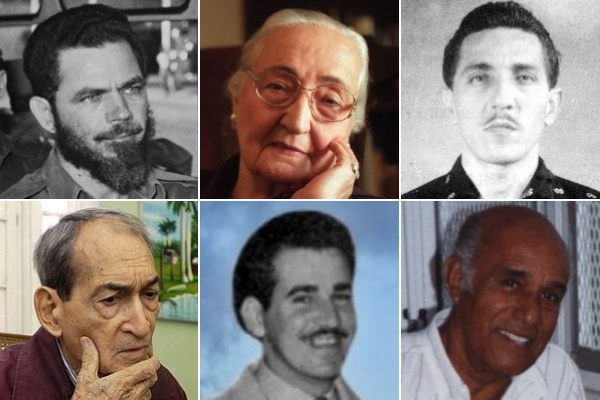
Huber Matos, Marta Frayde, Mario Chanes, Gustavo Arcos, Aramís
Taboada & Jesús Yanez Pelletier
Cuba's democratic resistance
As the totalitarian dictatorship
became evident, Cuba's democratic resistance defied the Castro regime
in two phases: 1959-1966 (violent resistance) and 1976 - present
(non-violent resistance).
Those who had fought by Castro's side in good faith believing it was a
struggle to restore democracy became uneasy with the course of the
revolution. Some, like Huber Matos, Julio Ruiz Pitaluga, and Mario Chanes de Armas who spoke out spent decades in prison. Many, who had fought alongside Fidel Castro, returned to the hills of the Escambray to carry on the struggle for the democratic restoration. This resistance was crushed in 1966 after the Castro regime had five years of assistance from 400 Soviet counterinsurgency advisors.
Finally,
in 1976, half a dozen Cuban opposition activists with leftist backgrounds
were summoned by Professor Ricardo Bofill and founded in Havana the
Cuban Committee for Human Rights, the first political organization in
the nation's history to expressly renounce violence as a method of
struggle. The group decided to abide by the rule of law to reclaim the
rights quashed by the dictatorship. Meanwhile, in exile in
Washington, about the same time, Mrs. Elena Mederos, former minister
in the revolutionary government, and activist and political scientist Frank Calzón, founded Of Human Rights with the same objective: to defend, by nonviolent and legal means, persecuted individuals, dissidents and
political prisoners in Cuba.
These groups documented human rights violations in Cuba, and distributed copies of the Universal Declaration of Human Rights. Their reports reached the United Nations Human Rights Commission and non-governmental organizations such as Amnesty International and Human Rights Watch. Over time this dissident movement went from documenting abuses to mobilizing Cubans to demand their rights.
On September 8, 1988 the Christian Liberation Movement was founded
in Havana in the neighborhood of El Cerro by Catholic laymen. Oswaldo
Payá Sardiñas was the first leader of this movement that in 2002 would
express the desire of millions of Cubans to be free with a petition
drive called the Varela Project.
Over 25,000 Cubans would sign the petition and have their signatures
confirmed and turned into the rubber stamp National Assembly of Peoples
Power demanding that their rights be respected in Cuba, but the response of the Castro regime was to declare the
constitution unchangeable and in March of 2003 to round up many of the
organizers of the petition drive, along with other human rights
activists and independent journalists in a crackdown that became known
as the Black Cuban Spring. 75 activists were sentenced to long and unjust prison terms.
In the midst of this crackdown a new movement arose. The wives,
sisters, daughters and mothers of these activists formed the Ladies in White. Laura Inés Pollán Toledo, a former school teacher, was the first leader of this movement. Sunday after Sunday braving violent repression
from the agents of the Castro regime these women marched with white
gladiolas in their hands demanding the freedom of their loved ones. By 2010 all of their loved ones would be out of prison.
Fidel Castro and Augusto Pinochet
Castroism's international impact From the start the Castro regime planned to turn the Andes into the Sierra Maestra of South America with the aim of achieving a hemisphere wide projection of power to spread their revolutionary project. Fidel Castro was skeptical of democratic elections ushering in revolutionary change and preferred training and exporting weapons and armed guerillas to undermine existing governments.
The Castro regime's interest in Venezuela began from the earliest days of the dictatorship. Venezuelans understood the threat poised by the
Cubans by 1960 when Ernesto "Che" Guevara was giving unsolicited advice
to Rómulo Betancourt, the democratically elected president of
Venezuela. Guevara called for Betancourt to use the firing squad against
his "rightist opponents." In 1963 Congressional Quarterly reported on how:
"Riots led by Communists and other pro-Castro elements in Caracas [in the
autumn of 1960] took the lives of 13 persons and injured 100. Venezuela recalled
its ambassador to Cuba, and Betancourt ordered out the army to end the
rioting, which he termed an attempt to “install a regime similar to that
in Cuba.”
Cuban Communist leader Blas Roca, told a Havana rally on January 23, 1963 that when the communists gained full control and “make themselves owners of the great
riches in oil, aluminum and everything their earth imprisons, then all
of America shall burn.” A cache of three tons of weapons was found on a Venezuelan beach in November
1963 that was to be used to disrupt the democratic elections there.
Fidel Castro would continue to agitate for revolution in Venezuela. A
well documented incident occurred on May 8, 1967 and was reported by
Francisco Toro in The Washington Post who described how:
"two small boats carrying a dozen heavily armed fighters made landfall
near Machurucuto, a tiny fishing village 100 miles east of the
Venezuelan capital, Caracas. Their plan was to march inland and recruit
Venezuelan peasants to the cause of socialist revolution." An all night
gun battle with the Venezuelan military led to nine guerrillas dead, two
captured, and one who had escaped. This led, at first, to American governments seeking to isolate Cuba in order to protect themselves from armed expeditions.
The Castro regime achieved only one success in Latin America with armed interventions: the overthrow of the Somoza regime in Nicaragua and the installation of the Marxist-Leninist Sandinista regime. Robert A. Pastor,
of The Carter Center in July 1992 in the report "The Carter
Administration and Latin America: A Test of Principle" explained the crucial role played by the Castro regime in the Sandinista victory
in Nicaragua, "by
May 1979, with Cuban President Fidel Castro's help, the three
Sandinista factions had united and established a secure and ample arms
flow from Cuba through Panama and Costa Rica." The Sandinistas drove out the Somoza regime on July 19, 1979 and would remain a force there to the present day. Efforts to subvert the Colombian government through a combination of training and arming communist guerilla groups while funding them through drug trafficking did not lead to the overthrow of the Colombian government but it led to the Castro regime being placed on the U.S. State Department's list of state sponsors of terrorism on March 1, 1982
The Castro regime's efforts in Venezuela would not begin to bear fruit until December 1994
with the arrival of Hugo Chavez in Havana to a hero's welcome following
two years in prison for a 1992 coup attempt in Venezuela. Four years later
Chavez had won the presidency of Venezuela and the Castro regime finally
had its entry to Venezuela. By 2007, Chávez had declared that Cuba and Venezuela were a single nation. “Deep down,” he said, “we are one single government.” When Hugo Chavez died in 2013 the succession to Nicolas Maduro was planned in Havana.
On July 19, 2017 the Secretary General of the Organization of American States, Luis Almagro testified before US lawmakers that “[t]here are currently about 15,000 Cubans in Venezuela ... It’s
like an occupation army from Cuba in Venezuela.” The Castro regime in Africa
However the Castro regime's international objectives extended beyond Latin America to Africa and Asia.
Fidel Castro lounging with war criminal Mengistu Haile Mariam, in Ethiopia in 1977
In the case of Africa, Cuba projected its military forces on the continent for decades with two high profile “victories”
according to government news sources: Ethiopia and Angola. The reliance
on military force and successes on the battlefield obscured some hard
truths that over time are revealed by history.
Fidel and Raul Castro were both deeply involved in sending 17,000 Cuban
troops to East Africa in assisting Lt. Col. Mengistu Haile Mariam in consolidating his rule
and eliminating actual and potential opposition in Ethiopia.
Charles Lane of The Washington Post in the December 1, 2016 article "Castro was no liberator" raises the following question that touches heavily on Ethiopia:
Mengistu participated in a
successful military coup against the U.S.-backed Emperor Haile Selassie
in 1974, eventually seizing power on Feb. 3, 1977,by massacring his
rivals in the officer corps. Castro admired this bloody deed as a
preemptive strike against “rightists” that showed “wisdom” and cleared
the way for Cuba to support Mengistu “without any constraints,” as he
explained to East German dictator Erich Honecker in an April 1977
meeting whose minutes became public after the fall of European
communism. [...] With the Cuban forces watching his back, Mengistu wrapped up
his bloody campaign of domestic repression, known as “the Red Terror,”
and sent his own Soviet-equipped, Cuban-trained troops to crush a
rebellion in Eritrea. The last Cuban troops did
not leave Ethiopia until September 1989; they were still on hand as
hundreds of thousands died during the 1983-1985 famine exacerbated by
Mengistu’s collectivization of agriculture.
In December 1979, a new Ethiopian military offensive, this time
including Soviet advisors and Cuban troops, “was more specifically
directed against the population’s means of survival, including poisoning
and bombing waterholes and machine gunning herds of cattle.”
The last Cuban troops
did not leave Ethiopia until 1989 and were present and complicit in the
engineered famine that took place there.
The case of Angola is not as clear cut. Non-violent scholar Michael Nagler on page 43 of his important book "The Nonviolence Handbook: A Guide for Practical Action" offers the following analysis of the
decision to embrace violence in South Africa and its consequences:
“When sixty peaceful demonstrators were shot dead at
Sharpeville, South Africa, in 1960, the African National Congress leaders
decided that nonviolence was not enough to overcome the apartheid regime. They
subsequently lost nearly thirty years trying to fight the regime with acts of
violence before Nelson Mandela was released from prison and they regained their
nonviolent momentum.”
It was not the African National Congress and the armed struggle that
brought the Apartheid regime to the negotiating table but the United Democratic Front (UDF) and mass civic nonviolent action combined with international sanctions. The inspiration for violent resistance arose from the example of the 1959 Cuban Revolution.
I've been to South Africa
and met with members of the African National Congress (ANC) and engaged
some of them in civil discussions on the nature of the Castro regime
and found differences of opinions within the ranks. However, the open letter by the ANC to the Cuban Communist Party released in July of 2014 re-writes South African history and the end of Apartheid ignoring that it was the nonviolent struggle that freed Nelson Mandela
and brought the racist regime to the negotiating table. Mandela's greatness, in my opinion, is that he presided over a
nonviolent transition and left office after serving out a full term as president following a free election.
The legacy of violence that did not succeed in defeating
Apartheid may in the end destroy South African democracy by glorifying a regime such as the one that exists in Cuba. Time will tell what the end result will be in South Africa. However, in Angola the Cuban involvement left another Marxist autocrat, José Eduardo dos Santos, who ruled Angola for thirty eight years from 1979 through 2017.
Raul Castro and Fidel Castro with ally Mengistu Haile Mariam
Castro's intelligence services tortured American prisoners of war in Vietnam. During the Vietnam War, the Cuban government sent advisers to Vietnam who tortured U.S. prisoners of war between 1967 and 1969 in what became known as "The Cuban Program" in an effort to demonstrate to the Vietnamese how to most effectively break the will of American soldiers. An account of what took place is found in Honor Bound: American Prisoners of War in Southeast Asia, 1961-1973 by Stuart I. Rochester, Frederick T. Kiley and published by the Naval Institute Press in 1999. In 2008, Senator John McCain said that American POWs imprisoned with him in Hanoi had been tortured "by a couple of Cubans."
Fidel Castro visiting Vietnam in 1973
In May of 2005 official media of the Castro regime revealed that Cuban military engineers "took
part in the widening of the famous Ho Chi Minh Trail in the midst of
Vietnam's war with the United States," and a former participant retired Cuban colonel Roberto Leon who called it "one of the greatest secrets" of the 1965-1975 war, "when he
led a team of 23 Cuban military engineers and about 50 Vietnamese
nationals in work on the trail over seven months." According to Leon, Cubans began work on the trail in 1973 after Fidel Castro's September 1973 visit, when Vietnamese authorities asked the Cuban dictator for technical
help on expanding the trail. On December 2, 2015, the Ambassador of Vietnam in Havana, Duong Minh spoke to Granma, the official publication of the Cuban Communist Party, and went into greater detail:
The government of Cuba also helped in the construction of major works
in Vietnam in the midst of the war, including the Victory Hotel in
Hanoi, and a highway stretching over 40km close to the capital, vital in
linking strategic points during the conflict. “Our Cuban brothers also contributed to the building of the historic
Ho Chi Minh Trail, used to transport food, medicine, arms and ammunition
from north to south, and a 400-bed hospital in the midst of the
conflict zone.”
The Tricontinental and International terrorism
The CIA library has a three page document that was approved for release on November 1, 2001 titled "Foreign Intervention by Cuba" that explains the nature of a 1966 gathering in Havana that set the course for international terrorism in the 1970s:
"The current phase of Cuban intervention outside Latin America began with the Tricontinental Conference in Havana in January 1966, attended by more than 500 delegates, which created the African-Asian-Latin American People's Solidarity Organization (AALAPSO) to assist and coordinate the activities of assorted insurgent and terrorist groups. ... Cuban pilots flew combat as well as training missions in Soviet-supplied MIGS for the "People's Democratic Republic of Yemen (PDRY) during active phases of that country's conflict with North Yemen in 1973--74. A Cuban armored brigade using Soviet vehicles, later turned over to the Syrian Army, was on the Golan Heights front in Syria in the wake of the Yom Kippur war [against Israel]."
The Castro regime views terrorism as a legitimate tactic to advance its revolutionary objectives. In 1970 the Cuban
government published the "Mini Manual for Revolutionaries" in the
official Latin American Solidarity Organization (LASO), a publication of the
Tricontinental and translated it into many languages. The manual is written by Brazilian urban terrorist Carlos Marighella, and it gives precise instructions in terror tactics, kidnappings, etc.
and distributed worldwide
by the Cuban dictatorship. There is a chapter on terrorism that declares, "Terrorism is a weapon the revolutionary can never
relinquish." This manual is still circulating today and the Cuban dictatorship has trained terrorists that targeted the United States and other countries in the 1960s, 1970s and 1980s with acts of violence with the objective of altering political behavior. John Hoyt Williams in a 1988 article in The Atlantic reported:
"In the Arab world some 3,000 [Cuban advisers] can be found in Libya
and Algeria, among other things training terrorists and Polisario
guerrillas."
The Cubans
were caught trying to provide the North Koreans with surface to air missile systems (SA-2 (C-75 Volga) and SA-3 (C-125 Pechora), two MiG
21 jet fighters, and 15 MiG-21 engines, eight 73 mm rocket propelled
projectiles
(PG-9/PG-15 anti-tank and OG-9/OG-15 fragmentation projectiles) to be
fired with recoil-less rifles, as well as a single PG-7VR round, a high
explosive antitank tandem charge to penetrate explosive reactive armor,
were also in the shipment.
Colombian government seizes smuggled weapons shipment bound for Cuba (2015)
On March 2, 2015 news broke
that the government of Colombia had seized a shipment of ammunition
bound for Cuba on a China-flagged ship due to a lack of proper
documentation. The BBC reported that
"Officials said about 100 tons of gunpowder, almost three million
detonators and some 3,000 cannon shells were found on board. The ship's
records said it was carrying grain products." Blogging by Boz,
founder of Hxagon, a consulting and technology company that provides
risk assessments and predictive analysis in emerging markets, reached
a reasonable conclusion: "Two big shipments of weapons seized in 20
months means that this is probably a regular occurrence."
Venezuela
On May 15, 2016 Henry Ramos Allup, the head of the National Assembly of Venezuela was complaining over social media of the leadership role played by a Cuban general and 60 Cuban officers over the Venezuelan military to maintain Maduro in power and continue exploiting Venezuela's natural resources. Despite this long time reality Secretary of State John Kerry in August of 2015 said "the United States and Cuba are talking about ways to solve the Venezuelan crisis."
Fidel Castro conversing with Argentine military dictator and ally
On March 28, 2008 the Castro
regime’s delegation together with the Organization of Islamic Congress (OIC) successfully passed resolutions undermining international freedom of expression standards at
the United Nations Human Rights Council.
On March 17, 2014 the UN Human
Rights
Council “was divided” in its discussion of the
atrocities in North Korea between
those who want the case to be elevated
to the International Criminal Court and those who reject outright the
existence of a commission of inquiry and conclusions. The Castro regime vigorously defended the
North Korean regime and denounced the inquiry.
The cost in lives under Castroism in Cuba In The Black Book of Communism in chapter 25 "Communism in Latin America" by Pascal Fontaine
states that in Cuba between 1959 through the late 1990s "between 15,000
and 17,000 people were shot." International human rights bodies such as
The Inter-American Commission on Human Rights (IACHR) documented some of what was taking place during this period of time.
Cuban exile activist Frank Calzon writing in National Review
on November 10, 1978 about the six year peasant uprising in the
Escambray (1960 - 1966) and numbers killed citing official and non-official sources.
"Raul Castro estimated that five hundred government soldiers died in
order to kill or capture 3,591 "bandits." Writing in 1971, the British
historian Hugh Thomas put the total slightly higher: "Minor guerrilla
skirmishing has gone on most of the time in Oriente and other
mountainous districts in an unsung war; rumors abound but probably at
least four thousand guerilleros have been killed since 1962."
Columnist Mary O'Grady in The Wall Street Journal on November 12, 2017 reported on the beginning of "howthe Soviets crushed the Escambray
rebellion, which at one point numbered 8,000 insurgents. Castro had sent
12,000 soldiers and 80,000 militia to the region in late 1960, but
they’d made no headway. So in January 1961 the Kremlin stepped in. It
sent a contingent of Soviet coaches to a military compound near the city
of Trinidad. That compound became a “KGB redoubt. ..."From there, the Soviets secretly directed a major offensive
to quash the insurgency.” ..."The operation mobilized 70,000 Cuban
soldiers and 110,000 militia. They 'uprooted most of the peasant
families living in the area, and dragged them into concentration camps'
in the far western part of the country. ...'The obsessive goal was total
extermination,' so the government forces 'destroyed crops, burned huts
and contaminated springs as they systematically combed the region for
rebels or suspects.'”
Miami Herald journalist Glenn Garvin on December 1, 2016 an article titled, "Red Ink: The high human cost of the Cuban Revolution" cited "University of Hawaii historian R. J. Rummel,
who made a career out of studying what he termed “democide,” the
killing of people by their own government, reported in 1987 that
credible estimates of the Castro regime’s death toll ran from 35,000 to 141,000, with a median of 73,000."
This does not take into account non-Cubans killed by the Castro regime.
US policy on Cuba 1959 - 2018
Vice President Richard Nixon greets Fidel Castro in Washington D.C. in April of 1959
Recognized Castro regime
The Castro regime has a revolutionary project to
spread communism. They sought within the first
months that they were in power to destabilize and overthrow governments across Latin America. The United States did not understand this at first and quickly recognized the Castro regime in January of 1959.
Severed diplomatic relations and tried to overthrow regime
After two years of increasingly hostile behavior by the Castro regime the United States severed diplomatic relations with Cuba and attempted to overthrow the dictatorship in April of 1961 at the Bay of Pigs. The Cuban exile force did not receive the promised support and the military mission failed and instead consolidated the Castro regime.
Engagement and concessions
The Carter Administration was the first to lift the travel ban and hold
high-level negotiations with the Cuban dictatorship, and both sides
opened Interest Sections in their respective capitals between 1977 and
1981. Then from 1981 to 1982, the Castro regime executed approximately 80 prisoners, which was a marked escalation when compared to 1976.
Furthermore, during the Carter presidency, Fidel Castro took steps that
resulted in the violent deaths of US citizens.
During the Mariel crisis of 1980, when over 125,000 Cubans sought to
flee the island, the Cuban dictator sought to save face by selectively releasing approximately 12,000 violent criminals or individuals who were mentally ill into the exodus. This first attempt at normalizing relations saw a worsening human rights situation and migration crisis.
This effectively
ended the era of isolation of the Castro regime. It is not a coincidence
that the Sandinistas came to power in Nicaragua two years later during the Carter
Administration.
Reagan's rollback of Carter concessions
Nor does easing sanctions improve the situation for Cuban dissidents.
The only time the Castro regime permitted the International Committee
of the Red Cross to visit Cuban prisons, and Amnesty International to
visit Cuba was in the late 1980s after Ronald Reagan took a hard line on
human rights violations in Cuba at the United Nations, rolled back the
Carter Administration’s 1977 opening of the travel embargo in 1982,
toughened economic sanctions, and began broadcasting uncensored news to Cuba over Radio Marti.
President George W. Bush did not rollback Clinton economic openings
The Bush Administration didn't rollback cash and carry trade with the dictatorship, but following March 2003 crackdown on Cuban dissidents by the Castro regime did toughen some sanctions.
Castro had some success first in Nicaragua in 1979, then in Venezuela in 1999 and today the regime is a strong and anti-democratic force in the hemisphere and at the United Nations Human Rights Council. No surprise that these regime offensives coincided with normalization policies of the United States.
President Trump has rolled back some policies and shifted rhetoric
The current Administration has rolled back some, not all, of the Obama era Cuba
policies, spoken out on the human rights situation in Cuba, and
Ambassador Nikki Haley defended the morality of U.S. sanctions on the
Castro regime. Despite the claims by the architect of the previous Administration's Cuba policy, that President Trump's turn around on the Obama Administration's Cuba policy
would fail, trade between the United States and Cuba was at its highest
level in 2017 following its collapse between 2014 and 2016 when the
previous Administration was pushing its new Cuba policy.
Summit of the Americas: Panama 2015 and Peru 2018
The 2015 Summit of the Americas in Panama marked the first time the Castro regime had been invited to attend. Latin American leaders threatened that
the VII Summit
would not take place if the Castro regime was not invited. On September
22, 2014 Colombian President Juan Manuel Santos at a Americas
Society/Council of the Americas meeting in New York City said, "if Cuba doesn’t go, then probably no Summit.” On December 17, 2014 President Obama announced that Cuba and the United States would seek to normalize relations. Four months later at the Summit of the Americas in Panama he held a bilateral meeting with General Raul Castro.
President Obama deemed the April 2015 gathering a success despite the Castro regime filling the event with shock troops that engaged in acts of harassment, in an atmosphere of
hostility, and acts of violence so extreme that some were
hospitalized as a result of physical attacks carried out by agents of the Castro regime.
The pattern repeated itself in 2018. The regime brought in shock troops to disrupt events and physically and verbally threaten and assault attendees who dissented from the regime's official line. One of the Castro regime's shock troops attending the Summit of the
Americas was identified
when he arrived in Peru. His name is Ronaldo Hidalgo Rivera. He was one of the men who knocked down Daniel Llorente Miranda (age 52) a Cuban dissident on May 1, 2017 as he ran with a flag of the United States outstretched in his arms over his head.
In contrast with the 2015 Summit during the 2018 Summit, Cuban human rights defenders got a full hearing and Vice President Mike Pence met with Rosa María Payá Acevedo and affirmed his support for human rights in Cuba and the desire of the Cuban people to live in freedom.
Last night, I spoke w/ Rosa María Payá, a Cuban dissident fighting for Cuba’s freedom. I made clear the Trump Admin stands w/ the Cuban people. We are w/ them for their freedom, the release of political prisoners, the restoration of basic human rights & for free & fair elections. pic.twitter.com/V5kSUhV9KE
Equally as important was that Peru's Minister of Justice and Human Rights, Salvador Heresi, recognized at this gathering that “Cuba is the mother of all evils in Latin America.” Latin America is at a dangerous crossroads and recognizing the damage done by the Castro regime in the hemisphere and its continuing threat is an important step that other countries need to understand before it is too late.





 Posts
Posts

